2004 FORD F150 light
[x] Cancel search: lightPage 117 of 280

will flash 4 times per second for 3 seconds, followed by 3 seconds with
the light off, then followed by the restraint system warning light
flashing 4 times per second for 3 seconds again.
Safety belt extension assembly
If the safety belt is too short when fully extended, there is a 20 cm (8
inch) safety belt extension assembly that can be added (part number
611C22). This assembly can be obtained from your dealer at no cost.
Use only extensions manufactured by the same supplier as the safety
belt. Manufacturer identification is located at the end of the webbing on
the label. Also, use the safety belt extension only if the safety belt is too
short for you when fully extended.
Do not use extensions to change the fit of the shoulder belt
across the torso.
Safety belt maintenance
Inspect the safety belt systems periodically to make sure they work
properly and are not damaged. Inspect the safety belts to make sure
there are no nicks, tears or cuts. Replace if necessary. All safety belt
assemblies, including retractors, buckles, front seat belt buckle
assemblies, buckle support assemblies (slide bar-if equipped), shoulder
belt height adjusters (if equipped), shoulder belt guide on seatback (if
equipped), child safety seat LATCH and tether anchors, and attaching
hardware, should be inspected after a collision. Ford Motor Company
recommends that all safety belt assemblies used in vehicles involved in a
collision be replaced. However, if the collision was minor and a qualified
technician finds that the belts do not show damage and continue to
operate properly, they do not need to be replaced. Safety belt assemblies
not in use during a collision should also be inspected and replaced if
either damage or improper operation is noted.
Failure to inspect and if necessary replace the safety belt
assembly under the above conditions could result in severe
personal injuries in the event of a collision.
Refer toInteriorin theCleaningchapter.
Seating and Safety Restraints
117
Page 119 of 280
The National Highway Traffic Safety Administration (NHTSA)
recommends a minimum distance of at least 25 cm (10 inches)
between an occupant's chest and the driver air bag cover.
Never place your arms or feet over the air bag module as a
deploying air bag can result in serious fractures or other injuries.
To properly position yourself away from the air bag:
²Move your seat to the rear as far as you can while still reaching the
pedals comfortably.
²Recline the seat slightly one or two degrees from the upright position.
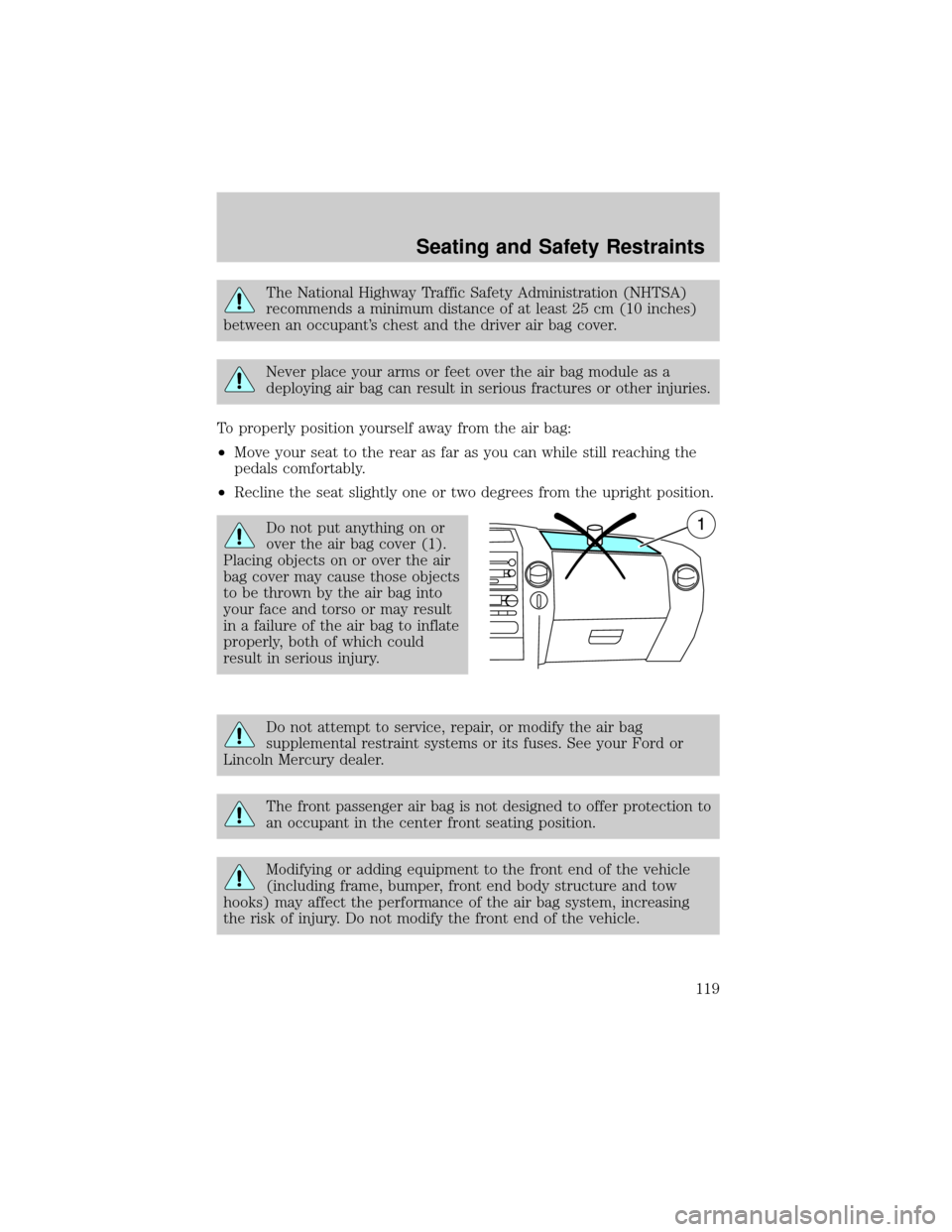
Do not put anything on or
over the air bag cover (1).
Placing objects on or over the air
bag cover may cause those objects
to be thrown by the air bag into
your face and torso or may result
in a failure of the air bag to inflate
properly, both of which could
result in serious injury.
Do not attempt to service, repair, or modify the air bag
supplemental restraint systems or its fuses. See your Ford or
Lincoln Mercury dealer.
The front passenger air bag is not designed to offer protection to
an occupant in the center front seating position.
Modifying or adding equipment to the front end of the vehicle
(including frame, bumper, front end body structure and tow
hooks) may affect the performance of the air bag system, increasing
the risk of injury. Do not modify the front end of the vehicle.
Seating and Safety Restraints
119
Page 122 of 280

If the air bag has deployed,the air bag will not function
again and must be replaced immediately.If the air bag is not
replaced, the unrepaired area will increase the risk of injury in a
collision.
The SRS consists of:
²driver and passenger air bag modules (which include the inflators,
covers and air bags),
²Occupation Classification Sensor (OCS)
²one or more impact and safing sensors, passenger air bag On/Off
switch (if equipped) and diagnostic monitor (RCM)
²a readiness light and tone,
²and the electrical wiring which connects the components.
The RCM (restraints control module) monitors its own internal circuits
and the supplemental air bag electrical system wiring (including the
passenger air bag On/Off switch, the impact sensors, the system wiring,
the air bag system readiness light, the air bag back up power and the air
bag ignitors).
Determining if the system is operational
The SRS uses readiness lights in the instrument cluster and the
passenger air bag on/off switch or a tone to indicate the condition of the
system. Refer to theAir bag readinesssection in theInstrument
clusterchapter orPassenger air bag on/off switchsection in this
chapter. Routine maintenance of the air bag is not required.
A difficulty with the system is indicated by one or more of the following:
²The readiness lights will either
flash or stay lit.
²The readiness lights will not
illuminate immediately after
ignition is turned on.
²A series of five beeps will be heard. The tone pattern will repeat
periodically until the problem and/or light are repaired.
If any of these things happen, even intermittently, have the SRS serviced
at your dealership or by a qualified technician immediately. Unless
serviced, the system may not function properly in the event of a
collision.
Seating and Safety Restraints
122
Page 124 of 280
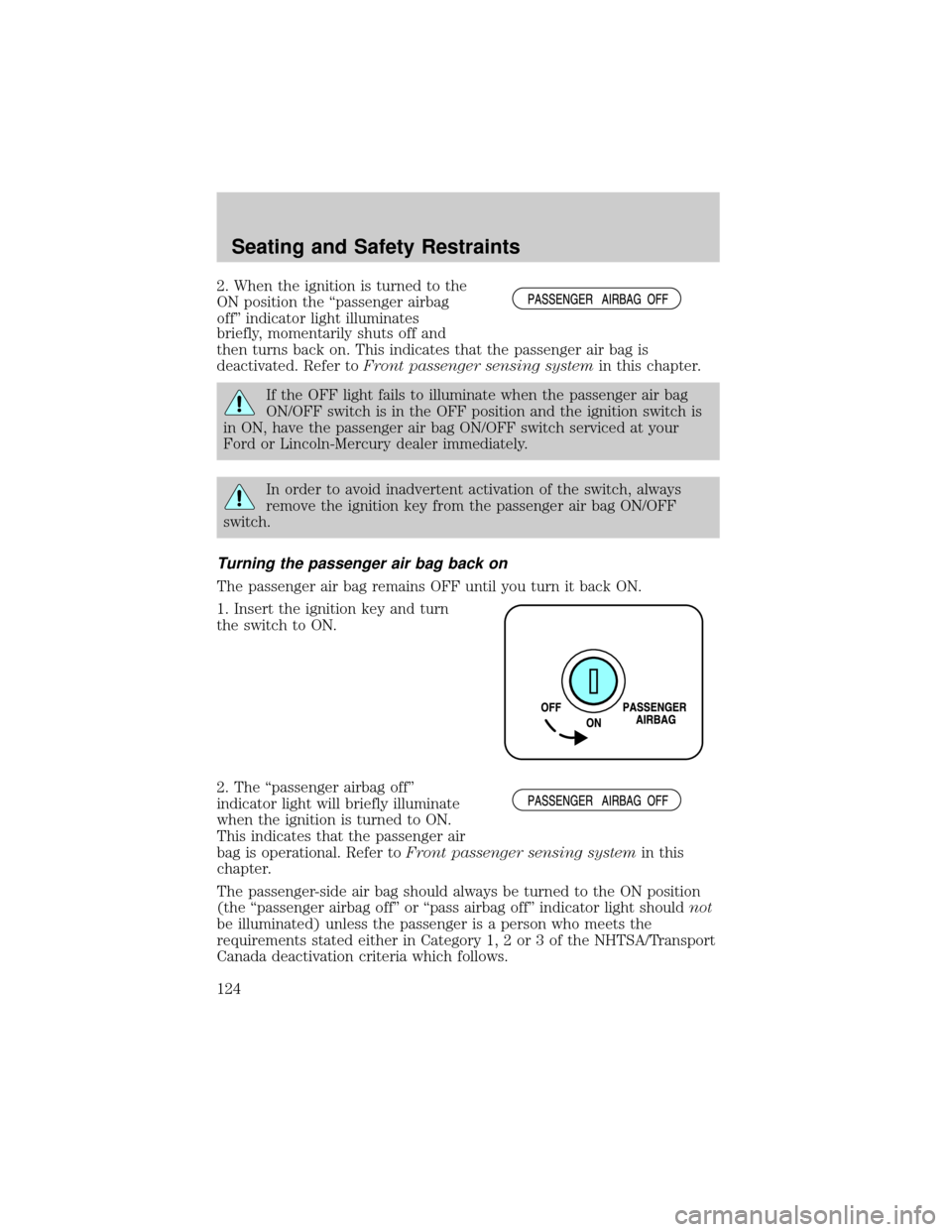
2. When the ignition is turned to the
ON position the ªpassenger airbag
offº indicator light illuminates
briefly, momentarily shuts off and
then turns back on. This indicates that the passenger air bag is
deactivated. Refer toFront passenger sensing systemin this chapter.
If the OFF light fails to illuminate when the passenger air bag
ON/OFF switch is in the OFF position and the ignition switch is
in ON, have the passenger air bag ON/OFF switch serviced at your
Ford or Lincoln-Mercury dealer immediately.
In order to avoid inadvertent activation of the switch, always
remove the ignition key from the passenger air bag ON/OFF
switch.
Turning the passenger air bag back on
The passenger air bag remains OFF until you turn it back ON.
1. Insert the ignition key and turn
the switch to ON.
2. The ªpassenger airbag offº
indicator light will briefly illuminate
when the ignition is turned to ON.
This indicates that the passenger air
bag is operational. Refer toFront passenger sensing systemin this
chapter.
The passenger-side air bag should always be turned to the ON position
(the ªpassenger airbag offº or ªpass airbag offº indicator light shouldnot
be illuminated) unless the passenger is a person who meets the
requirements stated either in Category 1, 2 or 3 of the NHTSA/Transport
Canada deactivation criteria which follows.
Seating and Safety Restraints
124
Page 127 of 280

3.Medical condition:A passenger has a medical condition that,
according to his or her physician:
²poses a special risk for the passenger if the air bag deploys; and
²makes the potential harm from the passenger air bag deployment
greater than the potential harm from turning OFF the air bag and
experiencing a crash without the protection offered by the air bag
Front passenger sensing system
The front passenger sensing system will turn off the front passenger's
frontal air bag under certain conditions. The driver's air bag is not part of
the front passenger sensing system. The front passenger sensing system
works with sensors that are part of the front passenger's seat and safety
belt. The sensors are designed to detect the presence of a
properly-seated occupant and determine if the front passenger's frontal
air bag should be enabled (may inflate) or not.
The front passenger sensing system is designed to meet the regulatory
requirements of Federal Motor Vehicle Safety Standard (FMVSS) 208
and is designed to turn off the front passenger's frontal air bag if:
²the front passenger seat is unoccupied,
²the system determines that an infant is present in a rear-facing infant
seat that is properly installed according to the manufacturer's
instructions,
²the system determines that a small child is present in a forward-facing
child restraint that is properly installed according to the
manufacturer's instructions,
²the system determines that a small child is present in a booster seat,
²a front passenger takes his/her weight off of the seat for a period of
time,
²a smaller person, such as a child who has outgrown child restraints or
a very small person, occupies the front passenger seat.
Even with Advanced Restraints Systems, children 12 and under
should be properly restrained in the back seat.
When the front passenger seat is
occupied and the sensing system
has turned off the passenger's
frontal air bag, the9passenger air
bag off9or9pass air bag off9indicator will light and stay lit to remind you
Seating and Safety Restraints
127
Page 128 of 280
that the front passenger frontal air bag is off. When the front passenger
seat is not occupied (empty seat) or in the event that the front passenger
frontal air bag is enabled (may inflate), the indicator light will be unlit.
The indicator light is located in the center stack of the instrument panel
just above the radio.
The front passenger sensing system is designed to turn off the front
passenger's frontal air bag when a rear facing infant seat, a
forward-facing child restraint, or a booster seat is detected. If the child
restraint has been installed and the indicator is not lit, then turn the
vehicle off, remove the child restraint from the vehicle and reinstall the
restraint following the child restraint manufacturer's directions.
The front passenger sensing system is designed to enable (may inflate)
the right front passenger's frontal air bag anytime the system senses that
a person of adult size is sitting properly in the front passenger seat,
unless the air bag on/off switch (if equipped) is turned to the Off
position. When the passenger sensing system has allowed the air bag to
be enabled, the indicator will be unlit and stay unlit to remind you that
the air bag is enabled (may inflate).
If a person of adult-size is sitting in the front passenger's seat, but the
ªpassenger air bag offº or ªpass air bag offº indicator is lit, it could be
that the person isn't sitting properly in the seat , or that the air bag
on/off switch (if equipped) is in the Off position. If this happens, turn
the vehicle off and ask the person to place the seatback in the full
upright position, then sit upright in the seat, centered on the seat
cushion, with the person's legs comfortably extended. Restart the vehicle
and have the person remain in this position for about two minutes. This
will allow the system to detect that person and then enable the
passenger's air bag. If the indicator lamp remains lit even after this, then
the occupant should be advised to ride in the back seat.
After all occupants have adjusted their seats and put on seat belts, it's
very important that they continue to sit upright, with their back against
the seatback, with their feet comfortably extended on the floor while the
vehicle is still in motion. Sitting improperly can increase the chance of
injury in a crash event. For example, if an occupant slouches, lies down,
turns sideways, sits forward, leans forward or sideways, or puts one or
both feet up, the chance of injury during a crash is greatly increased.
Sitting improperly out of position or with the seatback reclined too
far can take off weight from the seat cushion and affect the decision
of the passenger sensing system, resulting in serious injury or death in a
crash. Always sit upright against your seatback, with your feet on the floor.
Seating and Safety Restraints
128
Page 129 of 280
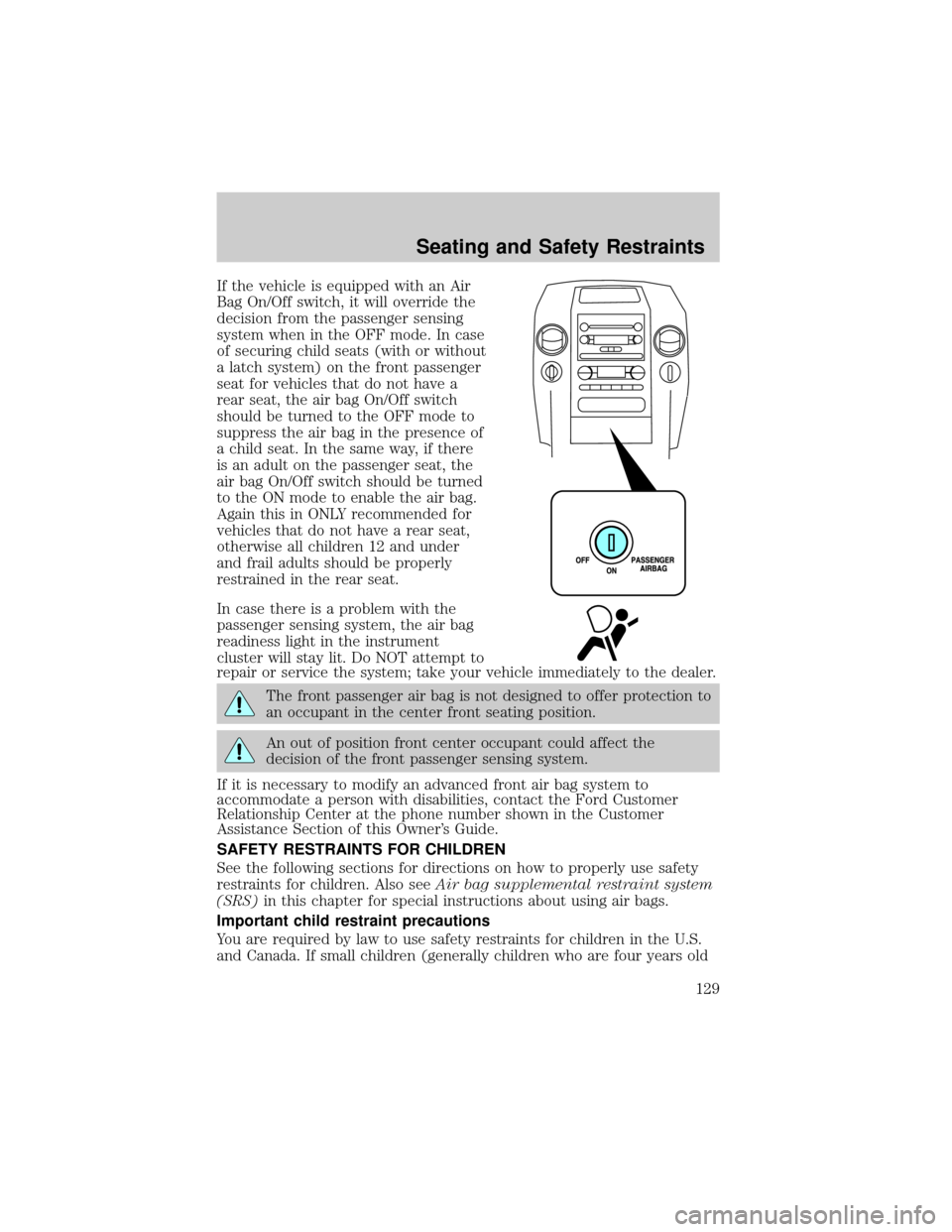
If the vehicle is equipped with an Air
Bag On/Off switch, it will override the
decision from the passenger sensing
system when in the OFF mode. In case
of securing child seats (with or without
a latch system) on the front passenger
seat for vehicles that do not have a
rear seat, the air bag On/Off switch
should be turned to the OFF mode to
suppress the air bag in the presence of
a child seat. In the same way, if there
is an adult on the passenger seat, the
air bag On/Off switch should be turned
to the ON mode to enable the air bag.
Again this in ONLY recommended for
vehicles that do not have a rear seat,
otherwise all children 12 and under
and frail adults should be properly
restrained in the rear seat.
In case there is a problem with the
passenger sensing system, the air bag
readiness light in the instrument
cluster will stay lit. Do NOT attempt to
repair or service the system; take your vehicle immediately to the dealer.
The front passenger air bag is not designed to offer protection to
an occupant in the center front seating position.
An out of position front center occupant could affect the
decision of the front passenger sensing system.
If it is necessary to modify an advanced front air bag system to
accommodate a person with disabilities, contact the Ford Customer
Relationship Center at the phone number shown in the Customer
Assistance Section of this Owner's Guide.
SAFETY RESTRAINTS FOR CHILDREN
See the following sections for directions on how to properly use safety
restraints for children. Also seeAir bag supplemental restraint system
(SRS)in this chapter for special instructions about using air bags.
Important child restraint precautions
You are required by law to use safety restraints for children in the U.S.
and Canada. If small children (generally children who are four years old
Seating and Safety Restraints
129
Page 144 of 280
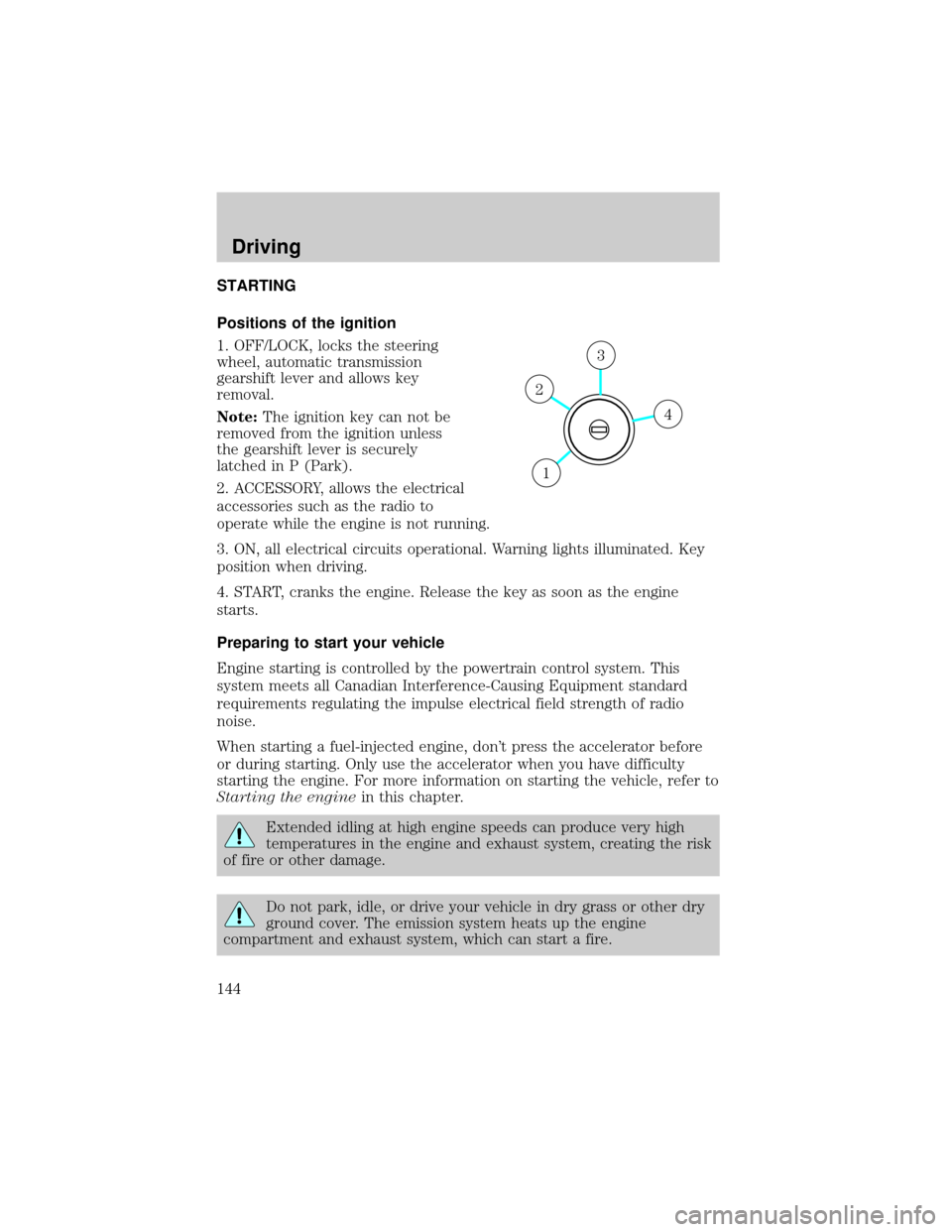
STARTING
Positions of the ignition
1. OFF/LOCK, locks the steering
wheel, automatic transmission
gearshift lever and allows key
removal.
Note:The ignition key can not be
removed from the ignition unless
the gearshift lever is securely
latched in P (Park).
2. ACCESSORY, allows the electrical
accessories such as the radio to
operate while the engine is not running.
3. ON, all electrical circuits operational. Warning lights illuminated. Key
position when driving.
4. START, cranks the engine. Release the key as soon as the engine
starts.
Preparing to start your vehicle
Engine starting is controlled by the powertrain control system. This
system meets all Canadian Interference-Causing Equipment standard
requirements regulating the impulse electrical field strength of radio
noise.
When starting a fuel-injected engine, don't press the accelerator before
or during starting. Only use the accelerator when you have difficulty
starting the engine. For more information on starting the vehicle, refer to
Starting the enginein this chapter.
Extended idling at high engine speeds can produce very high
temperatures in the engine and exhaust system, creating the risk
of fire or other damage.
Do not park, idle, or drive your vehicle in dry grass or other dry
ground cover. The emission system heats up the engine
compartment and exhaust system, which can start a fire.
4
3
2
1
Driving
Driving
144