2004 FORD F150 fuel
[x] Cancel search: fuelPage 246 of 280

permitted to intentionally remove an emission control device or prevent
it from working. Information about your vehicle's emission system is on
the Vehicle Emission Control Information Decal located on or near the
engine. This decal identifies engine displacement and gives some tune up
specifications.
Please consult yourWarranty Guidefor complete emission warranty
information.
On board diagnostics (OBD-II)
Your vehicle is equipped with a computer that monitors the engine's
emission control system. This system is commonly known as the On
Board Diagnostics System (OBD-II). This OBD-II system protects the
environment by ensuring that your vehicle continues to meet
government emission standards. The OBD-II system also assists the
service technician in properly servicing your vehicle. When theCheck
Engine/Service Engine Soonlight illuminates, the OBD-II system has
detected a malfunction. Temporary malfunctions may cause yourCheck
Engine/Service Engine Soonlight to illuminate. Examples are:
1. The vehicle has run out of fuel. (The engine may misfire or run
poorly.)
2. Poor fuel quality or water in the fuel.
3. The fuel cap may not have been securely tightened.
These temporary malfunctions can be corrected by filling the fuel tank
with good quality fuel and/or properly tightening the fuel cap. After three
driving cycles without these or any other temporary malfunctions
present, theCheck Engine/Service Engine Soonlight should turn off.
(A driving cycle consists of a cold engine startup followed by mixed
city/highway driving.) No additional vehicle service is required.
If theCheck Engine/Service Engine Soonlight remains on, have your
vehicle serviced at the first available opportunity.
Readiness for Inspection/Maintenance (I/M) testing
In some localities, it may be a legal requirement to pass an I/M test of
the on-board diagnostics system. If your ªService Engine Soonº light is
on, refer to the description in theWarning lights and chimessection of
theInstrument Clusterchapter. Your vehicle may not pass the I/M test
with the ªService Engine Soonº light on.
If the vehicle's powertrain system or its battery has just been serviced,
the on-board diagnostics system is reset to a ªnot ready for I/M testº
Maintenance and Specifications
246
Page 254 of 280
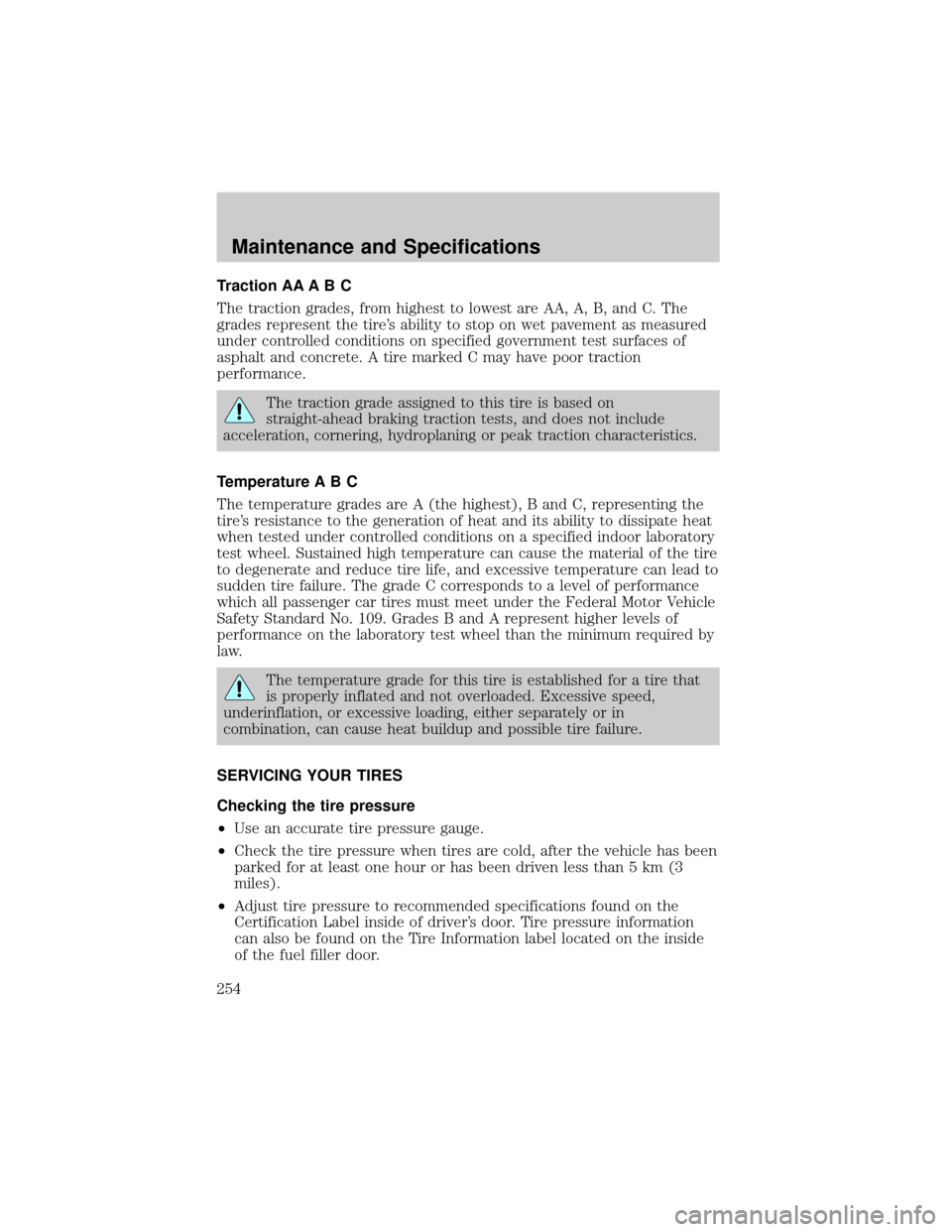
Traction AA A B C
The traction grades, from highest to lowest are AA, A, B, and C. The
grades represent the tire's ability to stop on wet pavement as measured
under controlled conditions on specified government test surfaces of
asphalt and concrete. A tire marked C may have poor traction
performance.
The traction grade assigned to this tire is based on
straight-ahead braking traction tests, and does not include
acceleration, cornering, hydroplaning or peak traction characteristics.
Temperature A B C
The temperature grades are A (the highest), B and C, representing the
tire's resistance to the generation of heat and its ability to dissipate heat
when tested under controlled conditions on a specified indoor laboratory
test wheel. Sustained high temperature can cause the material of the tire
to degenerate and reduce tire life, and excessive temperature can lead to
sudden tire failure. The grade C corresponds to a level of performance
which all passenger car tires must meet under the Federal Motor Vehicle
Safety Standard No. 109. Grades B and A represent higher levels of
performance on the laboratory test wheel than the minimum required by
law.
The temperature grade for this tire is established for a tire that
is properly inflated and not overloaded. Excessive speed,
underinflation, or excessive loading, either separately or in
combination, can cause heat buildup and possible tire failure.
SERVICING YOUR TIRES
Checking the tire pressure
²Use an accurate tire pressure gauge.
²Check the tire pressure when tires are cold, after the vehicle has been
parked for at least one hour or has been driven less than 5 km (3
miles).
²Adjust tire pressure to recommended specifications found on the
Certification Label inside of driver's door. Tire pressure information
can also be found on the Tire Information label located on the inside
of the fuel filler door.
Maintenance and Specifications
254
Page 256 of 280
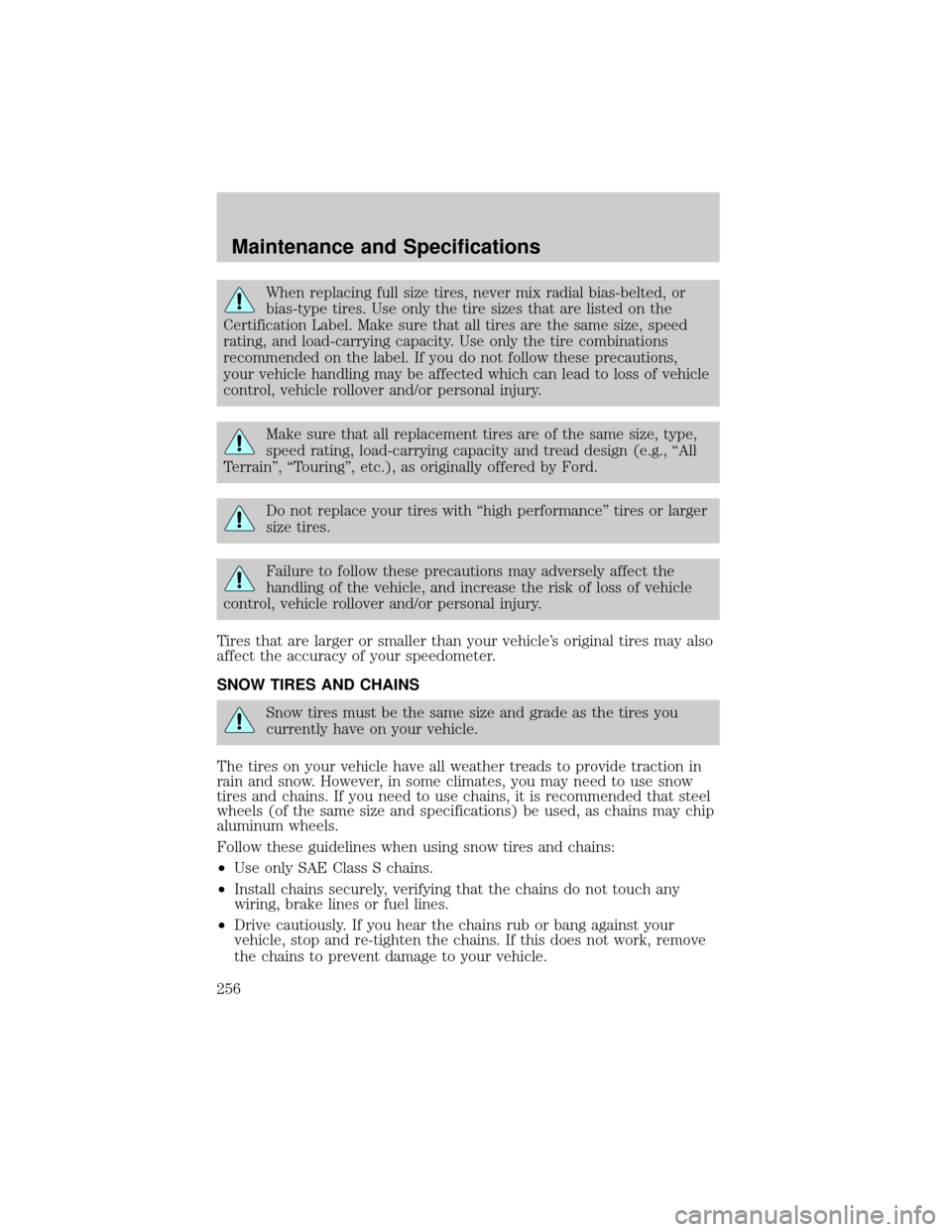
When replacing full size tires, never mix radial bias-belted, or
bias-type tires. Use only the tire sizes that are listed on the
Certification Label. Make sure that all tires are the same size, speed
rating, and load-carrying capacity. Use only the tire combinations
recommended on the label. If you do not follow these precautions,
your vehicle handling may be affected which can lead to loss of vehicle
control, vehicle rollover and/or personal injury.
Make sure that all replacement tires are of the same size, type,
speed rating, load-carrying capacity and tread design (e.g., ªAll
Terrainº, ªTouringº, etc.), as originally offered by Ford.
Do not replace your tires with ªhigh performanceº tires or larger
size tires.
Failure to follow these precautions may adversely affect the
handling of the vehicle, and increase the risk of loss of vehicle
control, vehicle rollover and/or personal injury.
Tires that are larger or smaller than your vehicle's original tires may also
affect the accuracy of your speedometer.
SNOW TIRES AND CHAINS
Snow tires must be the same size and grade as the tires you
currently have on your vehicle.
The tires on your vehicle have all weather treads to provide traction in
rain and snow. However, in some climates, you may need to use snow
tires and chains. If you need to use chains, it is recommended that steel
wheels (of the same size and specifications) be used, as chains may chip
aluminum wheels.
Follow these guidelines when using snow tires and chains:
²Use only SAE Class S chains.
²Install chains securely, verifying that the chains do not touch any
wiring, brake lines or fuel lines.
²Drive cautiously. If you hear the chains rub or bang against your
vehicle, stop and re-tighten the chains. If this does not work, remove
the chains to prevent damage to your vehicle.
Maintenance and Specifications
256
Page 257 of 280
²If possible, avoid fully loading your vehicle.
²Remove the tire chains when they are no longer needed. Do not use
tire chains on dry roads.
²The suspension insulation and bumpers will help prevent vehicle
damage. Do not remove these components from your vehicle when
using snow tires and chains.
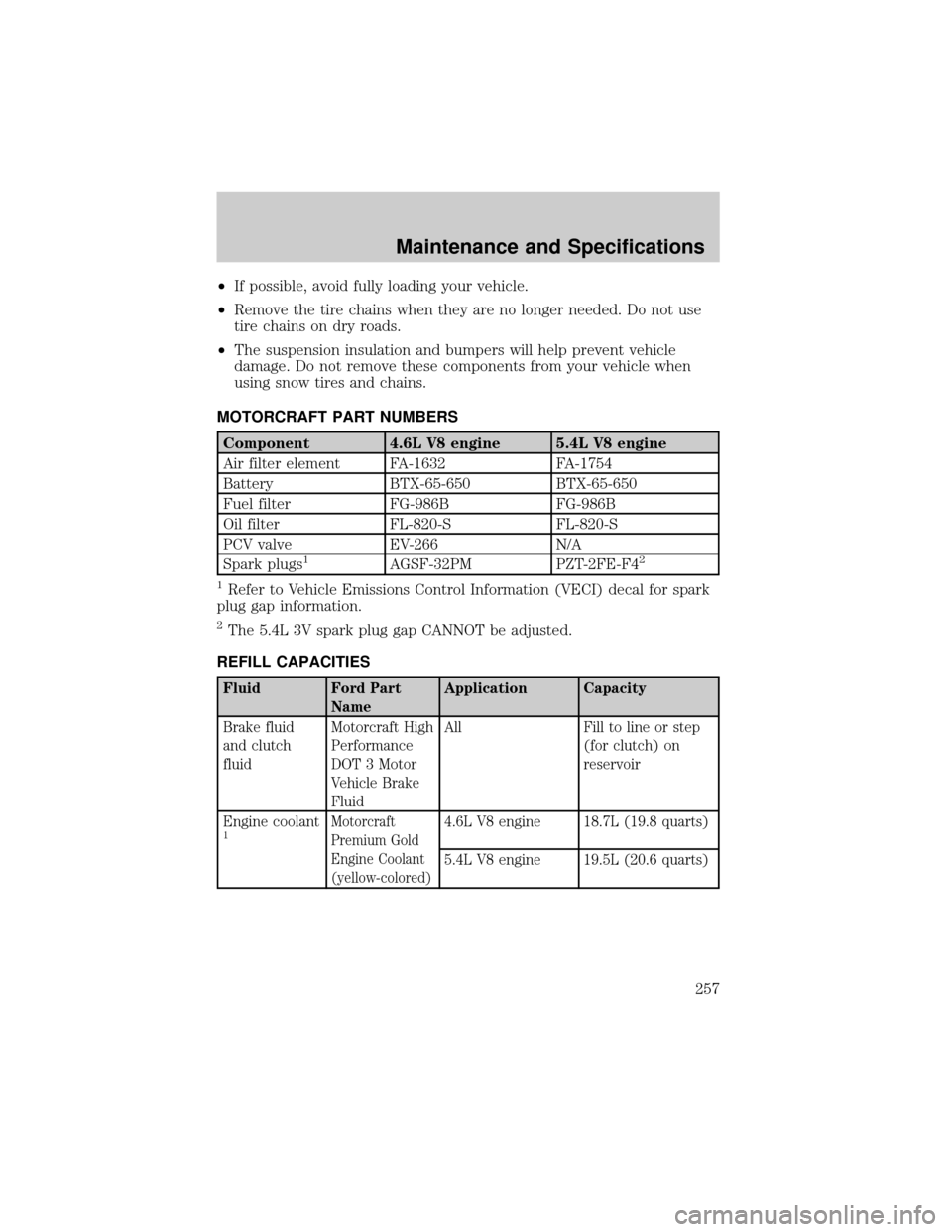
MOTORCRAFT PART NUMBERS
Component 4.6L V8 engine 5.4L V8 engine
Air filter element FA-1632 FA-1754
Battery BTX-65-650 BTX-65-650
Fuel filter FG-986B FG-986B
Oil filter FL-820-S FL-820-S
PCV valve EV-266 N/A
Spark plugs
1AGSF-32PM PZT-2FE-F42
1
Refer to Vehicle Emissions Control Information (VECI) decal for spark
plug gap information.
2The 5.4L 3V spark plug gap CANNOT be adjusted.
REFILL CAPACITIES
Fluid Ford Part
NameApplication Capacity
Brake fluid
and clutch
fluidMotorcraft High
Performance
DOT 3 Motor
Vehicle Brake
FluidAll Fill to line or step
(for clutch) on
reservoir
Engine coolant
1Motorcraft
Premium Gold
Engine Coolant
(yellow-colored)4.6L V8 engine 18.7L (19.8 quarts)
5.4L V8 engine 19.5L (20.6 quarts)
Maintenance and Specifications
257
Page 258 of 280
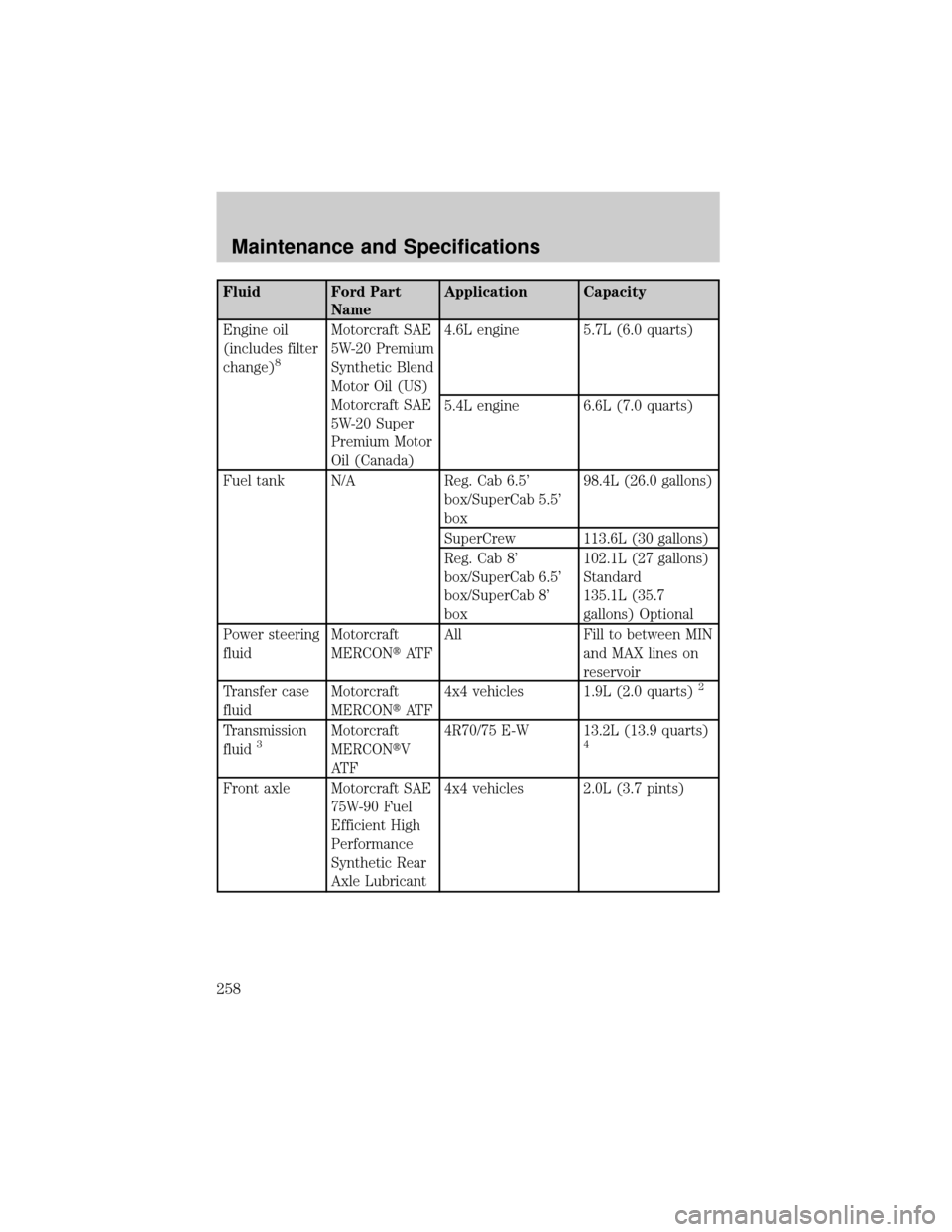
Fluid Ford Part
NameApplication Capacity
Engine oil
(includes filter
change)
8
Motorcraft SAE
5W-20 Premium
Synthetic Blend
Motor Oil (US)
Motorcraft SAE
5W-20 Super
Premium Motor
Oil (Canada)4.6L engine 5.7L (6.0 quarts)
5.4L engine 6.6L (7.0 quarts)
Fuel tank N/A Reg. Cab 6.5'
box/SuperCab 5.5'
box98.4L (26.0 gallons)
SuperCrew 113.6L (30 gallons)
Reg. Cab 8'
box/SuperCab 6.5'
box/SuperCab 8'
box102.1L (27 gallons)
Standard
135.1L (35.7
gallons) Optional
Power steering
fluidMotorcraft
MERCONtAT FAll Fill to between MIN
and MAX lines on
reservoir
Transfer case
fluidMotorcraft
MERCONtAT F4x4 vehicles 1.9L (2.0 quarts)
2
Transmission
fluid3Motorcraft
MERCONtV
AT F4R70/75 E-W 13.2L (13.9 quarts)4
Front axle Motorcraft SAE
75W-90 Fuel
Efficient High
Performance
Synthetic Rear
Axle Lubricant4x4 vehicles 2.0L (3.7 pints)
Maintenance and Specifications
258
Page 259 of 280
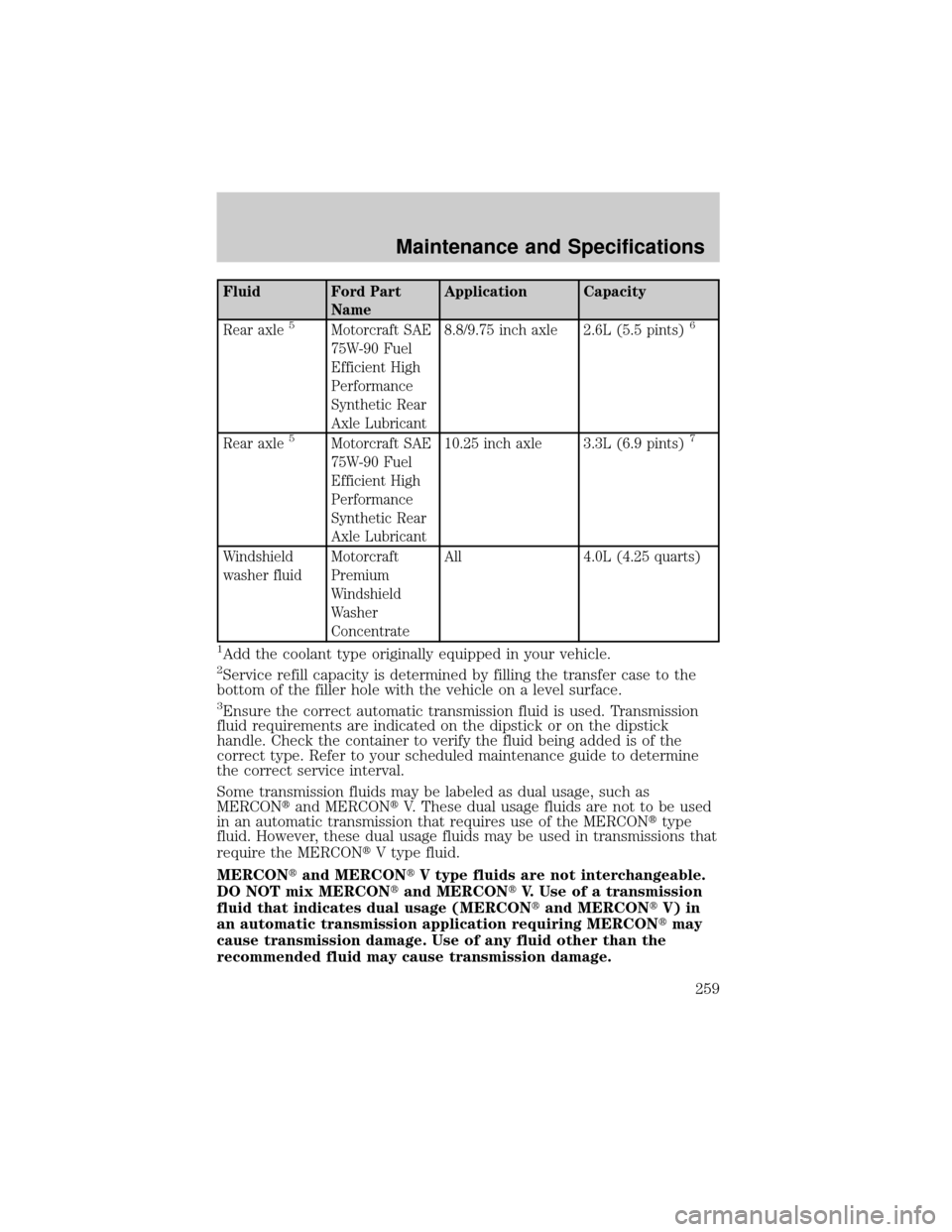
Fluid Ford Part
NameApplication Capacity
Rear axle
5Motorcraft SAE
75W-90 Fuel
Efficient High
Performance
Synthetic Rear
Axle Lubricant8.8/9.75 inch axle 2.6L (5.5 pints)6
Rear axle5Motorcraft SAE
75W-90 Fuel
Efficient High
Performance
Synthetic Rear
Axle Lubricant10.25 inch axle 3.3L (6.9 pints)7
Windshield
washer fluidMotorcraft
Premium
Windshield
Washer
ConcentrateAll 4.0L (4.25 quarts)
1Add the coolant type originally equipped in your vehicle.2Service refill capacity is determined by filling the transfer case to the
bottom of the filler hole with the vehicle on a level surface.
3Ensure the correct automatic transmission fluid is used. Transmission
fluid requirements are indicated on the dipstick or on the dipstick
handle. Check the container to verify the fluid being added is of the
correct type. Refer to your scheduled maintenance guide to determine
the correct service interval.
Some transmission fluids may be labeled as dual usage, such as
MERCONtand MERCONtV. These dual usage fluids are not to be used
in an automatic transmission that requires use of the MERCONttype
fluid. However, these dual usage fluids may be used in transmissions that
require the MERCONtV type fluid.
MERCONtand MERCONtV type fluids are not interchangeable.
DO NOT mix MERCONtand MERCONtV. Use of a transmission
fluid that indicates dual usage (MERCONtand MERCONtV) in
an automatic transmission application requiring MERCONtmay
cause transmission damage. Use of any fluid other than the
recommended fluid may cause transmission damage.
Maintenance and Specifications
259
Page 260 of 280
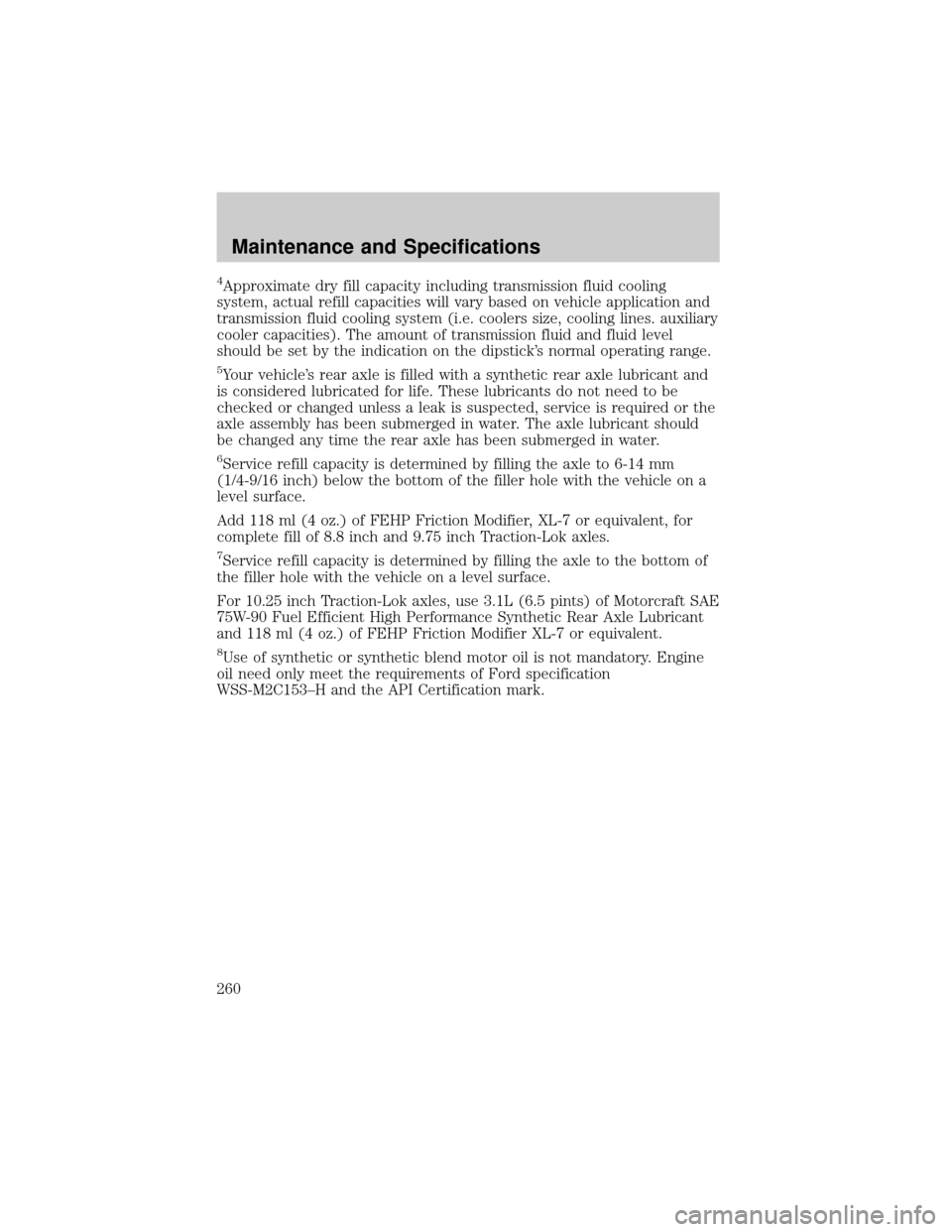
4Approximate dry fill capacity including transmission fluid cooling
system, actual refill capacities will vary based on vehicle application and
transmission fluid cooling system (i.e. coolers size, cooling lines. auxiliary
cooler capacities). The amount of transmission fluid and fluid level
should be set by the indication on the dipstick's normal operating range.
5Your vehicle's rear axle is filled with a synthetic rear axle lubricant and
is considered lubricated for life. These lubricants do not need to be
checked or changed unless a leak is suspected, service is required or the
axle assembly has been submerged in water. The axle lubricant should
be changed any time the rear axle has been submerged in water.
6Service refill capacity is determined by filling the axle to 6-14 mm
(1/4-9/16 inch) below the bottom of the filler hole with the vehicle on a
level surface.
Add 118 ml (4 oz.) of FEHP Friction Modifier, XL-7 or equivalent, for
complete fill of 8.8 inch and 9.75 inch Traction-Lok axles.
7Service refill capacity is determined by filling the axle to the bottom of
the filler hole with the vehicle on a level surface.
For 10.25 inch Traction-Lok axles, use 3.1L (6.5 pints) of Motorcraft SAE
75W-90 Fuel Efficient High Performance Synthetic Rear Axle Lubricant
and 118 ml (4 oz.) of FEHP Friction Modifier XL-7 or equivalent.
8Use of synthetic or synthetic blend motor oil is not mandatory. Engine
oil need only meet the requirements of Ford specification
WSS-M2C153±H and the API Certification mark.
Maintenance and Specifications
260
Page 261 of 280
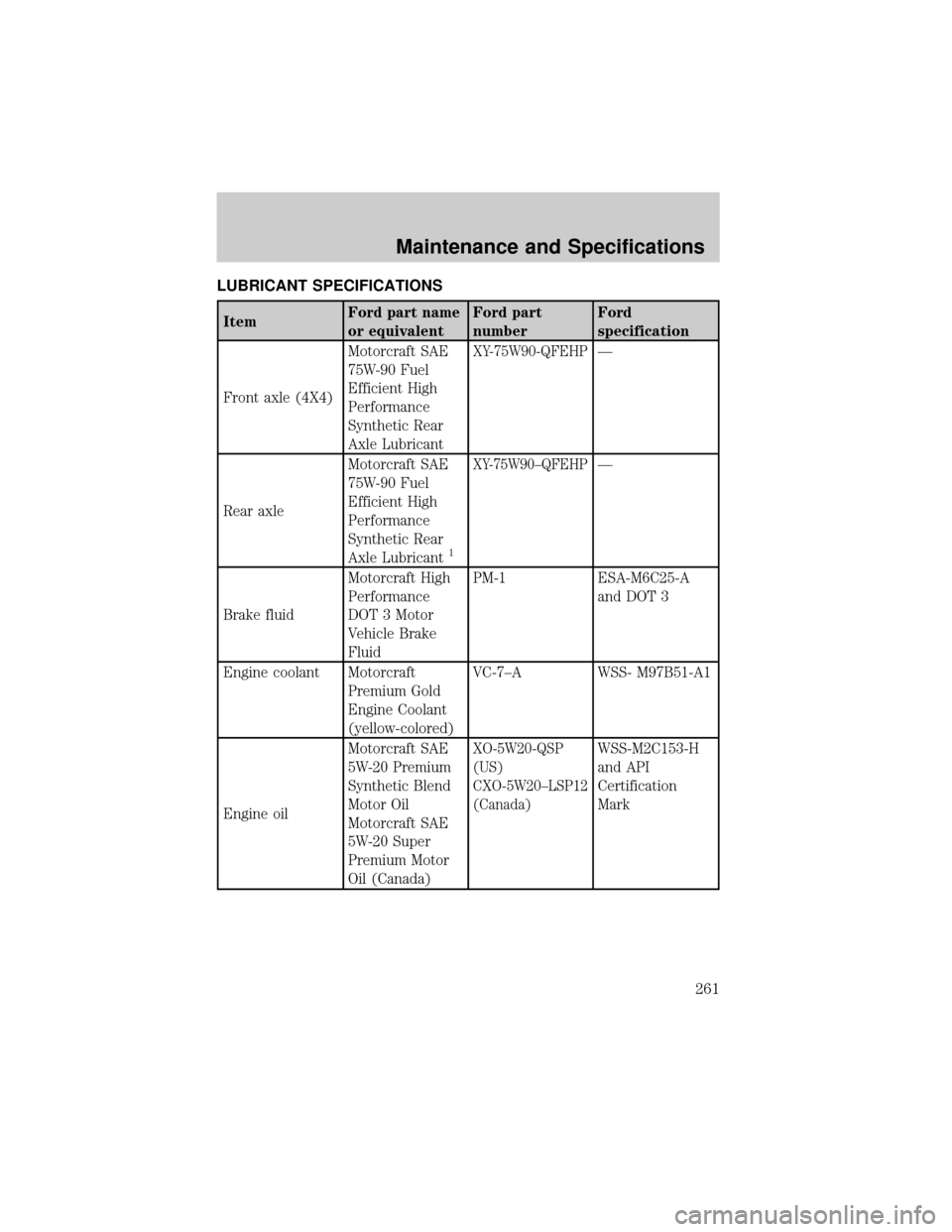
LUBRICANT SPECIFICATIONS
ItemFord part name
or equivalentFord part
numberFord
specification
Front axle (4X4)Motorcraft SAE
75W-90 Fuel
Efficient High
Performance
Synthetic Rear
Axle Lubricant
XY-75W90-QFEHPÐ
Rear axleMotorcraft SAE
75W-90 Fuel
Efficient High
Performance
Synthetic Rear
Axle Lubricant
1
XY-75W90±QFEHPÐ
Brake fluidMotorcraft High
Performance
DOT 3 Motor
Vehicle Brake
FluidPM-1 ESA-M6C25-A
and DOT 3
Engine coolant Motorcraft
Premium Gold
Engine Coolant
(yellow-colored)VC-7±A WSS- M97B51-A1
Engine oilMotorcraft SAE
5W-20 Premium
Synthetic Blend
Motor Oil
Motorcraft SAE
5W-20 Super
Premium Motor
Oil (Canada)
XO-5W20-QSP
(US)
CXO-5W20±LSP12
(Canada)WSS-M2C153-H
and API
Certification
Mark
Maintenance and Specifications
261