Page 165 of 280
Parking
On some 4WD vehicles, when the transfer case is in the N (Neutral)
position, the engine and transmission are disconnected from the rest of
the driveline. Therefore, the vehicle is free to roll even if the automatic
transmission is in P (Park) or the manual transmission is in gear. Do not
leave the vehicle unattended with the transfer case in the N (Neutral)
position. Always set the parking brake fully and turn off the ignition
when leaving the vehicle.
Always set the parking brake fully and make sure the gearshift is
latched in P (Park). Turn the ignition to the LOCK position and
remove the key whenever you leave your vehicle.
If the parking brake is fully released, but the brake warning lamp
remains illuminated, the brakes may not be working properly.
See your dealer or a qualified service technician.
4WD Systems
4WD (when you select a 4WD mode) uses all four wheels to power the
vehicle. This increases traction, enabling you to drive over terrain and
road conditions that a conventional two-wheel drive vehicle cannot.
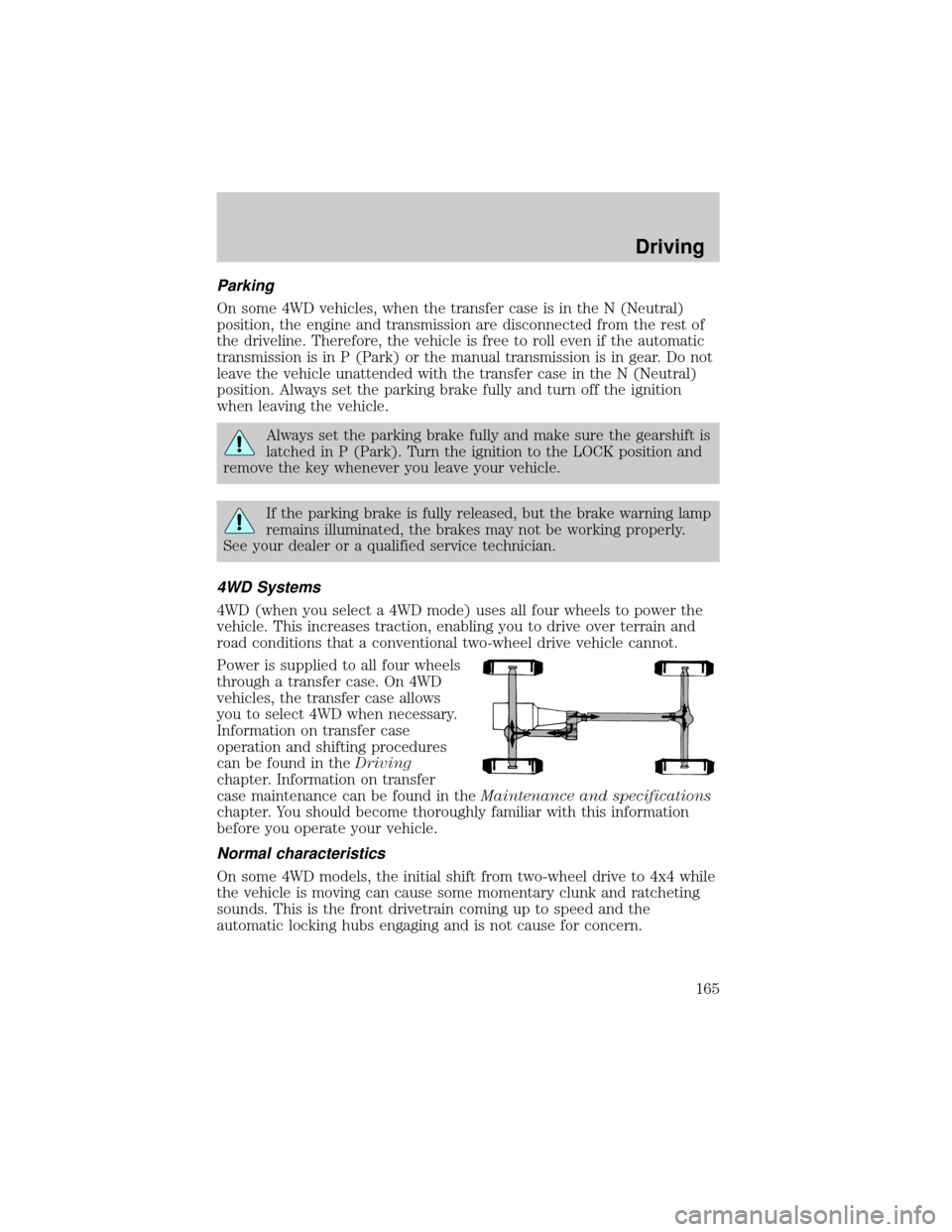
Power is supplied to all four wheels
through a transfer case. On 4WD
vehicles, the transfer case allows
you to select 4WD when necessary.
Information on transfer case
operation and shifting procedures
can be found in theDriving
chapter. Information on transfer
case maintenance can be found in theMaintenance and specifications
chapter. You should become thoroughly familiar with this information
before you operate your vehicle.
Normal characteristics
On some 4WD models, the initial shift from two-wheel drive to 4x4 while
the vehicle is moving can cause some momentary clunk and ratcheting
sounds. This is the front drivetrain coming up to speed and the
automatic locking hubs engaging and is not cause for concern.
Driving
165
Page 167 of 280
ªTread Lightlyº is an educational
program designed to increase public
awareness of land-use regulations
and responsibilities in our nations
wilderness areas. Ford Motor
Company joins the U.S. Forest Service and the Bureau of Land
Management in encouraging you to help preserve our national forest and
other public and private lands by ªtreading lightly.º
Driving on hilly or sloping terrain
Although natural obstacles may make it necessary to travel diagonally up
or down a hill or steep incline, you should always try to drive straight up
or straight down.Avoid driving crosswise or turning on steep
slopes or hills. A danger lies in losing traction, slipping sideways and
possibly rolling over. Whenever driving on a hill, determine beforehand
the route you will use. Do not drive over the crest of a hill without
seeing what conditions are on the other side. Do not drive in reverse
over a hill without the aid of an observer.
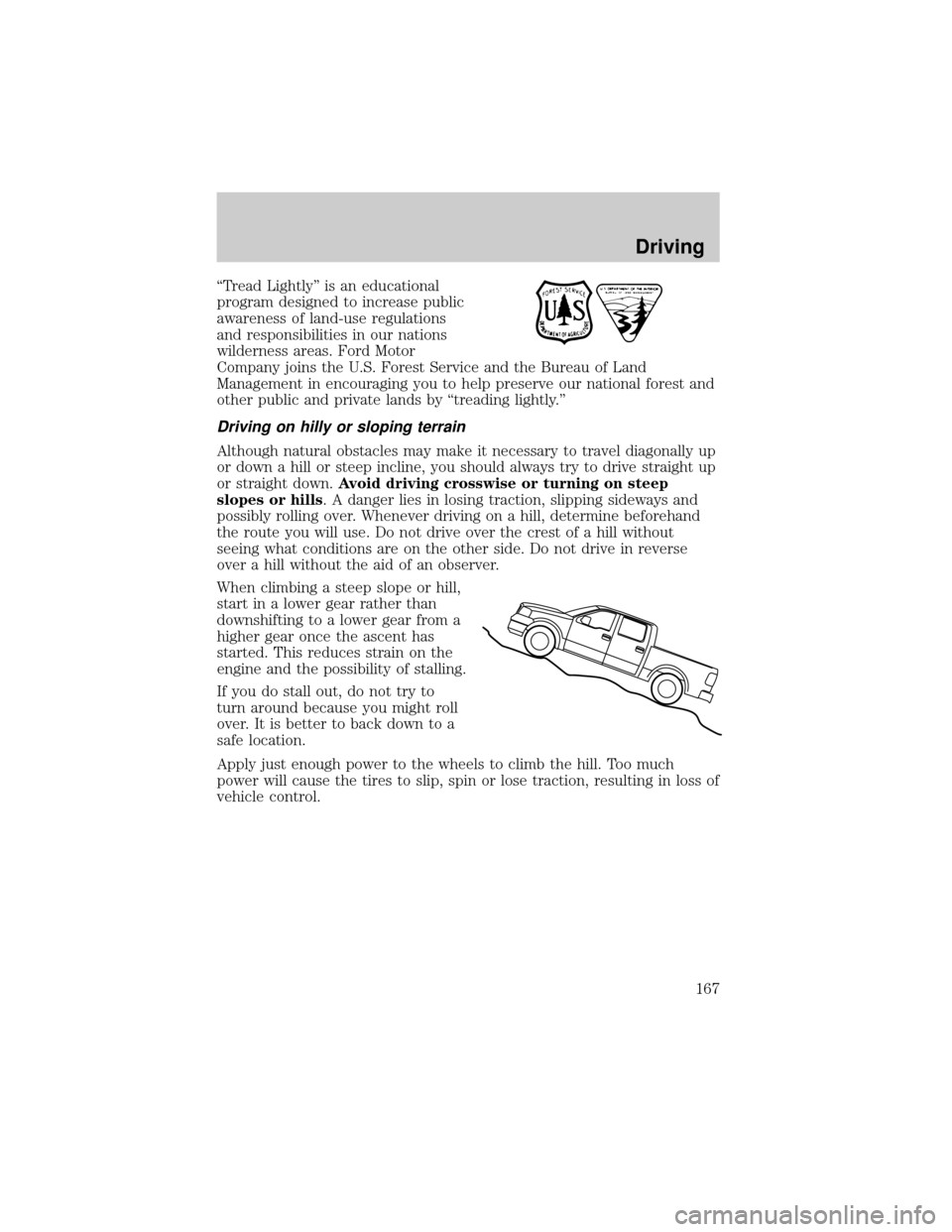
When climbing a steep slope or hill,
start in a lower gear rather than
downshifting to a lower gear from a
higher gear once the ascent has
started. This reduces strain on the
engine and the possibility of stalling.
If you do stall out, do not try to
turn around because you might roll
over. It is better to back down to a
safe location.
Apply just enough power to the wheels to climb the hill. Too much
power will cause the tires to slip, spin or lose traction, resulting in loss of
vehicle control.
Driving
167
Page 171 of 280

the wheel rims (for cars). Traction or brake capability may be limited
and your vehicle may stall. Water may also enter your engine's air intake
and severely damage your engine.
Once through the water, always dry the brakes by moving your vehicle
slowly while applying light pressure on the brake pedal. Wet brakes do
not stop the vehicle as quickly as dry brakes.Driving through deep
water where the transmission vent tube is submerged may allow
water into the transmission and cause internal transmission
damage.
VEHICLE LOADING
Before loading a vehicle, familiarize yourself with the following terms:
²Base Curb Weight:Weight of the vehicle including any standard
equipment, fluids, lubricants, etc. It does not include occupants or
aftermarket equipment.
²Payload:Combined maximum allowable weight of cargo, occupants
and optional equipment. The payload equals the gross vehicle weight
rating minus base curb weight.
²
GVW (Gross Vehicle Weight):Base curb weight plus payload weight.
²GVWR (Gross Vehicle Weight Rating):Maximum allowable total
weight of the base vehicle, occupants, optional equipment and cargo.
The GVWR is specific to each vehicle and is listed on the Safety
Certification Label on the driver's door pillar.
²GAWR (Gross Axle Weight Rating):Carrying capacity for each axle
system. The GAWR is specific to each vehicle and is listed on the
Safety Certification Label on the driver's door pillar.
²GCW (Gross Combined Weight):The combined weight of the
towing vehicle (including occupants and cargo) and the loaded trailer.
²GCWR (Gross Combined Weight Rating):Maximum allowable
combined weight of towing vehicle (including occupants and cargo)
and the loaded trailer.
²Maximum Trailer Weight Rating:Maximum weight of a trailer the
vehicle is permitted to tow. The maximum trailer weight rating is
determined by subtracting the vehicle curb weight for each
engine/transmission combination, any required option weight for trailer
towing and the weight of the driver from the GCWR for the towing
vehicle.
Driving
171
Page 173 of 280
Calculating the load your vehicle can carry/tow
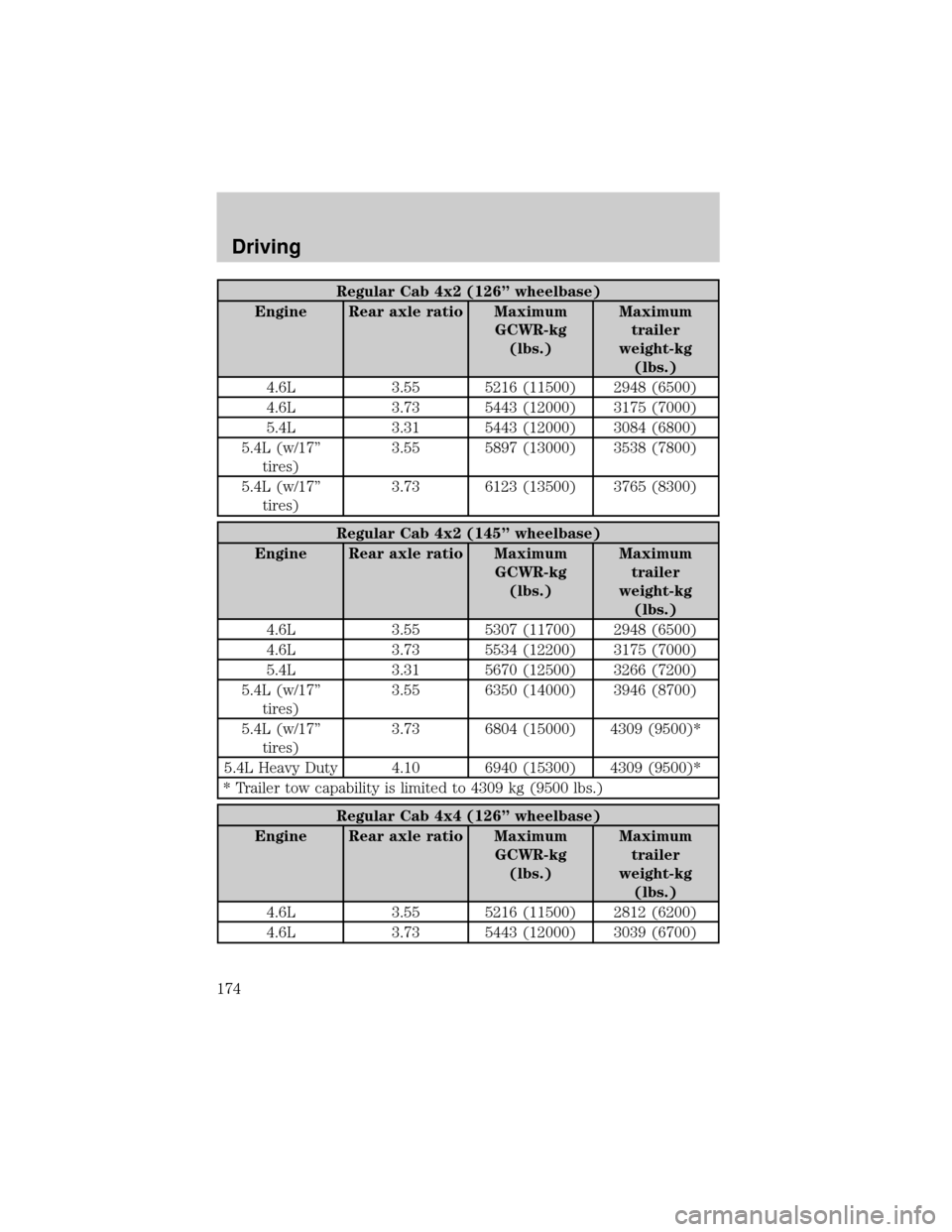
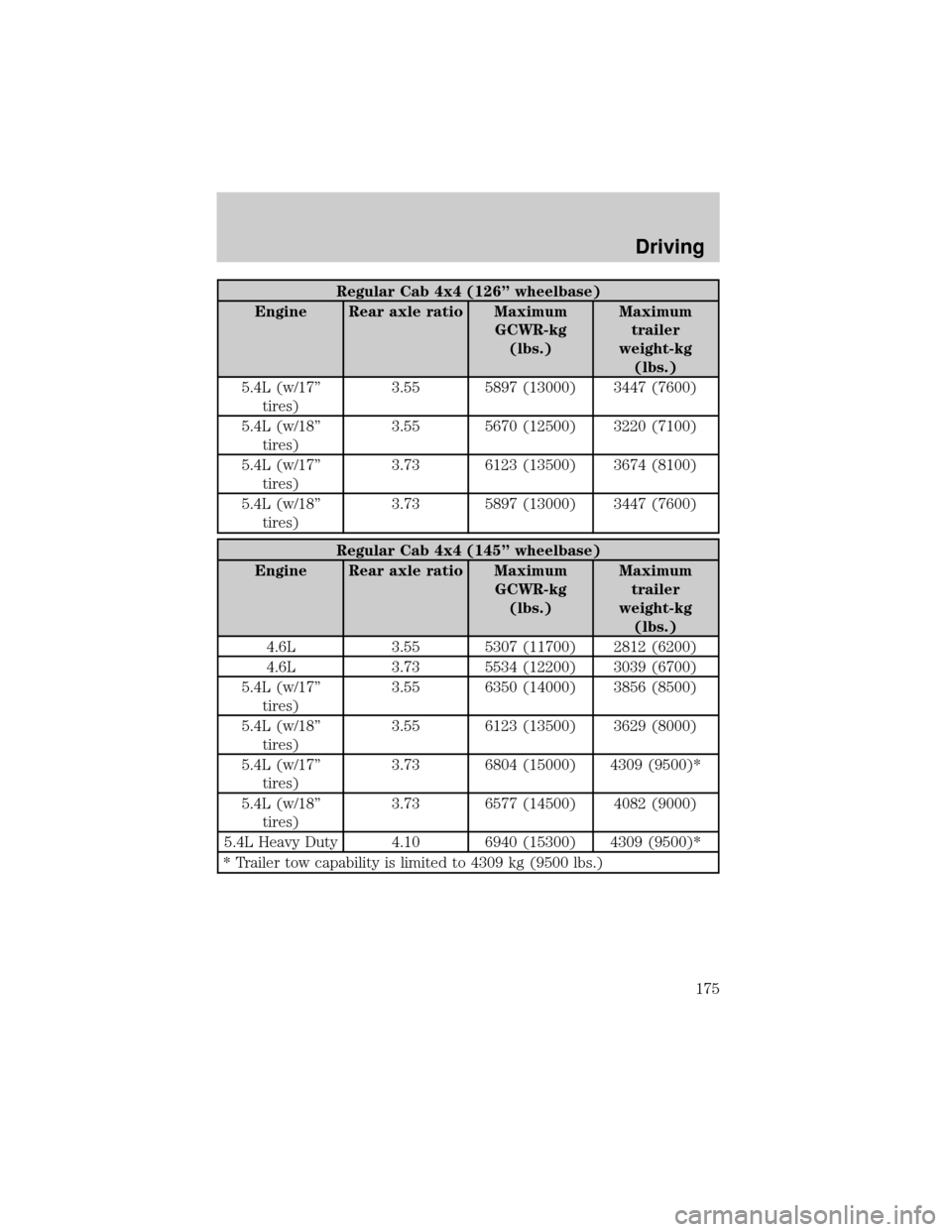
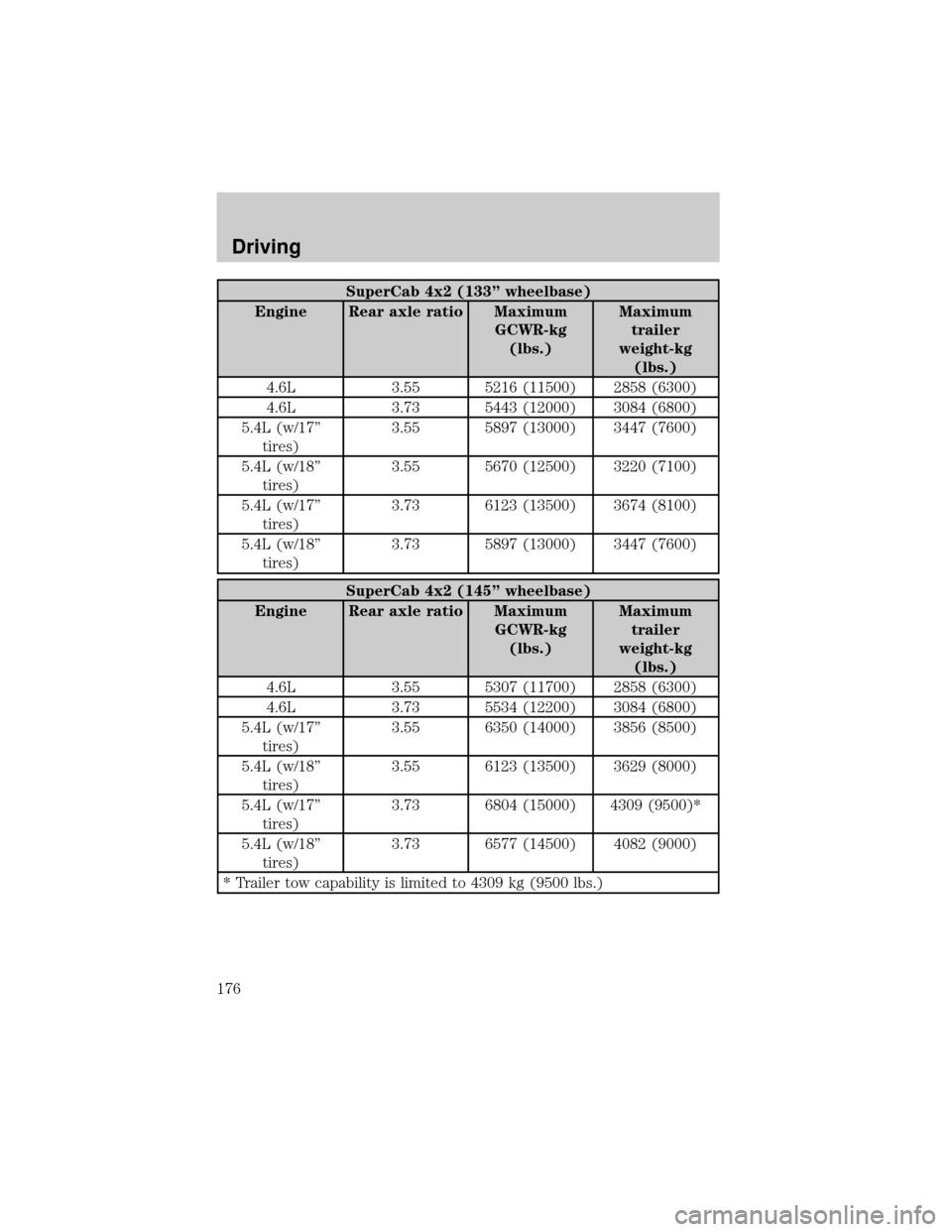
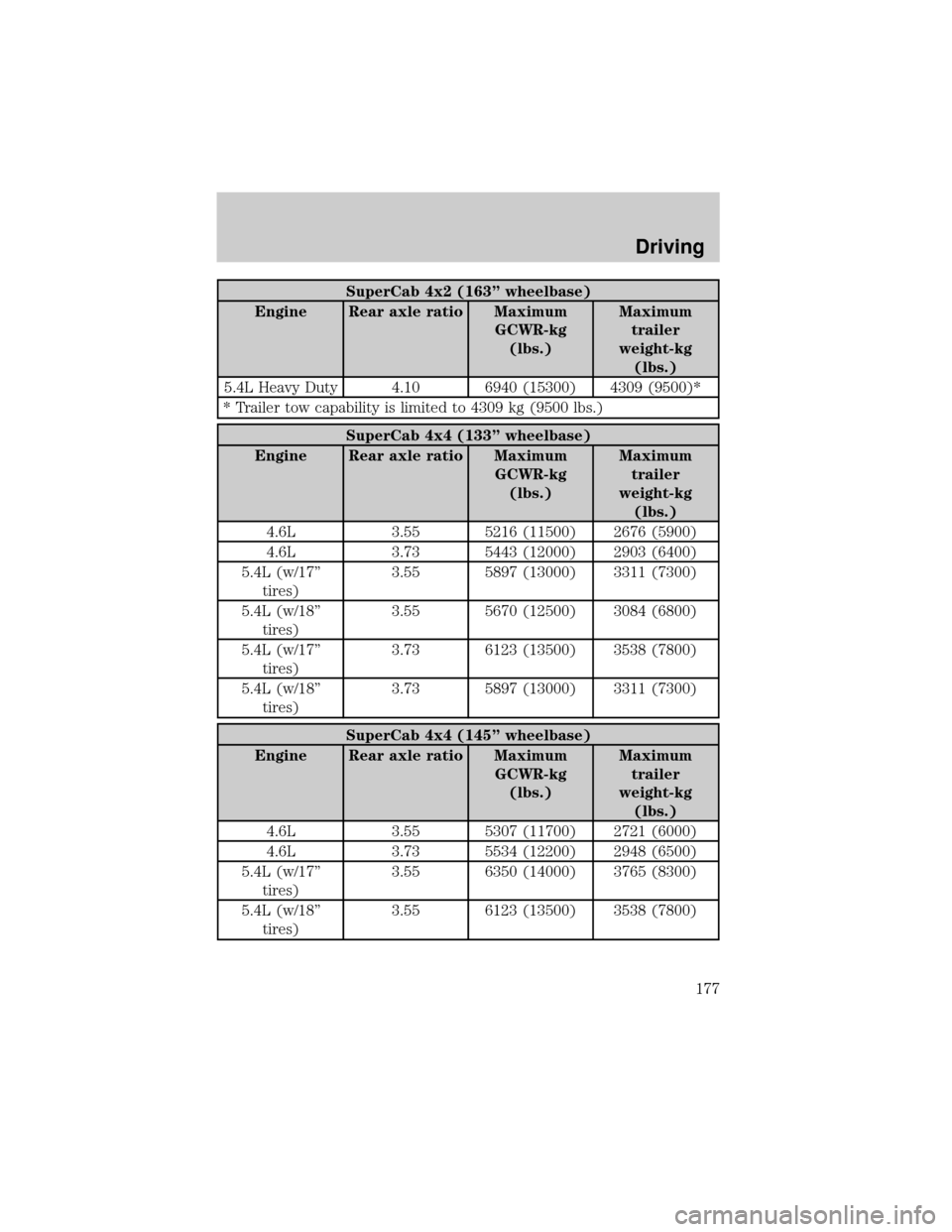
1. Use the appropriate maximum GCWR chart (in theTrailer Towing
section in this chapter) for your type of engine, rear axle ratio and tire size.
2. Weigh your vehicle without cargo. To obtain correct weights, take your
vehicle to a shipping company or an inspection station for trucks.
3. Subtract your loaded weight from the maximum GCWR in the chart.
This is the maximum trailer weight your vehicle can tow. It must be
below the maximum trailer weight shown in the chart.
TRAILER TOWING
Your vehicle may tow a class I, II, III or IV trailer provided the maximum
trailer weight is less than or equal to the maximum trailer weight listed
for your engine and rear axle ratio on the following charts.
If your vehicle is not equipped with a heavy-duty trailer towing package,
the maximum weight your vehicle can tow is limited to 2,268 kg (5,000
lbs.)
Your vehicle's load capacity is designated by weight, not by volume, so
you cannot necessarily use all available space when loading a vehicle.
Towing a trailer places an additional load on your vehicle's engine,
transmission, axle, brakes, tires and suspension. Inspect these
components carefully periodically during, and after any towing operation.
Exceeding the maximum GCWR could result in extensive damage
to your vehicle and personal injury.
Do not exceed the GVWR or the GAWR specified on the
certification label.
Towing trailers beyond the maximum recommended gross trailer
weight exceeds the limit of the vehicle and could result in
engine damage, transmission damage, structural damage, loss of vehicle
control, vehicle rollover and personal injury.
Driving
173
Page 174 of 280
Regular Cab 4x2 (126º wheelbase)
Engine Rear axle ratio Maximum
GCWR-kg
(lbs.)Maximum
trailer
weight-kg
(lbs.)
4.6L 3.55 5216 (11500) 2948 (6500)
4.6L 3.73 5443 (12000) 3175 (7000)
5.4L 3.31 5443 (12000) 3084 (6800)
5.4L (w/17º
tires)3.55 5897 (13000) 3538 (7800)
5.4L (w/17º
tires)3.73 6123 (13500) 3765 (8300)
Regular Cab 4x2 (145º wheelbase)
Engine Rear axle ratio Maximum
GCWR-kg
(lbs.)Maximum
trailer
weight-kg
(lbs.)
4.6L 3.55 5307 (11700) 2948 (6500)
4.6L 3.73 5534 (12200) 3175 (7000)
5.4L 3.31 5670 (12500) 3266 (7200)
5.4L (w/17º
tires)3.55 6350 (14000) 3946 (8700)
5.4L (w/17º
tires)3.73 6804 (15000) 4309 (9500)*
5.4L Heavy Duty 4.10 6940 (15300) 4309 (9500)*
* Trailer tow capability is limited to 4309 kg (9500 lbs.)
Regular Cab 4x4 (126º wheelbase)
Engine Rear axle ratio Maximum
GCWR-kg
(lbs.)Maximum
trailer
weight-kg
(lbs.)
4.6L 3.55 5216 (11500) 2812 (6200)
4.6L 3.73 5443 (12000) 3039 (6700)
Driving
174
Page 175 of 280
Regular Cab 4x4 (126º wheelbase)
Engine Rear axle ratio Maximum
GCWR-kg
(lbs.)Maximum
trailer
weight-kg
(lbs.)
5.4L (w/17º
tires)3.55 5897 (13000) 3447 (7600)
5.4L (w/18º
tires)3.55 5670 (12500) 3220 (7100)
5.4L (w/17º
tires)3.73 6123 (13500) 3674 (8100)
5.4L (w/18º
tires)3.73 5897 (13000) 3447 (7600)
Regular Cab 4x4 (145º wheelbase)
Engine Rear axle ratio Maximum
GCWR-kg
(lbs.)Maximum
trailer
weight-kg
(lbs.)
4.6L 3.55 5307 (11700) 2812 (6200)
4.6L 3.73 5534 (12200) 3039 (6700)
5.4L (w/17º
tires)3.55 6350 (14000) 3856 (8500)
5.4L (w/18º
tires)3.55 6123 (13500) 3629 (8000)
5.4L (w/17º
tires)3.73 6804 (15000) 4309 (9500)*
5.4L (w/18º
tires)3.73 6577 (14500) 4082 (9000)
5.4L Heavy Duty 4.10 6940 (15300) 4309 (9500)*
* Trailer tow capability is limited to 4309 kg (9500 lbs.)
Driving
175
Page 176 of 280
SuperCab 4x2 (133º wheelbase)
Engine Rear axle ratio Maximum
GCWR-kg
(lbs.)Maximum
trailer
weight-kg
(lbs.)
4.6L 3.55 5216 (11500) 2858 (6300)
4.6L 3.73 5443 (12000) 3084 (6800)
5.4L (w/17º
tires)3.55 5897 (13000) 3447 (7600)
5.4L (w/18º
tires)3.55 5670 (12500) 3220 (7100)
5.4L (w/17º
tires)3.73 6123 (13500) 3674 (8100)
5.4L (w/18º
tires)3.73 5897 (13000) 3447 (7600)
SuperCab 4x2 (145º wheelbase)
Engine Rear axle ratio Maximum
GCWR-kg
(lbs.)Maximum
trailer
weight-kg
(lbs.)
4.6L 3.55 5307 (11700) 2858 (6300)
4.6L 3.73 5534 (12200) 3084 (6800)
5.4L (w/17º
tires)3.55 6350 (14000) 3856 (8500)
5.4L (w/18º
tires)3.55 6123 (13500) 3629 (8000)
5.4L (w/17º
tires)3.73 6804 (15000) 4309 (9500)*
5.4L (w/18º
tires)3.73 6577 (14500) 4082 (9000)
* Trailer tow capability is limited to 4309 kg (9500 lbs.)
Driving
176
Page 177 of 280
SuperCab 4x2 (163º wheelbase)
Engine Rear axle ratio Maximum
GCWR-kg
(lbs.)Maximum
trailer
weight-kg
(lbs.)
5.4L Heavy Duty 4.10 6940 (15300) 4309 (9500)*
* Trailer tow capability is limited to 4309 kg (9500 lbs.)
SuperCab 4x4 (133º wheelbase)
Engine Rear axle ratio Maximum
GCWR-kg
(lbs.)Maximum
trailer
weight-kg
(lbs.)
4.6L 3.55 5216 (11500) 2676 (5900)
4.6L 3.73 5443 (12000) 2903 (6400)
5.4L (w/17º
tires)3.55 5897 (13000) 3311 (7300)
5.4L (w/18º
tires)3.55 5670 (12500) 3084 (6800)
5.4L (w/17º
tires)3.73 6123 (13500) 3538 (7800)
5.4L (w/18º
tires)3.73 5897 (13000) 3311 (7300)
SuperCab 4x4 (145º wheelbase)
Engine Rear axle ratio Maximum
GCWR-kg
(lbs.)Maximum
trailer
weight-kg
(lbs.)
4.6L 3.55 5307 (11700) 2721 (6000)
4.6L 3.73 5534 (12200) 2948 (6500)
5.4L (w/17º
tires)3.55 6350 (14000) 3765 (8300)
5.4L (w/18º
tires)3.55 6123 (13500) 3538 (7800)
Driving
177