2004 FORD F150 trailer
[x] Cancel search: trailerPage 193 of 280

Fuse/Relay
LocationFuse Amp
RatingPassenger Compartment Fuse
Panel Description
107 30A** Power door locks (BSM)
108 30A** Passenger power seat
109 30A** Driver power seat, Adjustable
pedals
110 Ð Not used
111 30A** 4x4 relays
112 40A** ABS pump power
113 30A** Wipers and washer pump
114 40A** Heated backlite, Heated mirror
power
115 Ð Not used
116 30A** Blower motor
117 Ð Not used
118 30A** Heated seats
401 30A Circuit
breakerPower windows, Moonroof, Power
sliding backlite
R01 Full ISO relay Starter solenoid
R02 Full ISO relay Accessory delay
R03 Full ISO relay Hi-beam headlamps
R04 Full ISO relay Heated backlite
R05 Full ISO relay Trailer tow battery charge
R06 Full ISO relay Blower motor
R201 Half ISO relay Trailer tow park lamps
R202 Half ISO relay Fog lamps
R203 Half ISO relay PCM
* Mini fuses ** Cartridge fuses
Roadside Emergencies
193
Page 244 of 280

Maintenance
²Keep tires properly inflated and use only recommended size.
²Operating a vehicle with the wheels out of alignment will reduce fuel
economy.
²Use recommended engine oil. Refer toLubricant specificationsin
this chapter.
²Perform all regularly scheduled maintenance items. Follow the
recommended maintenance schedule and owner maintenance checks
found in your vehicle scheduled maintenance guide.
Conditions
²Heavily loading a vehicle or towing a trailer may reduce fuel economy
at any speed.
²Carrying unnecessary weight may reduce fuel economy (approximately
0.4 km/L [1 mpg] is lost for every 180 kg [400 lb] of weight carried).
²Adding certain accessories to your vehicle (for example bug
deflectors, rollbars/light bars, running boards, ski/luggage racks) may
reduce fuel economy.
²To maximize the fuel economy, drive with the tonneau cover installed
(if equipped).
²Using fuel blended with alcohol may lower fuel economy.
²Fuel economy may decrease with lower temperatures during the first
12±16 km (8±10 miles) of driving.
²Driving on flat terrain offers improved fuel economy as compared to
driving on hilly terrain.
²Transmissions give their best fuel economy when operated in the top
cruise gear and with steady pressure on the gas pedal.
²Four-wheel-drive operation (if equipped) is less fuel efficient than
two-wheel-drive operation.
²Close windows for high speed driving.
EPA window sticker
Every new vehicle should have the EPA window sticker. Contact your
dealer if the window sticker is not supplied with your vehicle. The EPA
window sticker should be your guide for the fuel economy comparisons
with other vehicles.
Maintenance and Specifications
244
Page 248 of 280
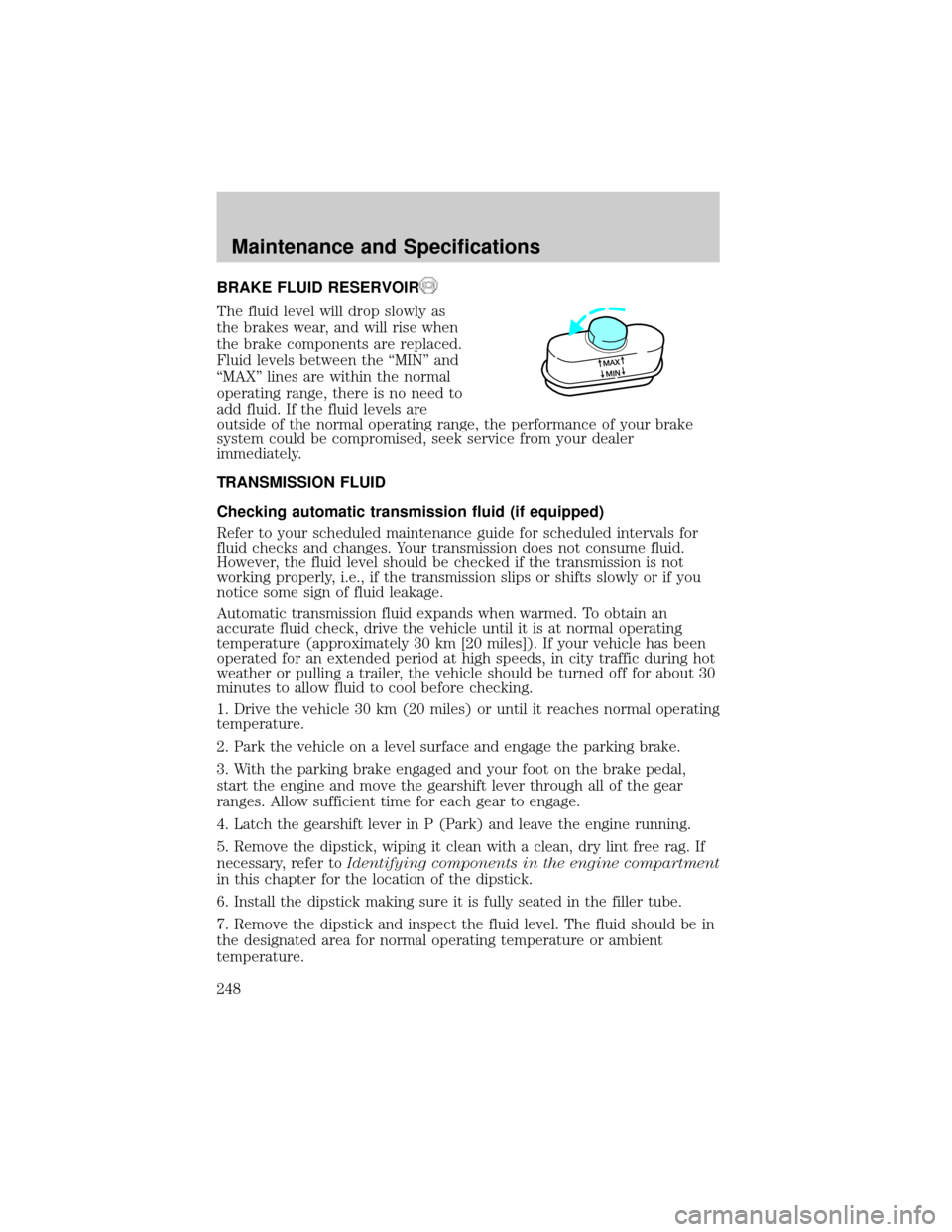
BRAKE FLUID RESERVOIR
The fluid level will drop slowly as
the brakes wear, and will rise when
the brake components are replaced.
Fluid levels between the ªMINº and
ªMAXº lines are within the normal
operating range, there is no need to
add fluid. If the fluid levels are
outside of the normal operating range, the performance of your brake
system could be compromised, seek service from your dealer
immediately.
TRANSMISSION FLUID
Checking automatic transmission fluid (if equipped)
Refer to your scheduled maintenance guide for scheduled intervals for
fluid checks and changes. Your transmission does not consume fluid.
However, the fluid level should be checked if the transmission is not
working properly, i.e., if the transmission slips or shifts slowly or if you
notice some sign of fluid leakage.
Automatic transmission fluid expands when warmed. To obtain an
accurate fluid check, drive the vehicle until it is at normal operating
temperature (approximately 30 km [20 miles]). If your vehicle has been
operated for an extended period at high speeds, in city traffic during hot
weather or pulling a trailer, the vehicle should be turned off for about 30
minutes to allow fluid to cool before checking.
1. Drive the vehicle 30 km (20 miles) or until it reaches normal operating
temperature.
2. Park the vehicle on a level surface and engage the parking brake.
3. With the parking brake engaged and your foot on the brake pedal,
start the engine and move the gearshift lever through all of the gear
ranges. Allow sufficient time for each gear to engage.
4. Latch the gearshift lever in P (Park) and leave the engine running.
5. Remove the dipstick, wiping it clean with a clean, dry lint free rag. If
necessary, refer toIdentifying components in the engine compartment
in this chapter for the location of the dipstick.
6. Install the dipstick making sure it is fully seated in the filler tube.
7. Remove the dipstick and inspect the fluid level. The fluid should be in
the designated area for normal operating temperature or ambient
temperature.
MAX
MIN
Maintenance and Specifications
248
Page 272 of 280

Step bars
Tonneau covers
Truck caps
Wheels
Interior style
Cell phone holders
Consoles
Electrochromatic compass/temperature interior mirrors
Floor mats
Interior trim kits
Leather wrapped steering wheels
Scuff plates
Speed control
Lifestyle
Bedliners and bedmats
Bed tents
Bike racks
Cargo organization and management
Diamond plate accessories
Engine block heaters and blankets
Rear seat entertainment systems
Toolboxes
Towing mirrors
TracRac and accessories
Trailer hitches, wiring harnesses and accessories
Peace of mind
Airbag anti-theft locks
First aid and safety kits
Full vehicle covers
Locking gas cap
Accessories
272
Page 277 of 280

heating and air conditioning
system ...........................33, 35, 37
HomeLink universal
transceiver (see Garage door
opener) ........................................69
Homelink wireless control
system ..........................................66
Hood
..........................................223
I
Ignition
...............................144, 263
Infant seats
(see Safety seats)
.....................133
Inspection/maintenance (I/M)
testing
........................................246
Instrument panel
cleaning
...................................219
cluster
........................................10
lighting up panel and
interior
.......................................43
J
Jack
............................................195
positioning
...............................195
storage
.....................................195
Jump-starting your vehicle
......201
K
Keyless entry system
.................92
autolock
.....................................90
programming entry code
.........92
Keys
.............................................95
positions of the ignition
.........144L
Lamps
autolamp system .......................41
bulb replacement
specifications chart ..................47
daytime running light ...............42
fog lamps ...................................42
headlamps .................................41
headlamps, flash to pass ..........43
instrument panel, dimming .....43
interior lamps .....................45±46
replacing bulbs ...................47±51
Lane change indicator
(see Turn signal) ........................45
Lights, warning and indicator ....10
anti-lock brakes (ABS) ..........149
Load limits .................................171
GAWR ......................................171
GVWR ......................................171
trailer towing ..........................171
Loading instructions .................172
Locks
autolock .....................................90
childproof ..................................83
Lubricant specifications ...261, 263
Lumbar support, seats ...............99
M
Message center ...........................70
english/metric button ...............74
system check button ................74
warning messages .....................75
Mirrors ...................................53, 59
automatic dimming rearview
mirror ........................................59
fold away ...................................61
programmable memory ....86, 100
side view mirrors (power) .......59
Index
277
Page 279 of 280

Specification chart,
lubricants ...........................261, 263
Speed control ..............................61
Starting your
vehicle ........................144±145, 148
jump starting ..........................201
Steering wheel
controls ......................................64
tilting .........................................53
T
Tailgate ..................................79±80
Temperature control
(see Climate control) .................32
Tilt steering wheel ......................53
Tires ...........................195, 253±254
changing ..................195±197, 201
checking the pressure ............254
replacing ..................................255
rotating ....................................255
snow tires and chains ............256
tire grades ...............................254
treadwear ................................253
Towing .......................................173
recreational towing .................182
trailer towing ..........................173
Traction-lok rear axle ...............151
Transfer case
fluid checking .........................250
Transmission .............................151brake-shift interlock
(BSI) ................................151±152
fluid, checking and adding
(automatic) .............................248
fluid, refill capacities ..............257
lubricant specifications ..261, 263
Trunk ...........................................83
Turn signal ..................................45
V
Vehicle dimensions ...........263, 268
Vehicle Identification Number
(VIN) ..........................................268
Vehicle loading ..........................171
camper bodies ........................206
Ventilating your vehicle ...........148
W
Warning lights (see Lights) .......10
Washer fluid ..............................226
Water, Driving through .............170
Windows
power .........................................58
power down back window .......58
Windshield washer fluid and
wipers ..........................................52
checking and adding fluid .....226
replacing wiper blades .............52
Index
279