2004 FORD F150 clock
[x] Cancel search: clockPage 200 of 280

²Seven lug nut wheel
12. Stow the flat tire. Refer toStowing the flat/spare tire.
13. Stow the jack and lug wrench. Make sure the jack is fastened so it
does not rattle when you drive.
14. Unblock the wheels.
Stowing the flat/spare tire
Note:Failure to follow spare tire stowage instructions may result in
failure of cable or loss of spare tire.
1. Lay the tire on the ground with the valve stem facing in the direction
specified on the Tire Changing Instructions located with the jack
hardware.
2. Slide the wheel partially under the vehicle and install the retainer
through the wheel center. Pull on the cable to align the components at
the end of the cable.
3. Turn the jack handle clockwise until the tire is raised to its stowed
position underneath the vehicle. The effort to turn the jack handle
increases significantly and the spare tire carrier ratchets or slips when
the tire is raised to the maximum tightness. Tighten to the best of your
ability, to the point where the ratchet/slip occurs, if possible. The spare
tire carrier will not allow you to overtighten. If the spare tire carrier
ratchets or slips with little effort, take the vehicle to your dealer for
assistance at your earliest convenience.
4. Check that the tire lies flat against the frame and is properly
tightened. Try to push or pull, then turn the tire to be sure it will not
move. Loosen and retighten, if necessary. Failure to properly stow the
spare tire may result in failure of the winch cable and loss of the tire.
5. Repeat this tightness check procedure when servicing the spare tire
pressure (every six months, per scheduled maintenance guide), or at any
time that the spare tire is disturbed through service of other
components.
Roadside Emergencies
200
Page 228 of 280
2. If the engine oil level is not within the normal range, add only certified
engine oil of the recommended viscosity. Remove the engine oil filler cap
and use a funnel to pour the engine oil into the opening.
3. Recheck the engine oil level. Make sure the oil level is not above the
MAX mark on the engine oil level indicator (dipstick).
4. Install the indicator and ensure it is fully seated.
5. Fully install the engine oil filler cap by turning the filler cap clockwise
1/4 of a turn until three clicks are heard or until the cap is fully seated.
To avoid possible oil loss, DO NOT operate the vehicle with the
engine oil level indicator and/or the engine oil filler cap removed.
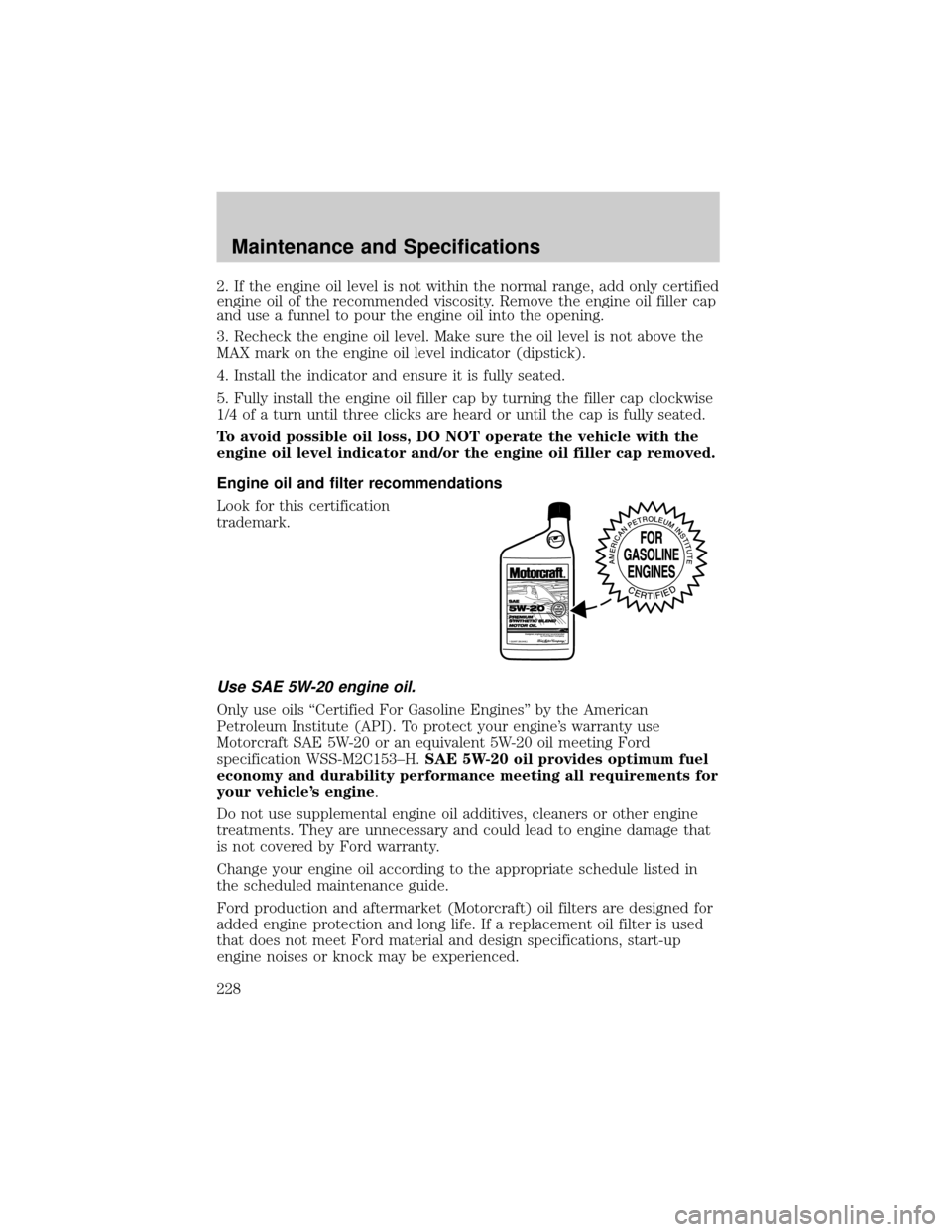
Engine oil and filter recommendations
Look for this certification
trademark.
Use SAE 5W-20 engine oil.
Only use oils ªCertified For Gasoline Enginesº by the American
Petroleum Institute (API). To protect your engine's warranty use
Motorcraft SAE 5W-20 or an equivalent 5W-20 oil meeting Ford
specification WSS-M2C153±H.SAE 5W-20 oil provides optimum fuel
economy and durability performance meeting all requirements for
your vehicle's engine.
Do not use supplemental engine oil additives, cleaners or other engine
treatments. They are unnecessary and could lead to engine damage that
is not covered by Ford warranty.
Change your engine oil according to the appropriate schedule listed in
the scheduled maintenance guide.
Ford production and aftermarket (Motorcraft) oil filters are designed for
added engine protection and long life. If a replacement oil filter is used
that does not meet Ford material and design specifications, start-up
engine noises or knock may be experienced.
Maintenance and Specifications
228
Page 230 of 280
Keep batteries out of reach of children. Batteries contain sulfuric
acid. Avoid contact with skin, eyes or clothing. Shield your eyes
when working near the battery to protect against possible splashing of
acid solution. In case of acid contact with skin or eyes, flush
immediately with water for a minimum of 15 minutes and get prompt
medical attention. If acid is swallowed, call a physician immediately.
Battery posts, terminals and related accessories contain lead and
lead compounds.Wash hands after handling.
Because your vehicle's engine is also electronically controlled by a
computer, some control conditions are maintained by power from the
battery. When the battery is disconnected or a new battery is installed,
the engine must relearn its idle and fuel trim strategy for optimum
driveability and performance. To begin this process:
1. With the vehicle at a complete stop, set the parking brake.
2. Put the gearshift in P (Park) (automatic transmission) or the neutral
position (manual transmission), turn off all accessories and start the
engine.
3. Run the engine until it reaches normal operating temperature.
4. Allow the engine to idle for at least one minute.
5. Turn the A/C on and allow the engine to idle for at least one minute.
6. Drive the vehicle to complete the relearning process.
²The vehicle may need to be driven 16 km (10 miles) or more to
relearn the idle and fuel trim strategy.
²If you do not allow the engine to relearn its idle trim, the idle
quality of your vehicle may be adversely affected until the idle
trim is eventually relearned.
If the battery has been disconnected or a new battery has been installed,
the clock and the preset radio stations must be reset once the battery is
reconnected.
Maintenance and Specifications
230
Page 234 of 280

1. Before you begin, turn the engine off and let it cool.
2. When the engine is cool, wrap a thick cloth around the coolant
pressure relief cap on the coolant reservoir (an opaque plastic bottle).
Slowly turn cap counterclockwise (left) until pressure begins to release.
3. Step back while the pressure releases.
4. When you are sure that all the pressure has been released, use the
cloth to turn it counterclockwise and remove the cap.
5. Fill the coolant reservoir slowly with the proper coolant mixture (see
above), to within the ªcold fill rangeº or the ªcold fullº level on the
reservoir.
6. Replace the cap. Turn until tightly installed. Turn cap until click is
heard/felt to ensure it is tightly installed.
After any coolant has been added, check the coolant concentration, refer
toChecking Engine Coolantsection. If the concentration is not 50/50
(protection to ±34É F/±36É C), drain some coolant and adjust the
concentration. It may take several drains and additions to obtain a 50/50
coolant concentration.
Whenever coolant has been added, the coolant level in the coolant
reservoir should be checked the next few times you drive the vehicle. If
necessary, add enough 50/50 concentration of engine coolant and
distilled water to bring the liquid level to the proper level.
If you have to add more than 1.0 liter (1.0 quart) of engine coolant per
month, have your dealer check the engine cooling system. Your cooling
system may have a leak. Operating an engine with a low level of coolant
can result in engine overheating and possible engine damage.
Recycled engine coolant
Ford Motor Company does NOT recommend the use of recycled engine
coolant in vehicles originally equipped with Motorcraft Premium Gold
Engine Coolant since a Ford-approved recycling process is not yet
available.
Used engine coolant should be disposed of in an appropriate
manner. Follow your community's regulations and standards for recycling
and disposing of automotive fluids.
Coolant refill capacity
To find out how much fluid your vehicle's cooling system can hold, refer
toRefill capacitiesin this chapter.
Maintenance and Specifications
234
Page 239 of 280
Use the following guidelines to avoid static build-up when filling an
ungrounded fuel container:
²Place approved fuel container on the ground.
²DO NOT fill a fuel container while it is in the vehicle (including the
cargo area).
²Keep the fuel pump nozzle in contact with the fuel container while
filling.
²DO NOT use a device that would hold the fuel pump handle in the fill
position.
Fuel Filler Cap
Your fuel tank filler cap has an indexed design with a 1/4 turn on/off
feature.
When fueling your vehicle:
1. Turn the engine off.
2. Carefully turn the filler cap counterclockwise 1/4 of a turn until it
stops.
3. Pull to remove the cap from the fuel filler pipe.
4. To install the cap, align the tabs on the cap with the notches on the
filler pipe.
5. Turn the filler cap clockwise 1/4 of a turn until it stops.
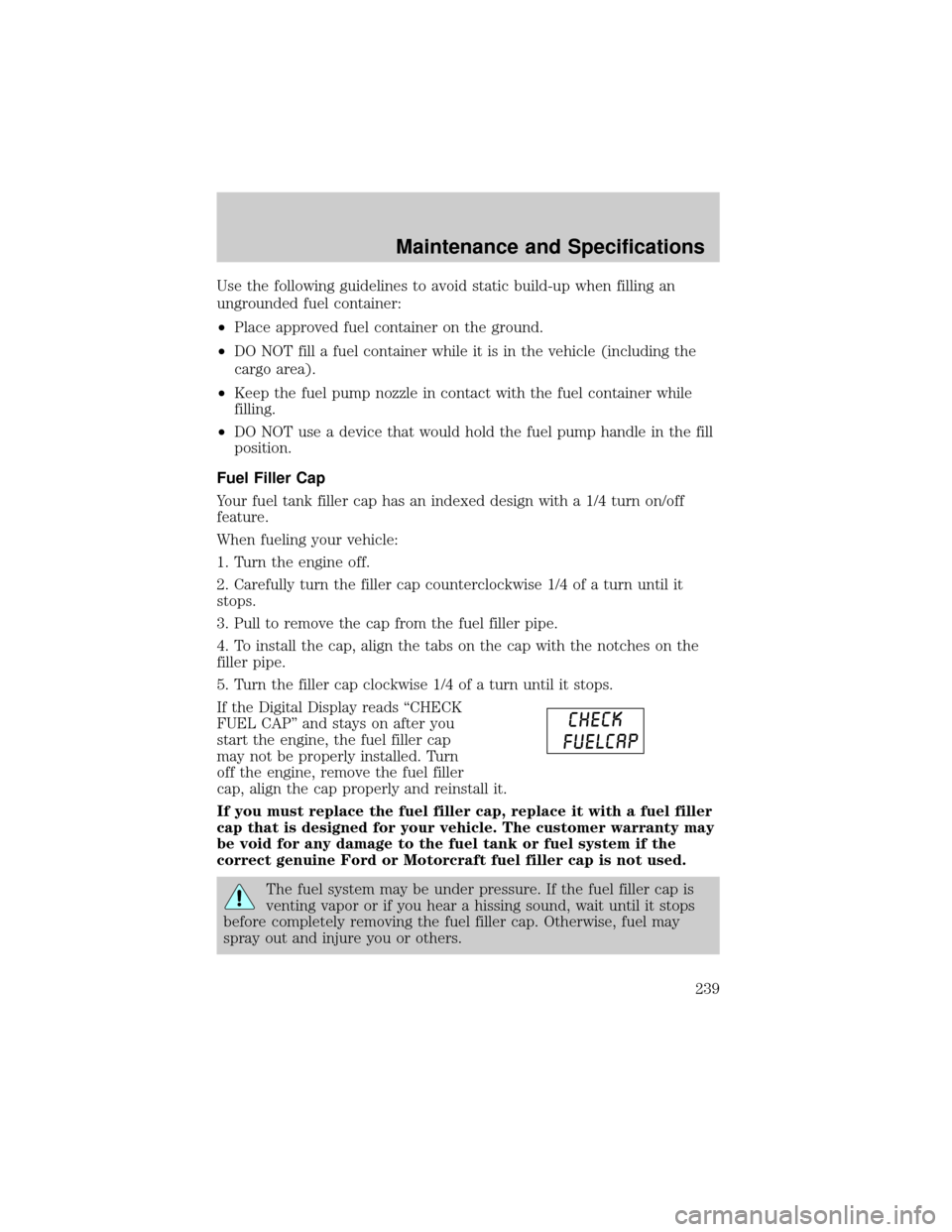
If the Digital Display reads ªCHECK
FUEL CAPº and stays on after you
start the engine, the fuel filler cap
may not be properly installed. Turn
off the engine, remove the fuel filler
cap, align the cap properly and reinstall it.
If you must replace the fuel filler cap, replace it with a fuel filler
cap that is designed for your vehicle. The customer warranty may
be void for any damage to the fuel tank or fuel system if the
correct genuine Ford or Motorcraft fuel filler cap is not used.
The fuel system may be under pressure. If the fuel filler cap is
venting vapor or if you hear a hissing sound, wait until it stops
before completely removing the fuel filler cap. Otherwise, fuel may
spray out and injure you or others.
Maintenance and Specifications
239
Page 275 of 280

waxing .....................................216
wheels ......................................217
wiper blades ............................219
Climate control
(see Air conditioning or
Heating) ...........................32, 35, 37
Clock adjust
6-CD in dash .............................29
AM/FM Stereo ...........................20
AM/FM/CD .................................23
AM/FM/Tape/CD .......................26
Compass, electronic ..............78±79
calibration .................................79
set zone adjustment ...........71, 79
Console
overhead ..............................53±54
Controls
power seat .................................99
steering column ........................64
Coolant
checking and adding ..............231
refill capacities ................234, 257
specifications ..................261, 263
Cruise control
(see Speed control) ....................61
Customer Assistance ................186
Ford accessories for your
vehicle .....................................220
Ford Extended Service
Plan ..........................................209
Getting assistance outside
the U.S. and Canada ..............213
Getting roadside assistance ...186
Getting the service you
need .........................................207
Ordering additional owner's
literature .................................214
The Dispute Settlement
Board .......................................209Utilizing the
Mediation/Arbitration
Program ...................................212
D
Daytime running lamps
(see Lamps) ................................42
Dipstick
automatic transmission
fluid ..........................................248
engine oil .................................226
Doors
lubricant specifications ..........261
Driveline universal joint and
slip yoke ....................................251
Driving under special
conditions ..................157, 164, 167
sand .........................................166
snow and ice ...........................168
through water .................166, 170
E
Electronic message center .........70
Emergencies, roadside
jump-starting ..........................201
Emergency Flashers .................187
Emission control system ..........245
Engine ........................................263
cleaning ...................................217
coolant .....................................231
fail-safe coolant ......................235
idle speed control ...................229
lubrication
specifications ..................261, 263
refill capacities ........................257
service points ..................224±225
starting after a collision .........187
Engine block heater .................148
Index
275
Page 278 of 280

Moon roof ....................................65
Motorcraft parts ................241, 257
O
Octane rating ............................240
Oil (see Engine oil) ..................226
P
Parking brake ............................150
Parts (see Motorcraft parts) ....257
Power distribution box
(see Fuses) ...............................189
Power door locks ........................82
Power point .................................56
Power steering ..........................150
fluid, checking and adding ....247
fluid, refill capacity ................257
fluid, specifications .........261, 263
Power Windows ...........................58
Preparing to drive your
vehicle ........................................151
R
Radio ..........................18, 20, 23, 26
Relays ........................................188
Remote entry system .................85
illuminated entry ......................89
locking/unlocking doors ...........82
replacement/additional
transmitters ...............................88
Reverse sensing system ...........157
Roadside assistance ..................186
S
Safety Belt Maintenance ..........117Safety belts (see Safety
restraints) ..........102, 104±106, 108
Safety defects, reporting ..........215
Safety restraints ........102, 104±108
extension assembly ................117
for adults .........................104±106
for children .....................129±130
lap belt ....................................108
safety belt maintenance .........117
warning light and
chime ...............................109±110
Safety seats for children ..........133
Seat belts
(see Safety restraints) .............102
Seats ............................................97
child safety seats ....................133
heated ................................37, 100
memory seat .....................86, 100
SecuriLock passive anti-theft
system ..........................................95
Servicing your vehicle ..............222
Setting the clock
AM/FM stereo ...........................20
AM/FM/CD .................................23
AM/FM/In-dash 6 CD ................29
AM/FM/Tape/CD .......................26
Snowplowing .................7, 183±184
Spare tire
(see Changing the Tire) ...........196
Spark plugs,
specifications .....................257, 263
Special notice
ambulance conversions ..............7
four-wheel drive
vehicles ............................184±185
utility-type vehicles ....................7
Index
278