Page 129 of 344
•Washer fluid
•Brake fluid
•Compass
•Outside temperature
•Engine sensor
Contact your dealer as soon as possible if these messages occur on a
regular basis.
CENTER CONSOLE (IF EQUIPPED)
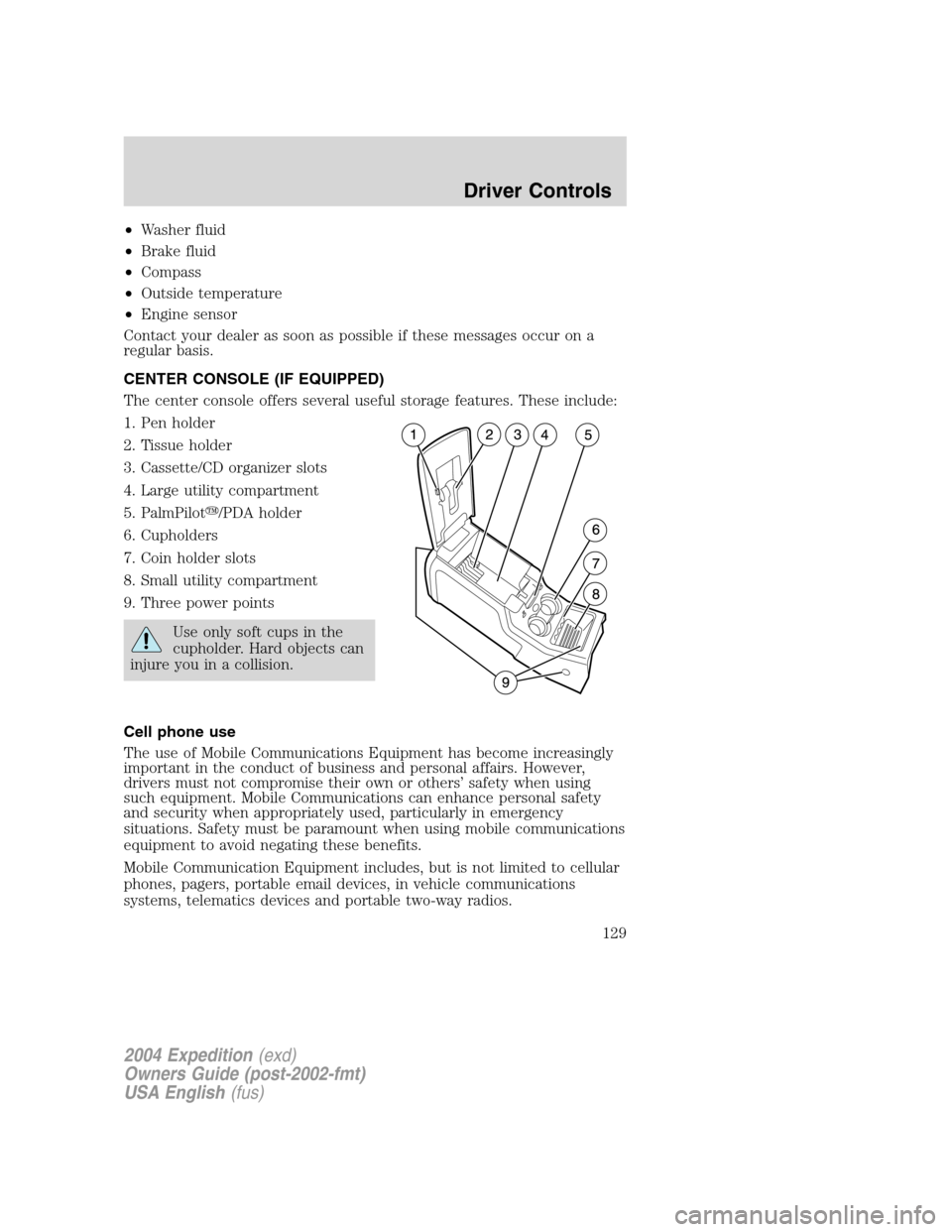
The center console offers several useful storage features. These include:
1. Pen holder
2. Tissue holder
3. Cassette/CD organizer slots
4. Large utility compartment
5. PalmPilot�/PDA holder
6. Cupholders
7. Coin holder slots
8. Small utility compartment
9. Three power points
Use only soft cups in the
cupholder. Hard objects can
injure you in a collision.
Cell phone use
The use of Mobile Communications Equipment has become increasingly
important in the conduct of business and personal affairs. However,
drivers must not compromise their own or others’safety when using
such equipment. Mobile Communications can enhance personal safety
and security when appropriately used, particularly in emergency
situations. Safety must be paramount when using mobile communications
equipment to avoid negating these benefits.
Mobile Communication Equipment includes, but is not limited to cellular
phones, pagers, portable email devices, in vehicle communications
systems, telematics devices and portable two-way radios.
2004 Expedition(exd)
Owners Guide (post-2002-fmt)
USA English(fus)
Driver Controls
129
Page 136 of 344
Replacing the battery
The remote entry transmitter uses one coin type three-volt lithium
battery CR2032 or equivalent. The typical operating range for your
remote entry transmitter is approximately 10 meters (33 feet). A
decrease in the operating range could be caused by:
•weather conditions,
•nearby radio towers,
•structures around the vehicle and
•other vehicles parked next to the vehicle.
To replace the battery:
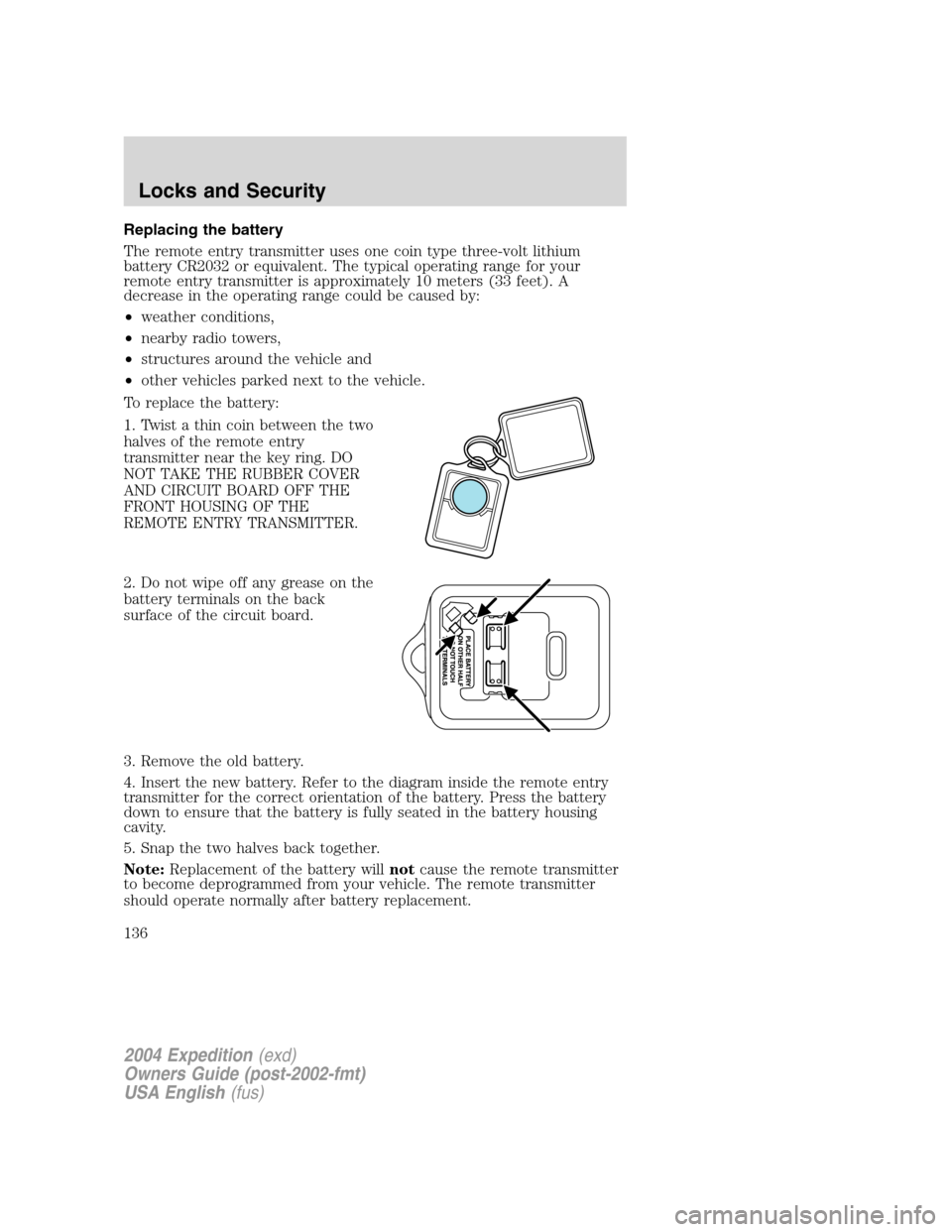
1. Twist a thin coin between the two
halves of the remote entry
transmitter near the key ring. DO
NOT TAKE THE RUBBER COVER
AND CIRCUIT BOARD OFF THE
FRONT HOUSING OF THE
REMOTE ENTRY TRANSMITTER.
2. Do not wipe off any grease on the
battery terminals on the back
surface of the circuit board.
3. Remove the old battery.
4. Insert the new battery. Refer to the diagram inside the remote entry
transmitter for the correct orientation of the battery. Press the battery
down to ensure that the battery is fully seated in the battery housing
cavity.
5. Snap the two halves back together.
Note:Replacement of the battery willnotcause the remote transmitter
to become deprogrammed from your vehicle. The remote transmitter
should operate normally after battery replacement.
2004 Expedition(exd)
Owners Guide (post-2002-fmt)
USA English(fus)
Locks and Security
136
Page 197 of 344
STARTING
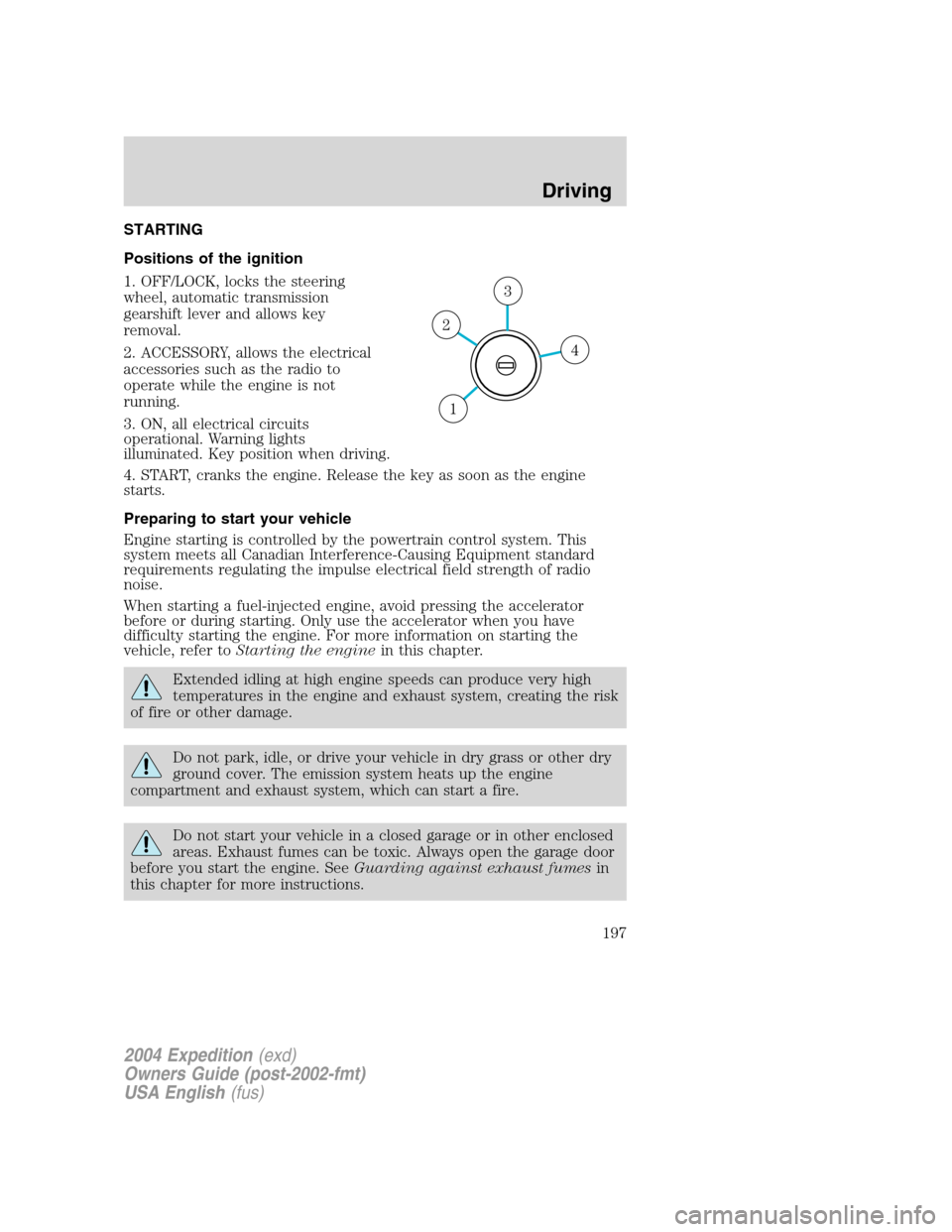
Positions of the ignition
1. OFF/LOCK, locks the steering
wheel, automatic transmission
gearshift lever and allows key
removal.
2. ACCESSORY, allows the electrical
accessories such as the radio to
operate while the engine is not
running.
3. ON, all electrical circuits
operational. Warning lights
illuminated. Key position when driving.
4. START, cranks the engine. Release the key as soon as the engine
starts.
Preparing to start your vehicle
Engine starting is controlled by the powertrain control system. This
system meets all Canadian Interference-Causing Equipment standard
requirements regulating the impulse electrical field strength of radio
noise.
When starting a fuel-injected engine, avoid pressing the accelerator
before or during starting. Only use the accelerator when you have
difficulty starting the engine. For more information on starting the
vehicle, refer toStarting the enginein this chapter.
Extended idling at high engine speeds can produce very high
temperatures in the engine and exhaust system, creating the risk
of fire or other damage.
Do not park, idle, or drive your vehicle in dry grass or other dry
ground cover. The emission system heats up the engine
compartment and exhaust system, which can start a fire.
Do not start your vehicle in a closed garage or in other enclosed
areas. Exhaust fumes can be toxic. Always open the garage door
before you start the engine. SeeGuarding against exhaust fumesin
this chapter for more instructions.
4
3
2
1
2004 Expedition(exd)
Owners Guide (post-2002-fmt)
USA English(fus)
Driving
Driving
197
Page 216 of 344
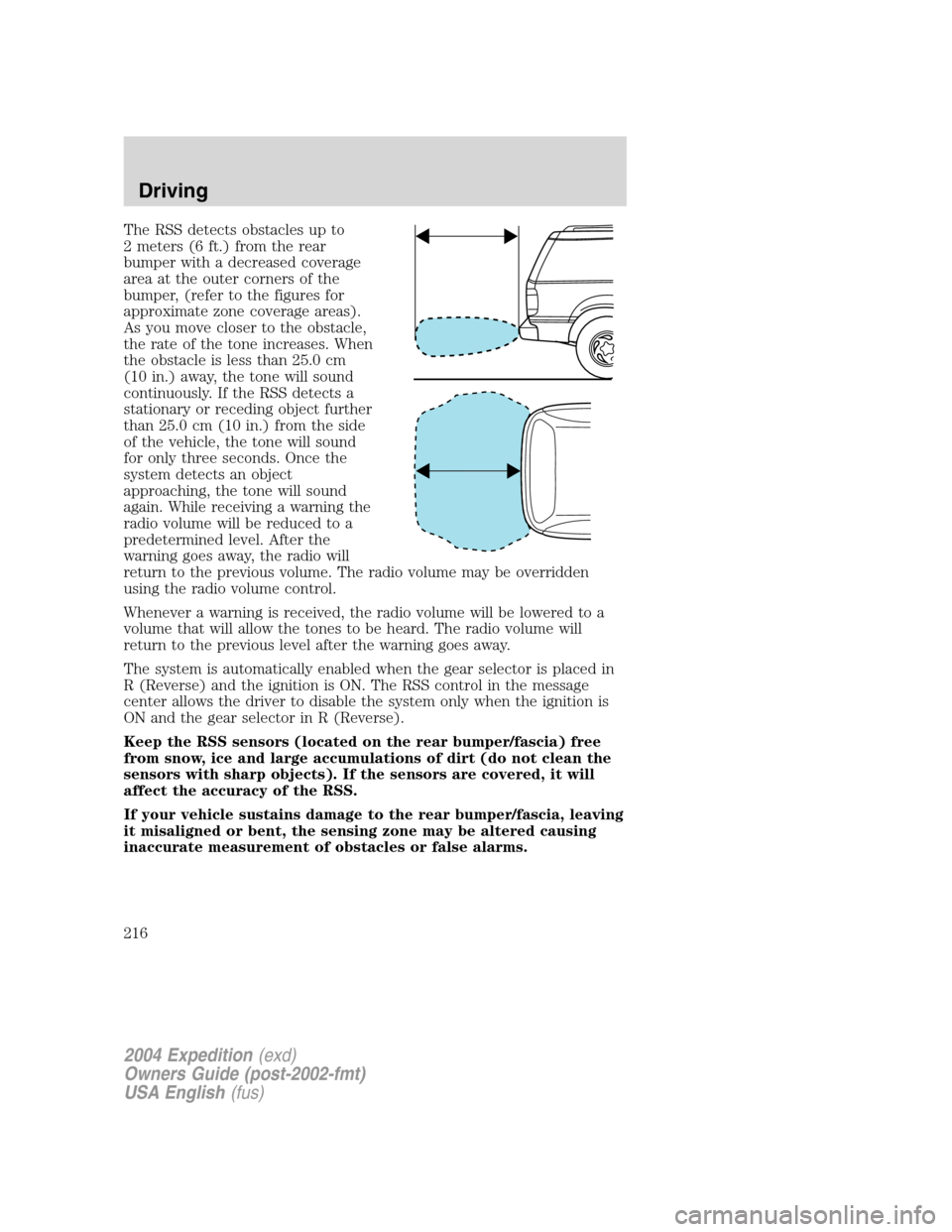
The RSS detects obstacles up to
2 meters (6 ft.) from the rear
bumper with a decreased coverage
area at the outer corners of the
bumper, (refer to the figures for
approximate zone coverage areas).
As you move closer to the obstacle,
the rate of the tone increases. When
the obstacle is less than 25.0 cm
(10 in.) away, the tone will sound
continuously. If the RSS detects a
stationary or receding object further
than 25.0 cm (10 in.) from the side
of the vehicle, the tone will sound
for only three seconds. Once the
system detects an object
approaching, the tone will sound
again. While receiving a warning the
radio volume will be reduced to a
predetermined level. After the
warning goes away, the radio will
return to the previous volume. The radio volume may be overridden
using the radio volume control.
Whenever a warning is received, the radio volume will be lowered to a
volume that will allow the tones to be heard. The radio volume will
return to the previous level after the warning goes away.
The system is automatically enabled when the gear selector is placed in
R (Reverse) and the ignition is ON. The RSS control in the message
center allows the driver to disable the system only when the ignition is
ON and the gear selector in R (Reverse).
Keep the RSS sensors (located on the rear bumper/fascia) free
from snow, ice and large accumulations of dirt (do not clean the
sensors with sharp objects). If the sensors are covered, it will
affect the accuracy of the RSS.
If your vehicle sustains damage to the rear bumper/fascia, leaving
it misaligned or bent, the sensing zone may be altered causing
inaccurate measurement of obstacles or false alarms.
2004 Expedition(exd)
Owners Guide (post-2002-fmt)
USA English(fus)
Driving
216
Page 246 of 344
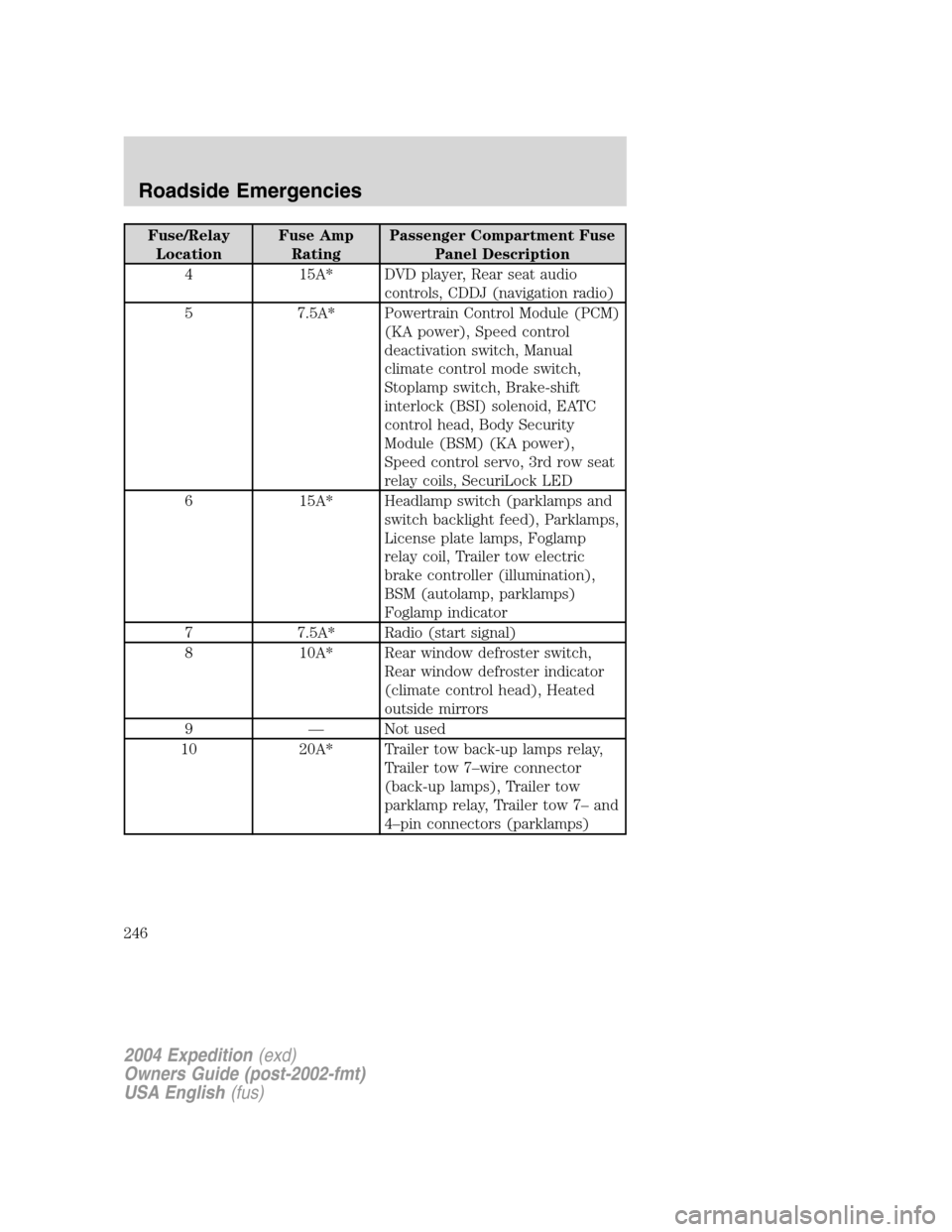
Fuse/Relay
LocationFuse Amp
RatingPassenger Compartment Fuse
Panel Description
4 15A* DVD player, Rear seat audio
controls, CDDJ (navigation radio)
5 7.5A* Powertrain Control Module (PCM)
(KA power), Speed control
deactivation switch, Manual
climate control mode switch,
Stoplamp switch, Brake-shift
interlock (BSI) solenoid, EATC
control head, Body Security
Module (BSM) (KA power),
Speed control servo, 3rd row seat
relay coils, SecuriLock LED
6 15A* Headlamp switch (parklamps and
switch backlight feed), Parklamps,
License plate lamps, Foglamp
relay coil, Trailer tow electric
brake controller (illumination),
BSM (autolamp, parklamps)
Foglamp indicator
7 7.5A* Radio (start signal)
8 10A* Rear window defroster switch,
Rear window defroster indicator
(climate control head), Heated
outside mirrors
9—Not used
10 20A* Trailer tow back-up lamps relay,
Trailer tow 7–wire connector
(back-up lamps), Trailer tow
parklamp relay, Trailer tow 7–and
4–pin connectors (parklamps)
2004 Expedition(exd)
Owners Guide (post-2002-fmt)
USA English(fus)
Roadside Emergencies
246
Page 247 of 344
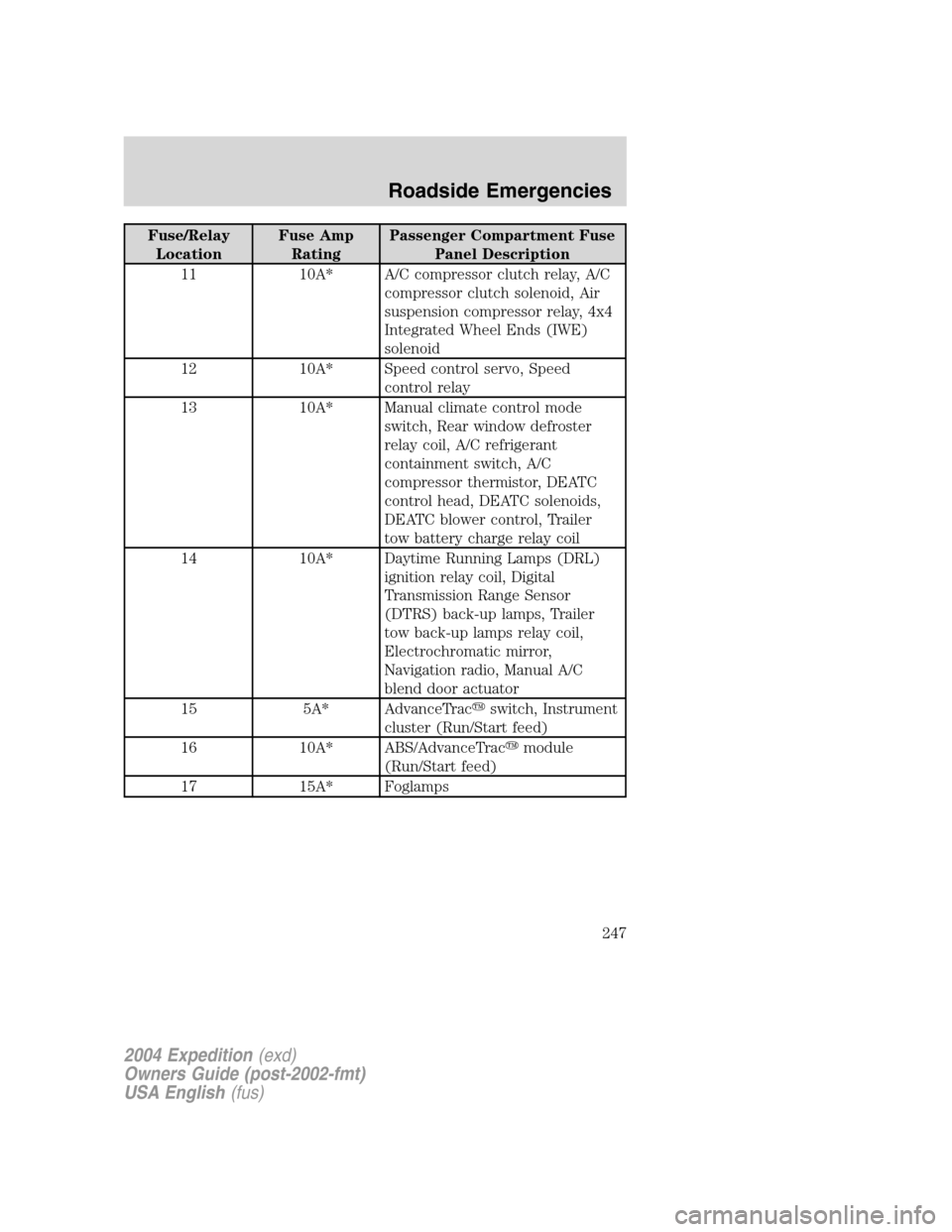
Fuse/Relay
LocationFuse Amp
RatingPassenger Compartment Fuse
Panel Description
11 10A* A/C compressor clutch relay, A/C
compressor clutch solenoid, Air
suspension compressor relay, 4x4
Integrated Wheel Ends (IWE)
solenoid
12 10A* Speed control servo, Speed
control relay
13 10A* Manual climate control mode
switch, Rear window defroster
relay coil, A/C refrigerant
containment switch, A/C
compressor thermistor, DEATC
control head, DEATC solenoids,
DEATC blower control, Trailer
tow battery charge relay coil
14 10A* Daytime Running Lamps (DRL)
ignition relay coil, Digital
Transmission Range Sensor
(DTRS) back-up lamps, Trailer
tow back-up lamps relay coil,
Electrochromatic mirror,
Navigation radio, Manual A/C
blend door actuator
15 5A* AdvanceTrac�switch, Instrument
cluster (Run/Start feed)
16 10A* ABS/AdvanceTrac�module
(Run/Start feed)
17 15A* Foglamps
2004 Expedition(exd)
Owners Guide (post-2002-fmt)
USA English(fus)
Roadside Emergencies
247
Page 248 of 344
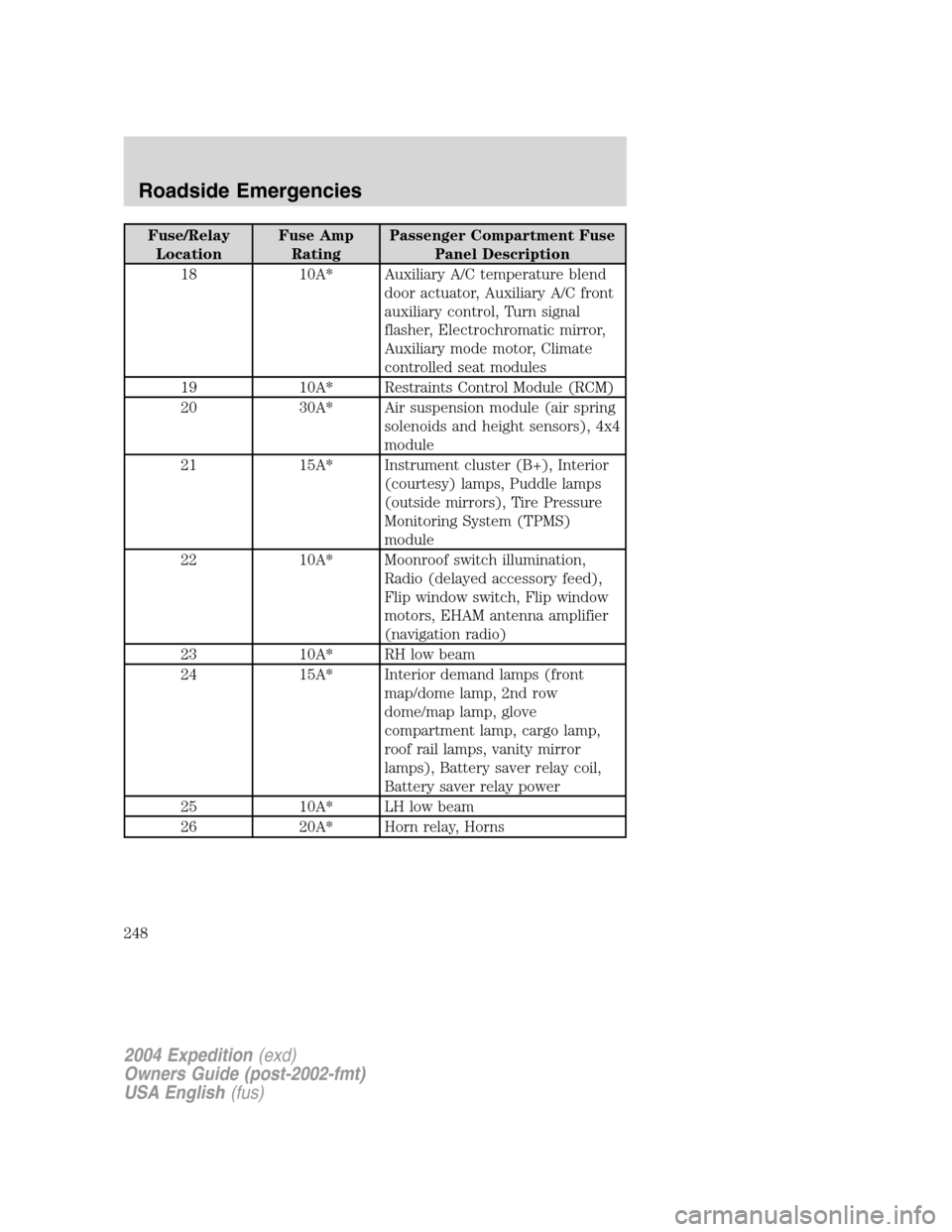
Fuse/Relay
LocationFuse Amp
RatingPassenger Compartment Fuse
Panel Description
18 10A* Auxiliary A/C temperature blend
door actuator, Auxiliary A/C front
auxiliary control, Turn signal
flasher, Electrochromatic mirror,
Auxiliary mode motor, Climate
controlled seat modules
19 10A* Restraints Control Module (RCM)
20 30A* Air suspension module (air spring
solenoids and height sensors), 4x4
module
21 15A* Instrument cluster (B+), Interior
(courtesy) lamps, Puddle lamps
(outside mirrors), Tire Pressure
Monitoring System (TPMS)
module
22 10A* Moonroof switch illumination,
Radio (delayed accessory feed),
Flip window switch, Flip window
motors, EHAM antenna amplifier
(navigation radio)
23 10A* RH low beam
24 15A* Interior demand lamps (front
map/dome lamp, 2nd row
dome/map lamp, glove
compartment lamp, cargo lamp,
roof rail lamps, vanity mirror
lamps), Battery saver relay coil,
Battery saver relay power
25 10A* LH low beam
26 20A* Horn relay, Horns
2004 Expedition(exd)
Owners Guide (post-2002-fmt)
USA English(fus)
Roadside Emergencies
248
Page 249 of 344
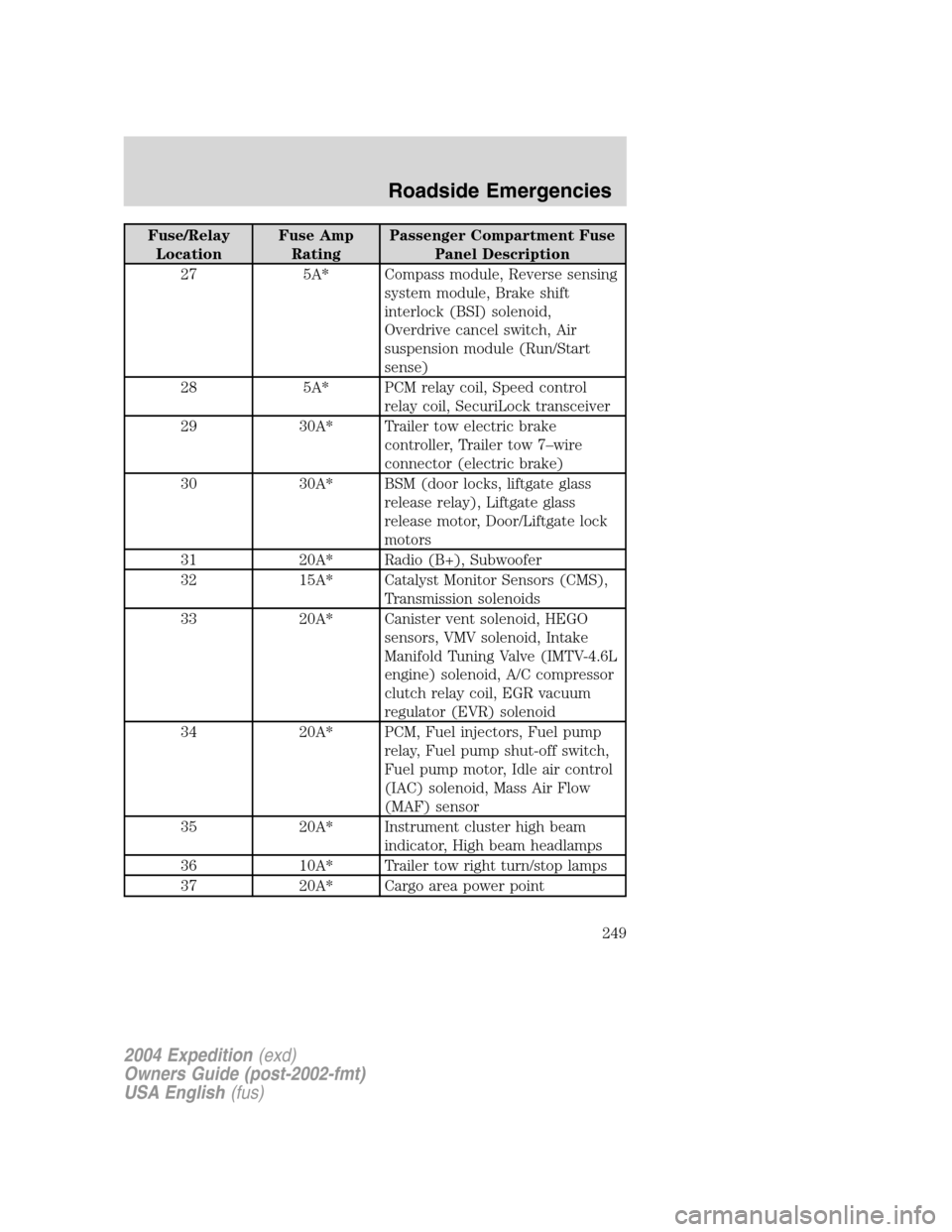
Fuse/Relay
LocationFuse Amp
RatingPassenger Compartment Fuse
Panel Description
27 5A* Compass module, Reverse sensing
system module, Brake shift
interlock (BSI) solenoid,
Overdrive cancel switch, Air
suspension module (Run/Start
sense)
28 5A* PCM relay coil, Speed control
relay coil, SecuriLock transceiver
29 30A* Trailer tow electric brake
controller, Trailer tow 7–wire
connector (electric brake)
30 30A* BSM (door locks, liftgate glass
release relay), Liftgate glass
release motor, Door/Liftgate lock
motors
31 20A* Radio (B+), Subwoofer
32 15A* Catalyst Monitor Sensors (CMS),
Transmission solenoids
33 20A* Canister vent solenoid, HEGO
sensors, VMV solenoid, Intake
Manifold Tuning Valve (IMTV-4.6L
engine) solenoid, A/C compressor
clutch relay coil, EGR vacuum
regulator (EVR) solenoid
34 20A* PCM, Fuel injectors, Fuel pump
relay, Fuel pump shut-off switch,
Fuel pump motor, Idle air control
(IAC) solenoid, Mass Air Flow
(MAF) sensor
35 20A* Instrument cluster high beam
indicator, High beam headlamps
36 10A* Trailer tow right turn/stop lamps
37 20A* Cargo area power point
2004 Expedition(exd)
Owners Guide (post-2002-fmt)
USA English(fus)
Roadside Emergencies
249