•decreased engine coolant concentrations below 40% will
decrease the freeze protection characteristics of the engine
coolant and may cause engine damage.
•refer to the chart on the coolant container to ensure the
coolant concentration in your vehicle will provide adequate
protection at the temperatures in which you drive.
Vehicles driven year-round in non-extreme climates should use a 50/50
mixture of engine coolant and distilled water for optimum cooling system
and engine protection.
Coolant conditioner (liquid)
For engines filled with green-colored Motorcraft Premium Engine
Coolant, a supplemental coolant additive FW-16 meeting Ford
specification ESN-M99B169–A has been added to the coolant in this
engine.
This additive aids in the prevention of rust and scale buildup on the
internal parts of the cooling system. Prevention of rust and scale buildup
allows for proper dissipation of heat generated by combustion.
See the scheduled maintenance guide for recommended intervals.
EMISSION CONTROL SYSTEM(S) LAWS
Federal law prohibits vehicle manufacturers, dealers and other persons
engaged in the business of repairing, servicing, selling, leasing or trading
motor vehicles as well as fleet operations from unknowingly removing or
rendering emission control system(s) inoperative. Further, modifications
of the emission control system(s) could create liability on the part of the
individual owners under the laws of some states. In Canada,
modifications of the emission control system(s) could create liability
under applicable Federal or Provincial laws.
Do not remove or alter the original equipment floor covering or
insulation between it and the metal floor of the vehicle. The floor
covering and insulation protect occupants of the vehicle from the engine
and exhaust system heat and noise. On vehicles with no original
equipment floor covering insulation, do not carry passengers in a manner
that permits prolonged skin contact with the metal floor. Provide
adequate insulation.
General maintenance information
42
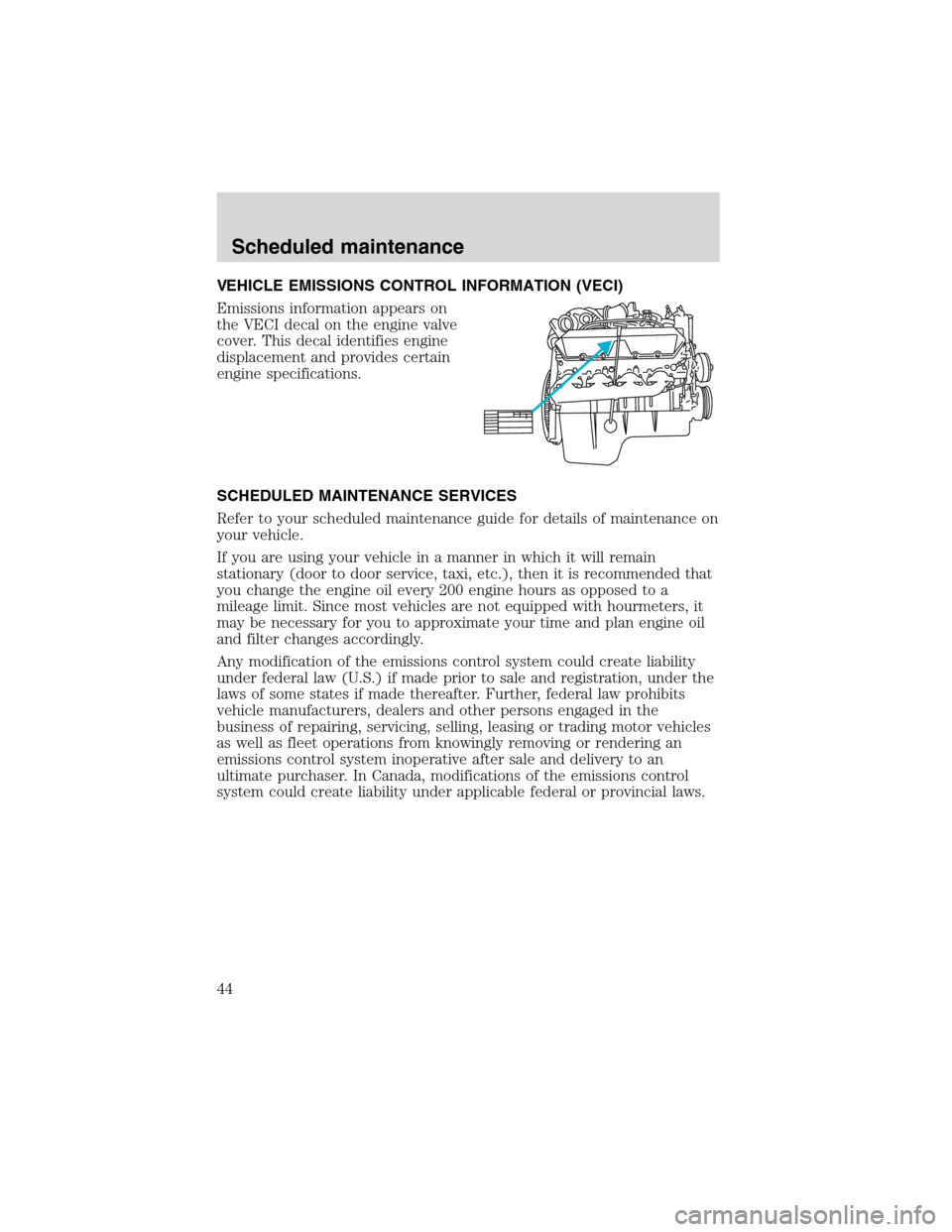
VEHICLE EMISSIONS CONTROL INFORMATION (VECI)
Emissions information appears on
the VECI decal on the engine valve
cover. This decal identifies engine
displacement and provides certain
engine specifications.
SCHEDULED MAINTENANCE SERVICES
Refer to your scheduled maintenance guide for details of maintenance on
your vehicle.
If you are using your vehicle in a manner in which it will remain
stationary (door to door service, taxi, etc.), then it is recommended that
you change the engine oil every 200 engine hours as opposed to a
mileage limit. Since most vehicles are not equipped with hourmeters, it
may be necessary for you to approximate your time and plan engine oil
and filter changes accordingly.
Any modification of the emissions control system could create liability
under federal law (U.S.) if made prior to sale and registration, under the
laws of some states if made thereafter. Further, federal law prohibits
vehicle manufacturers, dealers and other persons engaged in the
business of repairing, servicing, selling, leasing or trading motor vehicles
as well as fleet operations from knowingly removing or rendering an
emissions control system inoperative after sale and delivery to an
ultimate purchaser. In Canada, modifications of the emissions control
system could create liability under applicable federal or provincial laws.
Scheduled maintenance
44