Page 151 of 248
Fuse/Relay
LocationFuse Amp
RatingPassenger Compartment Fuse
Panel Description
21 15A LCM for park lamps and interior
illumination, Autolamp/Sunload
sensor
22 20A Speed control servo,
Multi-function switch for hazard
lamps, Brake on/off switch, Feed
for IP fuse 19
23 15A EATC module, Instrument cluster,
LCM, Interior lamps, Door lock
switches, Door ajar and roof
lamps (Taxi vehicles)
24 10A Left-hand low beam
25 20A Cigar lighter
26 10A Right-hand low beam
27 25A LCM for cornering lamps and high
beam headlamps, Police headlamp
wigwag module (police vehicles
only)
28 20A* Power windows, Instrument
panel/Door decklid release (police
vehicles only)
29—Not used
30—Not used
31—Not used
32—Not used
* Circuit breaker
Power distribution box
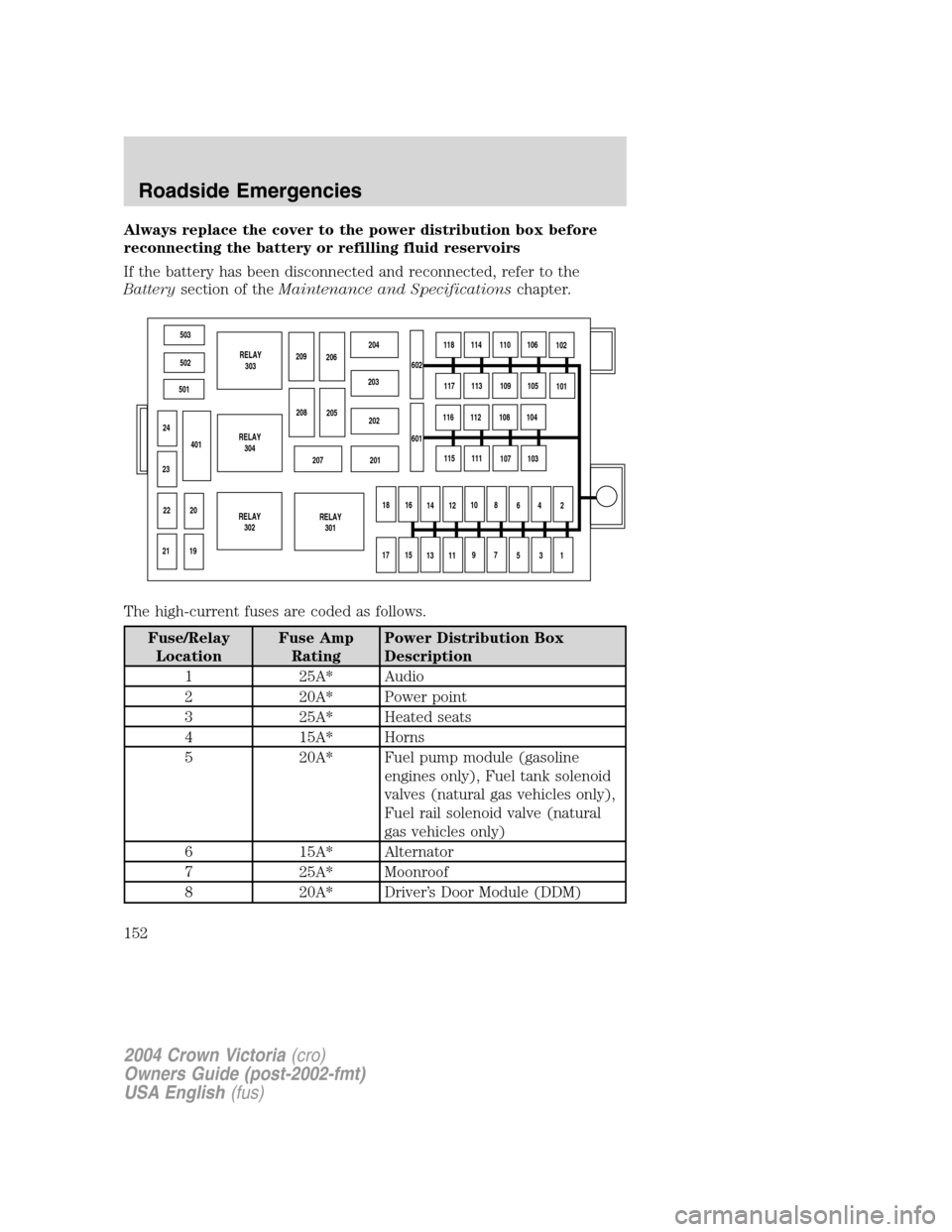
The power distribution box is located in the engine compartment. The
power distribution box contains high-current fuses that protect your
vehicle’s main electrical systems from overloads.
Always disconnect the battery before servicing high current
fuses.
2004 Crown Victoria(cro)
Owners Guide (post-2002-fmt)
USA English(fus)
Roadside Emergencies
151
Page 152 of 248
Always replace the cover to the power distribution box before
reconnecting the battery or refilling fluid reservoirs
If the battery has been disconnected and reconnected, refer to the
Batterysection of theMaintenance and Specificationschapter.
The high-current fuses are coded as follows.
Fuse/Relay
LocationFuse Amp
RatingPower Distribution Box
Description
1 25A* Audio
2 20A* Power point
3 25A* Heated seats
4 15A* Horns
5 20A* Fuel pump module (gasoline
engines only), Fuel tank solenoid
valves (natural gas vehicles only),
Fuel rail solenoid valve (natural
gas vehicles only)
6 15A* Alternator
7 25A* Moonroof
8 20A* Driver’s Door Module (DDM)
503
502
501
24
23401
20
19 22
21RELAY
302 RELAY
304 RELAY
303
RELAY
301 207
201 202 203204
209
206
208
205602
601118
114
110
106
102
117
113
109
105
101
116
112
108
104
115
111
107
103
18
16
14
1210
8
6
4
2
17
15
13
119
7
5
3
1
2004 Crown Victoria(cro)
Owners Guide (post-2002-fmt)
USA English(fus)
Roadside Emergencies
152
Page 153 of 248
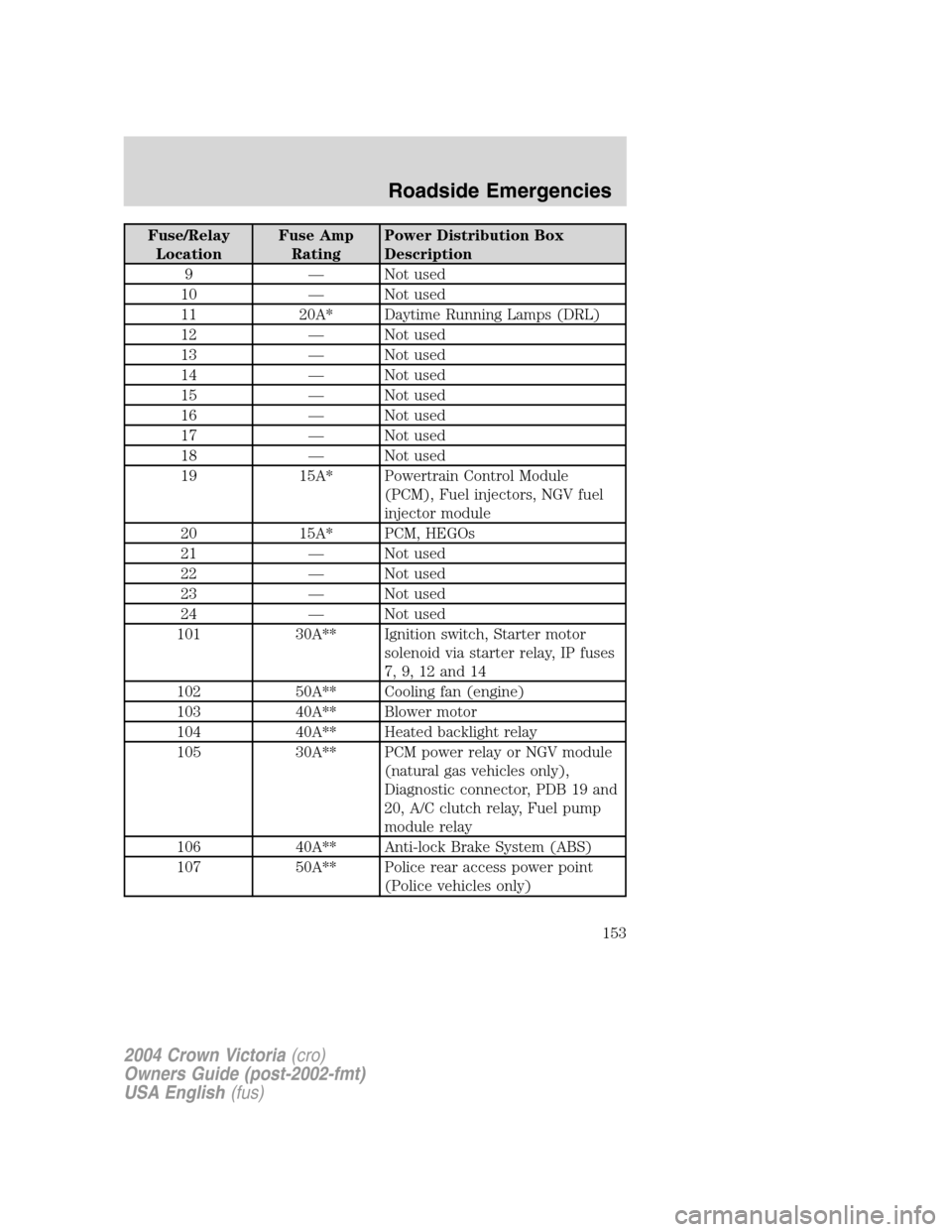
Fuse/Relay
LocationFuse Amp
RatingPower Distribution Box
Description
9—Not used
10—Not used
11 20A* Daytime Running Lamps (DRL)
12—Not used
13—Not used
14—Not used
15—Not used
16—Not used
17—Not used
18—Not used
19 15A* Powertrain Control Module
(PCM), Fuel injectors, NGV fuel
injector module
20 15A* PCM, HEGOs
21—Not used
22—Not used
23—Not used
24—Not used
101 30A** Ignition switch, Starter motor
solenoid via starter relay, IP fuses
7, 9, 12 and 14
102 50A** Cooling fan (engine)
103 40A** Blower motor
104 40A** Heated backlight relay
105 30A** PCM power relay or NGV module
(natural gas vehicles only),
Diagnostic connector, PDB 19 and
20, A/C clutch relay, Fuel pump
module relay
106 40A** Anti-lock Brake System (ABS)
107 50A** Police rear access power point
(Police vehicles only)
2004 Crown Victoria(cro)
Owners Guide (post-2002-fmt)
USA English(fus)
Roadside Emergencies
153
Page 158 of 248
2. Place gearshift lever in P (Park),
turn engine OFF and block the
diagonally opposite wheel.
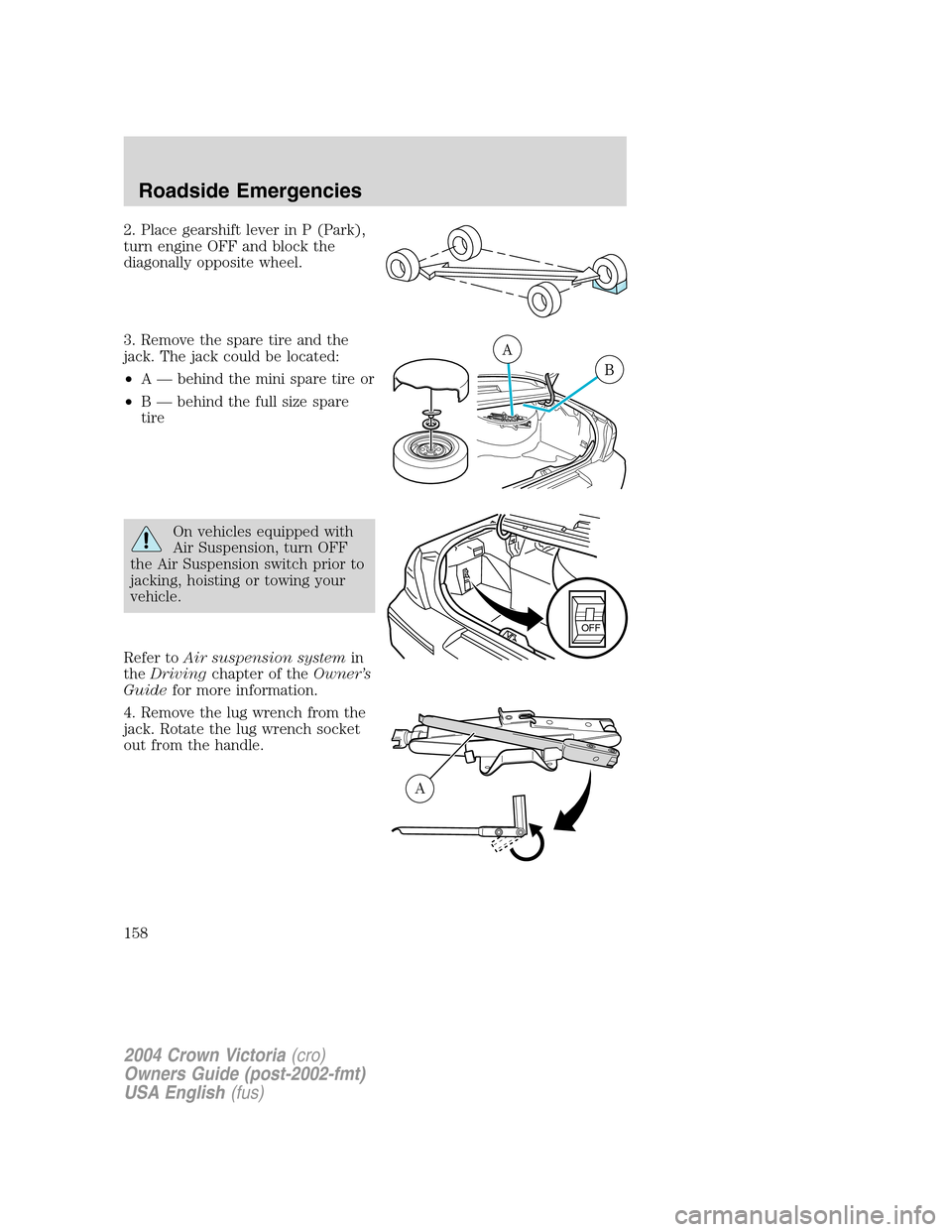
3. Remove the spare tire and the
jack. The jack could be located:
•A—behind the mini spare tire or
•B—behind the full size spare
tire
On vehicles equipped with
Air Suspension, turn OFF
the Air Suspension switch prior to
jacking, hoisting or towing your
vehicle.
Refer toAir suspension systemin
theDrivingchapter of theOwner’s
Guidefor more information.
4. Remove the lug wrench from the
jack. Rotate the lug wrench socket
out from the handle.
OFF
A
2004 Crown Victoria(cro)
Owners Guide (post-2002-fmt)
USA English(fus)
Roadside Emergencies
158
Page 160 of 248
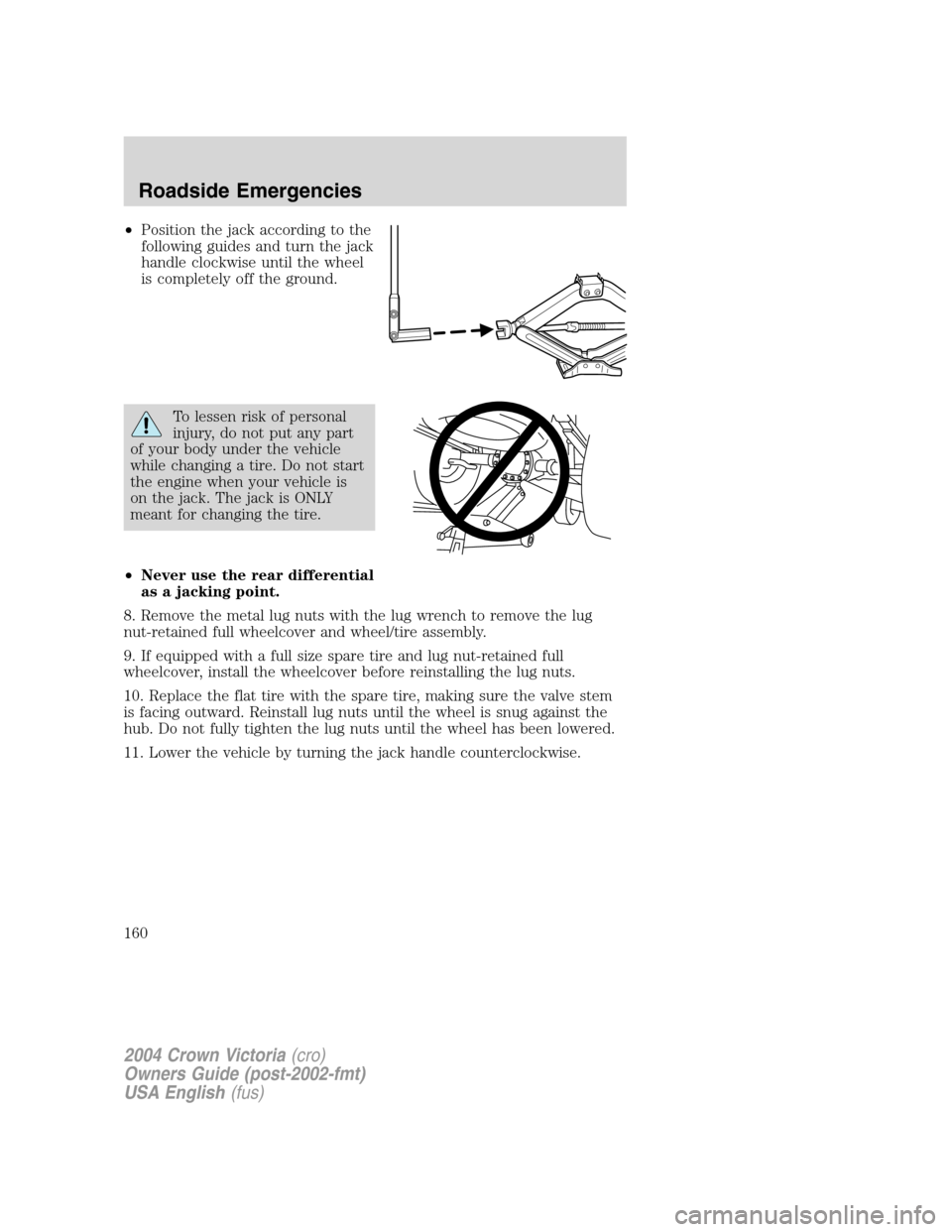
•Position the jack according to the
following guides and turn the jack
handle clockwise until the wheel
is completely off the ground.
To lessen risk of personal
injury, do not put any part
of your body under the vehicle
while changing a tire. Do not start
the engine when your vehicle is
on the jack. The jack is ONLY
meant for changing the tire.
•Never use the rear differential
as a jacking point.
8. Remove the metal lug nuts with the lug wrench to remove the lug
nut-retained full wheelcover and wheel/tire assembly.
9. If equipped with a full size spare tire and lug nut-retained full
wheelcover, install the wheelcover before reinstalling the lug nuts.
10. Replace the flat tire with the spare tire, making sure the valve stem
is facing outward. Reinstall lug nuts until the wheel is snug against the
hub. Do not fully tighten the lug nuts until the wheel has been lowered.
11. Lower the vehicle by turning the jack handle counterclockwise.
2004 Crown Victoria(cro)
Owners Guide (post-2002-fmt)
USA English(fus)
Roadside Emergencies
160
Page 162 of 248
Preparing your vehicle
When the battery is disconnected or a new battery is installed, the
transmission must relearn its shift strategy. As a result, the transmission
may have firm and/or soft shifts. This operation is considered normal and
will not affect function or durability of the transmission. Over time, the
adaptive learning process will fully update transmission operation.
1.Use only a 12–volt supply to start your vehicle.
2. Do not disconnect the battery of the disabled vehicle as this could
damage the vehicle’s electrical system.
3. Park the booster vehicle close to the hood of the disabled vehicle
making sure the two vehiclesdo nottouch. Set the parking brake on
both vehicles and stay clear of the engine cooling fan and other moving
parts.
4. Check all battery terminals and remove any excessive corrosion before
you attach the battery cables. Ensure that vent caps are tight and level.
5. Turn the heater fan on in both vehicles to protect any electrical
surges. Turn all other accessories off.
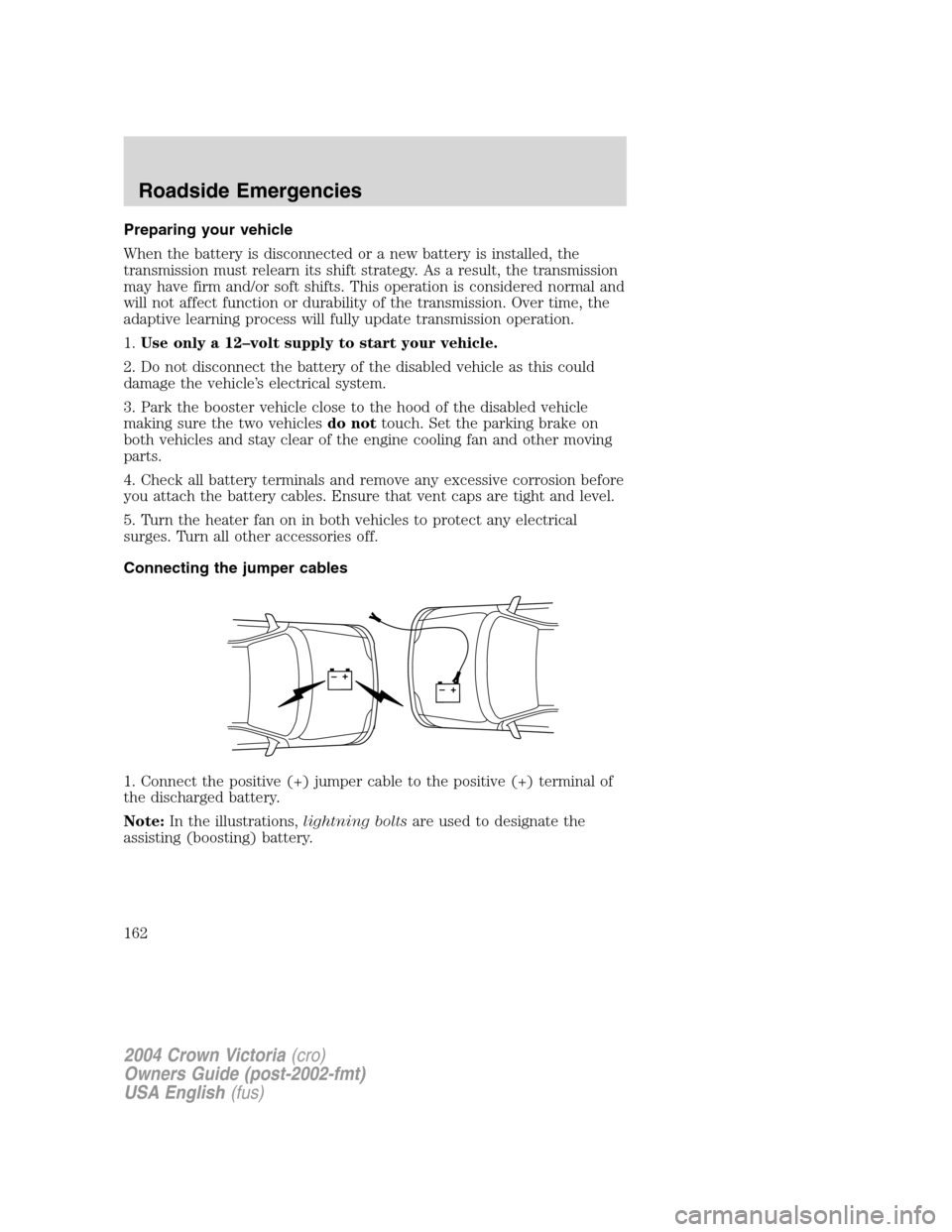
Connecting the jumper cables
1. Connect the positive (+) jumper cable to the positive (+) terminal of
the discharged battery.
Note:In the illustrations,lightning boltsare used to designate the
assisting (boosting) battery.
+–+–
2004 Crown Victoria(cro)
Owners Guide (post-2002-fmt)
USA English(fus)
Roadside Emergencies
162
Page 164 of 248
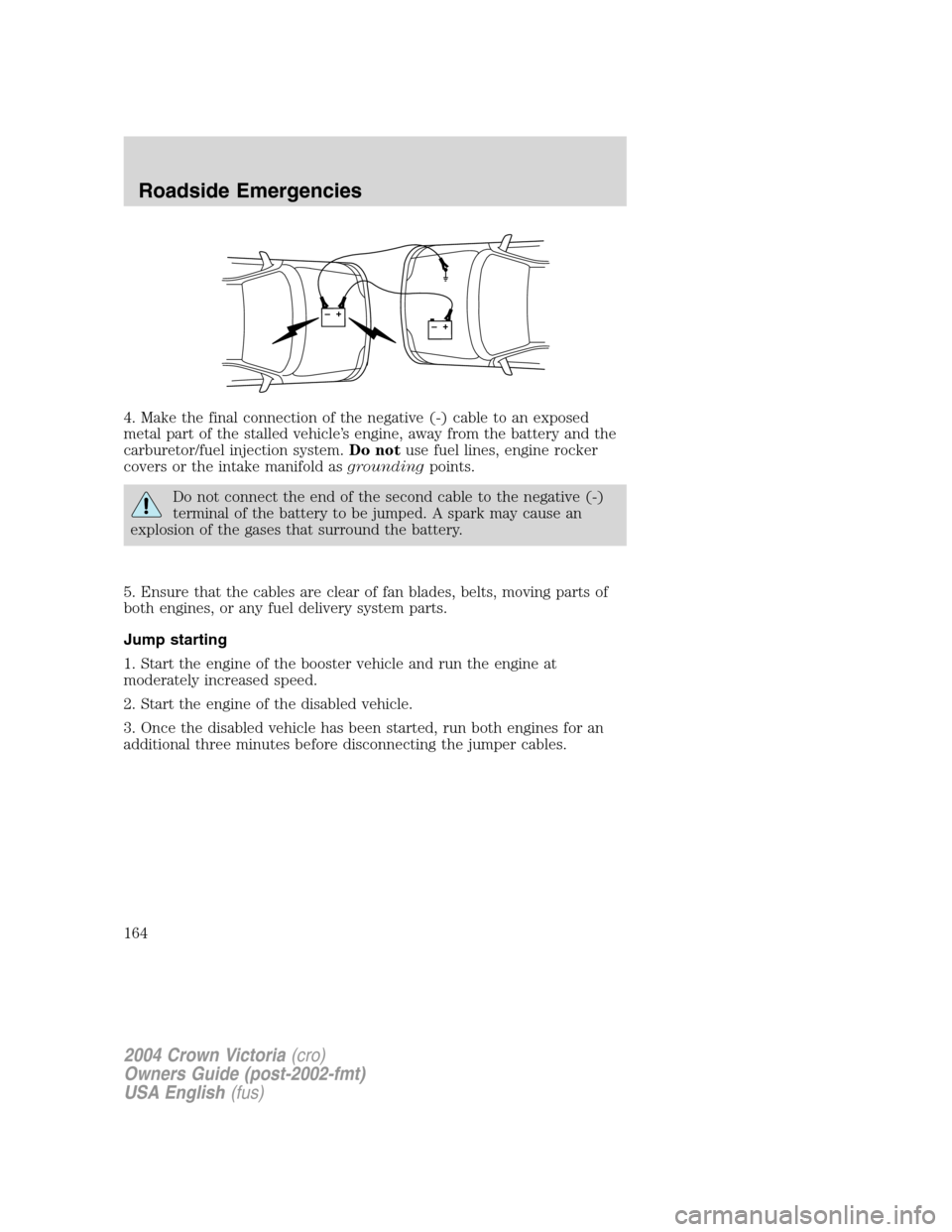
4. Make the final connection of the negative (-) cable to an exposed
metal part of the stalled vehicle’s engine, away from the battery and the
carburetor/fuel injection system.Do notuse fuel lines, engine rocker
covers or the intake manifold asgroundingpoints.
Do not connect the end of the second cable to the negative (-)
terminal of the battery to be jumped. A spark may cause an
explosion of the gases that surround the battery.
5. Ensure that the cables are clear of fan blades, belts, moving parts of
both engines, or any fuel delivery system parts.
Jump starting
1. Start the engine of the booster vehicle and run the engine at
moderately increased speed.
2. Start the engine of the disabled vehicle.
3. Once the disabled vehicle has been started, run both engines for an
additional three minutes before disconnecting the jumper cables.
+–+–
2004 Crown Victoria(cro)
Owners Guide (post-2002-fmt)
USA English(fus)
Roadside Emergencies
164
Page 166 of 248
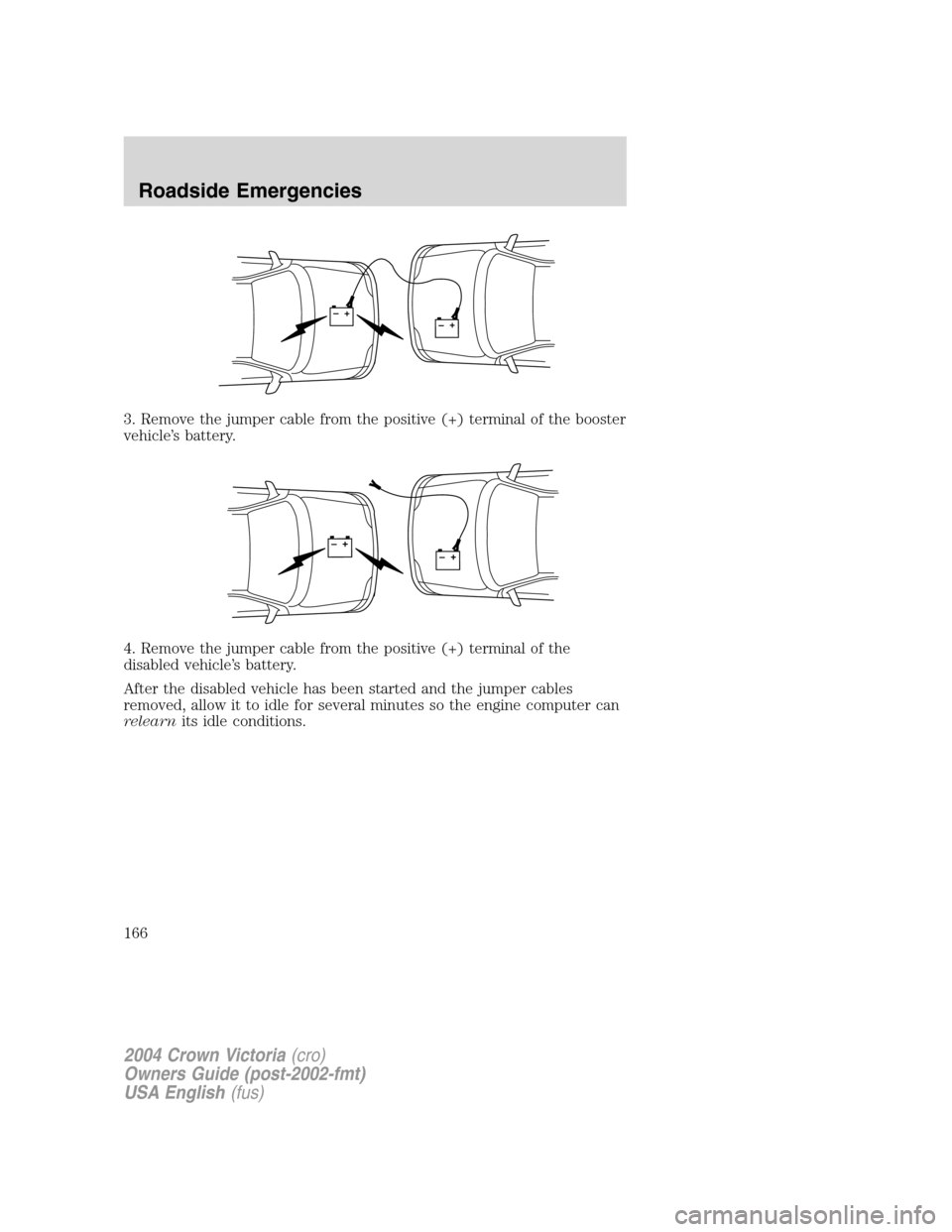
3. Remove the jumper cable from the positive (+) terminal of the booster
vehicle’s battery.
4. Remove the jumper cable from the positive (+) terminal of the
disabled vehicle’s battery.
After the disabled vehicle has been started and the jumper cables
removed, allow it to idle for several minutes so the engine computer can
relearnits idle conditions.
+–+–
+–+–
2004 Crown Victoria(cro)
Owners Guide (post-2002-fmt)
USA English(fus)
Roadside Emergencies
166