Page 136 of 388

Operation
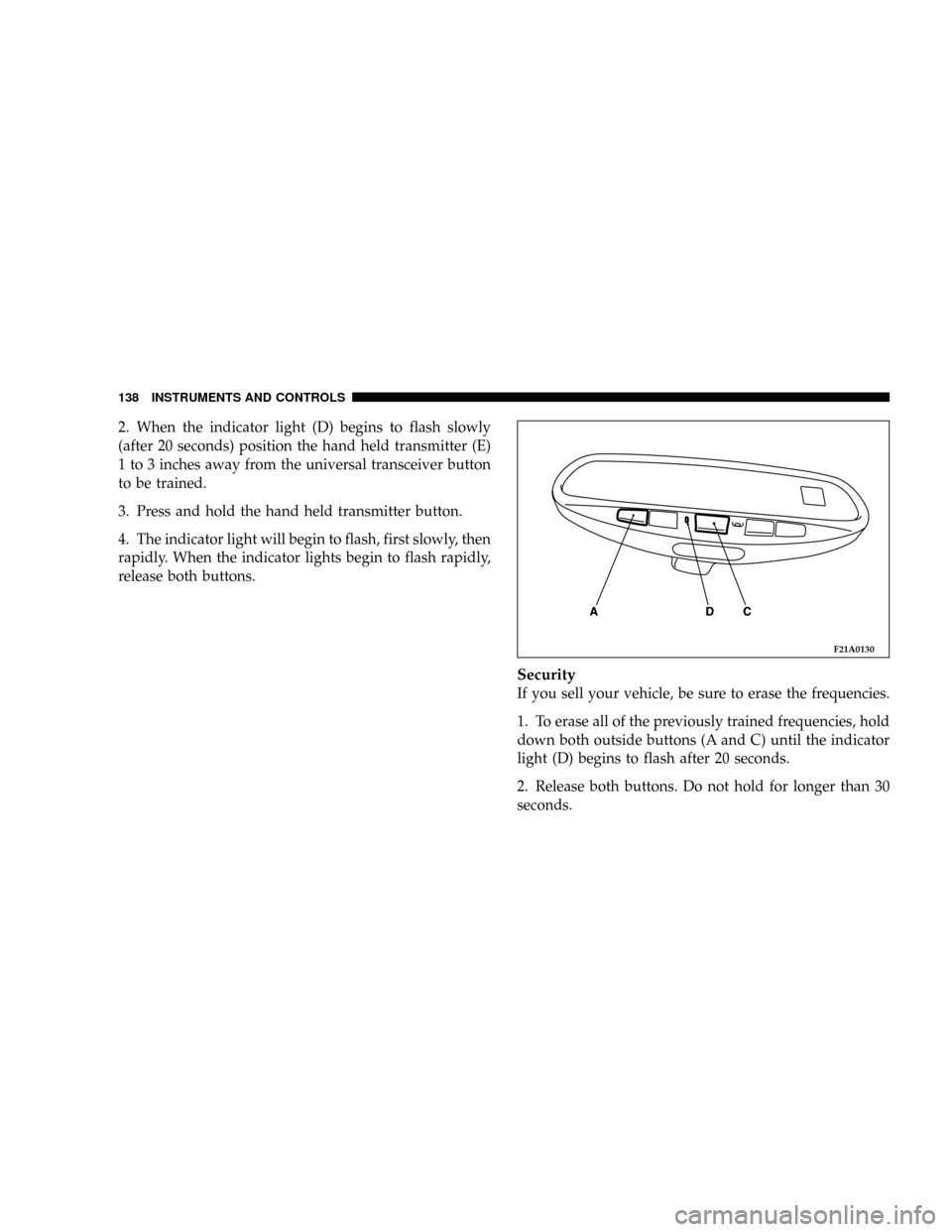
Press and hold the desired button (A, B or C) on the
universal transceiver until the garage door or other
device begins to operate. The indicator light (D) shows
that the signal is being transmitted. The hand held
transmitter (E) may also be used at any time.
NOTE:
²
If you have difficulty in programming, call toll-free for
customer assistance at 1-800-355-3515, or the internet
at www.homelink.jci.com.
²If your hand held transmitter appears to program the
universal transceiver, but your garage door or other
device does not operate, and your device was manu-
factured after 1996, your garage door opener or other
device may have a ªRolling Codeº system.To check if your device is protected by a ªRolling Codeº
system:
²Check the owner's manual for the device for mention
of ªRolling Codeº.
²The hand held transmitter appears to program the
universal transceiver but the universal transceiver
does not activate the garage door.
²Press and hold the programmed button on the univer-
sal transceiver. If the indicator light (D) flashes rapidly
and then stays on after 2 seconds, the device has the
ªRolling Codeº feature.
ªRolling Codeº Programming
On garage door openers with the ªRolling Codeº feature,
the transmitter code changes after each use to prevent the
copying of your code. Set the universal transceiver by
following these steps:
NOTE:
²
The assistance of a second person may make the
following programming procedure quicker and easier.
136 INSTRUMENTS AND CONTROLS
Page 137 of 388
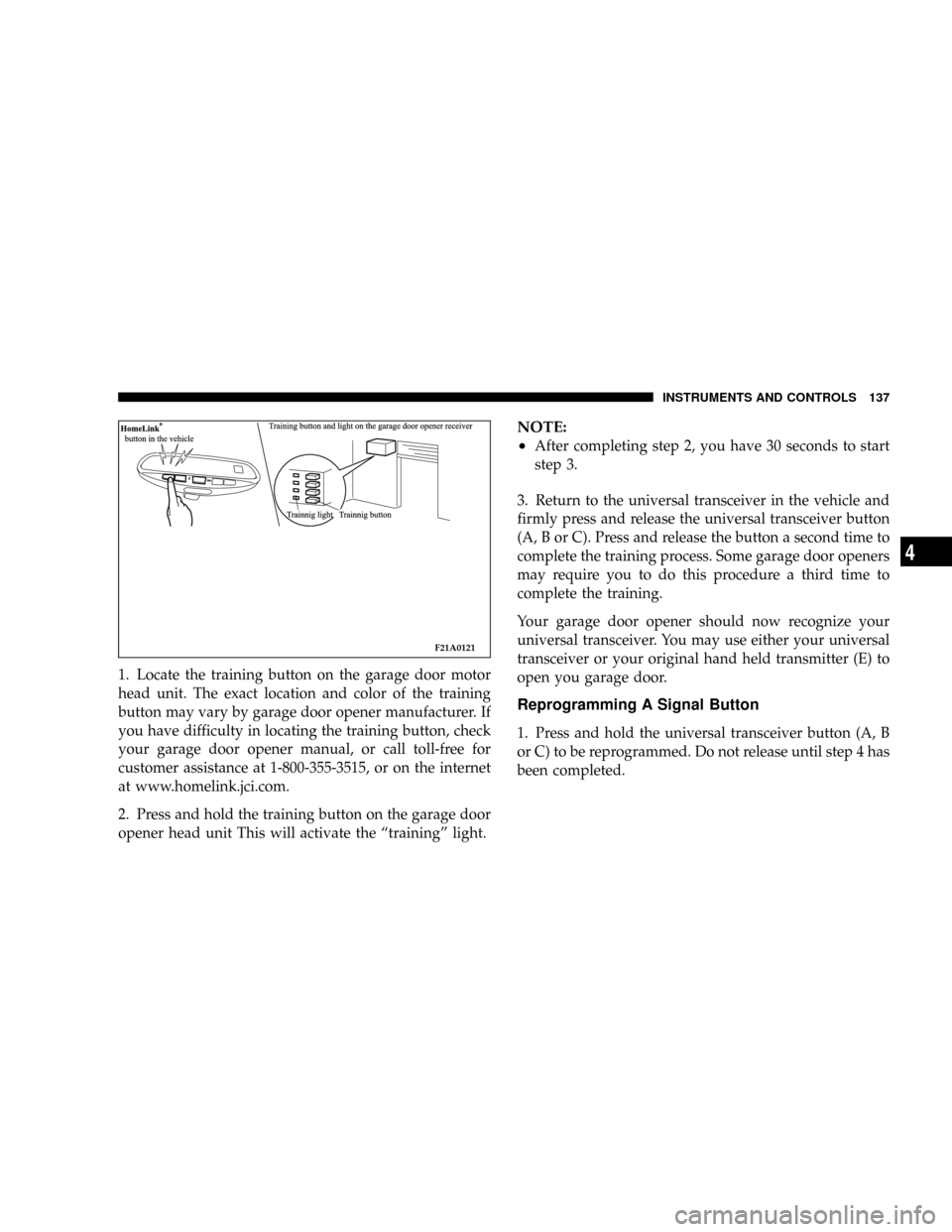
1. Locate the training button on the garage door motor
head unit. The exact location and color of the training
button may vary by garage door opener manufacturer. If
you have difficulty in locating the training button, check
your garage door opener manual, or call toll-free for
customer assistance at 1-800-355-3515, or on the internet
at www.homelink.jci.com.
2. Press and hold the training button on the garage door
opener head unit This will activate the ªtrainingº light.
NOTE:
²
After completing step 2, you have 30 seconds to start
step 3.
3. Return to the universal transceiver in the vehicle and
firmly press and release the universal transceiver button
(A, B or C). Press and release the button a second time to
complete the training process. Some garage door openers
may require you to do this procedure a third time to
complete the training.
Your garage door opener should now recognize your
universal transceiver. You may use either your universal
transceiver or your original hand held transmitter (E) to
open you garage door.
Reprogramming A Signal Button
1. Press and hold the universal transceiver button (A, B
or C) to be reprogrammed. Do not release until step 4 has
been completed.
F21A0121
INSTRUMENTS AND CONTROLS 137
4
Page 138 of 388
2. When the indicator light (D) begins to flash slowly
(after 20 seconds) position the hand held transmitter (E)
1 to 3 inches away from the universal transceiver button
to be trained.
3. Press and hold the hand held transmitter button.
4. The indicator light will begin to flash, first slowly, then
rapidly. When the indicator lights begin to flash rapidly,
release both buttons.
Security
If you sell your vehicle, be sure to erase the frequencies.
1. To erase all of the previously trained frequencies, hold
down both outside buttons (A and C) until the indicator
light (D) begins to flash after 20 seconds.
2. Release both buttons. Do not hold for longer than 30
seconds.
F21A0130
138 INSTRUMENTS AND CONTROLS
Page 142 of 388

NGear positions........................156
NDriving speed
(Vehicles with automatic transaxle).........157
NHolding on an upgrade.................157
NTransaxle reset mode...................158
mAutomatic transaxle Autostick
(if so equipped)
........................158
NSelector lever operation.................159
NIndicator lights.......................161
NSelector positions (Main gate).............162
NSelector positions Manual gate Autostick.....163
NHolding on an upgrade.................165
NTransaxle reset mode...................166
mManual transaxle (if so equipped)..........166
NTo start.............................167
NProper shift points.....................167NRecommended downshifting speed.........169
NDriving precautions....................169
mParking brake.........................169
mBrake pedal...........................171
mPower brakes.........................172
mBrake pad wear alarm...................172
mAnti-lock braking (ABS) system
(if so equipped)
........................173
NGeneral driving hints
(standard/anti-lock brakes)...............173
mSteering wheel tilt lock lever..............175
mPower steering........................176
mInside Day/Night rearview mirrors.........177
NElectrochromic inside rearview mirror
(if so equipped.......................178
NElectrochromic mirror operation
(if so equipped).......................179
142 STARTING AND DRIVING
Page 143 of 388
mCruise/speed control....................189
NTo activate...........................190
NTo deactivate.........................194
NTo resume the set speed.................195
mTraction control (if so equipped)...........196
mCatalytic converter.....................197
mVehicle preparation before driving..........199
NSeat belts and seats....................199
NDefrosters...........................199
NTires...............................199NLights..............................200
NFluid leaks..........................200
NDriver..............................200
mSafe driving techniques..................200
mDriving, alcohol and drugs...............201
mTips for driving in various conditions........201
mOperation during cold weather............202
mTrailer Towing.........................203
NWarranty Requirements.................203
STARTING AND DRIVING 143
5
Page 147 of 388

states adopting California emission standards, your ve-
hicle will operate satisfactorily on fuels meeting Federal
specifications, but emission control system performance
may be adversely affected.
Gasoline sold outside of California is permitted to have
higher sulfur levels which may affect the performance of
the vehicle's catalytic converter. This may cause the
Check Engine Light to illuminate. The manufacturer
recommends that you try a different brand of unleaded
gasoline having lower sulfur to determine if the problem
is fuel related prior to returning your vehicle to an
authorized dealer for service.
CAUTION!
If the Malfunction Indicator Light (Service Engine
Soon) is flashing, immediate service is required. See
the On Board Diagnostics paragraph in the Mainte-
nance section of this manual.
Materials Added to Fuel
All gasoline sold in the United States is required to
contain effective detergent additives. Use of additional
detergents or other additives is not needed under normal
conditions and would result in additional cost. Therefore
you should not have to add anything to the fuel.
Adding Fuel
NOTE:
The fuel tank filler tube has a restricting door
about 2 inches (50 mm) down from the opening. If fuel is
poured from a portable container, the container should
have a flexible nozzle long enough to force open the
restricting door.
CAUTION!
To avoid fuel spillage and overfilling, do not ªtop
offº the fuel tank after filling.
NOTE:When the fuel nozzle ªclicksº or shuts off, the
fuel tank is full.
STARTING AND DRIVING 147
5
Page 148 of 388
NOTE:Tighten the gas cap until you hear a ªclickingº
sound. This is an indication that the gas cap is properly
tightened.
The Malfunction Indicator Light (ªSERVICE ENGINE
SOONº) will come on if the gas cap is not properly
secured. Make sure that the gas cap is tightened each
time the vehicle is refueled.
WARNING!
A fire may result if gasoline is pumped into a
portable container that is inside of a vehicle. You
could be burned. Always place gas containers on the
ground while filling.
Fuel Filler Cap (Gas Cap)
The gas cap is behind the fuel filler door, on the passen-
ger's side of the vehicle. If the gas cap is lost or damaged,
be sure the replacement cap is for use with this vehicle.
CAUTION!
Damage to the fuel system or emission control
system could result from using an improper fuel
tank filler tube cap (gas cap). A poorly fitting cap
could let impurities into the fuel system.
CAUTION!
A poorly fitting gas cap may cause the Malfunction
Indicator Light (ªSERVICE ENGINE SOONº) to
turn on.
WARNING!
²Never have any smoking materials lit in or near
the vehicle when the gas cap is removed or the
tank filled.
²Never add fuel to the vehicle when the engine is
running.
148 STARTING AND DRIVING
Page 149 of 388

FUEL ECONOMY
Fuel economy is dependent on many factors. Your per-
sonal driving habits can have a significant effect on your
fuel economy. Several recommendations for achieving
maximum fuel economy are listed below.
1. When pulling away from traffic lights or stop signs,
accelerate slowly and smoothly.
2. When parked for even a short period, do not idle the
engine. Shut it off.
3. Plan your trips to avoid unnecessary stops.
4. Keep your tires inflated to the recommended pres-
sures.
5. For freeway driving, maintain a constant speed within
the posted limits when traffic, roadway and weather
conditions safely permit, for the best fuel economy.
6. Keep your air filter clean and your vehicle lubricated
according to the recommendations in this manual.
7. Keep your vehicle ªtuned-upº.
An out-of-tune engine wastes fuel and costs money.
8. Reduce excess vehicle load.
IGNITION SWITCH
LOCK
For vehicles with a manual transaxle, when removing the
key, push the key in at the ªACCº position and keep it
depressed until it is turned to the ªLOCKº position, and
remove the key.
For vehicles with an automatic transaxle: When remov-
ing the key, first set the gear selector lever to the ªPº
(PARK) position, and then turn the key to ªLOCKº and
remove it.
I21A0230
STARTING AND DRIVING 149
5