Page 202 of 388

over curbs or parking stop blocks. Always use caution
when traveling up or down sharp inclines as your
bumper may contact the road surface.
2. Maintain specified tire inflation pressures. Replace
tires before they are excessively worn.
3. If you plan to drive in another country, comply with
the vehicle registration laws and confirm the availability
of the correct fuel.
OPERATION DURING COLD WEATHER
1. Check the battery, including terminals and cables.
During extremely cold weather, the battery capacity will
decrease. Also, the battery power level may drop because
more power is needed for cold starting and operation.
Before driving the vehicle, check to see if the engine runs
at the proper speed and if the headlights are at their usual
intensity. Charge or replace the battery if necessary.
During cold weather, it is possible that a discharged
battery could freeze.
WARNING!
The battery gives off explosive hydrogen gas. Any
spark or flame can cause the battery to explode,
which could seriously injury or kill you.
Always wear protective clothes and a face shield
when doing battery maintenance, or let a skilled
technician do it.
2. Manual transaxles may be more difficult to shift
during cold weather operation. This is normal and shift
effort will become easier as the transaxle reaches a
normal operating temperature.
Maintain low-speed operation at first to allow the trans-
axle oil to be distributed to all lubrication points.
3. Check the engine antifreeze.
If there is a shortage of coolant due to leakage or engine
overheating, add high-quality ethylene glycol antifreeze
and water. The recommended ratio is about 50% water
and 50% anti-freeze. This ratio provides adequate corro-
sion, boiling, and freeze protection.
202 STARTING AND DRIVING
Page 205 of 388

FOR PLEASANT DRIVING
CONTENTS
mSun visors............................209
NTo adjust the sun visor position...........209
NVanity mirror........................210
mAccessory socket.......................211
mCup holder...........................212
mAccessory boxes.......................213
NGlove compartment....................214
NCenter console with lid..................215
NTrunk net (if so equipped)...............215
mElectronic digital clock...................216
NClock setting procedure.................216
mGeneral information about your radio.......216
NSignal transmission....................217NWeak reception (fading).................217
NReflections...........................217
NCross modulation......................218
NFM stereo reception....................218
NCauses of disturbances..................218
mWhip antenna.........................219
mAM Stereo & FM Stereo Radio With Graphic
Equalizer, Cassette Tape Player And CD Player
(if so equipped)
.......................219
NOperating Instructions - Radio Mode.......219
NPower Switch, Volume Control............220
NSeek Button (Radio Mode)...............220
NTuning.............................220
NBalance............................220
6
Page 206 of 388

NFade..............................220
NGraphic Equalizer.....................220
NAM/FM Selection.....................220
NScan Button.........................220
NTo Set The Radio Pushbutton Memory......221
NGeneral Information...................221
NTo Change From Clock To Radio Mode......221
NTape Player Operation..................221
NSeek Button.........................222
NFast Forward (FF).....................222
NRewind (RW)........................222
NTape Eject...........................222
NScan Button.........................222
NChanging Tape Direction................222
NMetal Tape Selection...................222
NPinch Roller Release...................222NNoise Reduction......................223
NOperation InstructionsÐCD Player.........223
NInserting The Compact Disc..............223
NSeek Button.........................223
NEJT CD (Eject) Button..................223
NFF/Tune/RW Button...................223
NProgram Button 4 (Random Play)..........224
NTape /CD Button.....................224
NTime Button.........................224
NScan Button.........................224
mCassette Tape And Player Maintenance......224
mAM/FM Stereo Radio With 4 Disc CD Changer
(if so equipped)
.......................225
NOperating Instructions - Radio Mode.......225
NPower Switch, Volume Control............225
NSeek Button (Radio Mode)...............226
206 FOR PLEASANT DRIVING
Page 207 of 388

NTuning.............................226
NBalance............................226
NFade..............................226
NTone Control........................226
NMODE Selection......................226
NPTY (Program Type) Selection.............226
NScan Button.........................226
NTo Set The Pushbutton Memory...........227
NTo Change From Clock To Radio Mode......227
NGeneral Information...................227
NOperating Instructions Ð CD Changer......227
NInserting the Compact Disc..............227
NSeek Button.........................228
NFF /Tune/ RW Button..................228
NRandom Play........................228
NRadio/CD Button.....................228NTime Button.........................228
NScan Button.........................228
NLoading The CD Changer...............228
NPlaying Discs........................229
NRemoving Discs From The CD Changer.....229
mSteering wheel remote control switches (if so
equipped)
...........................229
NHow to adjust the volume...............230
NTo listen to the audio system..............230
NTo listen to the radio...................230
NAutomatic tuning the radio...............230
NTo select the preset memory..............230
NTo listen to a tape.....................231
NTo listen to a CD......................231
NHandling of compact discs...............232
mRadio operation and cellular phones........234
FOR PLEASANT DRIVING 207
6
Page 214 of 388
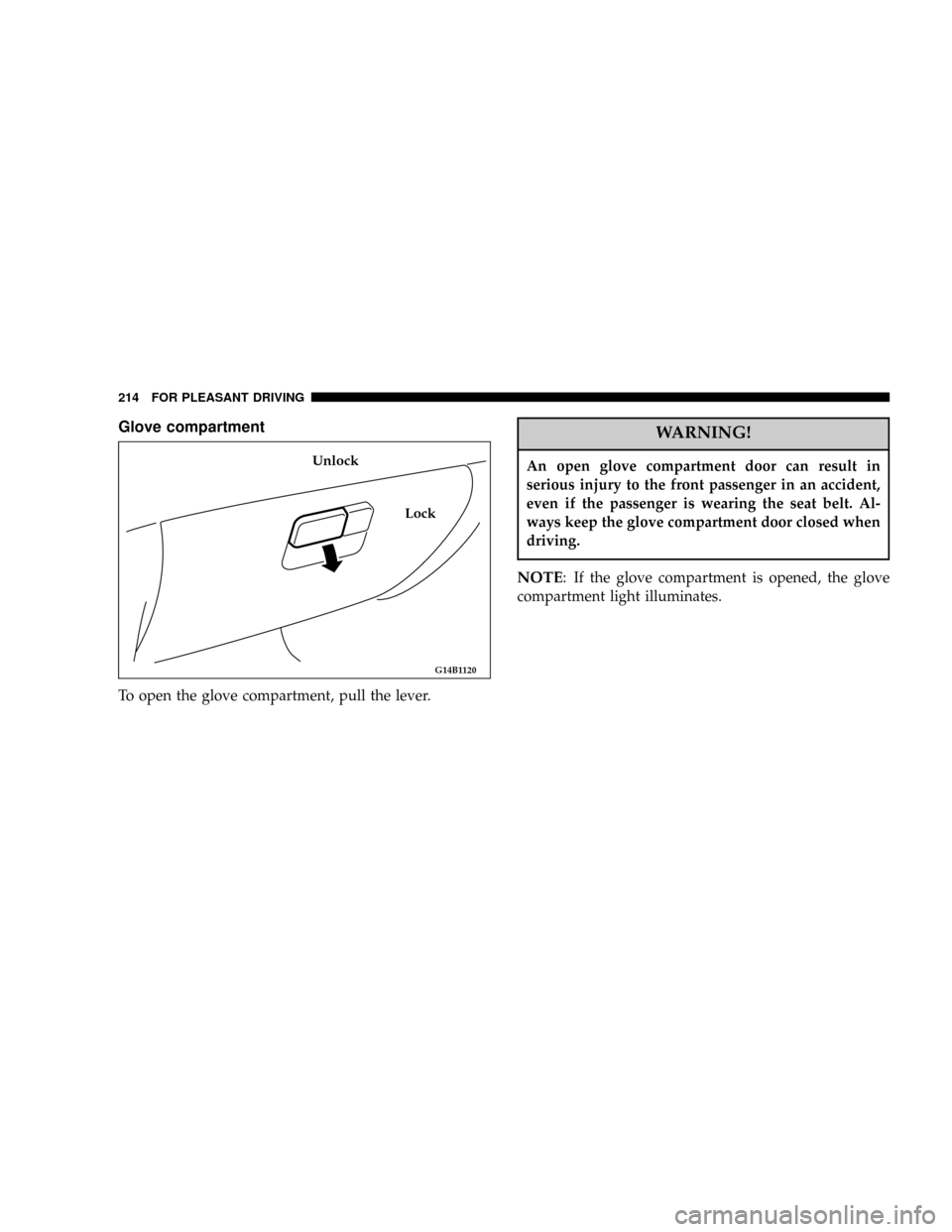
Glove compartment
To open the glove compartment, pull the lever.
WARNING!
An open glove compartment door can result in
serious injury to the front passenger in an accident,
even if the passenger is wearing the seat belt. Al-
ways keep the glove compartment door closed when
driving.
NOTE: If the glove compartment is opened, the glove
compartment light illuminates.
G14B1120
Lock Unlock
214 FOR PLEASANT DRIVING
Page 216 of 388
ELECTRONIC DIGITAL CLOCK
The clock and radio each use the display panel built into
the radio. A digital readout indicates the time in hours
and minutes whenever the ignition switch is in the ON or
ACC position.
Clock setting procedure
1. Using the point of a ballpoint pen or similar object,
press either the hour (H) or minute (M) buttons on the
radio. The time setting will increase each time you press
the button.
2. Press any other button to exit from the clock setting
mode.
GENERAL INFORMATION ABOUT YOUR RADIO
A vehicle is not an ideal place to listen to the radio,
because the vehicle moves, and reception conditions are
constantly changing. Buildings, terrain, signal distance
and noise from other vehicles are all working against
good reception.
Please read the following information regarding radio
reception, especially those regarding stereo transmission.
H12G0010
FM AM
25 to 40 mile radius
(40 to 64 Km)100 mile radius
(160 Km)
216 FOR PLEASANT DRIVING
Page 217 of 388
Signal transmission
FM signals do not follow the earth's surface nor are they
reflected by the upper atmosphere. For this reason, FM
broadcasts cannot be received over long distances.
AM signals follow the earth's surface and are reflected by
the upper atmosphere. For this reason, AM broadcasts
can be received over longer distances.
Weak reception (fading)
Because of the limited range of FM transmissions and the
way FM waves spread, fading usually occurs with FM
reception.
When the broadcast is blocked by mountains or similar
obstructions, reception disturbance may result.
Reflections
The reason why one can hear FM but not AM in parking
garages, under bridges etc., is that FM signals unlike AM
signals, are reflected by solid objects such as buildings,
etc.
Because FM signals are easily reflected by buildings, this
can also cause reception disturbances.
H12G0020
FOR PLEASANT DRIVING 217
6
Page 219 of 388
FM reception is not as sensitive to electrical disturbances
as AM. AM reception is sensitive to electrical distur-
bances such as power lines, lightning and other types of
similar electrical phenomena.
WHIP ANTENNA
To remove the whip antenna, turn it counterclockwise.
CAUTION!
It is recommended to remove the whip antenna
before going into an automatic vehicle wash or
passing under places with a low height clearance.
AM STEREO & FM STEREO RADIO WITH
GRAPHIC EQUALIZER, CASSETTE TAPE PLAYER
AND CD PLAYER (IF SO EQUIPPED)
Operating Instructions - Radio Mode
NOTE:
Power to operate the radio is supplied through
the ignition switch. It must be in the ON or ACC position
to operate the radio.
H11A3220
FOR PLEASANT DRIVING 219
6