2004 DODGE DAKOTA automatic transmission fluid
[x] Cancel search: automatic transmission fluidPage 101 of 300

12. Seat Belt Reminder Light
This light comes on for several seconds after the
ignition is turned ON as a reminder to ªbuckle
up.º This light will remain on as long as the seat
belt remains unbuckled. If this light flashes, it indi-
cates a fault in the airbag system. Have the system
checked by an authorized dealer.
13. Low Washer Fluid Indicator
This light comes on when the washer fluid level falls
below approximately 1/4 full. The light will remain on
until fluid is added and ignition switch is cycled.
14. Brake System Warning Light
This light will light when the ignition key is turned to the
ON position and will remain on for a few seconds. If the
light stays on, it may be an indication that the parking
brake has not been released, or there is a low brake fluid
level. If the light remains on when the parking brake has
been disengaged, and the fluid level is at the full mark on
the master cylinder reservoir, it indicates a possible brake
hydraulic system malfunction. In this case, the light will
remain on until the cause is corrected. If the parking
brake is applied, the light will flash when the gearposition is out of park for automatic transmissions, or the
engine RPM is greater than 0 for manual transmissions.
If brake failure is indicated, immediate repair is neces-
sary.Operating the vehicle in this condition is danger-
ous!
15. SERVICE 4WD Indicator
This light monitors the electric shift 4WD
system. This light will come on when the
ignition key is turned to the ON position and
will stay on for 2 seconds. If the light stays
on or comes on during driving, it means that the 4WD
system is not functioning properly and that service is
required.
16. Check Gages
This light illuminates when the Voltmeter, En-
gine Oil Pressure or Engine Coolant Tempera-
ture gages indicate a reading either too high or too
low. Examine the gages carefully, and follow the
instructions above for each indicated problem.
NOTE:
When the ignition switch is turned to OFF, the
Fuel Gage, Voltmeter, Oil Pressure and Engine Coolant
INSTRUMENT PANEL AND CONTROLS 101
4
Page 149 of 300

The ªO/D OFFº feature must be selected, if desired, each
time the engine is started.
NOTE:If the vehicle is started in extremely cold
temperatures, the transmission may not shift into Over-
drive and will automatically select the most desirable
gear for operation at this temperature. Normal operation
will resume when the transmission fluid temperature has
risen to a suitable level. Refer also to the Note under
torque converter clutch, later in this section.
If the transmission temperature gets extremely hot, the
transmission will automatically select the most desir-
able gear for operation at this temperature. If the
transmission temperature becomes hot enough the
O/D OFF and/or TRANS TEMP light(s) may illumi-
nate and the transmission may downshift out of
Overdrive until the transmission cools down. After
cooldown, the transmission will resume normal op-
eration.
When To Lock Out Overdrive
When driving in hilly areas, towing a trailer, carrying a
heavy load, or whenever frequent transmission shifting
occurs, press the ªO/D OFFº button. This will improve
performance and reduce the potential for transmission
overheating or failure due to excessive shifting.
Torque Converter Clutch
A feature designed to improve fuel economy is included
in all automatic transmissions. A clutch within the torque
converter engages automatically at a calibrated speed at
light throttle. It engages at higher speeds under heavier
acceleration. This may result in a slightly different feeling
or response during normal operation in high gear. When
STARTING AND OPERATING 149
5
Page 150 of 300

the vehicle speed drops below a calibrated speed, or
during acceleration, the clutch automatically and
smoothly disengages. The feature is operational in Over-
drive and in Drive.
NOTE:The torque converter clutch will not engage
until the transmission fluid and engine coolant are warm
[usually after 1-3 miles (1.6 - 4.8 km) of driving]. Because
the engine speed is higher when the torque converter
clutch is not engaged, it may seem as if the transmission
is not shifting into Overdrive when cold. This is normal.
Pressing the O/D OFF button, when the transmission is
sufficiently warm, will demonstrate that the transmission
is able to shift into and out of overdrive.
NOTE:If the vehicle has not been driven in several
days, the first few seconds of operation after shifting the
transmission into gear may seem sluggish. This is due to
the fluid partially draining from the torque converter into
the transmission. This condition is normal and will not
cause damage to the transmission. The torque converter
will refill within five seconds of shifting from Park into
any other gear position.
Manual Transmission
NOTE:
The parking brake should be engaged before
leaving the vehicle, especially on an incline.
Use each gear in numerical order - do
not skip a gear. Be sure the transmission
is in FIRST gearÐ not THIRD, when
starting from a standing position; other-
wise damage to the clutch can result
from starting in THIRD.
For most city driving you will find it easier to use only
the lower gears. For steady highway driving with light
accelerations, 5th gear is recommended. To shift into 5th
gear, move the shift lever to the right beyond the spring
pressure point and push it forward. When shifting from
5th to 4th gear, pull the lever down toward you in one
motion. Do not pull the lever sharply left as you may
shift accidentally into 2nd gear and damage the trans-
mission or engine.
150 STARTING AND OPERATING
Page 220 of 300

NWindshield Wiper Blades................235
NWindshield Washers...................236
NExhaust System......................236
NCooling System.......................237
NEmission Related Components............241
NBrake System........................243
NClutch Hydraulic System................245
NManual Transmission..................245
NAutomatic Transmission................245
NTransfer Case........................248
NAxles..............................248
NSelection Of Lubricating Grease...........248
NAppearance Care And Protection From
Corrosion...........................249
mPower Distribution Center...............252
mFuse Block...........................253
mVehicle Storage........................254
mReplacement Light Bulbs................254
mBulb Replacement......................255
NHeadlights..........................255
NParking/Turn Signal Lights..............256
NRear Side Marker, Tail Lights, Turn Signals
And Backup Lights Ð Replacement........256
NLicense Lights........................257
NCenter High-Mounted Stoplight...........257
NFog Lights..........................257
mFluids And Capacities...................258
mRecommended Fluids, Lubricants And
Genuine Parts
.........................259
NEngine.............................259
NChassis............................260
220 MAINTAINING YOUR VEHICLE
Page 245 of 300
WARNING!
Worn brake hoses can burst and cause brake failure.
You could have an accident. If you see any sign of
cracking, scuffing, or worn spots, have the brake
hoses replaced immediately.
Clutch Hydraulic System
The clutch hydraulic system is a sealed maintenance free
system. In the event of leakage or other malfunction, the
system must be replaced.
Manual Transmission
Fluid Level Check
This fluid should be checked whenever other underhood
services are performed. The fluid level is checked by
removing the fill plug. If the level of the lubricant is more
than 1/49(6.35 mm) below the bottom of the filler hole
while the vehicle is level, enough lubricant should be
added to bring the level to the bottom of the filler hole.
NV-3500 5-Speed Transmission Lubricant Selection
These transmissions are filled with manual transmission
fluid at the factory. This fluid does not require periodic
changing. If it becomes necessary to add or change the
fluid in these transmissions, Refer to Recommended
Fluids, Lubricants and Genuine Parts for correct fluid
type.
Automatic Transmission
Fluid Level Check ± 3.7/4.7L Engine
Check the fluid level while the transmission is at normal
operating temperature 180ÉF (82ÉC). This occurs after at
least 15 miles (25 km) of driving. At normal operating
temperature the fluid cannot be held comfortably be-
tween the fingertips.
To check the automatic transmission fluid level properly,
the following procedure must be used:
1. Operate the engine at idle speed and normal operating
temperature.
2. The vehicle must be on level ground.
MAINTAINING YOUR VEHICLE 245
7
Page 247 of 300
7. Check for leaks. Release parking brake.
To prevent dirt and water from entering the transmission
after checking or replenishing fluid, make certain that the
dipstick cap is properly reseated. It is normal for the
dipstick cap to spring back slightly from its fully seated
position, as long as its seal remains engaged in the
dipstick tube.
Automatic Transmission Fluid And Filter Change
To obtain best performance and long life for automatic
transmissions, the manufacturer recommends that they
be given regular maintenance service by an Authorized
Dodge Dealer or Service Center. It is important that the
transmission be adjusted periodically, the fluid be main-
tained at the correct level, and that it be drained and
refilled as specified.
It is important that proper lubricant is used in the
transmission. Refer to Recommended Fluids, Lubricants
and Genuine Parts for correct fluid type. It is important
that the transmission fluid be maintained at the pre-
scribed level using the recommended fluid.
CAUTION!
Using a transmission fluid other than the manufac-
turers recommended fluid may cause deterioration
in transmission shift quality and/or torque converter
shudder. Using a transmission fluid other than the
manufacturers recommended fluid will result in
more frequent fluid and filter changes. Refer to
Recommended Fluids, Lubricants and Genuine Parts
for correct fluid type.
Refer to the ªMaintenance Schedulesº section for the
proper service intervals for your type of driving.
If the transmission is disassembled for any reason, the
fluid and filter should be changed, and the bands ad-
justed (if equipped).
Special Additives
The manufacturer strongly recommends against the ad-
dition of any fluid additives to the transmission. Excep-
tion to this policy is the use of special dyes to aid in
detecting fluid leaks. The use of transmission sealers
should be avoided, since they may adversely affect seals.
MAINTAINING YOUR VEHICLE 247
7
Page 260 of 300
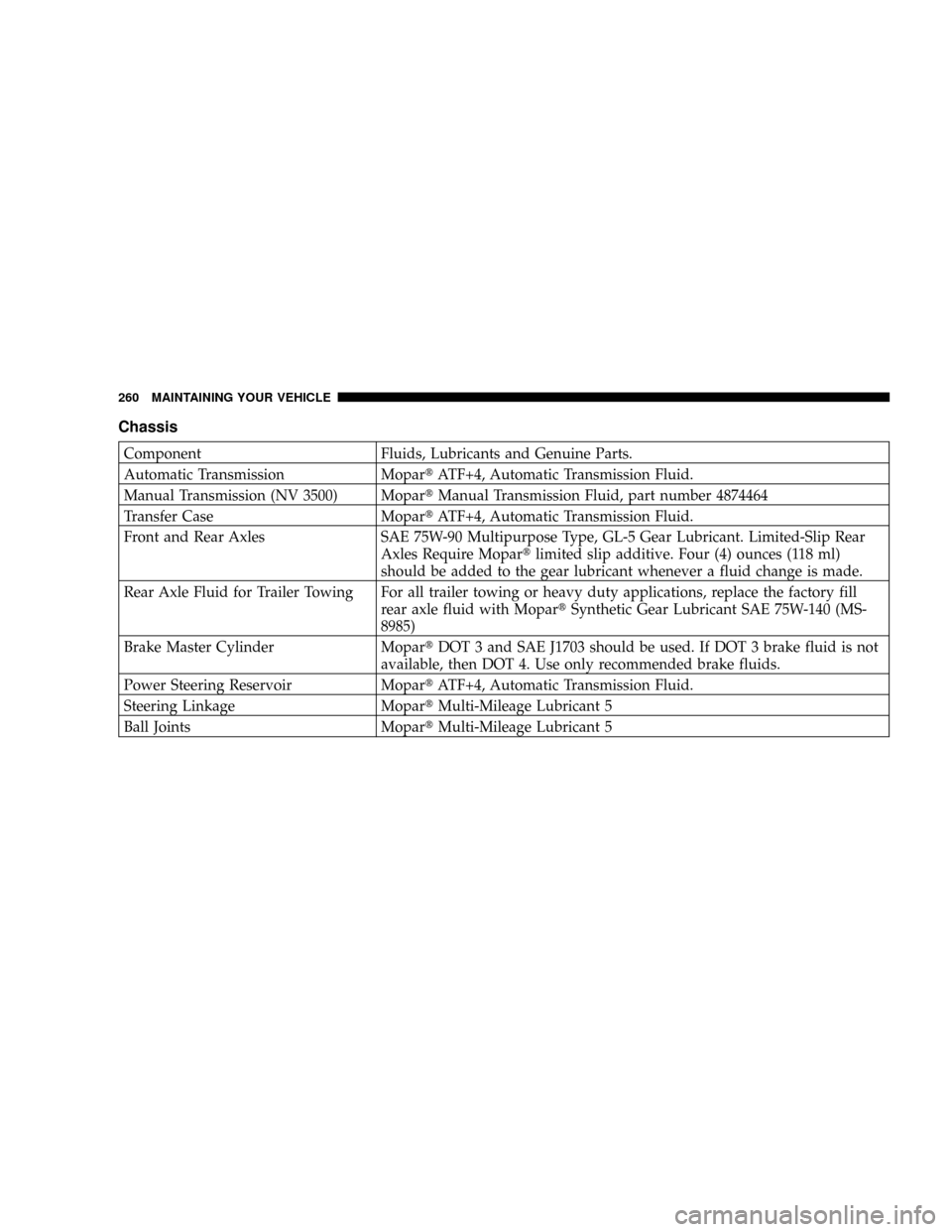
Chassis
Component Fluids, Lubricants and Genuine Parts.
Automatic Transmission MopartATF+4, Automatic Transmission Fluid.
Manual Transmission (NV 3500) MopartManual Transmission Fluid, part number 4874464
Transfer Case MopartATF+4, Automatic Transmission Fluid.
Front and Rear Axles SAE 75W-90 Multipurpose Type, GL-5 Gear Lubricant. Limited-Slip Rear
Axles Require Mopartlimited slip additive. Four (4) ounces (118 ml)
should be added to the gear lubricant whenever a fluid change is made.
Rear Axle Fluid for Trailer Towing For all trailer towing or heavy duty applications, replace the factory fill
rear axle fluid with MopartSynthetic Gear Lubricant SAE 75W-140 (MS-
8985)
Brake Master Cylinder MopartDOT 3 and SAE J1703 should be used. If DOT 3 brake fluid is not
available, then DOT 4. Use only recommended brake fluids.
Power Steering Reservoir MopartATF+4, Automatic Transmission Fluid.
Steering Linkage MopartMulti-Mileage Lubricant 5
Ball Joints MopartMulti-Mileage Lubricant 5
260 MAINTAINING YOUR VEHICLE
Page 264 of 300

CAUTION!
Failure to perform the required maintenance items
may result in damage to the vehicle.
At Each Stop for Fuel
²
Check the engine oil level about 5 minutes after a fully
warmed engine is shut off. Checking the oil level while
the vehicle is on level ground will improve the accu-
racy of the oil level reading. Add oil only when the
level is at or below the ADD or MIN mark.
²Check the windshield washer solvent and add if
required.
Once a Month
²
Check tire pressure and look for unusual wear or
damage.
²Inspect the battery and clean and tighten the terminals
as required.
²Check the fluid levels of coolant reservoir, brake
master cylinder, and transmission and add as needed.
²Check all lights and all other electrical items for correct
operation.
At Each Oil Change
²
Change the engine oil filter.
²Inspect the exhaust system.
²Inspect the brake hoses.
²Inspect the CV joints (if equipped) and front suspen-
sion components.
²Check the automatic transmission fluid level (if
equipped).
²Check the manual transmission fluid level (if
equipped).
²Check the coolant level, hoses, and clamps.
Tire Rotation
²
Rotate the tires every 6,000 miles (10 000 km).
264 MAINTENANCE SCHEDULES
8
M
A
I
N
T
E
N
A
N
C
E
S
C
H
E
D
U
L
E
S