2004 DODGE DAKOTA tires
[x] Cancel search: tiresPage 191 of 300

VEHICLE LOADING
Certification Label
As required by National Highway Traffic Safety Admin-
istration Regulations, your vehicle has a certification
label affixed to the driver's side door or pillar.
This label contains the month and year of manufacture,
Gross Vehicle Weight Rating (GVWR), Gross Axle Weight
Rating (GAWR) front and rear, and Vehicle Identification
Number (VIN). A Month-Day-Hour (MDH) number is
included on this label and shows the Month, Day, andHour of manufacture. The bar code that appears on the
bottom of the label is your Vehicle Identification Number
(VIN).
Gross Vehicle Weight Rating (GVWR)
The GVWR is the total permissible weight of your vehicle
including driver, passengers, vehicle, options, and cargo.
The label also specifies maximum capacities of front and
rear axle systems. Total load must be limited so that
GVWR is not exceeded.
Payload
The payload of a vehicle is defined as the allowable load
weight a truck can carry including the weight of the
driver, all passengers, options, and cargo.
Gross Axle Weight Rating (GAWR)
The GAWR is the maximum permissible load on the front
and rear axles. The load must be distributed in the cargo
area so that the GAWR of each axle is not exceeded.
Each axle GAWR is determined by the component in the
system with the lowest load carrying capacity (axle,
springs, tires, or wheels).
STARTING AND OPERATING 191
5
Page 192 of 300

Heavier axles or suspension components sometimes
specified by purchasers for increased durability do not
necessarily increase the vehicle's GVWR.
Tire Size
This is the minimum allowable tire size for your vehicle.
Replacement tires must be equal to the load capacity of
this tire size.
Rim Size
This is the rim size that is appropriate for the tire size
listed.
Inflation Pressure (Cold)
This is the cold tire inflation pressure for your vehicle for
all loading conditions up to full GAWR.
Curb Weight
The curb weight of a vehicle is defined as the total weight
of the vehicle with all fluids, including vehicle fuel, at full
capacity conditions, and with no occupants or cargo
loaded into the vehicle. The front and rear curb weight
values are determined by weighing your vehicle on a
commercial scale before any occupants or cargo are
added.
Loading
The actual total weight and the weight of the front and
rear of your vehicle at the ground can best be determined
by weighing it when it is loaded and ready for operation.
The entire vehicle should first be weighed on a commer-
cial scale to insure that the GVWR has not been exceeded.
The weight on the front and rear of the vehicle should
then be determined separately to be sure that the load is
properly distributed over front and rear axle. Weighing
the vehicle may show that the GAWR of either the front
or rear axles has been exceeded but the total load is
within the specified GVWR. If so, weight must be shifted
from front to rear or rear to front as appropriate until the
specified weight limitations are met.
Store heavier items down low and be sure that the weight
is distributed equally. Stow all loose items securely before
driving.
Improper weight distribution can have an adverse effect
on the way your vehicle steers and handles and the way
the brakes operate.
192 STARTING AND OPERATING
Page 197 of 300

Wheel9style trailer, this range of loading on the9King
Pin9should be between 15% and 25%.) Loads balanced
over the wheels or biased toward9heavier in the rear9
can cause the trailer to sway severely side to side
which will cause loss of control of vehicle and trailer.
Failure to load trailers heavier in front is the cause of
many trailer accidents.
²Donotinterconnect the hydraulic brake system of
your vehicle with that of the trailer. This could cause
inadequate braking and possible personal injury.
²Trailer brakes are recommended for trailers over 1,000
lbs. (454 kg) and required for trailers in excess of 2,000
lbs. (907 kg).
²Use an approved trailer harness and connector. If a
hitch is ordered, the proper wiring will be provided.
²When hauling cargo or towing a trailer, do not over-
load your vehicle or trailer. Overloading can cause a
loss of control, poor performance or damage to brakes,
axle, engine, transmission, steering, suspension, chas-
sis structure or tires.
²Make certain that the load is secured in the trailer and
will not shift during travel. When trailering cargo that
cannot be fully secured, dynamic load shifts can occur
that may be difficult for the driver to control.
²All trailer hitches should be professionally installed on
your vehicle.
²Safety chains must always be used between your
vehicle and trailer.
²Connect trailer lighting and brakes using factory har-
nesses only. Do not cut or splice any wiring to the
brake circuits.
Trailer and Tongue Weight
Gross Trailer Weight (GTW) means the weight of the
trailer plus the weight of all cargo and equipment loaded
on the trailer when in actual underway towing condition.
The recommended way to measure GTW is to put your
fully loaded trailer on a vehicle scale. The entire weight
of the trailer must be supported by the scale.
Tongue Weight is the weight placed on the vehicle's
trailer hitch by the trailer. Always load a trailer with 60%
STARTING AND OPERATING 197
5
Page 206 of 300

TRACTION
When driving on wet or slushy roads, it is possible for a
wedge of water to build up between the tire and road
surface. This is known as hydroplaning and may cause
partial or complete loss of vehicle control and stopping
ability. To reduce this possibility, the following precau-
tions should be observed:
1. Slow down during rainstorms or when roads are
slushy.
2. Slow down if road has standing water or puddles.
3. Replace tires when tread wear indicators first become
visible.
4. Keep tires properly inflated.
5. Maintain sufficient distance between your vehicle and
the car in front to avoid a collision in a sudden stop.
EQUIPMENT IDENTIFICATION PLATE
The equipment Identification Plate is located on the hood
inner surface.
The following information about your vehicle is dis-
played on this plate: Model, Wheelbase, Vehicle Identifi-
cation Number, Truck Order Number, and code numbers
with descriptions of all production and special equip-
ment on the truck as shipped from the factory.
NOTE:Always refer to the Equipment Identification
Plate When Ordering Parts.
206 STARTING AND OPERATING
Page 209 of 300
WARNING!
Remove the gas cap slowly to prevent fuel spray
from the filler neck which may cause injury.
The volatility of present gasolines may cause a build
up of pressure in the fuel tank that may increase
while you drive. This pressure can result in a spray
of gasoline and/or vapors when you remove the cap
from a hot vehicle. Removing the cap slowly allows
the pressure to vent and prevents fuel spray.
Never allow any lit smoking materials near the
vehicles while removing the cap or filling the tank.
Never add fuel to the vehicle when the engine is
running.
CHANGING A FLAT TIRE
Jack Location
The jack, jack drive tube, 2 tube extensions, and wheel
wrench are located behind the seat on the passenger's
side of the vehicle.
WARNING!
The jack is designed as a tool for changing tires only.
The jack should not be used to lift the vehicle for
service purposes, unless suitable supports are placed
under the vehicle as a safety measure. The vehicle
should be jacked on a firm level surface only. Avoid
ice or slippery areas.
²In the Regular Cab the jack and tools are stowed under
a formation in the carpet behind the passenger seat.
²In the Quad Cab the jack and tools are stowed under
the rear seat. Lift the passenger side rear seat cushion
to gain access to this area.
WHAT TO DO IN EMERGENCIES 209
6
Page 211 of 300
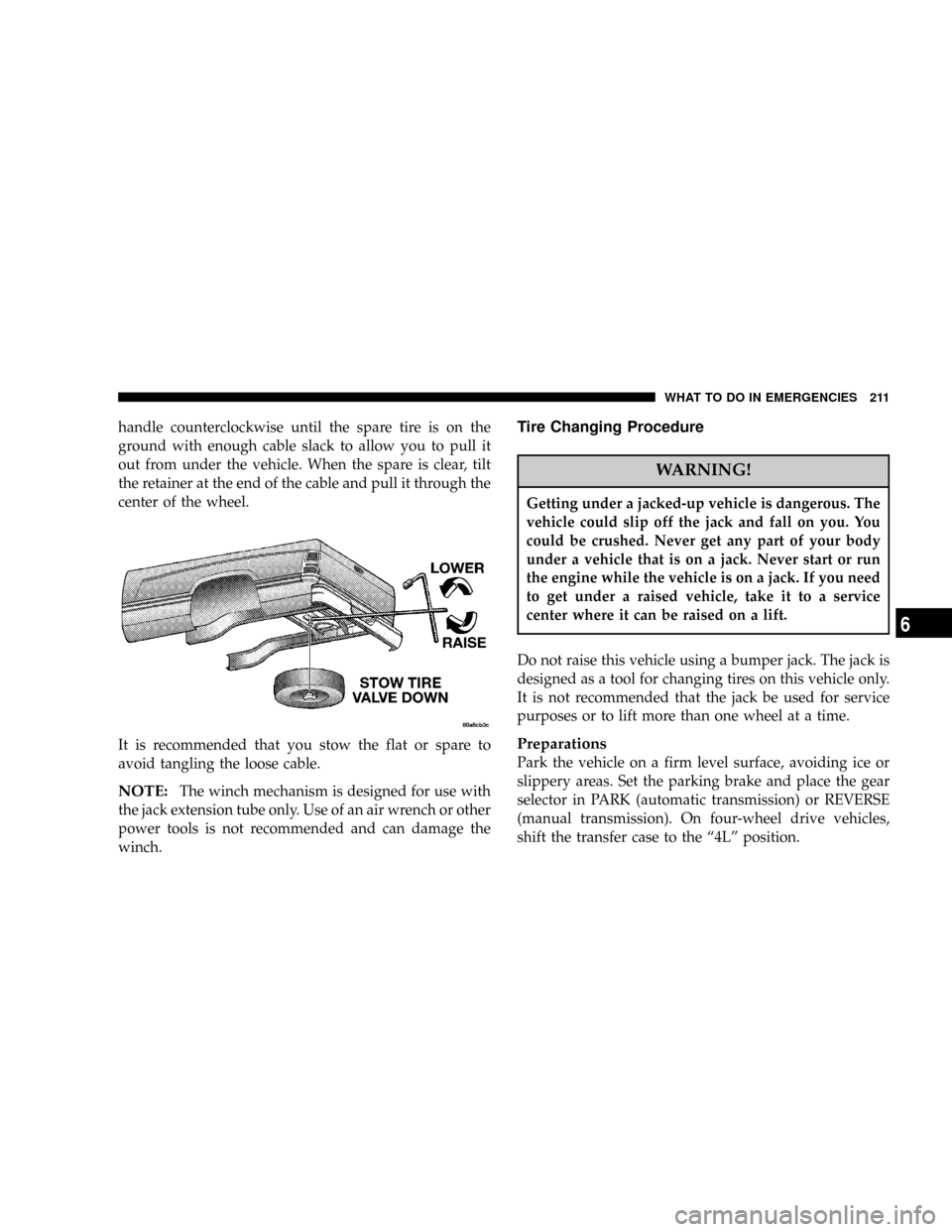
handle counterclockwise until the spare tire is on the
ground with enough cable slack to allow you to pull it
out from under the vehicle. When the spare is clear, tilt
the retainer at the end of the cable and pull it through the
center of the wheel.
It is recommended that you stow the flat or spare to
avoid tangling the loose cable.
NOTE:The winch mechanism is designed for use with
the jack extension tube only. Use of an air wrench or other
power tools is not recommended and can damage the
winch.
Tire Changing Procedure
WARNING!
Getting under a jacked-up vehicle is dangerous. The
vehicle could slip off the jack and fall on you. You
could be crushed. Never get any part of your body
under a vehicle that is on a jack. Never start or run
the engine while the vehicle is on a jack. If you need
to get under a raised vehicle, take it to a service
center where it can be raised on a lift.
Do not raise this vehicle using a bumper jack. The jack is
designed as a tool for changing tires on this vehicle only.
It is not recommended that the jack be used for service
purposes or to lift more than one wheel at a time.
Preparations
Park the vehicle on a firm level surface, avoiding ice or
slippery areas. Set the parking brake and place the gear
selector in PARK (automatic transmission) or REVERSE
(manual transmission). On four-wheel drive vehicles,
shift the transfer case to the ª4Lº position.
WHAT TO DO IN EMERGENCIES 211
6
Page 264 of 300

CAUTION!
Failure to perform the required maintenance items
may result in damage to the vehicle.
At Each Stop for Fuel
²
Check the engine oil level about 5 minutes after a fully
warmed engine is shut off. Checking the oil level while
the vehicle is on level ground will improve the accu-
racy of the oil level reading. Add oil only when the
level is at or below the ADD or MIN mark.
²Check the windshield washer solvent and add if
required.
Once a Month
²
Check tire pressure and look for unusual wear or
damage.
²Inspect the battery and clean and tighten the terminals
as required.
²Check the fluid levels of coolant reservoir, brake
master cylinder, and transmission and add as needed.
²Check all lights and all other electrical items for correct
operation.
At Each Oil Change
²
Change the engine oil filter.
²Inspect the exhaust system.
²Inspect the brake hoses.
²Inspect the CV joints (if equipped) and front suspen-
sion components.
²Check the automatic transmission fluid level (if
equipped).
²Check the manual transmission fluid level (if
equipped).
²Check the coolant level, hoses, and clamps.
Tire Rotation
²
Rotate the tires every 6,000 miles (10 000 km).
264 MAINTENANCE SCHEDULES
8
M
A
I
N
T
E
N
A
N
C
E
S
C
H
E
D
U
L
E
S
Page 288 of 300

Adding Engine Coolant (Antifreeze)......... 239
Adding Fuel........................186,208
Air Conditioner Maintenance.............. 233
Air Conditioning....................... 134
Air Conditioning, Operating Tips........135,137
Air Conditioning Refrigerant.............. 234
Air Conditioning System................. 134
Air Pressure, Tires...................176,182
Airbag...........................31,34,102
Airbag Light........................... 38
Airbag On/Off Switch.................... 34
Alarm.............................21,102
Alarm, Panic........................... 19
Alignment and Balance.................. 181
Alterations/Modifications, Vehicle............ 5
Antifreeze (Engine Coolant)............238,258
Anti-Lock Brake System...............164,165
Anti-Lock Warning Light................. 102
Anti-Theft System....................21,102
Appearance Care....................... 249
Automatic Dimming Mirror................ 59
Automatic Transmission............144,146,245
Adding Fluid........................ 246Fluid and Filter Changes................ 247
Fluid Level Check..................... 245
Fluid Type.......................247,260
Gear Ranges......................... 147
Overdrive........................... 148
Shifting............................ 146
Special Additives..................... 247
Torque Converter..................... 149
Axle Fluid............................ 260
Axle Lubrication....................... 248
Backfire, Engine........................ 190
Ball Joints............................ 235
Battery............................... 232
Charging........................... 215
Emergency Starting.................... 215
Gas Caution......................... 215
Keyless Transmitter Replacement.......... 21
Saving Feature........................ 68
Belts, Drive........................... 230
Belts, Seat............................. 25
Body Mechanism Lubrication.............. 235
B-Pillar Location....................... 172
288 INDEX