2004 DODGE DAKOTA maintenance
[x] Cancel search: maintenancePage 230 of 300

quality filters should be used to assure most efficient
service. Mopar Engine Oil Filters are a high quality oil
filter and are recommended.
Drive Belts Ð Check Condition and Tension
At the mileage indicated in the maintenance schedule, all
belts should be checked for condition and proper tension.
Improper belt tension can cause belt slippage and failure.
Belts should be inspected for evidence of cuts, cracks, or
glazing, and replaced if there is indication of damage
which could result in belt failure. If adjustment is re-
quired, see your authorized dealer for service. Low
generator belt tension can cause battery failure. A special
tool is required to properly measure tension and to
restore belt tension to factory specifications.
Also check belt routing to make sure there is no interfer-
ence between the belts and other engine components.
Spark Plugs
Spark plugs must fire properly to assure proper engine
performance and emission control. The plugs installed in
your vehicle should operate satisfactorily in normal
service for the mileage indicated in the MaintenanceChart. New plugs should be installed at this mileage. The
entire set should be replaced if there is any malfunction
due to a faulty spark plug. Check the Vehicle Emissions
Control Information label for the proper type of spark
plug for your vehicle.
CAUTION!
When replacing plugs, do not overtighten. You could
damage them and cause them to leak.
Ignition Cables
Replace the ignition cables at the mileage interval shown
in the maintenance charts.
Engine Air Cleaner Filter
Under normal driving conditions, replace the air filter at
the intervals shown on Schedule ªAº. If, however, you
drive the vehicle frequently under dusty or severe con-
ditions, the filter element should be inspected periodi-
cally and replaced if necessary at the intervals shown on
Schedule ªBº.
230 MAINTAINING YOUR VEHICLE
Page 231 of 300
WARNING!
The air cleaner can provide a measure of protection
in the case of engine backfire. Do not remove the air
cleaner unless such removal is necessary for repair or
maintenance. Make sure that no one is near the
engine compartment before starting the vehicle with
the air cleaner removed. Failure to do so can result in
serious personal injury.
Engine Fuel Filter
A plugged fuel filter can cause stalling, limit the speed at
which a vehicle can be driven or cause hard starting.
Should an excessive amount of dirt accumulate in the
fuel tank, frequent filter replacement may be necessary.
Catalytic Converter
The catalytic converter requires the use of unleaded fuel
only. Leaded gasoline will destroy the effectiveness of the
catalyst as an emission control device.Under normal operating conditions, the catalytic con-
verter will not require maintenance. However, it is im-
portant to keep the engine properly tuned to assure
proper catalyst operation and prevent possible catalyst
damage.
CAUTION!
Damage to the catalytic converter can result if your
vehicle is not kept in proper operating condition. In
the event of engine malfunction, particularly involv-
ing engine misfire or other apparent loss of perfor-
mance, have your vehicle serviced promptly. Contin-
ued operation of your vehicle with a severe
malfunction could cause the converter to overheat,
resulting in possible damage to the converter and the
vehicle.
NOTE:Intentional tampering with emissions control
systems can result in civil penalties being assessed
against you.
MAINTAINING YOUR VEHICLE 231
7
Page 232 of 300
WARNING!
A hot exhaust system can start a fire if you park over
materials that can burn. Such materials might be
grass or leaves coming into contact with your ex-
haust system. Do not park or operate your vehicle in
areas where your exhaust system can contact any-
thing that can burn.
In unusual situations involving grossly malfunctioning
engine operation, a scorching odor may indicate severe
and abnormal catalyst overheating. If this occurs, the
vehicle should be stopped, the engine shut off and the
vehicle allowed to cool. Thereafter, service, including a
tune-up to manufacturer's specifications, should be ob-
tained immediately.To minimize the possibility of catalyst damage:
²Do not shut off the engine or interrupt the ignition
when the transmission is in gear and the vehicle is in
motion.
²Do not try to start engine by pushing or towing the
vehicle.
²Do not idle the engine with any spark plug wires
disconnected or removed, such as when diagnostic
testing, or for prolonged periods during very rough
idling or malfunctioning operating conditions.
Maintenance-Free Battery
All Dodge trucks are equipped with maintenance-free
batteries. You will never have to add water, nor is
periodic maintenance required.
232 MAINTAINING YOUR VEHICLE
Page 233 of 300
WARNING!
Battery posts, terminals, and related accessories con-
tain lead and lead compounds. Always wash hands
after handling the battery.
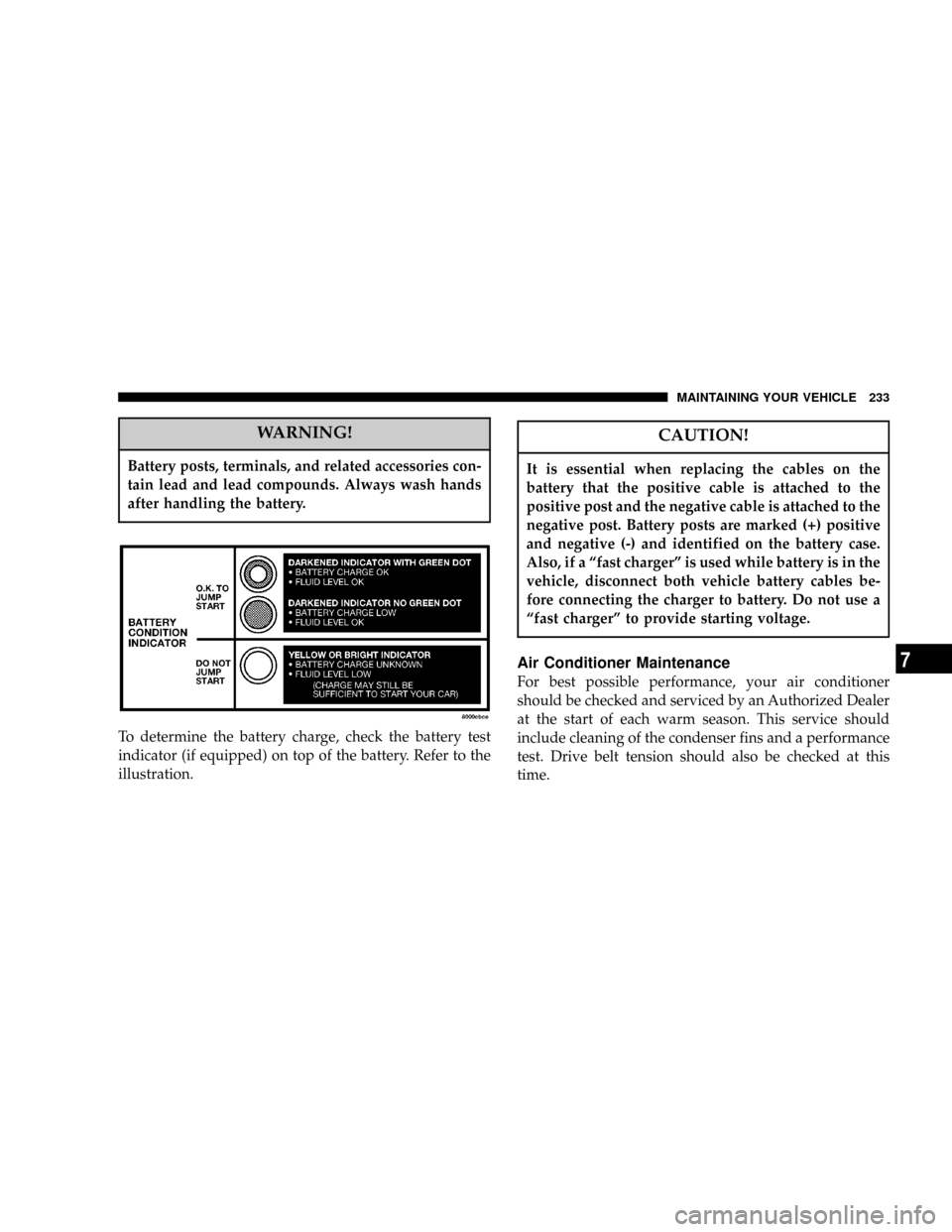
To determine the battery charge, check the battery test
indicator (if equipped) on top of the battery. Refer to the
illustration.
CAUTION!
It is essential when replacing the cables on the
battery that the positive cable is attached to the
positive post and the negative cable is attached to the
negative post. Battery posts are marked (+) positive
and negative (-) and identified on the battery case.
Also, if a ªfast chargerº is used while battery is in the
vehicle, disconnect both vehicle battery cables be-
fore connecting the charger to battery. Do not use a
ªfast chargerº to provide starting voltage.
Air Conditioner Maintenance
For best possible performance, your air conditioner
should be checked and serviced by an Authorized Dealer
at the start of each warm season. This service should
include cleaning of the condenser fins and a performance
test. Drive belt tension should also be checked at this
time.
MAINTAINING YOUR VEHICLE 233
7
Page 238 of 300
WARNING!
You or others can be badly burned by hot coolant or
steam from your radiator. If you see or hear steam
coming from under the hood don't open the hood
until the radiator has had time to cool. If you open
the hood and see steam or hot coolant escaping from
the radiator, don't touch anything. Get away quickly.
Never try to open a pressure cap when the radiator is
hot.
Cooling System Maintenance
At the intervals shown on the Maintenance Schedules,
the system should be drained, flushed and filled.
Cooling System Ð Drain, Flush And Refill
If the solution is dirty and contains a considerable
amount of sediment, clean and flush with a reliable
cooling system cleaner. Follow with a thorough rinsing to
remove all deposits and chemicals. Discard old antifreeze
solution according to recommended procedure.
Disposal of Used Engine Coolant
Used ethylene glycol-based engine coolant is a regulated
substance requiring proper disposal. Check with your
local authorities to determine the disposal rules for your
community. Do not store ethylene glycol-based engine
coolant in open containers or allow it to remain in
puddles on the ground. Prevent ingestion by animals and
children. If ingested by a child, contact a physician
immediately. Clean up any ground spills immediately.
Recommended Engine Coolant
Refer to Recommended Fluids, Lubricants and Genuine
Parts for correct fluid type.
238 MAINTAINING YOUR VEHICLE
Page 241 of 300

The radiator normally remains completely full, so there is
no need to remove the pressure cap except when check-
ing coolant freeze point or when replacing coolant. Your
service attendant should be advised of this. When addi-
tional coolant is needed to maintain the proper level, it
should be added to the overflow bottle. Do not overfill.
Points To Remember
A. Do not overfill the reserve tank (overflow bottle).
B. Check coolant freeze point in the radiator and in the
reserve tank. If antifreeze needs to be added, contents of
reserve tank also must be protected against freezing.
C. If frequent coolant additions are required, or if the
level in the reserve tank does not drop when the engine
cools, the cooling system should be pressure tested for
leaks.D. Maintain a minimum coolant concentration of 50%
ethylene glycol.
E. Make sure that the radiator and reserve tank overflow
hoses are not kinked or obstructed.
F. Keep the front of the radiator clean. If your vehicle is
equipped with air conditioning, keep the front of the
condenser clean also.
G. The thermostat should not be changed for summer or
winter operation. If replacement is ever necessary, install
ONLY the correct type thermostat. Other designs may
result in unsatisfactory cooling performance.
Emission Related Components
Fuel System Hoses And Vapor/Vacuum Harnesses
When the vehicle is serviced for scheduled maintenance,
inspect surface of hoses and nylon tubing for evidence of
heat and mechanical damage. Hard and brittle rubber,
cracking, checking, tears, cuts, abrasions, and excessive
swelling suggest deterioration of the rubber. Particular
attention should be given to examining hose surfaces
nearest to high heat sources, such as the exhaust mani-
fold.
MAINTAINING YOUR VEHICLE 241
7
Page 243 of 300

Brake System
Power Disc Brakes (Front)
Disc brakes do not require adjustment; however, several
hard stops during the break-in period are recommended
to seat the linings and wear off any foreign material.
Self-Adjusting Rear Brakes
To maintain the correct adjustment, you need only drive
your vehicle in reverse and apply the brakes. If further
adjustment is needed, drive forward about 20 feet (6
meters) before you repeat the reverse application. To
avoid poor braking, brake pull, or damage to brake
drums, the brake linings should be inspected as specified
in the Maintenance Schedule.
Brake Master Cylinders
The fluid level in the master cylinders should be checked
whenever the vehicle is serviced, or immediately if the
brake system warning light is on. If necessary, add fluid
to bring level to the full mark on the side of the reservoir
of the brake master cylinder. Be sure to clean the top of
the master cylinder area before removing the cap. With
disc brakes, fluid level can be expected to fall as the brakepads wear. Brake fluid level should be checked when
pads are replaced. If the brake fluid level is abnormally
low, check system for leaks.
Refer to Recommended Fluids, Lubricants and Genuine
Parts for correct fluid type.
MAINTAINING YOUR VEHICLE 243
7
Page 245 of 300
WARNING!
Worn brake hoses can burst and cause brake failure.
You could have an accident. If you see any sign of
cracking, scuffing, or worn spots, have the brake
hoses replaced immediately.
Clutch Hydraulic System
The clutch hydraulic system is a sealed maintenance free
system. In the event of leakage or other malfunction, the
system must be replaced.
Manual Transmission
Fluid Level Check
This fluid should be checked whenever other underhood
services are performed. The fluid level is checked by
removing the fill plug. If the level of the lubricant is more
than 1/49(6.35 mm) below the bottom of the filler hole
while the vehicle is level, enough lubricant should be
added to bring the level to the bottom of the filler hole.
NV-3500 5-Speed Transmission Lubricant Selection
These transmissions are filled with manual transmission
fluid at the factory. This fluid does not require periodic
changing. If it becomes necessary to add or change the
fluid in these transmissions, Refer to Recommended
Fluids, Lubricants and Genuine Parts for correct fluid
type.
Automatic Transmission
Fluid Level Check ± 3.7/4.7L Engine
Check the fluid level while the transmission is at normal
operating temperature 180ÉF (82ÉC). This occurs after at
least 15 miles (25 km) of driving. At normal operating
temperature the fluid cannot be held comfortably be-
tween the fingertips.
To check the automatic transmission fluid level properly,
the following procedure must be used:
1. Operate the engine at idle speed and normal operating
temperature.
2. The vehicle must be on level ground.
MAINTAINING YOUR VEHICLE 245
7