2004 DAEWOO NUBIRA service
[x] Cancel search: servicePage 844 of 2643

1F – 598IENGINE CONTROLS
DAEWOO V–121 BL4
Installation Procedure
1. Install the new fuel filter into the retaining clamp.
Note the flow direction.
2. Install the fuel filter.
3. Connect the inlet/outlet lines. Secure the lines with
the connector lock.
4. Install the fuel filter cover.
5. Install the fuel filter mounting bracket assembly bolt
with the fuel filter ground.
Tighten
Tighten the fuel filter mounting bracket assembly
bolts to 4 NSm (35 lb–ft).
6. Connect the negative battery cable.
7. Perform a leak test of the fuel filter.
FUEL RAIL AND INJECTORS
(1.4L/1.6L DOHC)
Removal Procedure
CAUTION : The fuel system is under pressure. To
avoid fuel spillage and the risk of personal injury or
fire, it is necessary to relieve the fuel system pressure
before disconnecting the fuel lines.
1. Relieve the fuel system pressure. Refer to ”Fuel
Pump”in this section.
2. Disconnect the negative battery cable.
3. Remove the intake manifold bracket bolts.
4. Remove the intake manifold bracket.
5. Disconnect the fuel injector harness connectors.
6. Remove the fuel feed line.
7. Remove the fuel rail mounting bolts.
Notice : Before removal, the fuel rail assembly may be
cleaned with a spray–type cleaner, following package in-
structions. Do not immerse the fuel rails in liquid cleaning
solvent. Use care in removing the fuel rail assembly to pre-
vent damage to the electrical connectors and the injector
spray tips. Prevent dirt and other contaminants from enter-
ing open lines and passages. Fittings should be capped
and holes plugged during service.
Important : If an injector becomes separated from the rail
and remains in the cylinder head, replace the injector O–
ring seals and the retaining clip.
Page 847 of 2643

ENGINE CONTROLS 1F – 601
DAEWOO V–121 BL4
Notice : Before removal, the fuel rail assembly may be
cleaned with a spray–type cleaner, following package in-
structions. Do not immerse the fuel rails in liquid cleaning
solvent. Use care in removing the fuel rail assembly to pre-
vent damage to the electrical connectors and the injector
spray tips. Prevent dirt and other contaminants from enter-
ing open lines and passages. Fittings should be capped
and holes plugged during service.
Important : If an injector becomes separated from the rail
and remains in the cylinder head, replace the injector O–
ring seals and the retaining clip.
9. Remove the fuel rail with the injectors attached.
10. Remove the fuel injector retainer clips.
11. Remove the fuel injectors by pulling them down and
out.
12. Discard the fuel injector O–rings.
Installation Procedure
Important : Different injectors are calibrated for different
flow rates. When ordering new fuel injectors, be certain to
order the identical part number that is inscribed on the old
injector.
1. Lubricate the new fuel injector O–rings with engine
oil. Install the new O–rings on the fuel injectors.
2. Install the fuel injectors into the fuel rail sockets
with the fuel injector terminals facing outward.
3. Install the fuel injector retaining clips onto the fuel
injector and the fuel rail ledge.
4. Make sure that the clips are parallel to the fuel in-
jector harness connector.
5. Install the fuel rail assembly into the cylinder head.
6. Install the fuel rail retaining bolts.
Tighten
Tighten the fuel rail retaining bolts to 25 NSm (18 lb–
ft).
7. Connect the fuel feed line to the fuel rail.
8. Connect the fuel injector connectors. Rotate each
fuel injector as required.
Page 852 of 2643

1F – 606IENGINE CONTROLS
DAEWOO V–121 BL4
7. Connect the TP sensor connector and the IAC
valve connector.
8. Connect the coolant hoses to the throttle body.
9. Connect the vacuum hoses to the throttle body.
Important : Make sure the throttle/cruise control cables
do not hold the throttle open. With the engine off, check to
see that the accelerator pedal is free.
10. Connect the throttle cable.
11. Install the air intake tube.
12. Connect the breather hose to the valve cover.
13. Connect the IAT sensor connector.
14. Connect the negative battery cable.
15. Fill the cooling system.
FRONT HEATED OXYGEN SENSOR
(HO2S1) (1.4L/1.6L DOHC)
Removal Procedure
1. Disconnect the negative battery cable.
Notice : The oxygen sensor uses a permanently attached
pigtail and connector. This pigtail should not be removed
from the oxygen sensor. Damage or removal of the pigtail
or the connector could affect proper operation of the oxy-
gen sensor. Take care when handling the oxygen sensor.
Do not drop the oxygen sensor.
2. Disconnect the front heated oxygen sensor
(HO2S1) connector.
Notice : The oxygen sensor may be difficult to remove
when engine temperature is below 48°C (120°F). Exces-
sive force may damage threads in the exhaust manifold.
3. Carefully remove the HO2S1 from the exhaust
manifold.
Installation Procedure
Important : A special anti–seize compound is used on the
oxygen sensor threads. This compound consists of a liq-
uid graphite and glass beads. The graphite will burn away,
but the glass beads will remain, making the sensor easier
to remove. New or service sensors will already have the
compound applied to the threads. If a sensor is removed
from any engine and if for any reason it is to be reinstalled,
the threads must have anti–seize compound applied be-
fore reinstallation.
1. Coat the threads of the HO2S1 with an anti–seize
compound, if needed.
2. Install the HO2S1 into the exhaust manifold.
Tighten
Tighten the oxygen sensor to 42 NSm (31 lb–ft).
3. Connect the HO2S1 connector.
4. Connect the negative battery cable.
Page 853 of 2643

ENGINE CONTROLS 1F – 607
DAEWOO V–121 BL4
FRONT HEATED OXYGEN SENSOR
(HO2S1) (1.8L DOHC)
Removal Procedure
1. Disconnect the negative battery cable.
Notice : The oxygen sensor (O2S) uses a permanently at-
tached pigtail and connector. This pigtail should not be re-
moved from the O2S. Damage or removal of the pigtail or
the connector could affect proper operation of the O2S.
Take care when handling the O2S. Do not drop the O2S.
2. Disconnect the HO2S1 connector.
Notice : The oxygen sensor may be difficult to remove
when engine temperature is below 118°F (48°C). Exces-
sive force may damage threads in the exhaust manifold.
3. Carefully remove the HO2S1 from the exhaust
manifold.
Installation Procedure
Important : A special anti–seize compound is used on the
oxygen sensor threads. This compound consists of a liq-
uid graphite and glass beads. The graphite will burn away,
but the glass beads will remain, making the sensor easier
to remove. New or serviced sensors will already have the
compound applied to the threads. If a sensor is removed
from any engine and is to be reinstalled, the threads must
have an anti–seize compound applied before reinstalla-
tion.
1. Coat the threads of the HO2S1 with an anti–seize
compound, if needed.
2. Install the HO2S1 into the exhaust manifold.
Tighten
Tighten the oxygen sensor to 42 NSm (31 lb–ft).
3. Connect the HO2S1 connector.
4. Connect the negative battery cable.
REAR HEATED OXYGEN SENSOR
(HO2S2)
Removal Procedure
1. Disconnect the negative battery cable.
2. Disconnect the electrical connector.
Page 855 of 2643
ENGINE CONTROLS 1F – 609
DAEWOO V–121 BL4
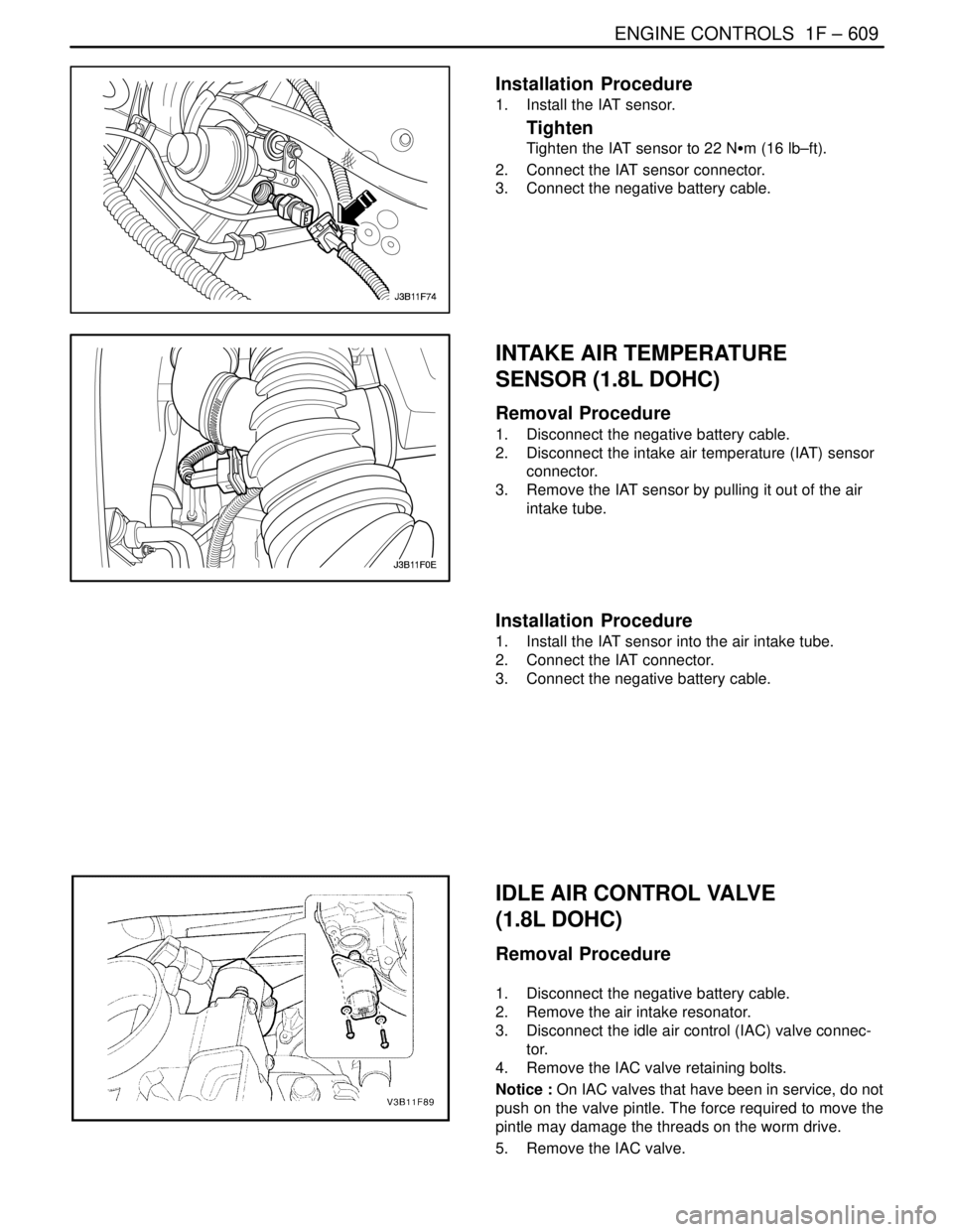
Installation Procedure
1. Install the IAT sensor.
Tighten
Tighten the IAT sensor to 22 NSm (16 lb–ft).
2. Connect the IAT sensor connector.
3. Connect the negative battery cable.
INTAKE AIR TEMPERATURE
SENSOR (1.8L DOHC)
Removal Procedure
1. Disconnect the negative battery cable.
2. Disconnect the intake air temperature (IAT) sensor
connector.
3. Remove the IAT sensor by pulling it out of the air
intake tube.
Installation Procedure
1. Install the IAT sensor into the air intake tube.
2. Connect the IAT connector.
3. Connect the negative battery cable.
IDLE AIR CONTROL VALVE
(1.8L DOHC)
Removal Procedure
1. Disconnect the negative battery cable.
2. Remove the air intake resonator.
3. Disconnect the idle air control (IAC) valve connec-
tor.
4. Remove the IAC valve retaining bolts.
Notice : On IAC valves that have been in service, do not
push on the valve pintle. The force required to move the
pintle may damage the threads on the worm drive.
5. Remove the IAC valve.
Page 869 of 2643

ENGINE CONTROLS 1F – 623
DAEWOO V–121 BL4
GENERAL DESCRIPTION
AND SYSTEM OPERATION
IGNITION SYSTEM OPERATION
This ignition system does not use a conventional distribu-
tor and coil. It uses a crankshaft position sensor input to
the engine control module (ECM). The ECM then deter-
mines Electronic Spark Timing (EST) and triggers the di-
rect ignition system ignition coil.
This type of distributorless ignition system uses a ”waste
spark” method of spark distribution. Each cylinder is
paired with the cylinder that is opposite it (1–4 or 2–3). The
spark occurs simultaneously in the cylinder coming up on
the compression stroke and in the cylinder coming up on
the exhaust stroke. The cylinder on the exhaust stroke re-
quires very little of the available energy to fire the spark
plug. The remaining energy is available to the spark plug
in the cylinder on the compression stroke.
These systems use the EST signal from the ECM to con-
trol the electronic spark timing. The ECM uses the follow-
ing information:
S Engine load (manifold pressure or vacuum).
S Atmospheric (barometric) pressure.
S Engine temperature.
S Intake air temperature.
S Crankshaft position.
S Engine speed (rpm).
ELECTRONIC IGNITION SYSTEM
IGNITION COIL
The Electronic Ignition (EI) system ignition coil provides
the spark for two spark plugs simultaneously. The EI sys-
tem ignition coil is not serviceable and must be replaced
as an assembly.
CRANKSHAFT POSITION SENSOR
This direct ignition system uses a magnetic crankshaft
position sensor. This sensor protrudes through its mount
to within approximately 0.05 inch (1.3 mm) of the crank-
shaft reluctor. The reluctor is a special wheel attached to
the crankshaft or crankshaft pulley with 58 slots machined
into it, 57 of which are equally spaced in 6 degree intervals.
The last slot is wider and serves to generate a ”sync
pulse.” As the crankshaft rotates, the slots in the reluctor
change the magnetic field of the sensor, creating an in-
duced voltage pulse. The longer pulse of the 58th slot
identifies a specific orientation of the crankshaft and al-
lows the engine control module (ECM) to determine the
crankshaft orientation at all times. The ECM uses this in-
formation to generate timed ignition and injection pulses
that it sends to the ignition coils and to the fuel injectors.
CAMAHAFT POSITION SENSOR
The Camshaft Position (CMP) sensor sends a CMP sen-
sor signal to the engine control module (ECM). The ECM
uses this signal as a ”sync pulse” to trigger the injectors in
the proper sequence. The ECM uses the CMP sensor sig-
nal to indicate the position of the #1 piston during its power
stroke. This allows the ECM to calculate true sequential
fuel injection mode of operation. If the ECM detects an in-
correct CMP sensor signal while the engine is running,
DTC P0341 will set. If the CMP sensor signal is lost while
the engine is running, the fuel injection system will shift to
a calculated sequential fuel injection mode based on the
last fuel injection pulse, and the engine will continue to run.
As long as the fault is present, the engine can be restarted.
It will run in the calculated sequential mode with a 1–in–6
chance of the injector sequence being correct.
IDLE AIR SYSTEM OPERATION
The idle air system operation is controlled by the base idle
setting of the throttle body and the Idle Air Control (IAC)
valve.
The engine control module (ECM) uses the IAC valve to
set the idle speed dependent on conditions. The ECM
uses information from various inputs, such as coolant tem-
perature, manifold vacuum, etc., for the effective control
of the idle speed.
FUEL CONTROL SYSTEM
OPERATION
The function of the fuel metering system is to deliver the
correct amount of fuel to the engine under all operating
conditions. The fuel is delivered to the engine by the indi-
vidual fuel injectors mounted into the intake manifold near
each cylinder.
The two main fuel control sensors are the Manifold Abso-
lute Pressure (MAP) sensor, the Front Heated Oxygen
Sensor (HO2S1) and the Rear Heated Oxygen Sensor
(HO2S2).
The MAP sensor measures or senses the intake manifold
vacuum. Under high fuel demands the MAP sensor reads
a low vacuum condition, such as wide open throttle. The
engine control module (ECM) uses this information to ri-
chen the mixture, thus increasing the fuel injector on–time,
to provide the correct amount of fuel. When decelerating,
the vacuum increases. This vacuum change is sensed by
the MAP sensor and read by the ECM, which then de-
creases the fuel injector on–time due to the low fuel de-
mand conditions.
HO2S Sensors
The HO2S sensor is located in the exhaust manifold. The
HO2S sensor indicates to the ECM the amount of oxygen
in the exhaust gas and the ECM changes the air/fuel ratio
to the engine by controlling the fuel injectors. The best air/
fuel ratio to minimize exhaust emissions is 14.7 to 1, which
allows the catalytic converter to operate most efficiently.
Page 873 of 2643

ENGINE CONTROLS 1F – 627
DAEWOO V–121 BL4
A closed throttle on engine coast down produces a rela-
tively low MAP output. MAP is the opposite of vacuum.
When manifold pressure is high, vacuum is low. The MAP
sensor is also used to measure barometric pressure. This
is performed as part of MAP sensor calculations. With the
ignition ON and the engine not running, the engine control
module (ECM) will read the manifold pressure as baromet-
ric pressure and adjust the air/fuel ratio accordingly. This
compensation for altitude allows the system to maintaindriving performance while holding emissions low. The
barometric function will update periodically during steady
driving or under a wide open throttle condition. In the case
of a fault in the barometric portion of the MAP sensor, the
ECM will set to the default value.
A failure in the MAP sensor circuit sets a diagnostic trouble
code P0107 or P0108.
The following tables show the difference between absolute pressure and vacuum related to MAP sensor output, which
appears as the top row of both tables.
MAP
Volts4.94.43.83.32.72.21.71.10.60.30.3
kPa1009080706050403020100
in. Hg29.626.623.720.717.714.811.88.95.92.90
VACUUM
Volts4.94.43.83.32.72.21.71.10.60.30.3
kPa0102030405060708090100
in. Hg02.95.98.911.814.817..720.723.726.729.6
ENGINE CONTROL MODULE
The engine control module (ECM), located inside the pas-
senger kick–panel, is the control center of the fuel injection
system. It constantly looks at the information from various
sensors and controls the systems that affect the vehicle’s
performance. The ECM also performs the diagnostic func-
tions of the system. It can recognize operational problems,
alert the driver through the Malfunction Indicator Lamp
(MIL), and store diagnostic trouble code(s) which identify
problem areas to aid the technician in making repairs.
There are no serviceable parts in the ECM. The calibra-
tions are stored in the ECM in the Programmable Read–
Only Memory (PROM).
The ECM supplies either 5 or 12 volts to power the sensors
or switches. This is done through resistances in the ECM
which are so high in value that a test light will not come on
when connected to the circuit. In some cases, even an or-
dinary shop voltmeter will not give an accurate reading be-
cause its resistance is too low. You must use a digital volt-
meter with a 10 megohm input impedance to get accurate
voltage readings. The ECM controls output circuits such
as the fuel injectors, the idle air control valve, the A/C
clutch relay, etc., by controlling the ground circuit through
transistors or a device called a ”quad–driver.”
FUEL INJECTOR
The Multiport Fuel Injection (MFI) assembly is a solenoid–
operated device controlled by the engine control module
(ECM). It meters pressurized fuel to a single engine cylin-
der. The ECM energizes the fuel injector or the solenoid
to a normally closed ball or pintle valve. This allows fuel toflow into the top of the injector, past the ball or pintle valve,
and through a recessed flow director plate at the injector
outlet.
The director plate has six machined holes that control the
fuel flow, generating a conical spray pattern of finely atom-
ized fuel at the injector tip. Fuel from the tip is directed at
the intake valve, causing it to become further atomized
and vaporized before entering the combustion chamber.
A fuel injector which is stuck partially open will cause a loss
of fuel pressure after the engine is shut down. Also, an ex-
tended crank time will be noticed on some engines. Diesel-
ing can also occur because some fuel can be delivered to
the engine after the ignition is turned OFF.
KNOCK SENSOR
The knock sensor detects abnormal knocking in the en-
gine. The sensor is mounted in the engine block near the
cylinders. The sensor produces an AC output voltage
which increases with the severity of the knock. This signal
is sent to the engine control module (ECM). The ECM then
adjusts the ignition timing to reduce the spark knock.
ROUGH ROAD SENSOR
The engine control module (ECM) receives rough road in-
formation from the VR sensor. The ECM uses the rough
road information to enable or disable the misfire diagnos-
tic. The misfire diagnostic can be greatly affected by
crankshaft speed variations caused by driving on rough
road surfaces. The VR sensor generates rough road infor-
mation by producing a signal which is proportional to the
movement of a small metal bar inside the sensor.
If a fault occurs which causes the ECM to not receive
rough road information between 30 and 80 mph (50 and
132 km/h), DTC P1391 will set.
Page 874 of 2643

1F – 628IENGINE CONTROLS
DAEWOO V–121 BL4
STRATEGY – BASED DIAGNOSTICS
Strategy–Based Diagnostics
The strategy–based diagnostic is a uniform approach to
repair all Electrical/Electronic (E/E) systems. The diag-
nostic flow can always be used to resolve an E/E system
problem and is a starting point when repairs are neces-
sary. The following steps will instruct the technician on
how to proceed with a diagnosis:
S Verify the customer complaint. To verify the cus-
tomer complaint, the technician should know the
normal operation of the system.
S Perform preliminary checks as follows:
S Conduct a thorough visual inspection.
S Review the service history.
S Detect unusual sounds or odors.
S Gather Diagnostic Trouble Code (DTC) informa-
tion to achieve an effective repair.
S Check bulletins and other service information. This
includes videos, newsletters, etc.
S Refer to service information (manual) system
check(s).
S Refer to service diagnostics.
No Trouble Found
This condition exists when the vehicle is found to operate
normally. The condition described by the customer may be
normal. Verify the customer complaint against another ve-
hicle that is operating normally. The condition may be in-
termittent. Verify the complaint under the conditions de-
scribed by the customer before releasing the vehicle.
Re–examine the complaint.
When the complaint cannot be successfully found or iso-
lated, a re–evaluation is necessary. The complaint should
be re–verified and could be intermittent as defined in ”In-
termittents,” or could be normal.
After isolating the cause, the repairs should be made. Vali-
date for proper operation and verify that the symptom has
been corrected. This may involve road testing or other
methods to verify that the complaint has been resolved un-
der the following conditions:
S Conditions noted by the customer.
S If a DTC was diagnosed, verify a repair by duplicat-
ing conditions present when the DTC was set as
noted in the Failure Records or Freeze Frame data.
Verifying Vehicle Repair
Verification of the vehicle repair will be more comprehen-
sive for vehicles with On–Board Diagnostic (EOBD) sys-
tem diagnostics. Following a repair, the technician should
perform these steps:
Important : Follow the steps below when you verify re-
pairs on EOBD systems. Failure to follow these steps
could result in unnecessary repairs.S Review and record the Failure Records and the
Freeze Frame data for the DTC which has been
diagnosed (Freeze Fame data will only be stored
for an A or B type diagnostic and only if the MIL
has been requested).
S Clear the DTC(s).
S Operate the vehicle within conditions noted in the
Failure Records and Freeze Frame data.
S Monitor the DTC status information for the specific
DTC which has been diagnosed until the diagnostic
test associated with that DTC runs.
EOBD SERVICEABILITY ISSUES
Based on the knowledge gained from On–Board Diagnos-
tic (EOBD) experience in the 1994 and 1995 model years,
this list of non–vehicle faults that could affect the perfor-
mance of the EOBD system has been compiled. These
non–vehicle faults vary from environmental conditions to
the quality of fuel used. With the introduction of EOBD
diagnostics across the entire passenger car and light–duty
truck market in 1996, illumination of the MIL due to a non–
vehicle fault could lead to misdiagnosis of the vehicle, in-
creased warranty expense and customer dissatisfaction.
The following list of non–vehicle faults does not include ev-
ery possible fault and may not apply equally to all product
lines.
Fuel Quality
Fuel quality is not a new issue for the automotive industry,
but its potential for turning on the Malfunction Indicator
Lamp (MIL) with EOBD systems is new.
Fuel additives such as ”dry gas” and ”octane enhancers”
may affect the performance of the fuel. If this results in an
incomplete combustion or a partial burn, it will set DTC
P0300. The Reed Vapor Pressure of the fuel can also
create problems in the fuel system, especially during the
spring and fall months when severe ambient temperature
swings occur. A high Reed Vapor Pressure could show up
as a Fuel Trim DTC due to excessive canister loading.
High vapor pressures generated in the fuel tank can also
affect the Evaporative Emission diagnostic as well.
Using fuel with the wrong octane rating for your vehicle
may cause driveability problems. Many of the major fuel
companies advertise that using ”premium” gasoline will
improve the performance of your vehicle. Most premium
fuels use alcohol to increase the octane rating of the fuel.
Although alcohol–enhanced fuels may raise the octane
rating, the fuel’s ability to turn into vapor in cold tempera-
tures deteriorates. This may affect the starting ability and
cold driveability of the engine.
Low fuel levels can lead to fuel starvation, lean engine op-
eration, and eventually engine misfire.
Non–OEM Parts
All of the EOBD diagnostics have been calibrated to run
with Original Equipment Manufacturer (OEM) parts.
Something as simple as a high–performance exhaust sys-
tem that affects exhaust system back pressure could po-