Page 2442 of 2643
9P – 22IDOORS
DAEWOO V–121 BL4
DOOR LOCK STRIKER ADJUSTMENT
(Front Door Shown, Rear Door Similar)
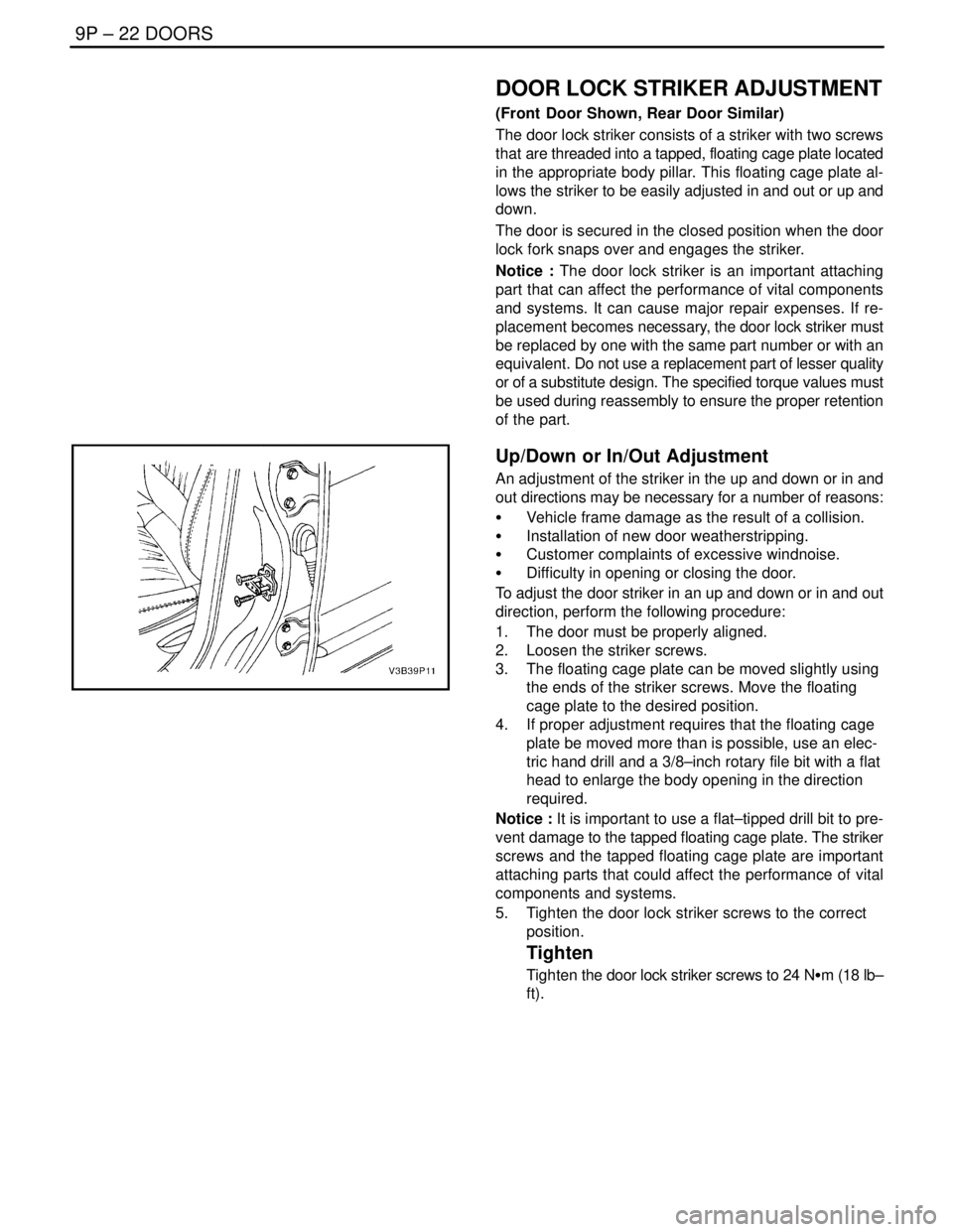
The door lock striker consists of a striker with two screws
that are threaded into a tapped, floating cage plate located
in the appropriate body pillar. This floating cage plate al-
lows the striker to be easily adjusted in and out or up and
down.
The door is secured in the closed position when the door
lock fork snaps over and engages the striker.
Notice : The door lock striker is an important attaching
part that can affect the performance of vital components
and systems. It can cause major repair expenses. If re-
placement becomes necessary, the door lock striker must
be replaced by one with the same part number or with an
equivalent. Do not use a replacement part of lesser quality
or of a substitute design. The specified torque values must
be used during reassembly to ensure the proper retention
of the part.
Up/Down or In/Out Adjustment
An adjustment of the striker in the up and down or in and
out directions may be necessary for a number of reasons:
S Vehicle frame damage as the result of a collision.
S Installation of new door weatherstripping.
S Customer complaints of excessive windnoise.
S Difficulty in opening or closing the door.
To adjust the door striker in an up and down or in and out
direction, perform the following procedure:
1. The door must be properly aligned.
2. Loosen the striker screws.
3. The floating cage plate can be moved slightly using
the ends of the striker screws. Move the floating
cage plate to the desired position.
4. If proper adjustment requires that the floating cage
plate be moved more than is possible, use an elec-
tric hand drill and a 3/8–inch rotary file bit with a flat
head to enlarge the body opening in the direction
required.
Notice : It is important to use a flat–tipped drill bit to pre-
vent damage to the tapped floating cage plate. The striker
screws and the tapped floating cage plate are important
attaching parts that could affect the performance of vital
components and systems.
5. Tighten the door lock striker screws to the correct
position.
Tighten
Tighten the door lock striker screws to 24 NSm (18 lb–
ft).
Page 2447 of 2643
DOORS 9P – 27
DAEWOO V–121 BL4
Installation Procedure
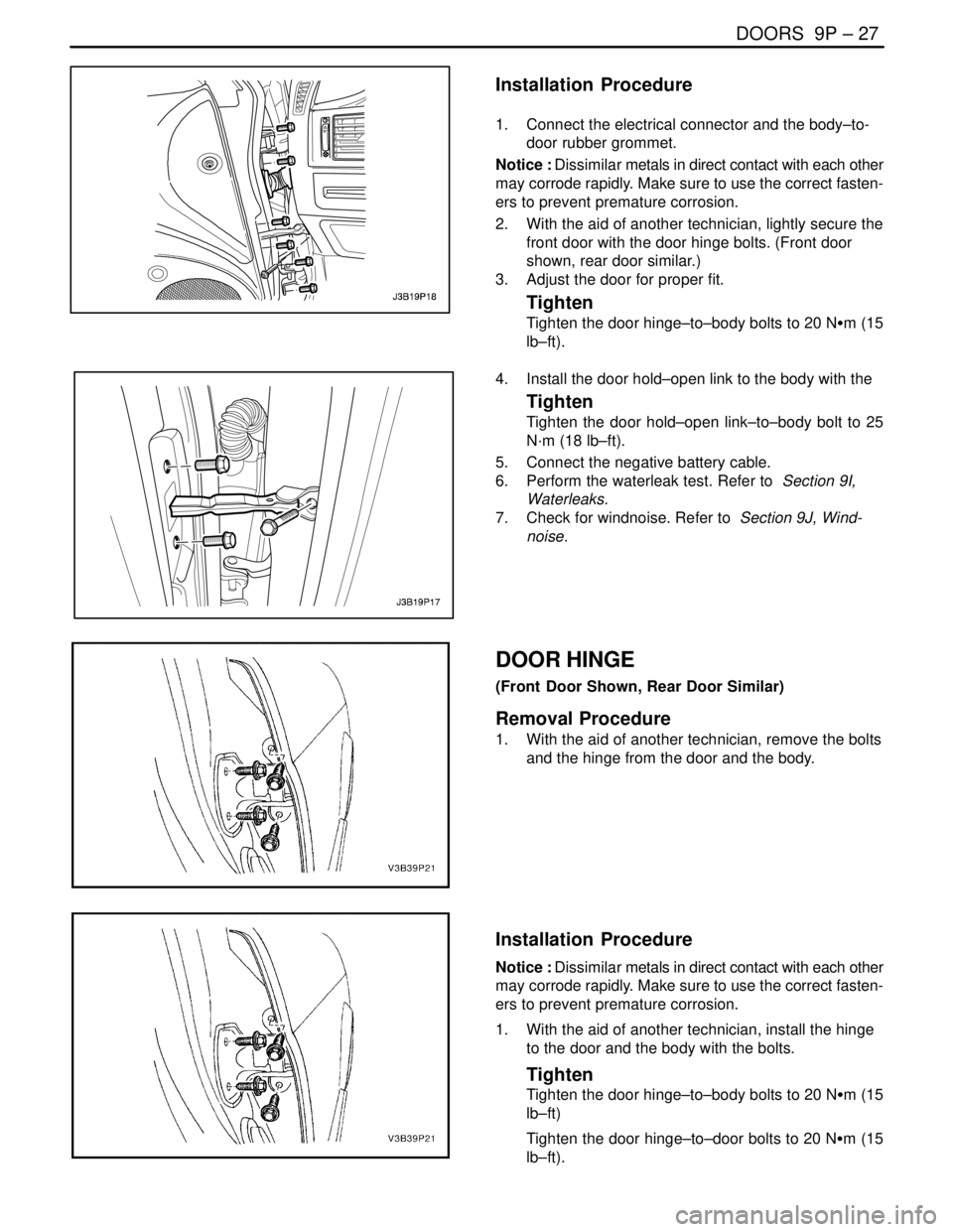
1. Connect the electrical connector and the body–to-
door rubber grommet.
Notice : Dissimilar metals in direct contact with each other
may corrode rapidly. Make sure to use the correct fasten-
ers to prevent premature corrosion.
2. With the aid of another technician, lightly secure the
front door with the door hinge bolts. (Front door
shown, rear door similar.)
3. Adjust the door for proper fit.
Tighten
Tighten the door hinge–to–body bolts to 20 NSm (15
lb–ft).
4. Install the door hold–open link to the body with the
Tighten
Tighten the door hold–open link–to–body bolt to 25
N·m (18 lb–ft).
5. Connect the negative battery cable.
6. Perform the waterleak test. Refer to Section 9I,
Waterleaks.
7. Check for windnoise. Refer to Section 9J, Wind-
noise.
DOOR HINGE
(Front Door Shown, Rear Door Similar)
Removal Procedure
1. With the aid of another technician, remove the bolts
and the hinge from the door and the body.
Installation Procedure
Notice : Dissimilar metals in direct contact with each other
may corrode rapidly. Make sure to use the correct fasten-
ers to prevent premature corrosion.
1. With the aid of another technician, install the hinge
to the door and the body with the bolts.
Tighten
Tighten the door hinge–to–body bolts to 20 NSm (15
lb–ft)
Tighten the door hinge–to–door bolts to 20 NSm (15
lb–ft).
Page 2449 of 2643

DOORS 9P – 29
DAEWOO V–121 BL4
GENERAL DESCRIPTION
AND SYSTEM OPERATION
DOOR LOCK STRIKER
The front and the rear door lock strikers each consist of a
striker with two screws threaded into a floating cage plate
in the B–pillars and the C–pillars. The door is secured in
the closed position when the door lock fork snaps over and
engages the striker.
CHILDPROOF REAR DOOR LOCK
The childproof rear door locks help prevent passengers,
especially children, from opening the rear doors of the ve-
hicle from the inside.
To activate the locks, move the levers of both rear doors
to the lock position. Then, close both doors. The rear pas-
sengers will be unable to open the doors from inside of the
vehicle.
To deactivate the locks, unlock the door from the inside of
the vehicle and open the door from the outside. Move the
lever to the unlock position. The rear door will now work
normally.
POWER DOOR LOCKS
The power door locks use a solenoid that is contained in
each door lock assembly. The door locks are activated by
the actuator on the inside door handle or by the lock cylin-
der on the driver’s side door only. When the driver’s side
door is locked or unlocked by the actuator or the lock cylin-
der, all doors are locked or unlocked accordingly.
POWER WINDOWS
The power windows are controlled by electrical switches
on the door panels and are operated by a motor at each
window regulator. Each door has a switch to control its
window, and the driver’s side door has four switches to
control all door windows on the vehicle. The windows are
lowered by pressing the switch and raised by pulling up on
the switch. The window will stop movement when the
switch is released or when the window is completely open
or closed.
The driver’s side window opens automatically. By pressing
and releasing the switch, the driver ’s side window will low-
er and will stop only when the switch is activated again, or
when the window is completely open.
The driver’s side door control also contains a window lock
button that will prevent the operation of the front passen-
ger door or the rear door windows when pressed.
Page 2464 of 2643
BODY FRONT END 9R – 3
DAEWOO V–121 BL4
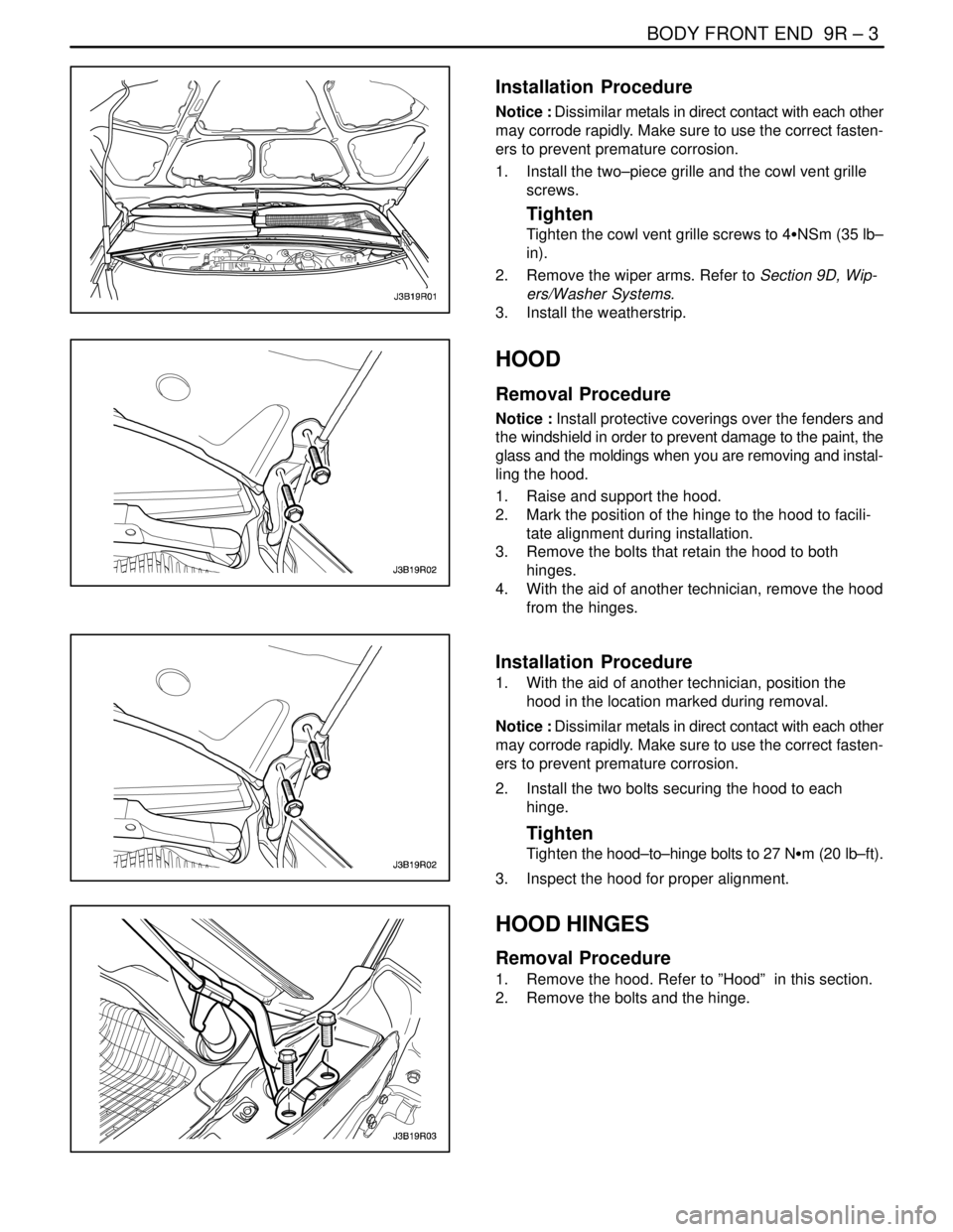
Installation Procedure
Notice : Dissimilar metals in direct contact with each other
may corrode rapidly. Make sure to use the correct fasten-
ers to prevent premature corrosion.
1. Install the two–piece grille and the cowl vent grille
screws.
Tighten
Tighten the cowl vent grille screws to 4SNSm (35 lb–
in).
2. Remove the wiper arms. Refer to Section 9D, Wip-
ers/Washer Systems.
3. Install the weatherstrip.
HOOD
Removal Procedure
Notice : Install protective coverings over the fenders and
the windshield in order to prevent damage to the paint, the
glass and the moldings when you are removing and instal-
ling the hood.
1. Raise and support the hood.
2. Mark the position of the hinge to the hood to facili-
tate alignment during installation.
3. Remove the bolts that retain the hood to both
hinges.
4. With the aid of another technician, remove the hood
from the hinges.
Installation Procedure
1. With the aid of another technician, position the
hood in the location marked during removal.
Notice : Dissimilar metals in direct contact with each other
may corrode rapidly. Make sure to use the correct fasten-
ers to prevent premature corrosion.
2. Install the two bolts securing the hood to each
hinge.
Tighten
Tighten the hood–to–hinge bolts to 27 NSm (20 lb–ft).
3. Inspect the hood for proper alignment.
HOOD HINGES
Removal Procedure
1. Remove the hood. Refer to ”Hood” in this section.
2. Remove the bolts and the hinge.
Page 2468 of 2643
BODY FRONT END 9R – 7
DAEWOO V–121 BL4
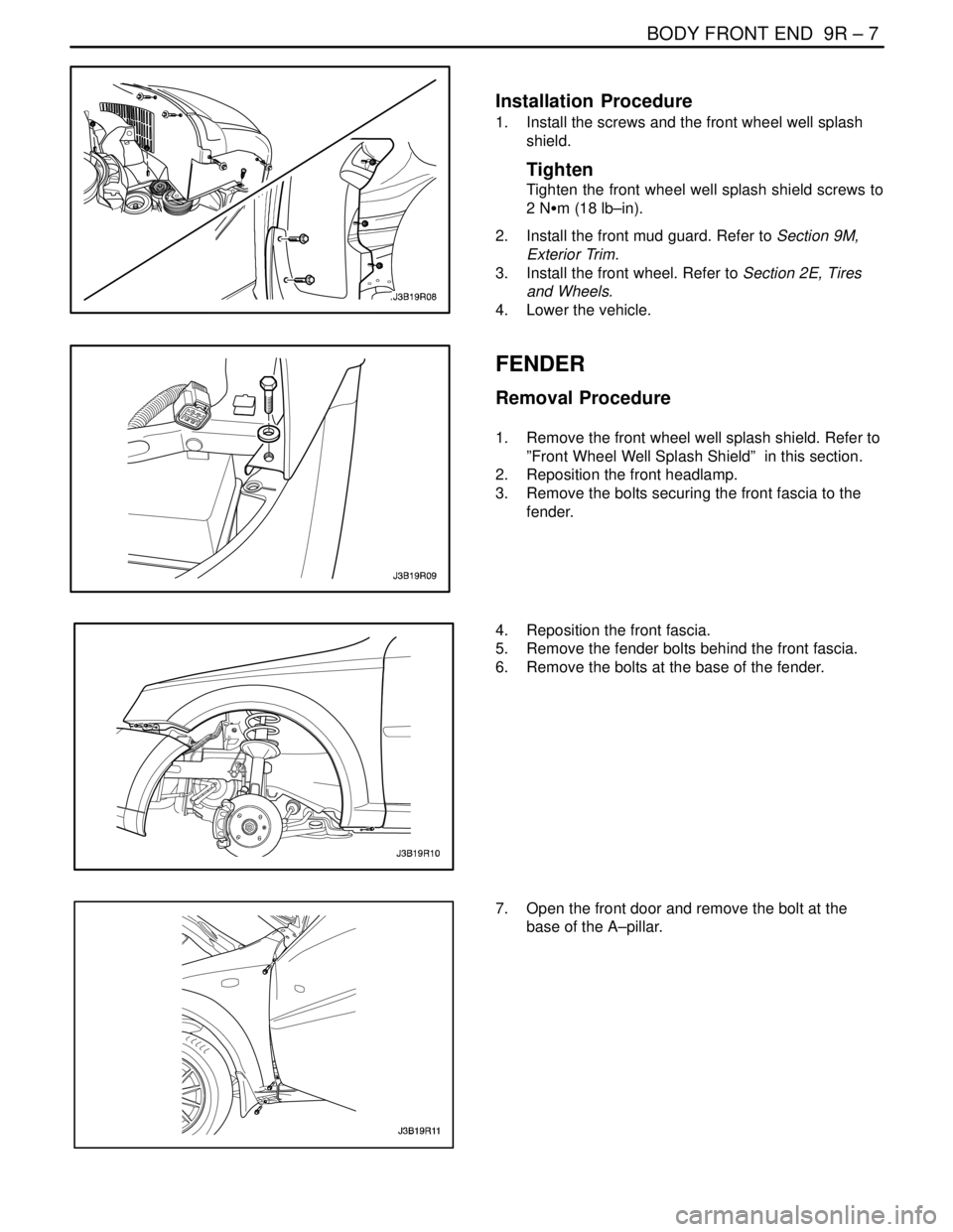
Installation Procedure
1. Install the screws and the front wheel well splash
shield.
Tighten
Tighten the front wheel well splash shield screws to
2 NSm (18 lb–in).
2. Install the front mud guard. Refer to Section 9M,
Exterior Trim.
3. Install the front wheel. Refer to Section 2E, Tires
and Wheels.
4. Lower the vehicle.
FENDER
Removal Procedure
1. Remove the front wheel well splash shield. Refer to
”Front Wheel Well Splash Shield” in this section.
2. Reposition the front headlamp.
3. Remove the bolts securing the front fascia to the
fender.
4. Reposition the front fascia.
5. Remove the fender bolts behind the front fascia.
6. Remove the bolts at the base of the fender.
7. Open the front door and remove the bolt at the
base of the A–pillar.
Page 2470 of 2643
BODY FRONT END 9R – 9
DAEWOO V–121 BL4
6. Install the front fascia to its original position.
7. Install the bolts securing the front fascia to the
fender.
Tighten
Tighten the front fascia–to–fender bolts to 2.5 NSm
(22 lb–in).
8. Install the front headlamp to its original position.
9. Install the front wheel well splash shield. Refer to
”Front Wheel Well Splash Shield” in this section.
Page 2476 of 2643
BODY REAR END 9S – 5
DAEWOO V–121 BL4
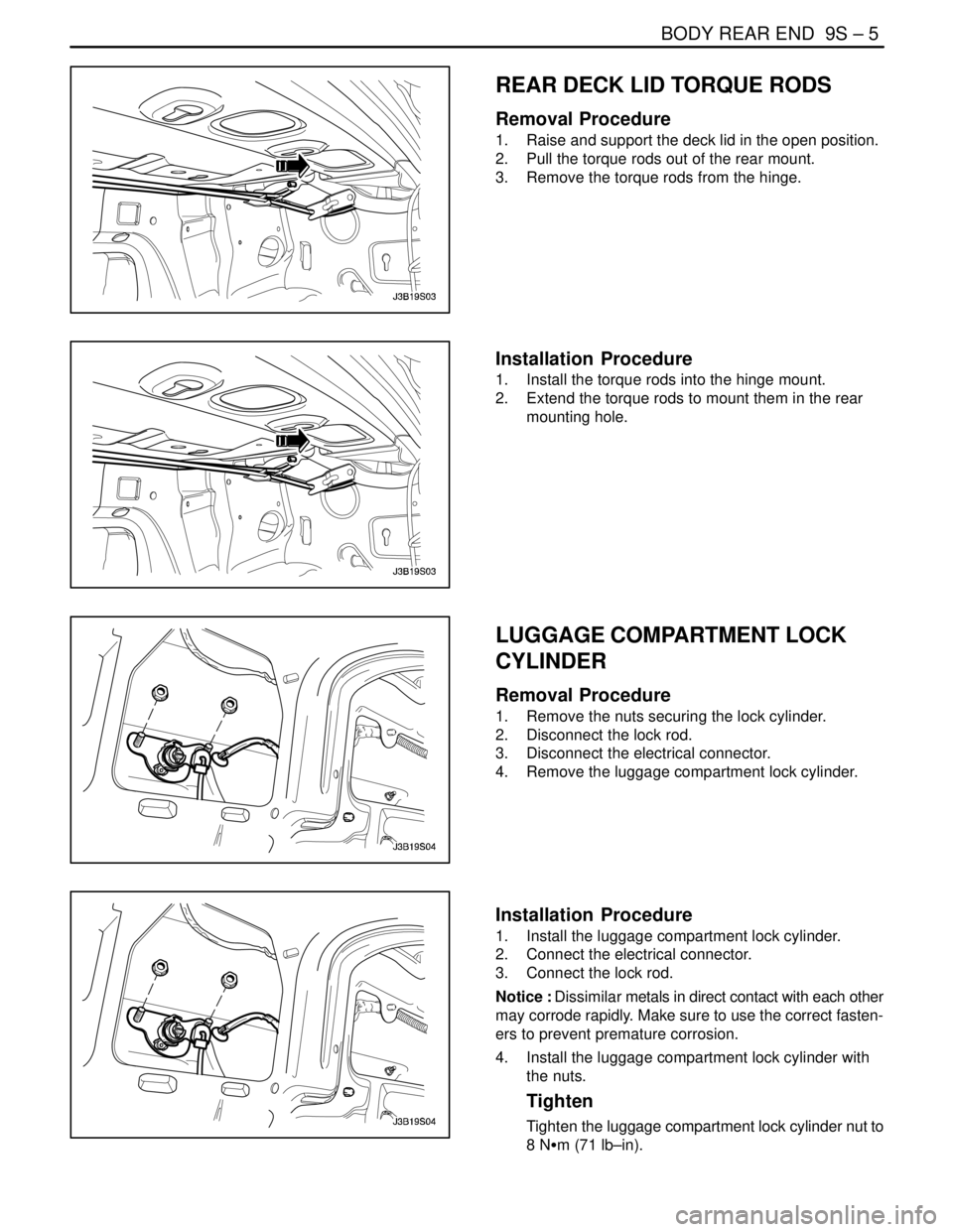
REAR DECK LID TORQUE RODS
Removal Procedure
1. Raise and support the deck lid in the open position.
2. Pull the torque rods out of the rear mount.
3. Remove the torque rods from the hinge.
Installation Procedure
1. Install the torque rods into the hinge mount.
2. Extend the torque rods to mount them in the rear
mounting hole.
LUGGAGE COMPARTMENT LOCK
CYLINDER
Removal Procedure
1. Remove the nuts securing the lock cylinder.
2. Disconnect the lock rod.
3. Disconnect the electrical connector.
4. Remove the luggage compartment lock cylinder.
Installation Procedure
1. Install the luggage compartment lock cylinder.
2. Connect the electrical connector.
3. Connect the lock rod.
Notice : Dissimilar metals in direct contact with each other
may corrode rapidly. Make sure to use the correct fasten-
ers to prevent premature corrosion.
4. Install the luggage compartment lock cylinder with
the nuts.
Tighten
Tighten the luggage compartment lock cylinder nut to
8 NSm (71 lb–in).
Page 2477 of 2643
9S – 6IBODY REAR END
DAEWOO V–121 BL4
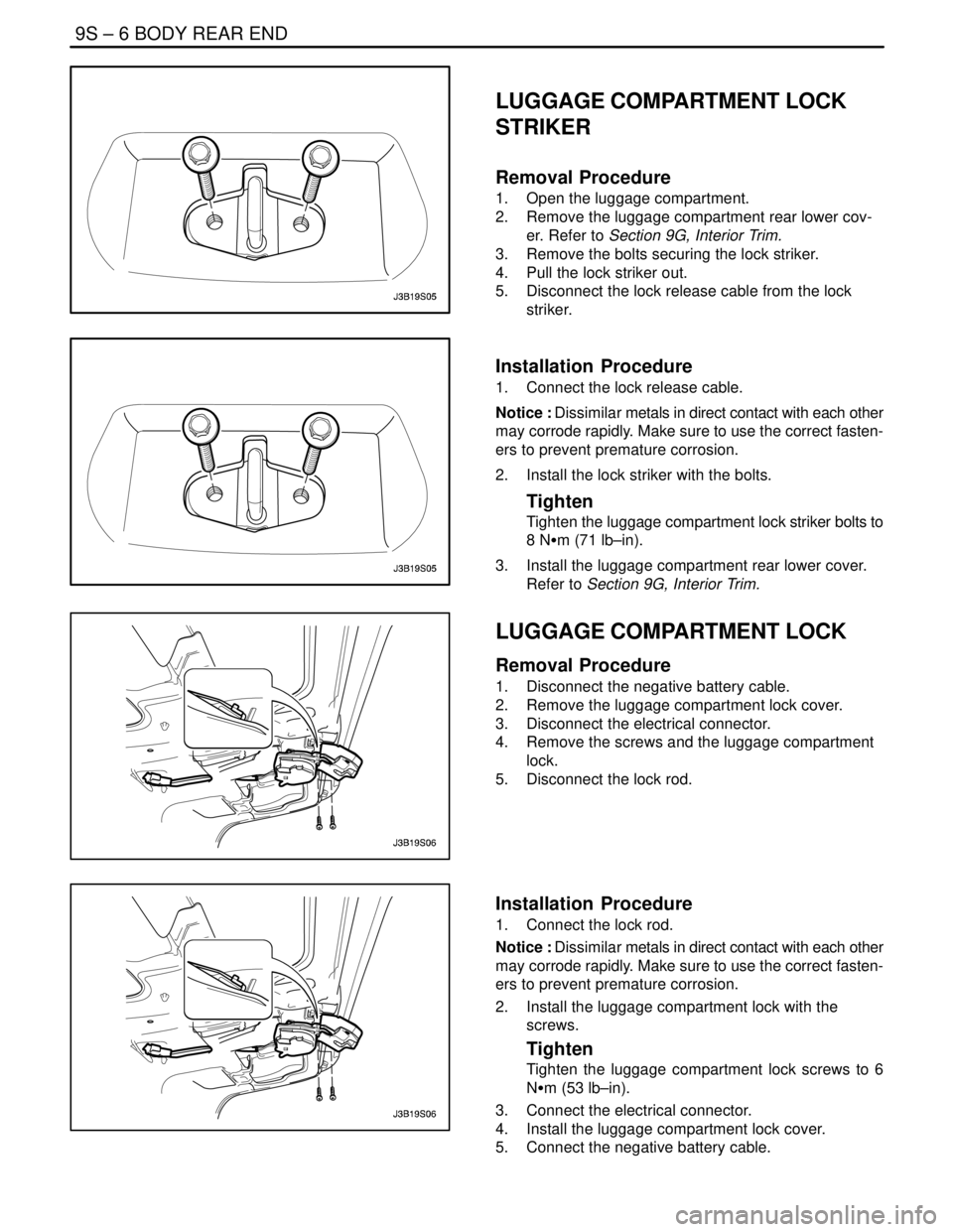
LUGGAGE COMPARTMENT LOCK
STRIKER
Removal Procedure
1. Open the luggage compartment.
2. Remove the luggage compartment rear lower cov-
er. Refer to Section 9G, Interior Trim.
3. Remove the bolts securing the lock striker.
4. Pull the lock striker out.
5. Disconnect the lock release cable from the lock
striker.
Installation Procedure
1. Connect the lock release cable.
Notice : Dissimilar metals in direct contact with each other
may corrode rapidly. Make sure to use the correct fasten-
ers to prevent premature corrosion.
2. Install the lock striker with the bolts.
Tighten
Tighten the luggage compartment lock striker bolts to
8 NSm (71 lb–in).
3. Install the luggage compartment rear lower cover.
Refer to Section 9G, Interior Trim.
LUGGAGE COMPARTMENT LOCK
Removal Procedure
1. Disconnect the negative battery cable.
2. Remove the luggage compartment lock cover.
3. Disconnect the electrical connector.
4. Remove the screws and the luggage compartment
lock.
5. Disconnect the lock rod.
Installation Procedure
1. Connect the lock rod.
Notice : Dissimilar metals in direct contact with each other
may corrode rapidly. Make sure to use the correct fasten-
ers to prevent premature corrosion.
2. Install the luggage compartment lock with the
screws.
Tighten
Tighten the luggage compartment lock screws to 6
NSm (53 lb–in).
3. Connect the electrical connector.
4. Install the luggage compartment lock cover.
5. Connect the negative battery cable.