2004 DAEWOO LACETTI fuel cap
[x] Cancel search: fuel capPage 792 of 2643

1F – 546IENGINE CONTROLS
DAEWOO V–121 BL4
DIAGNOSTIC TROUBLE CODE (DTC) P1167
FRONT HEATED OXYGEN SENSOR (HO2S1) RICH IN
DECEL FUEL CUTOFF (DFCO)
Circuit Description
The Engine Control Module (ECM) supplies a voltage of
about 0.45 volts between terminals M12 and M29 (if mea-
sured with a 10 megohm digital voltmeter, this may read
as low as 0.32 volts). The Front Heated Oxygen Sensor
(HO2S1) varies the voltage within a range of about 1 volt
if the exhaust is rich, down through about 0.10 volts if the
exhaust is lean.
In internal circuitry of the Engine control Module (ECM)
can identify if the vehicle fuel system is capable of cutoff
amount of the fuel supply during deceleration. When a De-
cel Fuel Cutoff (DFCO) mode of operation is requested
during Closed Loop operation, the ECM will cutoff the fuel
supply to the engine. Under these conditions the ECM
should detect a lean condition. If the ECM detect a rich
condition at this time, Diagnostic Trouble Code (DTC)
P1167 will set. Damaged fuel pressure regulator and faulty
injector will be the cause of this DTC.
Conditions for Setting the DTC
S HO2S1 voltage is greater than 0.55 volts in Decel
Fuel Cutoff (DFCO) mode.
S System voltage is greater than 10 volts.S Engine Coolant Temperature (ECT) is greater than
60°C (140°F)
S DTCs P0106, P0107, P0108, P0117, P0118,
P0122, P0123, P0171, P0172, P0201, P0202,
P0203, P0204, P0300, P0336, P0337, P0351,
P0352, P0402, P0404, P0405, P0406, P0506,
P0507, P1404, and P0443 are not set.
S 3 second delay after in DFCO mode.
Action Taken When the DTC Sets
S The Malfunction Indicator Lamp (MIL) will illumi-
nate.
S The ECM will record operating conditions at the
time the diagnostic fails. This information will be
stored in the Freeze Frame and Failure Records
buffers.
S A history DTC is stored.
S The vehicle will operate in Open Loop.
Conditions for Clearing the MIL/DTC
S The MIL will turn off after four consecutive ignition
cycles in which the diagnostic runs without a fault.
S A history DTC will clear after 40 consecutive warm–
up cycles without a fault.
S DTC can be cleared by using the scan tool.
Page 794 of 2643

1F – 548IENGINE CONTROLS
DAEWOO V–121 BL4
DIAGNOSTIC TROUBLE CODE (DTC) P1171
FUEL TRIM SYSTEM LEAN DURING POWER
ENRICHMENT
System Description
The internal circuitry of the Engine control Module (ECM)
can identify if the vehicle fuel system is capable of supply-
ing adequate amounts of fuel during heavy acceleration(
power enrichment). When a Power Enrichment (PE)
mode of operation is requested by heavy acceleration dur-
ing Closed Loop operation, the ECM will provide more fuel
to the engine. Under these conditions the ECM should de-
tect a rich condition. If this reich condition is nor detected
at this time, Diagnostic Trouble Code (DTC) P1171 will set.
A plugged fuel filter or restricted fuel line can prevent ade-
quate amount of fuel from being supplied during Power
Enrichment mode.
Conditions for Setting the DTC
S HO2S1 voltage is less than 0.35 volts in Power En-
richment (PE) mode.
S Engine is operating in Closed Loop and in PE
mode.
S Engine Coolant Temperature (ECT) is greater than
60°C (140°F).
S System voltage is greater than 10 volts.
S Air/Fuel ration is less than 13.5:1.
S DTCs P0106, P0107, P0108, P0117, P0118,
P0122, P0123, P0171, P0172, P0201, P0202,
P0203, P0204, P0300, P0336, P0337, P0351,
P0352, P0402, P0404, P0405, P0406, P0506,
P0507, P1404, and P0443 are not set.
S 3 second delay after in PE mode.
Action Taken When the DTC Sets
S The Malfunction Indicator Lamp (MIL) will illuminate
after two consecutive ignition cycle with a fail.
S The ECM will record operating conditions at the
time the diagnostic fails. This information will be
stored in the Freeze Frame and Failure Records
buffers.
S A history DTC is stored.
S The vehicle will operate in Open Loop.Conditions for Clearing the MIL/DTC
S The MIL will turn off after three consecutive ignition
cycles in which the diagnostic runs without a fault.
S A history DTC will clear after 40 consecutive warm–
up cycles without a fault.
S DTC(s) can be cleared by using the scan tool.
S Disconnecting the ECM battery feed for more than
10 seconds.v
Diagnostic Aids
A restricted fuel filter can supply adequate amounts of fuel
at idle, but may not be able to supply enough fuel during
heavy acceleration.
Water or alcohol n fuel may cause low HO2S1 voltage dur-
ing acceleration.
Check for adequate amount of fuel in the Tank.
When the engine is idling or at steady cruise, the HO2S1
voltage should vary from between approximately a00 to
900 millivolts. During power enrichment mode, more fuel
is needed, and the HO2S1 should rise above 444 milli-
volts.
Check for faulty or plugged injector(s).
Test Description
Number(s) below refer to the step number(s) on the Diag-
nostic Table.
1. The On–Board Diagnostic (EOBD) System Check
prompts the technician to complete some basic
checks and store the freeze frame and failure re-
cords data on the scan tool if applicable. This
creates an electronic copy of the data taken when
the malfunction occurred. The information is then
stored on the scan tool for later reference.
4. This step checks to see if the HO2S1 is operating
properly.
6. If no faults have been found at this point and no
additional DTCs were set, refer to ”Diagnostic Aids”
in this section for additional checks and informa-
tion.
Page 837 of 2643

ENGINE CONTROLS 1F – 591
DAEWOO V–121 BL4
EXCESSIVE EXHAUST EMISSIONS OR ODORS
Definition : A vehicle fails an emission test. The vehicle
has an excessive rotten egg smell.Important : Excessive odors do not necessarily indicate
excessive emissions.
Step
ActionValue(s)YesNo
1Were the Important Preliminary Checks performed?–Go toStep 2Go to
”Important Pre-
liminary
Checks”
21. Run the engine until it reaches operating tem-
perature.
2. Perform an emission test.
Does the vehicle pass the emission test?–System OKGo toStep 3
31. Connect the scan tool to the Data Link Con-
nector (DLC).
2. Road test the vehicle.
3. Monitor the long term fuel trim memory.
Is the long term fuel trim memory within the value
specified?–20–25%Go toStep 6Go toStep 4
4Is the long term fuel trim memory below the value
specified?–20%Go to
”Diagnostic
Aids for DTC
P0172”Go toStep 5
5Is the long term fuel trim memory above the value
specified?25%Go to
”Diagnostic
Aids for DTC
P0171”–
61. Check for a properly installed fuel cap.
2. Check the fuel system pressure.
3. Perform an injector balance test.
Is the problem found?–Go toStep 7Go toStep 8
71. Repair or replace any fuel system components
as needed.
2. Perform an emission test.
Does the vehicle pass the emission test?–System OK–
81. Check the ignition system for proper operation.
2. Inspect the spark plugs for excessive wear,
insulation cracks, improper gap, or heavy de-
posits.
3. Check the ignition wires for cracking, hardness,
or improper connections.
Is the problem found?–Go toStep 9Go toStep 10
Page 840 of 2643

1F – 594IENGINE CONTROLS
DAEWOO V–121 BL4
MAINTENANCE AND REPAIR
ON–VEHICLE SERVICE
FUEL SYSTEM PRESSURE RELIEF
Procedure
CAUTION : The fuel system is under pressure. To
avoid fuel spillage and the risk of personal injury or
fire, it is necessary to relieve the fuel system pressure
before disconnecting the fuel lines.
1. Remove the fuel cap.
2. Remove the fuel pump fuse Ef18 from the engine
fuse block.
3. Start the engine and allow the engine to stall.
4. Crank the engine for an additional 10 seconds.
FUEL TANK
Removal Procedure
CAUTION : The fuel system is under pressure. To
avoid fuel spillage and the risk of personal injury or
fire, it is necessary to relieve the fuel system pressure
before disconnecting the fuel lines.
1. Relieve the fuel pressure. Refer to ” Fuel System
Pressure Relief ” in this section.
2. Disconnect the negative battery cable.
3. Drain the fuel tank.
4. Remove the front muffler. Refer to Section 1G, Ex-
haust System
5. Remove the fuel tank filler tube clamp at the fuel
tank.
6. Disconnect the fuel tank filler tube.
7. Disconnect the fuel vapor line near the fuel tank
filler tube.
8. Disconnect the fuel pump harness connector.
Page 842 of 2643
1F – 596IENGINE CONTROLS
DAEWOO V–121 BL4
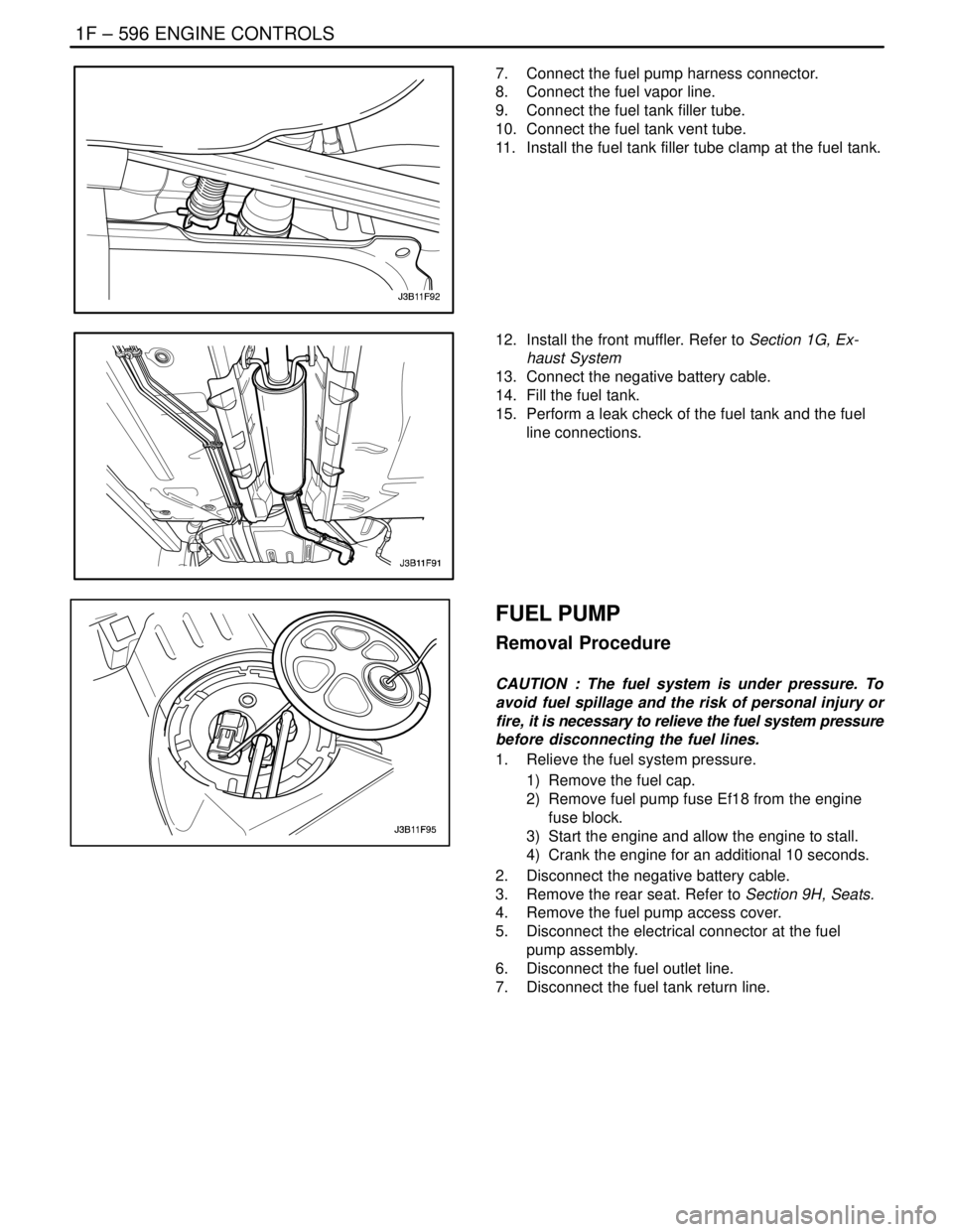
7. Connect the fuel pump harness connector.
8. Connect the fuel vapor line.
9. Connect the fuel tank filler tube.
10. Connect the fuel tank vent tube.
11. Install the fuel tank filler tube clamp at the fuel tank.
12. Install the front muffler. Refer to Section 1G, Ex-
haust System
13. Connect the negative battery cable.
14. Fill the fuel tank.
15. Perform a leak check of the fuel tank and the fuel
line connections.
FUEL PUMP
Removal Procedure
CAUTION : The fuel system is under pressure. To
avoid fuel spillage and the risk of personal injury or
fire, it is necessary to relieve the fuel system pressure
before disconnecting the fuel lines.
1. Relieve the fuel system pressure.
1) Remove the fuel cap.
2) Remove fuel pump fuse Ef18 from the engine
fuse block.
3) Start the engine and allow the engine to stall.
4) Crank the engine for an additional 10 seconds.
2. Disconnect the negative battery cable.
3. Remove the rear seat. Refer to Section 9H, Seats.
4. Remove the fuel pump access cover.
5. Disconnect the electrical connector at the fuel
pump assembly.
6. Disconnect the fuel outlet line.
7. Disconnect the fuel tank return line.
Page 844 of 2643
1F – 598IENGINE CONTROLS
DAEWOO V–121 BL4
Installation Procedure
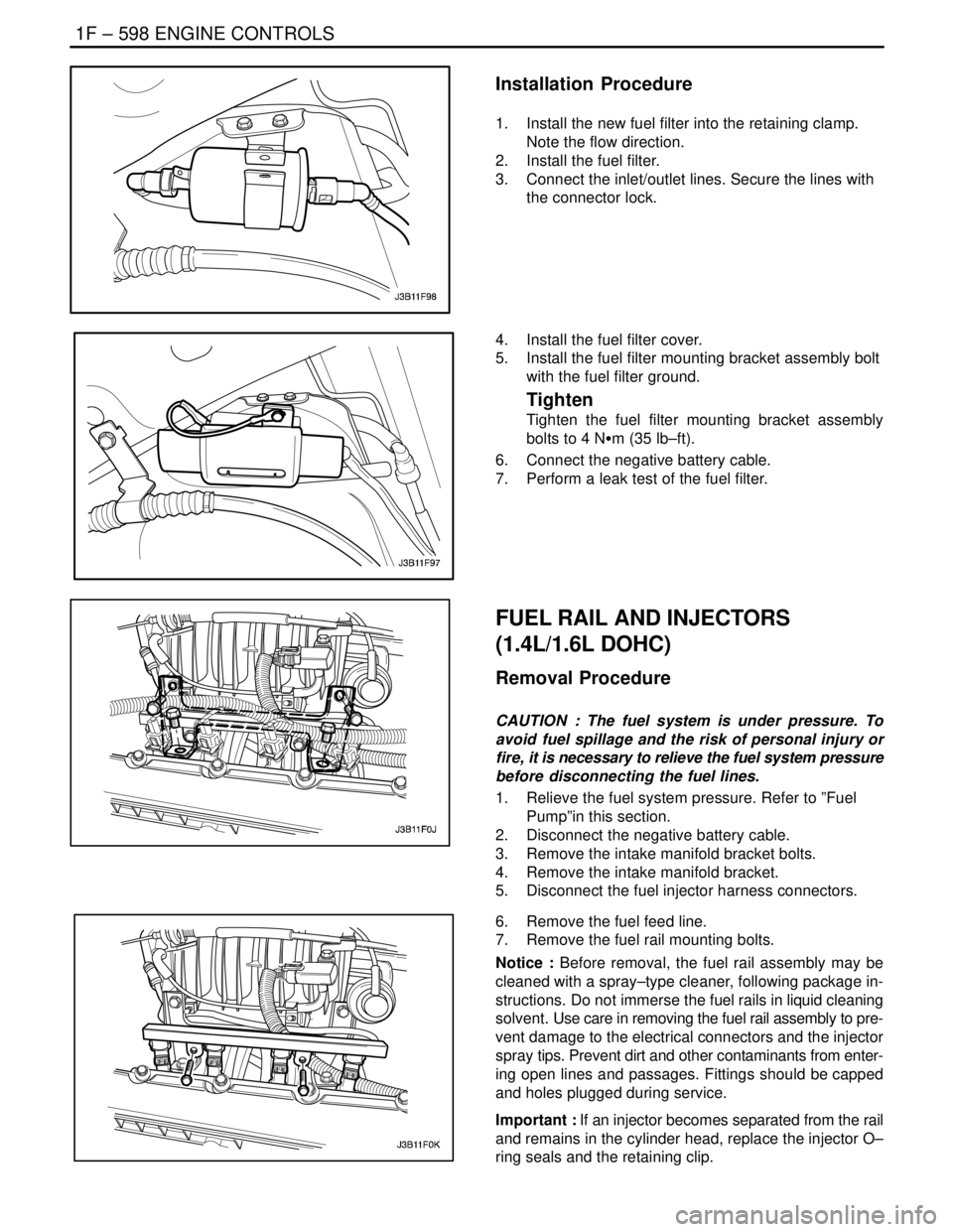
1. Install the new fuel filter into the retaining clamp.
Note the flow direction.
2. Install the fuel filter.
3. Connect the inlet/outlet lines. Secure the lines with
the connector lock.
4. Install the fuel filter cover.
5. Install the fuel filter mounting bracket assembly bolt
with the fuel filter ground.
Tighten
Tighten the fuel filter mounting bracket assembly
bolts to 4 NSm (35 lb–ft).
6. Connect the negative battery cable.
7. Perform a leak test of the fuel filter.
FUEL RAIL AND INJECTORS
(1.4L/1.6L DOHC)
Removal Procedure
CAUTION : The fuel system is under pressure. To
avoid fuel spillage and the risk of personal injury or
fire, it is necessary to relieve the fuel system pressure
before disconnecting the fuel lines.
1. Relieve the fuel system pressure. Refer to ”Fuel
Pump”in this section.
2. Disconnect the negative battery cable.
3. Remove the intake manifold bracket bolts.
4. Remove the intake manifold bracket.
5. Disconnect the fuel injector harness connectors.
6. Remove the fuel feed line.
7. Remove the fuel rail mounting bolts.
Notice : Before removal, the fuel rail assembly may be
cleaned with a spray–type cleaner, following package in-
structions. Do not immerse the fuel rails in liquid cleaning
solvent. Use care in removing the fuel rail assembly to pre-
vent damage to the electrical connectors and the injector
spray tips. Prevent dirt and other contaminants from enter-
ing open lines and passages. Fittings should be capped
and holes plugged during service.
Important : If an injector becomes separated from the rail
and remains in the cylinder head, replace the injector O–
ring seals and the retaining clip.
Page 847 of 2643
ENGINE CONTROLS 1F – 601
DAEWOO V–121 BL4
Notice : Before removal, the fuel rail assembly may be
cleaned with a spray–type cleaner, following package in-
structions. Do not immerse the fuel rails in liquid cleaning
solvent. Use care in removing the fuel rail assembly to pre-
vent damage to the electrical connectors and the injector
spray tips. Prevent dirt and other contaminants from enter-
ing open lines and passages. Fittings should be capped
and holes plugged during service.
Important : If an injector becomes separated from the rail
and remains in the cylinder head, replace the injector O–
ring seals and the retaining clip.
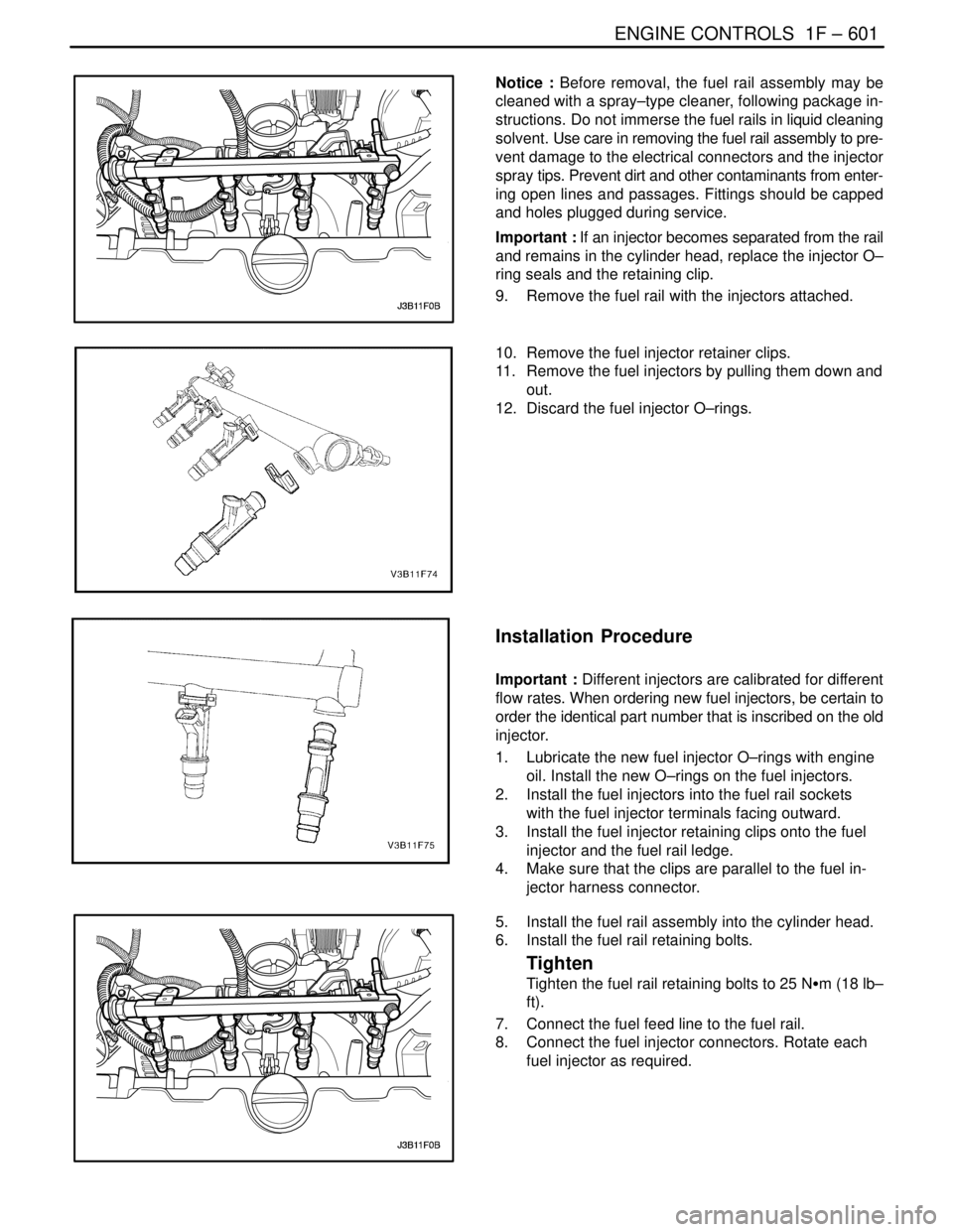
9. Remove the fuel rail with the injectors attached.
10. Remove the fuel injector retainer clips.
11. Remove the fuel injectors by pulling them down and
out.
12. Discard the fuel injector O–rings.
Installation Procedure
Important : Different injectors are calibrated for different
flow rates. When ordering new fuel injectors, be certain to
order the identical part number that is inscribed on the old
injector.
1. Lubricate the new fuel injector O–rings with engine
oil. Install the new O–rings on the fuel injectors.
2. Install the fuel injectors into the fuel rail sockets
with the fuel injector terminals facing outward.
3. Install the fuel injector retaining clips onto the fuel
injector and the fuel rail ledge.
4. Make sure that the clips are parallel to the fuel in-
jector harness connector.
5. Install the fuel rail assembly into the cylinder head.
6. Install the fuel rail retaining bolts.
Tighten
Tighten the fuel rail retaining bolts to 25 NSm (18 lb–
ft).
7. Connect the fuel feed line to the fuel rail.
8. Connect the fuel injector connectors. Rotate each
fuel injector as required.
Page 872 of 2643

1F – 626IENGINE CONTROLS
DAEWOO V–121 BL4
EXHAUST GAS RECIRCULATION
VA LV E
The Exhaust Gas Recirculation (EGR) system is used on
engines equipped with an automatic transaxle to lower
NOx (oxides of nitrogen) emission levels caused by high
combustion temperature. The EGR valve is controlled by
the engine control module (ECM). The EGR valve feeds
small amounts of exhaust gas into the intake manifold to
decrease combustion temperature. The amount of ex-
haust gas recirculated is controlled by variations in vacu-
um and exhaust back pressure. If too much exhaust gas
enters, combustion will not take place. For this reason,
very little exhaust gas is allowed to pass through the valve,
especially at idle.
The EGR valve is usually open under the following condi-
tions:
S Warm engine operation.
S Above idle speed.
Results of Incorrect Operation
Too much EGR flow tends to weaken combustion, causing
the engine to run roughly or to stop. With too much EGR
flow at idle, cruise, or cold operation, any of the following
conditions may occur:
S The engine stops after a cold start.
S The engine stops at idle after deceleration.
S The vehicle surges during cruise.
S Rough idle.
If the EGR valve stays open all the time, the engine may
not idle. Too little or no EGR flow allows combustion tem-
peratures to get too high during acceleration and load con-
ditions. This could cause the following conditions:
S Spark knock (detonation)
S Engine overheating
S Emission test failure
INTAKE AIR TEMPERATURE
SENSOR
The Intake Air Temperature (IAT) sensor is a thermistor,
a resistor which changes value based on the temperature
of the air entering the engine. Low temperature produces
a high resistance (4,500 ohms at –40°F [–40°C]), while
high temperature causes a low resistance (70 ohms at
266°F [130°C]).
The engine control module (ECM) provides 5 volts to the
IAT sensor through a resistor in the ECM and measures
the change in voltage to determine the IAT. The voltage will
be high when the manifold air is cold and low when the air
is hot. The ECM knows the intake IAT by measuring the
voltage.
The IAT sensor is also used to control spark timing when
the manifold air is cold.
A failure in the IAT sensor circuit sets a diagnostic trouble
code P0112 or P0113.
IDLE AIR CONTROL VALVE
Notice : Do not attempt to remove the protective cap to
readjust the stop screw. Misadjustment may result in dam-
age to the Idle Air Control (IAC) valve or to the throttle
body.
The IAC valve is mounted on the throttle body where it
controls the engine idle speed under the command of the
engine control module (ECM). The ECM sends voltage
pulses to the IAC valve motor windings, causing the IAC
valve pintle to move in or out a given distance (a step or
count) for each pulse. The pintle movement controls the
airflow around the throttle valves which, in turn, control the
engine idle speed.
The desired idle speeds for all engine operating conditions
are programmed into the calibration of the ECM. These
programmed engine speeds are based on the coolant
temperature, the park/neutral position switch status, the
vehicle speed, the battery voltage, and the A/C system
pressure (if equipped).
The ECM ”learns” the proper IAC valve positions to
achieve warm, stabilized idle speeds (rpm) desired for the
various conditions (park/neutral or drive, A/C on or off, if
equipped). This information is stored in ECM ”keep alive”
memories. Information is retained after the ignition is
turned OFF. All other IAC valve positioning is calculated
based on these memory values. As a result, engine varia-
tions due to wear and variations in the minimum throttle
valve position (within limits) do not affect engine idle
speeds. This system provides correct idle control under all
conditions. This also means that disconnecting power to
the ECM can result in incorrect idle control or the necessity
to partially press the accelerator when starting until the
ECM relearns idle control.
Engine idle speed is a function of total airflow into the en-
gine based on the IAC valve pintle position, the throttle
valve opening, and the calibrated vacuum loss through ac-
cessories. The minimum throttle valve position is set at the
factory with a stop screw. This setting allows enough air-
flow by the throttle valve to cause the IAC valve pintle to
be positioned a calibrated number of steps (counts) from
the seat during ”controlled” idle operation. The minimum
throttle valve position setting on this engine should not be
considered the ”minimum idle speed,” as on other fuel in-
jected engines. The throttle stop screw is covered with a
plug at the factory following adjustment.
If the IAC valve is suspected as the cause of improper idle
speed, refer to ”Idle Air Control System Check” in this sec-
tion.
MANIFOLD ABSOLUTE PRESSURE
SENSOR
The Manifold Absolute Pressure (MAP) sensor measures
the changes in the intake manifold pressure which result
from engine load and speed changes. It converts these to
a voltage output.