2004 DAEWOO LACETTI air condition
[x] Cancel search: air conditionPage 317 of 2643
ENGINE CONTROLS 1F – 71
DAEWOO V–121 BL4
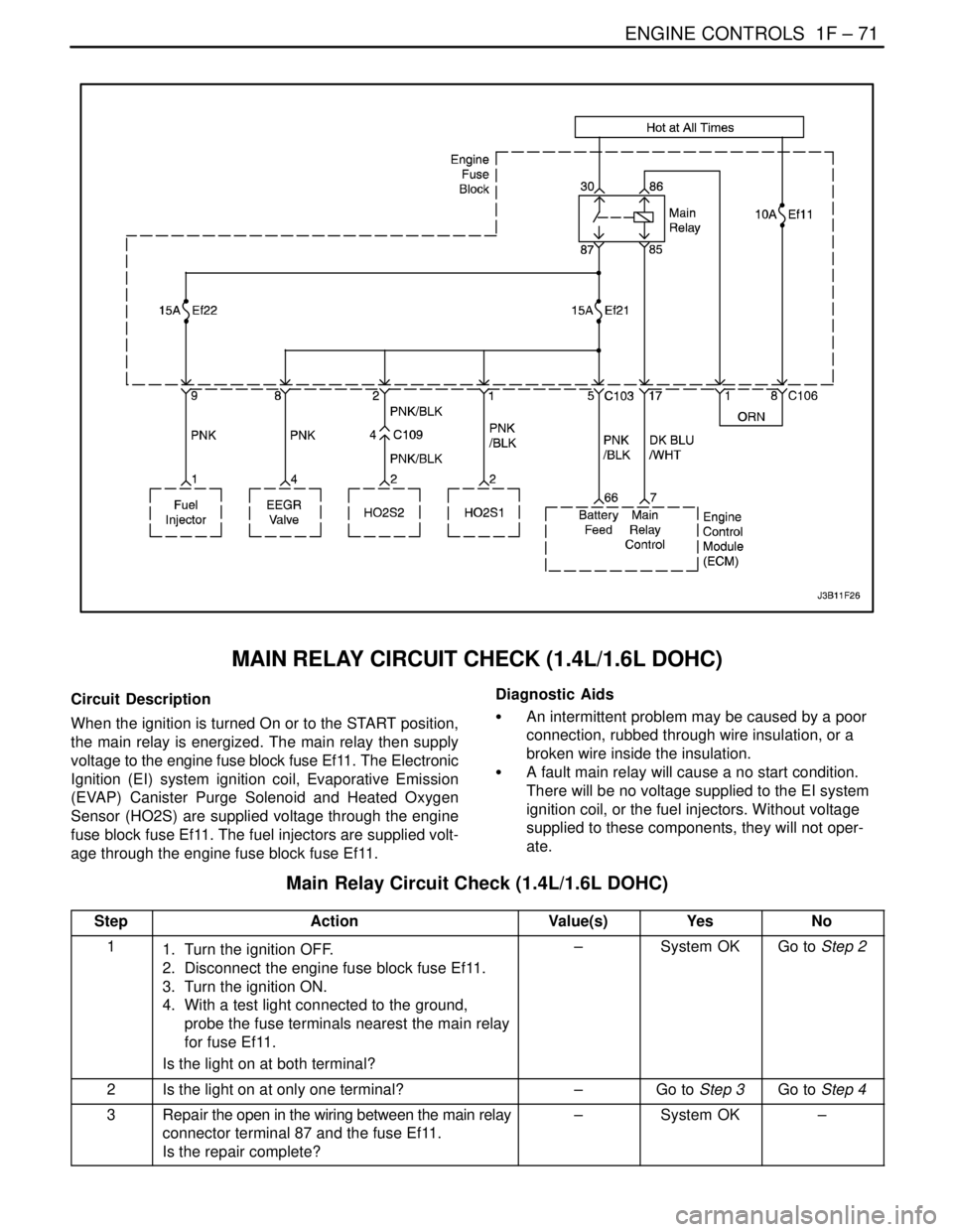
MAIN RELAY CIRCUIT CHECK (1.4L/1.6L DOHC)
Circuit Description
When the ignition is turned On or to the START position,
the main relay is energized. The main relay then supply
voltage to the engine fuse block fuse Ef11. The Electronic
Ignition (EI) system ignition coil, Evaporative Emission
(EVAP) Canister Purge Solenoid and Heated Oxygen
Sensor (HO2S) are supplied voltage through the engine
fuse block fuse Ef11. The fuel injectors are supplied volt-
age through the engine fuse block fuse Ef11.Diagnostic Aids
S An intermittent problem may be caused by a poor
connection, rubbed through wire insulation, or a
broken wire inside the insulation.
S A fault main relay will cause a no start condition.
There will be no voltage supplied to the EI system
ignition coil, or the fuel injectors. Without voltage
supplied to these components, they will not oper-
ate.
Main Relay Circuit Check (1.4L/1.6L DOHC)
StepActionValue(s)YesNo
11. Turn the ignition OFF.
2. Disconnect the engine fuse block fuse Ef11.
3. Turn the ignition ON.
4. With a test light connected to the ground,
probe the fuse terminals nearest the main relay
for fuse Ef11.
Is the light on at both terminal?–System OKGo to Step 2
2Is the light on at only one terminal?–Go to Step 3Go to Step 4
3Repair the open in the wiring between the main relay
connector terminal 87 and the fuse Ef11.
Is the repair complete?–System OK–
Page 319 of 2643

ENGINE CONTROLS 1F – 73
DAEWOO V–121 BL4
MAIN RELAY CIRCUIT CHECK (1.8L DOHC)
Circuit Description
When the ignition is turned On or to the START position,
the main relay is energized. The main relay then supply
voltage to the engine fuse block fuse F2. The Electronic
Ignition (EI) system ignition coil, Evaporative Emission
(EVAP) Canister Purge Solenoid and Heated Oxygen
Sensor (HO2S) are supplied voltage through the engine
fuse block fuse F2. The fuel injectors are supplied voltage
through the engine fuse block fuse F2.Diagnostic Aids
S An intermittent problem may be caused by a poor
connection, rubbed through wire insulation, or a
broken wire inside the insulation.
S A fault main relay will cause a no start condition.
There will be no voltage supplied to the EI system
ignition coil, or the fuel injectors. Without voltage
supplied to these components, they will not oper-
ate.
Main Relay Circuit Check (1.8L DOHC)
StepActionValue(s)YesNo
11. Turn the ignition OFF.
2. Disconnect the I/P fuse block fuse F2.
3. Turn the ignition ON.
4. With a test light connected to the ground,
probe the fuse terminals nearest the ignition
relay for fuse F2.
Is the light on at both terminal?–System OKGo to Step 2
2Is the light on at only one terminal?–Go to Step 3Go to Step 4
3Repair the open in the wiring between the ignition
relay connector terminal 87 and the fuse F2.
Is the repair complete?–System OK–
Page 339 of 2643

ENGINE CONTROLS 1F – 93
DAEWOO V–121 BL4
ENGINE COOLING FAN CIRCUIT CHECK – DUAL FAN
(1.4L/1.6L DOHC)
Circuit Description
The engine cooling fan circuit operates the main cooling
fan and the auxiliary cooling fan. The cooling fans are con-
trolled by the engine control module (ECM) based on in-
puts from the Engine Coolant Temperature (ECT) sensor
and the Air Conditioning Pressure (ACP) sensor. The
ECM controls the low speed cooling fan operation by inter-
nally grounding the ECM connector terminal 10. This ener-
gizes the low speed cooling fan relay and operates the
main cooling fan and the auxiliary cooling fan at low speed
as the cooling fans are connected in a series circuit. The
ECM controls the high speed cooling fan operation by in-
ternally grounding the ECM connector terminal 10 and the
ECM connector terminal 9 at the same time. This ener-
gizes the low speed cooling fan relay, the high speed cool-
ing fan relay, and the series/parallel cooling fan relay re-
sulting in high speed fan operation as the cooling fans are
now connected in a parallel circuit.
Diagnostic Aids
S If the owner complained of an overheating problem,
it must be determined if the complaint was due to
an actual boil over, or the engine coolant tempera-
ture gauge indicated overheating. If the engine is
overheating and the cooling fans are on, the cooling
system should be checked.
S If the engine fuse block fuses Ef11 become open
(blown) immediately after installation, inspect for a
short to ground in the wiring of the appropriate cir-
cuit. If the fuses become open (blown) when the
cooling fans are to be turned on by the ECM, sus-
pect a faulty cooling fan motor.
S The ECM will turn the cooling fans on at low speed
when the coolant temperature is 97°C (207°F). The
ECM will turn the cooling fans off when the coolant
temperature is 94°C(201°F).
S The ECM will turn the cooling fans on at high speed
when the coolant temperature is 101°C (214°F).
The ECM will change the cooling fans from high
speed to low speed when the coolant temperature
is 98°C (208°F).S The ECM will turn the cooling fans on at low speed
when the A/C system is on. The ECM will change
the cooling fans from low speed to high speed
when the high side A/C pressure is 1882 kPa (273
psi) then return to low speed when the high side
A/C pressure is 1448 kPa (210 psi). When the A/C
system is on, the ECM will change the cooling fans
from low to high speed when the coolant tempera-
ture reaches 117°C (244°F) then return to low
speed when the coolant temperature reaches
11 4°C (237°F).
S The cooling fan circuit can be checked quickly by
disconnecting the ECM connector 2 and grounding
the connector terminal 10. This should create low
speed cooling fan operation with the ignition ON. By
grounding the ECM connector terminals 10 and 9
and turning the ignition ON, high speed cooling fan
operation should be achieved.
Test Description
The number(s) below refer to step(s) on the diagnostic
table.
4. This step, along with step 5, checks for the ability of
the ECM to operate the cooling fans.
8. This step, along with step 9, checks for the ability of
the ECM to operate the cooling fans in response to
A/C pressure readings.
16. After confirming battery voltage and the ECM sup-
plying a ground to the coil side of the cooling fan
relay A, by jumpering connector terminals 30 and
87 it will be determined if the relay is at fault or a
wiring problem is present.
31. This step checks for the presence of battery volt-
age to the main cooling fan when the A/C is on. If
battery voltage is present and the cooling fans are
not operating, the problem is in the ground side of
the cooling fan circuit.
37. By directly grounding the ECM connector terminals
10 and 9, the main and auxiliary cooling fans
should run at high speed.
Engine Cooling Fan Circuit Check – Dual Fan (1.4L/1.6L DOHC)
StepActionValue(s)YesNo
1Perform an On–Board Diagnostic (EOBD) system
check.
Is the check completed?–Go to Step 2Go to
”On–Board
Diagnostic Sys-
tem Check”
21. Check the engine fuse block fuse Ef11.
2. Replace the fuse as needed.
Is the fuse OK?–Go to Step 3Go to
”Diagnostic
Aids”
Page 346 of 2643

1F – 100IENGINE CONTROLS
DAEWOO V–121 BL4
ENGINE COOLING FAN CIRCUIT CHECK – DUAL FAN
(1.8L DOHC)
Circuit Description
The engine cooling fan circuit operates the main cooling
fan and the auxiliary cooling fan. The cooling fans are con-
trolled by the engine control module (ECM) based on in-
puts from the Engine Coolant Temperature (ECT) sensor
and the Air Conditioning Pressure (ACP) sensor. The
ECM controls the low speed cooling fan operation by inter-
nally grounding the ECM connector terminal K28. This en-
ergizes the low speed cooling fan relay and operates the
main cooling fan and the auxiliary cooling fan at low speed
as the cooling fans are connected in a series circuit. The
ECM controls the high speed cooling fan operation by in-
ternally grounding the ECM connector terminal K28 and
the ECM connector terminal K12 at the same time. This
energizes the low speed cooling fan relay, the high speed
cooling fan relay, and the series/parallel cooling fan relay
resulting in high speed fan operation as the cooling fans
are now connected in a parallel circuit.
Diagnostic Aids
S If the owner complained of an overheating problem,
it must be determined if the complaint was due to
an actual boil over, or the engine coolant tempera-
ture gauge indicated overheating. If the engine is
overheating and the cooling fans are on, the cooling
system should be checked.
S If the engine fuse block fuses Ef21, Ef6, Ef8 be-
come open (blown) immediately after installation,
inspect for a short to ground in the wiring of the ap-
propriate circuit. If the fuses become open (blown)
when the cooling fans are to be turned on by the
ECM, suspect a faulty cooling fan motor.
S The ECM will turn the cooling fans on at low speed
when the coolant temperature is 97°C (207°F). The
ECM will turn the cooling fans off when the coolant
temperature is 94°C(201°F).
S The ECM will turn the cooling fans on at high speed
when the coolant temperature is 101°C (214°F).
The ECM will change the cooling fans from high
speed to low speed when the coolant temperature
is 98°C (208°F).S The ECM will turn the cooling fans on at low speed
when the A/C system is on. The ECM will change
the cooling fans from low speed to high speed
when the high side A/C pressure is 1882 kPa (273
psi) then return to low speed when the high side
A/C pressure is 1448 kPa (210 psi). When the A/C
system is on, the ECM will change the cooling fans
from low to high speed when the coolant tempera-
ture reaches 117°C (244°F) then return to low
speed when the coolant temperature reaches
11 4°C (237°F).
S The cooling fan circuit can be checked quickly by
disconnecting the ECM connector 2 and grounding
the connector terminal K28. This should create low
speed cooling fan operation with the ignition ON. By
grounding the ECM connector terminals K28 and
K12 and turning the ignition ON, high speed cooling
fan operation should be achieved.
Test Description
The number(s) below refer to step(s) on the diagnostic
table.
4. This step, along with step 5, checks for the ability of
the ECM to operate the cooling fans.
8. This step, along with step 9, checks for the ability of
the ECM to operate the cooling fans in response to
A/C pressure readings.
16. After confirming battery voltage and the ECM sup-
plying a ground to the coil side of the cooling fan
relay A, by jumpering connector terminals 30 and
87 it will be determined if the relay is at fault or a
wiring problem is present.
31. This step checks for the presence of battery volt-
age to the main cooling fan when the A/C is on. If
battery voltage is present and the cooling fans are
not operating, the problem is in the ground side of
the cooling fan circuit.
37. By directly grounding the ECM connector terminals
K28 and K12, the main and auxiliary cooling fans
should run at high speed.
Engine Cooling Fan Circuit Check – Dual Fan (1.8L DOHC)
StepActionValue(s)YesNo
1Perform an On–Board Diagnostic (EOBD) system
check.
Is the check completed?–Go to Step 2Go to
”On–Board
Diagnostic Sys-
tem Check”
21. Check the I/P fuse block fuse F2.
2. Replace the fuse as needed.
Is the fuse OK?–Go to Step 3Go to
”Diagnostic
Aids”
Page 352 of 2643

1F – 106IENGINE CONTROLS
DAEWOO V–121 BL4
DATA LINK CONNECTOR DIAGNOSIS (1.4L/1.6L DOHC)
Circuit Description
The provision for communicating with the Engine Control
Module (ECM) is the Data Link Connector (DLC). It is lo-
cated under the instrument panel. The DLC is used to con-
nect the scan tool. Battery power and ground is supplied
for the scan tool through the DLC. The Keyword 2000 seri-
al data circuit to the DLC allows the ECM to communicate
with the scan tool. A Universal Asynchronous Receiver
Transmitter (UART) serial data line is used to communi-
cate with the other modules such as the Electronic Brake
Control Module (EBCM), the Supplemental Inflatable Re-
straint (SIR) system. and the Instrument Panel Cluster.
Diagnostic Aids
Ensure that the correct application (model line, car year,
etc.) has been selected on the scan tool. If communication
still cannot be established, try the scan tool on another ve-
hicle to ensure that the scan tool or cables are not the
cause of the condition.
An intermittent may be caused by a poor connection,
rubbed through wire insulation, or a broken wire inside the
insulation.
Any circuitry that is suspected of causing an intermittent
complaint should be thoroughly checked for the following
conditions:
S Backed–out terminals.S Improper mating of terminals.
S Broken locks.
S Improperly formed or damaged terminals.
S Poor terminal–to–wiring connection.
S Physical damage to the wiring harness.
S Corrosion.
Test Description
Number(s) below refer to the step number(s) on the Diag-
nostic Table.
1. The On–Board Diagnostic (EOBD) System Check
prompts the technician to complete some basic
checks and store the freeze frame and failure re-
cords data on the scan tool if applicable. This
creates an electronic copy of the data taken when
the malfunction occurred. The information is then
stored on the scan tool for later reference.
2. Unlike the UART serial data circuit, the only time a
Class II serial data circuit has any voltage on it is
when a scan tool asks the ECM for information and
sends the information out.
5. Locate and repair any shorts that may have caused
the fuse to open before replacement, if the no volt-
age condition was due to an open fuse.
10. The scan tool or associated cables could be mal-
functioning. Refer to the scan tool’s manual for re-
pair information.
Page 354 of 2643

1F – 108IENGINE CONTROLS
DAEWOO V–121 BL4
DATA LINK CONNECTOR DIAGNOSIS (1.8L DOHC)
Circuit Description
The provision for communicating with the Engine Control
Module (ECM) is the Data Link Connector (DLC). It is lo-
cated under the instrument panel. The DLC is used to con-
nect the scan tool. Battery power and ground is supplied
for the scan tool through the DLC. The Keyword 2000 seri-
al data circuit to the DLC allows the ECM to communicate
with the scan tool. A Universal Asynchronous Receiver
Transmitter (UART) serial data line is used to communi-
cate with the other modules such as the Electronic Brake
Control Module (EBCM), the Supplemental Inflatable Re-
straint (SIR) system. and the Instrument Panel Cluster.
Diagnostic Aids
Ensure that the correct application (model line, car year,
etc.) has been selected on the scan tool. If communication
still cannot be established, try the scan tool on another ve-
hicle to ensure that the scan tool or cables are not the
cause of the condition.
An intermittent may be caused by a poor connection,
rubbed through wire insulation, or a broken wire inside the
insulation.
Any circuitry that is suspected of causing an intermittent
complaint should be thoroughly checked for the following
conditions:
S Backed–out terminals.S Improper mating of terminals.
S Broken locks.
S Improperly formed or damaged terminals.
S Poor terminal–to–wiring connection.
S Physical damage to the wiring harness.
S Corrosion.
Test Description
Number(s) below refer to the step number(s) on the Diag-
nostic Table.
1. The On–Board Diagnostic (EOBD) System Check
prompts the technician to complete some basic
checks and store the freeze frame and failure re-
cords data on the scan tool if applicable. This
creates an electronic copy of the data taken when
the malfunction occurred. The information is then
stored on the scan tool for later reference.
2. Unlike the UART serial data circuit, the only time a
Class II serial data circuit has any voltage on it is
when a scan tool asks the ECM for information and
sends the information out.
5. Locate and repair any shorts that may have caused
the fuse to open before replacement, if the no volt-
age condition was due to an open fuse.
10. The scan tool or associated cables could be mal-
functioning. Refer to the scan tool’s manual for re-
pair information.
Page 366 of 2643

1F – 120IENGINE CONTROLS
DAEWOO V–121 BL4
J3B11F51
BRNORN
/BLK
DIAGNOSTIC TROUBLE CODE (DTC) P0112
INTAKE AIR TEMPERATURE SENSOR LOW VOLTAGE
Circuit Description
The Intake Air Temperature (IAT) Sensor uses a thermis-
tor to control the signal voltage to the engine control mod-
ule (ECM). The ECM supplies a 5 volt reference voltage
and a ground to the sensor. When the air is cold, the resist-
ance is high ; therefore IAT sensor signal voltage will be
high. If the intake air is warm, resistance is low ; therefore
the IAT sensor signal voltage will be low.
Conditions for Setting the DTC
S IAT voltage is less than 0.01V.
Action Taken When the DTC Sets
S The Malfunction Indicator Lamp (MIL) will illuminate
after three consecutive trip with a fail.
S The ECM will record operating conditions at the
time the diagnostic fail. This information will be
stored in the Freeze Frame and Failure Records
buffers.
S A history DTC is stored.S The ECM will default to 605C(1405F) for intake air
temperature. The scan tool will not show the de-
faulted value.
Conditions for Clearing the MIL/DTC
S The MIL will turn off after four consecutive ignition
cycles in which the diagnostic runs without a fault.
S A history DTC will clear after 40 consecutive warm
up cycles without a fault.
S DTC(s) can be cleared by using the scan tool.
S Disconnecting the ECM battery feed for 10 sec-
onds.
Diagnostic Aids
If the vehicle is at ambient temperature, compare the IAT
sensor to the engine coolant temperature(ECT) sensor.
The IAT sensor and the ECT sensor should be relatively
close to each other. Use the temperature vs. Resistance
Values table to evaluate the possibility of a skewed sensor.
Refer to ”Temperature vs. Resistance” in this section.
Page 368 of 2643

1F – 122IENGINE CONTROLS
DAEWOO V–121 BL4
J3B11F51
BRNORN
/BLK
DIAGNOSTIC TROUBLE CODE (DTC) P0113
INTAKE AIR TEMPERATURE SENSOR HIGH VOLTAGE
Circuit Description
The Intake Air Temperature (IAT) Sensor uses a thermis-
tor to control the signal voltage to the engine control mod-
ule (ECM). The ECM supplies a 5 volt reference voltage
and a ground to the sensor . when the air is cold, the resist-
ance is high ; therefore IAT sensor signal voltage will be
high. If the intake air is warm, resistance is low ; therefore
the IAT sensor signal voltage will be low.
Conditions for Setting the DTC
S IAT voltage is less than 4.99V.
Action Taken When the DTC Sets
S The Malfunction Indicator Lamp (MIL) will illuminate
after three consecutive trip with a fail.
S The ECM will record operating conditions at the
time the diagnostic fail. This information will be
stored in the Freeze Frame and Failure Records
buffers.
S A history DTC is stored.S The ECM will default to 605C(1405F) for intake air
temperature. The scan tool will not show the de-
faulted value.
Conditions for Clearing the MIL/DTC
S The MIL will turn off after four consecutive ignition
cycles in which the diagnostic runs without a fault.
S A history DTC will clear after 40 consecutive warm
up cycles without a fault.
S DTC(s) can be cleared by using the scan tool.
S Disconnecting the ECM battery feed for 10 sec-
onds.
Diagnostic Aids
S If the vehicle is at ambient temperature, compare
the IAT sensor to the engine coolant temperature
(ECT) sensor. The IAT sensor and the ECT sensor
should be relatively close to each other.
S Use the temperature vs. Resistance Values table to
evaluate the possibility of a skewed sensor. Refer
to ”Temperature vs. Resistance” in this section.