Page 1030 of 2643
4A – 14IHYDRAULIC BRAKES
DAEWOO V–121 BL4
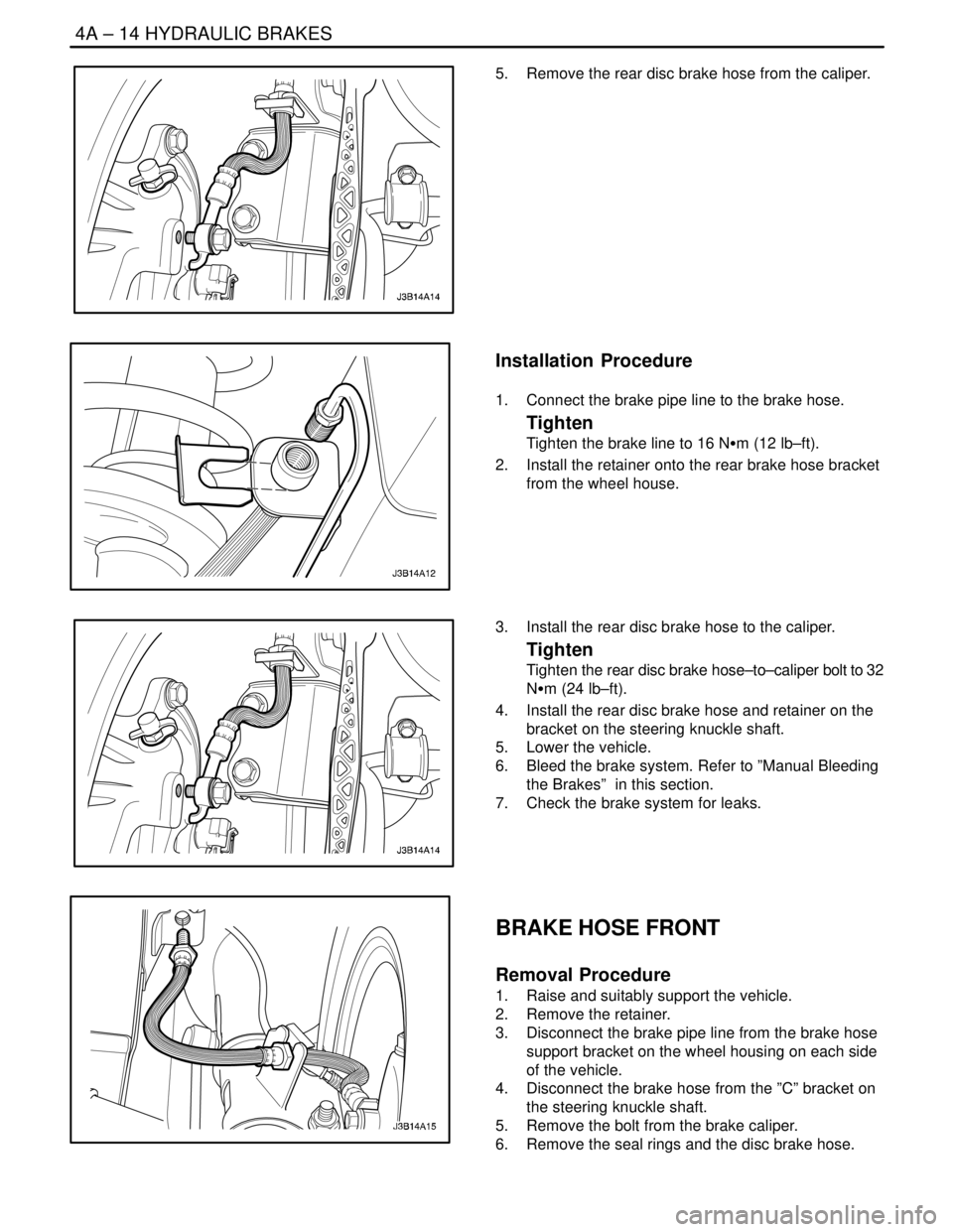
5. Remove the rear disc brake hose from the caliper.
Installation Procedure
1. Connect the brake pipe line to the brake hose.
Tighten
Tighten the brake line to 16 NSm (12 lb–ft).
2. Install the retainer onto the rear brake hose bracket
from the wheel house.
3. Install the rear disc brake hose to the caliper.
Tighten
Tighten the rear disc brake hose–to–caliper bolt to 32
NSm (24 lb–ft).
4. Install the rear disc brake hose and retainer on the
bracket on the steering knuckle shaft.
5. Lower the vehicle.
6. Bleed the brake system. Refer to ”Manual Bleeding
the Brakes” in this section.
7. Check the brake system for leaks.
BRAKE HOSE FRONT
Removal Procedure
1. Raise and suitably support the vehicle.
2. Remove the retainer.
3. Disconnect the brake pipe line from the brake hose
support bracket on the wheel housing on each side
of the vehicle.
4. Disconnect the brake hose from the ”C” bracket on
the steering knuckle shaft.
5. Remove the bolt from the brake caliper.
6. Remove the seal rings and the disc brake hose.
Page 1031 of 2643
HYDRAULIC BRAKES 4A – 15
DAEWOO V–121 BL4
Installation Procedure
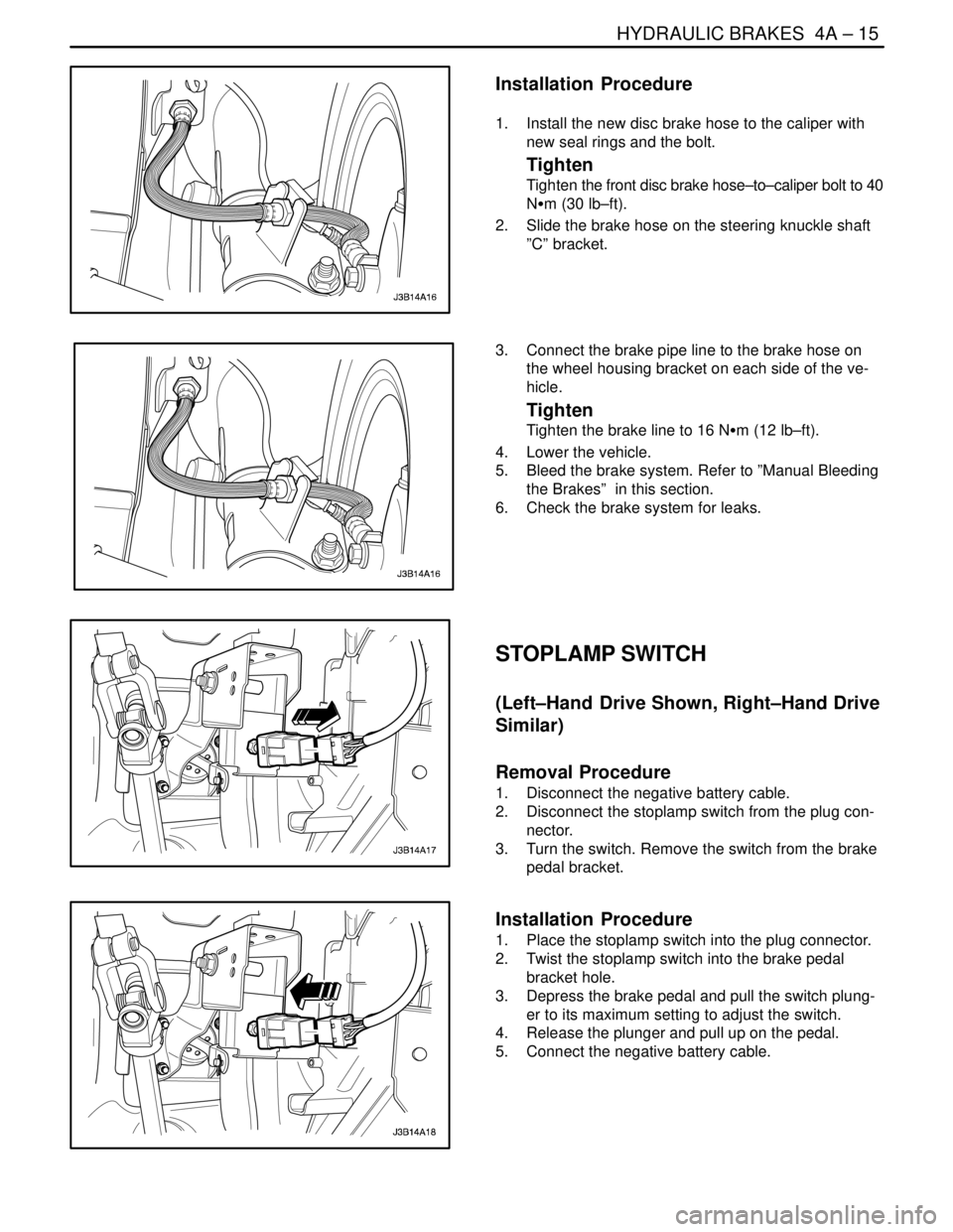
1. Install the new disc brake hose to the caliper with
new seal rings and the bolt.
Tighten
Tighten the front disc brake hose–to–caliper bolt to 40
NSm (30 lb–ft).
2. Slide the brake hose on the steering knuckle shaft
”C” bracket.
3. Connect the brake pipe line to the brake hose on
the wheel housing bracket on each side of the ve-
hicle.
Tighten
Tighten the brake line to 16 NSm (12 lb–ft).
4. Lower the vehicle.
5. Bleed the brake system. Refer to ”Manual Bleeding
the Brakes” in this section.
6. Check the brake system for leaks.
STOPLAMP SWITCH
(Left–Hand Drive Shown, Right–Hand Drive
Similar)
Removal Procedure
1. Disconnect the negative battery cable.
2. Disconnect the stoplamp switch from the plug con-
nector.
3. Turn the switch. Remove the switch from the brake
pedal bracket.
Installation Procedure
1. Place the stoplamp switch into the plug connector.
2. Twist the stoplamp switch into the brake pedal
bracket hole.
3. Depress the brake pedal and pull the switch plung-
er to its maximum setting to adjust the switch.
4. Release the plunger and pull up on the pedal.
5. Connect the negative battery cable.
Page 1032 of 2643
4A – 16IHYDRAULIC BRAKES
DAEWOO V–121 BL4
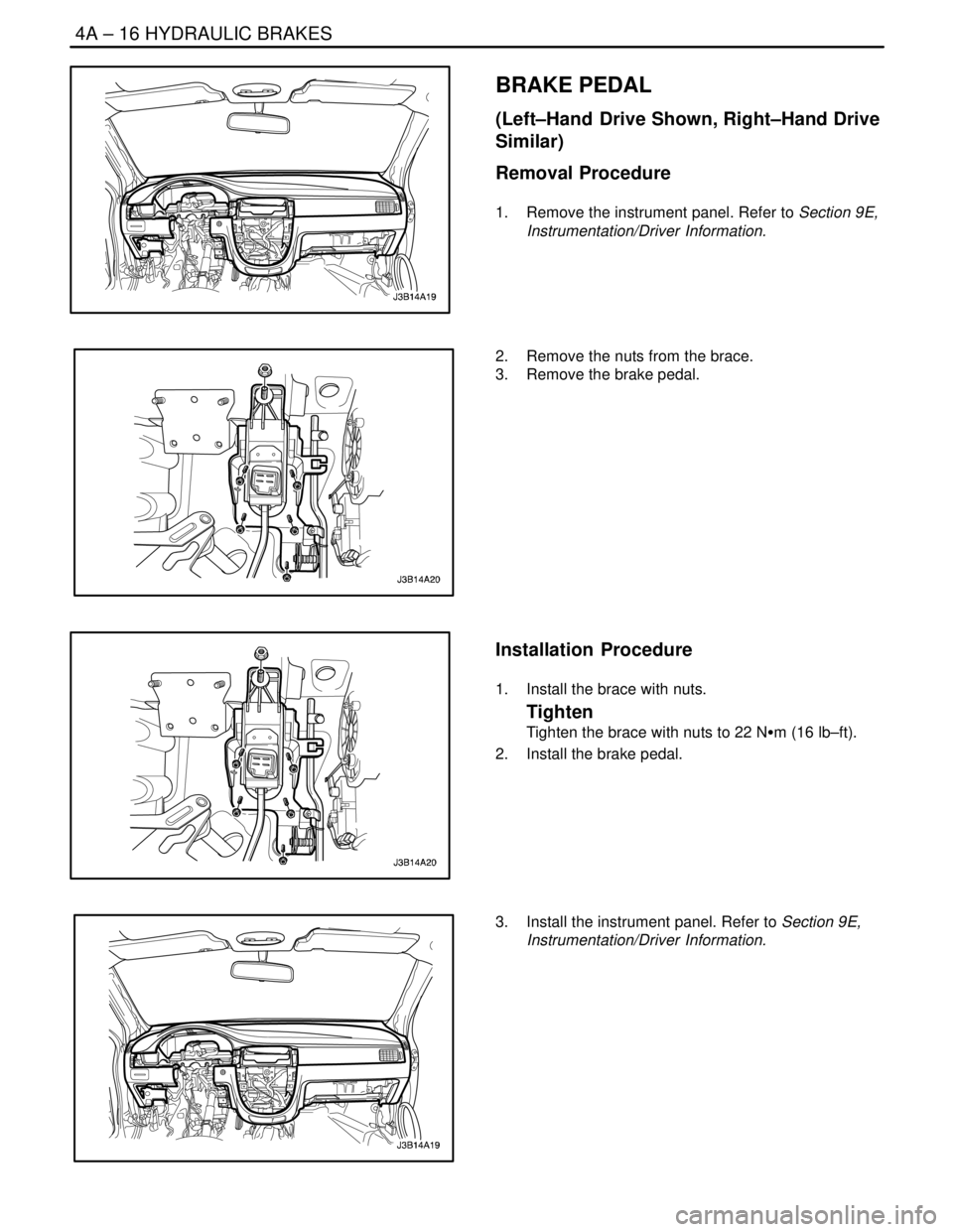
BRAKE PEDAL
(Left–Hand Drive Shown, Right–Hand Drive
Similar)
Removal Procedure
1. Remove the instrument panel. Refer to Section 9E,
Instrumentation/Driver Information.
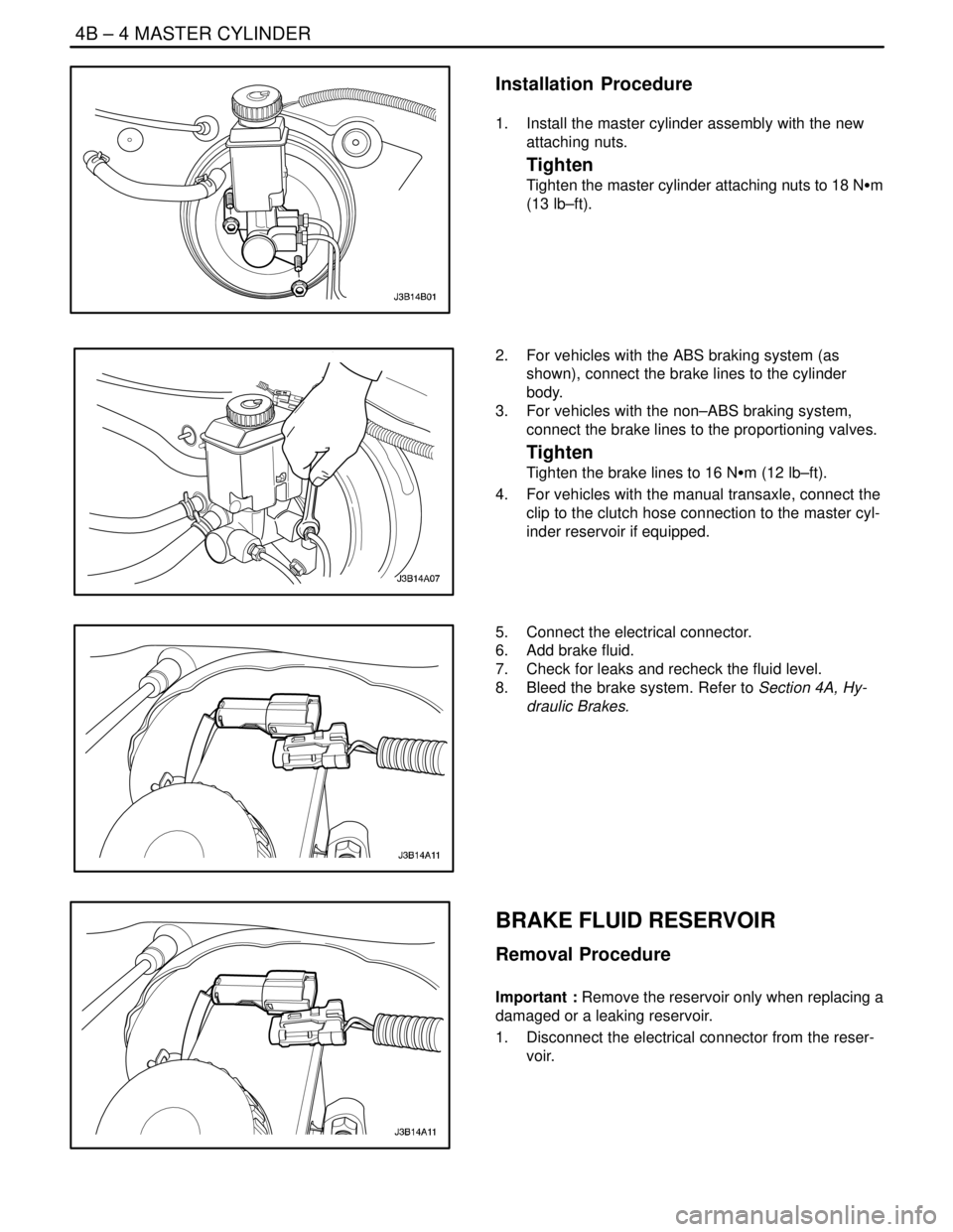
2. Remove the nuts from the brace.
3. Remove the brake pedal.
Installation Procedure
1. Install the brace with nuts.
Tighten
Tighten the brace with nuts to 22 NSm (16 lb–ft).
2. Install the brake pedal.
3. Install the instrument panel. Refer to Section 9E,
Instrumentation/Driver Information.
Page 1034 of 2643

SECTION : 4B
MASTER CYLINDER
TABLE OF CONTENTS
SPECIFICATIONS4B–1 . . . . . . . . . . . . . . . . . . . . . . . . . .
Fastener Tightening Specifications 4B–1. . . . . . . . . .
DIAGNOSIS4B–2 . . . . . . . . . . . . . . . . . . . . . . . . . . . . . . . .
Checking Brake Proportioning Valve 4B–2. . . . . . . . .
MAINTENANCE AND REPAIR4B–3 . . . . . . . . . . . . . . .
ON–VEHICLE SERVICE 4B–3. . . . . . . . . . . . . . . . . . . . .
Master Cylinder Assembly 4B–3. . . . . . . . . . . . . . . . . . Brake Fluid Reservoir 4B–4. . . . . . . . . . . . . . . . . . . . . .
UNIT REPAIR 4B–7. . . . . . . . . . . . . . . . . . . . . . . . . . . . . .
Master Cylinder Overhaul 4B–7. . . . . . . . . . . . . . . . . . .
GENERAL DESCRIPTION AND SYSTEM
OPERATION4B–9 . . . . . . . . . . . . . . . . . . . . . . . . . . . . . .
Master Cylinder 4B–9. . . . . . . . . . . . . . . . . . . . . . . . . . .
Fluid Level Sensor 4B–9. . . . . . . . . . . . . . . . . . . . . . . .
SPECIFICATIONS
FASTENER TIGHTENING SPECIFICATIONS
ApplicationNSmLb–FtLb–In
Brake Lines1612–
Master Cylinder Attaching Nuts1813–
Proportioning Valves2216–
Page 1037 of 2643
4B – 4IMASTER CYLINDER
DAEWOO V–121 BL4
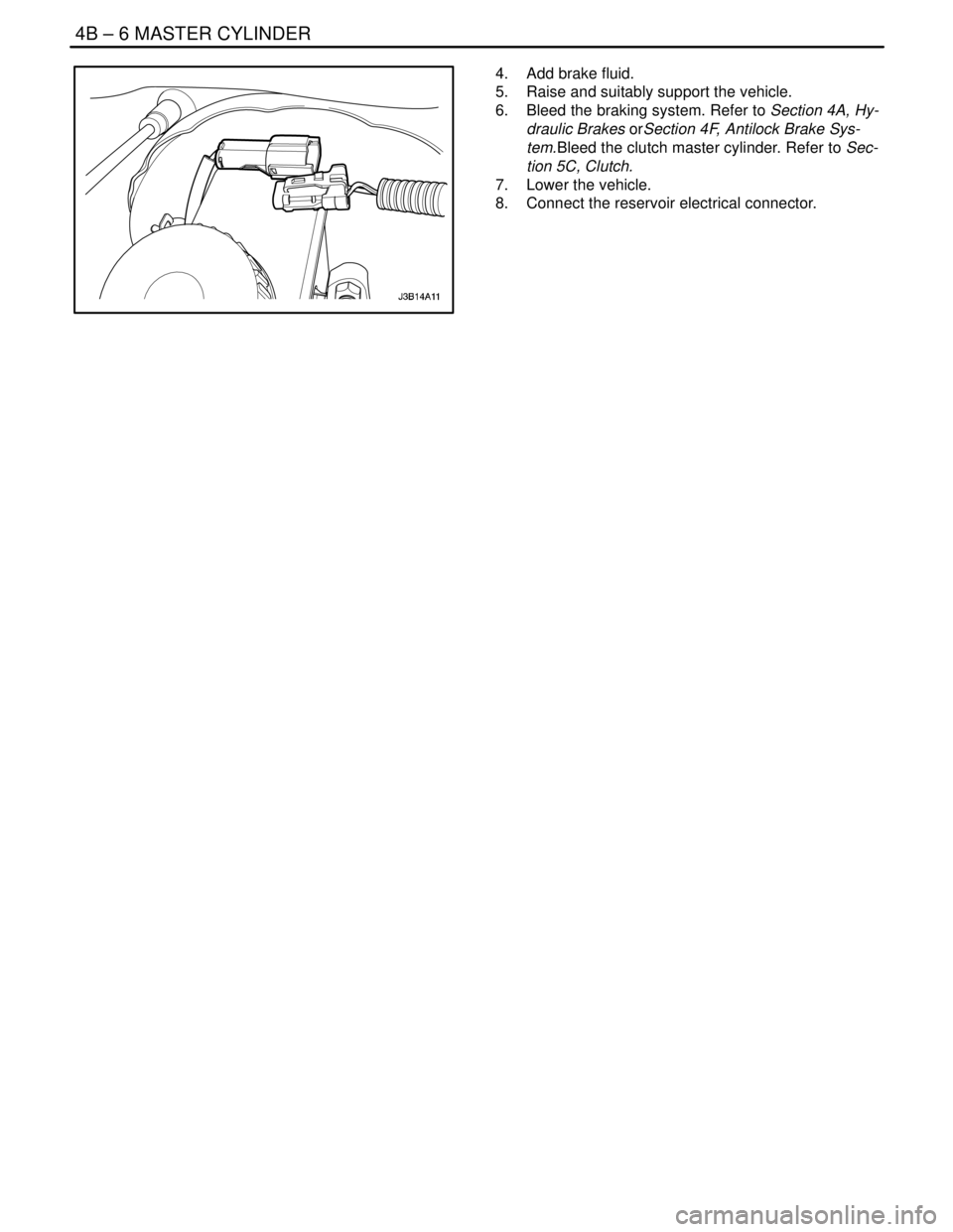
Installation Procedure
1. Install the master cylinder assembly with the new
attaching nuts.
Tighten
Tighten the master cylinder attaching nuts to 18 NSm
(13 lb–ft).
2. For vehicles with the ABS braking system (as
shown), connect the brake lines to the cylinder
body.
3. For vehicles with the non–ABS braking system,
connect the brake lines to the proportioning valves.
Tighten
Tighten the brake lines to 16 NSm (12 lb–ft).
4. For vehicles with the manual transaxle, connect the
clip to the clutch hose connection to the master cyl-
inder reservoir if equipped.
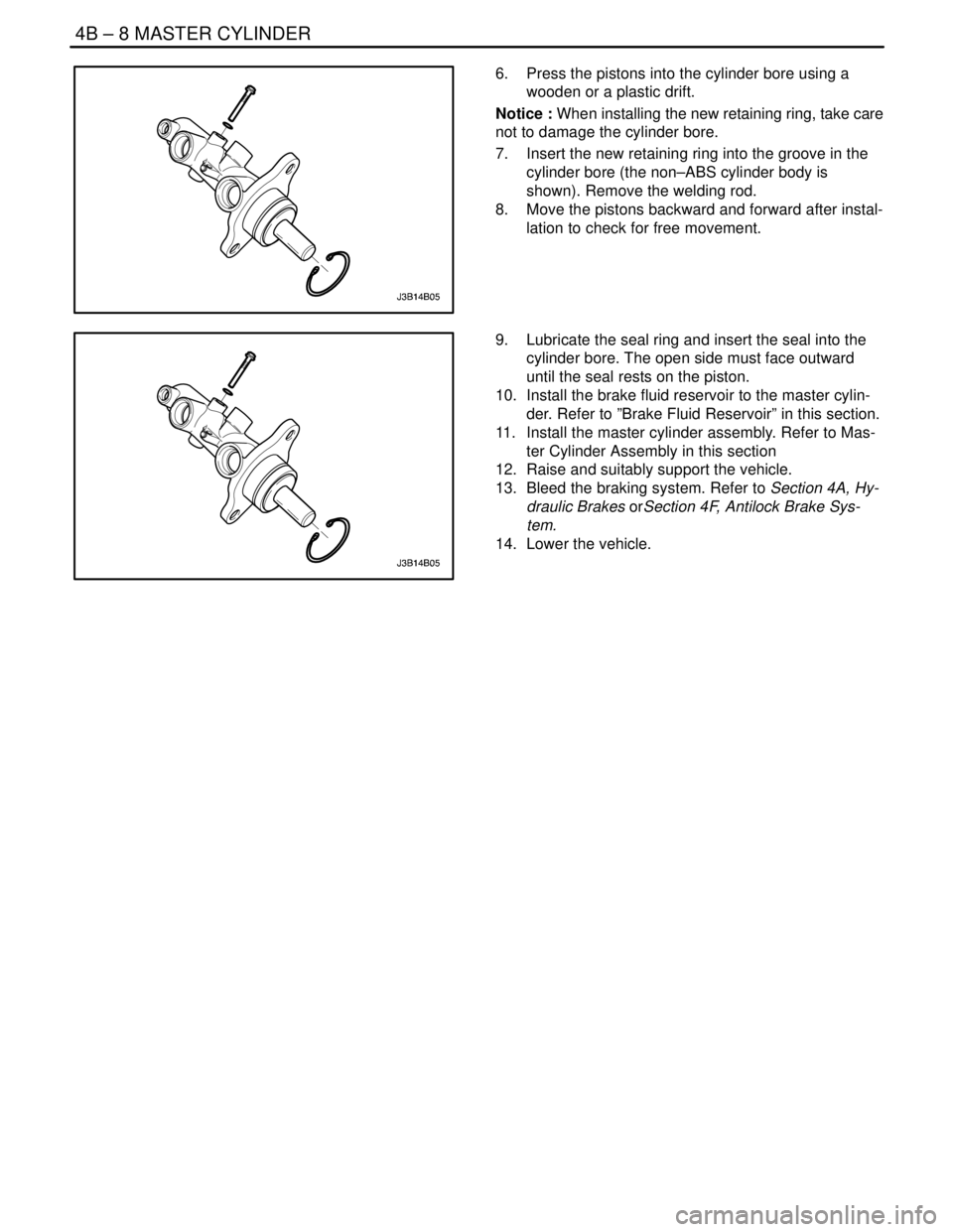
5. Connect the electrical connector.
6. Add brake fluid.
7. Check for leaks and recheck the fluid level.
8. Bleed the brake system. Refer to Section 4A, Hy-
draulic Brakes.
BRAKE FLUID RESERVOIR
Removal Procedure
Important : Remove the reservoir only when replacing a
damaged or a leaking reservoir.
1. Disconnect the electrical connector from the reser-
voir.
Page 1039 of 2643
4B – 6IMASTER CYLINDER
DAEWOO V–121 BL4
4. Add brake fluid.
5. Raise and suitably support the vehicle.
6. Bleed the braking system. Refer to Section 4A, Hy-
draulic Brakes orSection 4F, Antilock Brake Sys-
tem.Bleed the clutch master cylinder. Refer to Sec-
tion 5C, Clutch.
7. Lower the vehicle.
8. Connect the reservoir electrical connector.
Page 1040 of 2643
MASTER CYLINDER 4B – 7
DAEWOO V–121 BL4
UNIT REPAIR
MASTER CYLINDER OVERHAUL
Disassembly Procedure
1. Remove the master cylinder. Refer to ”Master Cyl-
inder Assembly” in this section.
2. Remove the brake fluid reservoir. Refer to ”Brake
Fluid Reservoir” in this section.
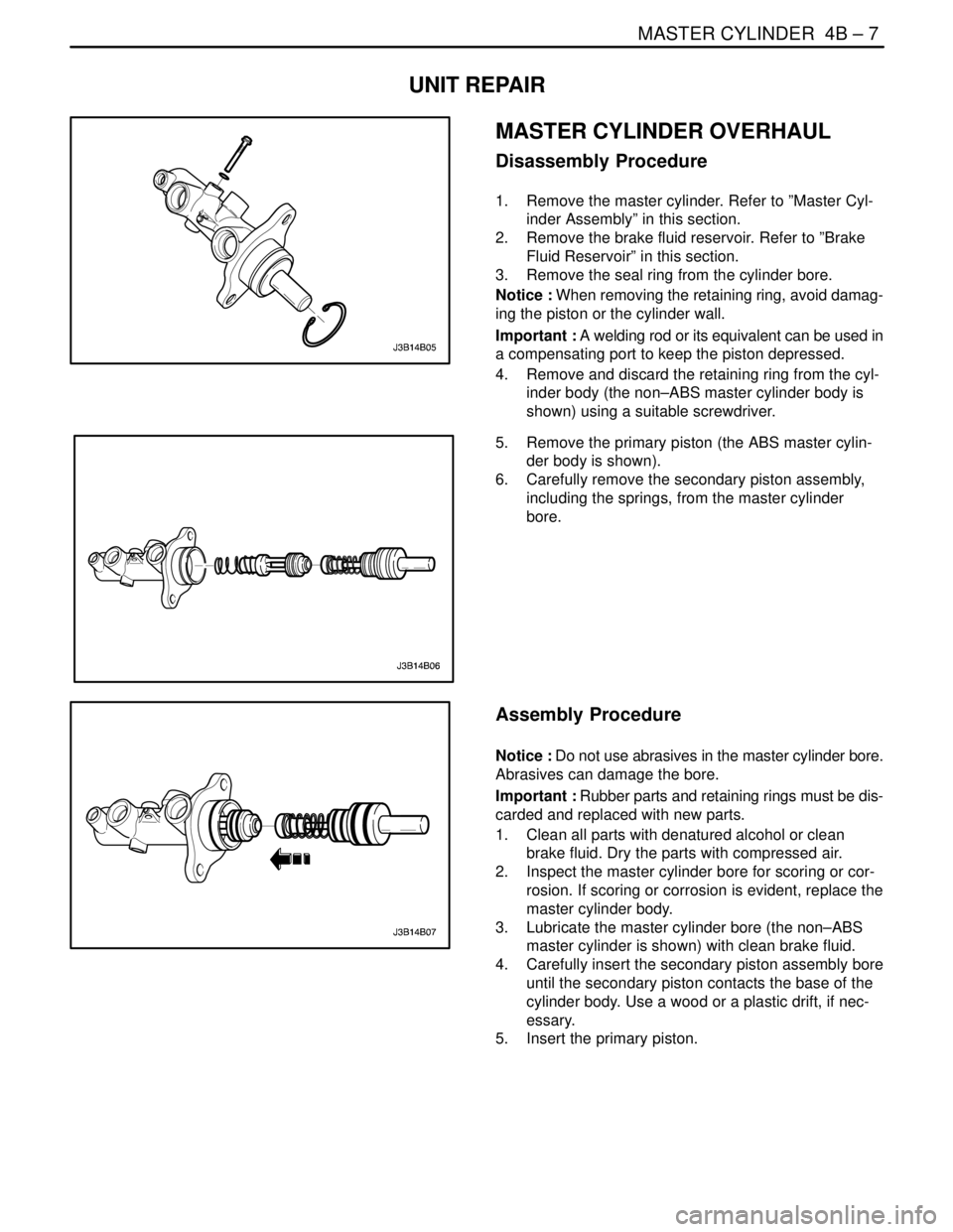
3. Remove the seal ring from the cylinder bore.
Notice : When removing the retaining ring, avoid damag-
ing the piston or the cylinder wall.
Important : A welding rod or its equivalent can be used in
a compensating port to keep the piston depressed.
4. Remove and discard the retaining ring from the cyl-
inder body (the non–ABS master cylinder body is
shown) using a suitable screwdriver.
5. Remove the primary piston (the ABS master cylin-
der body is shown).
6. Carefully remove the secondary piston assembly,
including the springs, from the master cylinder
bore.
Assembly Procedure
Notice : Do not use abrasives in the master cylinder bore.
Abrasives can damage the bore.
Important : Rubber parts and retaining rings must be dis-
carded and replaced with new parts.
1. Clean all parts with denatured alcohol or clean
brake fluid. Dry the parts with compressed air.
2. Inspect the master cylinder bore for scoring or cor-
rosion. If scoring or corrosion is evident, replace the
master cylinder body.
3. Lubricate the master cylinder bore (the non–ABS
master cylinder is shown) with clean brake fluid.
4. Carefully insert the secondary piston assembly bore
until the secondary piston contacts the base of the
cylinder body. Use a wood or a plastic drift, if nec-
essary.
5. Insert the primary piston.
Page 1041 of 2643
4B – 8IMASTER CYLINDER
DAEWOO V–121 BL4
6. Press the pistons into the cylinder bore using a
wooden or a plastic drift.
Notice : When installing the new retaining ring, take care
not to damage the cylinder bore.
7. Insert the new retaining ring into the groove in the
cylinder bore (the non–ABS cylinder body is
shown). Remove the welding rod.
8. Move the pistons backward and forward after instal-
lation to check for free movement.
9. Lubricate the seal ring and insert the seal into the
cylinder bore. The open side must face outward
until the seal rests on the piston.
10. Install the brake fluid reservoir to the master cylin-
der. Refer to ”Brake Fluid Reservoir” in this section.
11. Install the master cylinder assembly. Refer to Mas-
ter Cylinder Assembly in this section
12. Raise and suitably support the vehicle.
13. Bleed the braking system. Refer to Section 4A, Hy-
draulic Brakes orSection 4F, Antilock Brake Sys-
tem.
14. Lower the vehicle.