2004 DAEWOO LACETTI Fuel tank
[x] Cancel search: Fuel tankPage 289 of 2643

ENGINE CONTROLS 1F – 43
DAEWOO V–121 BL4
StepNo Yes Value(s) Action
301. Disconnect vacuum line from the fuel pressure
regulator.
2. Inspect the vacuum line for the presence of
fuel.
3. Inspect the fuel pressure regulator vacuum port
for the presence of fuel.
Is any fuel present?–Go to Step 31Go to Step 32
31Replace the fuel pressure regulator.
Is the repair complete?–Go to Step 2–
321. Remove the fuel pump assembly from the fuel
tank.
2. Inspect the fuel pump sender and the fuel cou-
pling hoses for a restriction.
3. Inspect the in–tank fuel filter for restriction.
Is the problem found?–Go to Step 33Go to Step 25
33Replace the fuel pump sender, the in–tank fuel filter,
and/or the fuel coupling hoses as needed.
Is the repair complete?–Go to Step 2–
341. Turn the ignition OFF.
2. Disconnect the electric connector at the fuel
pump.
3. Connect a test light between fuel pump con-
nector terminal 3 and ground.
4. Turn the ignition ON.
5. With the ignition ON, the test light should illumi-
nate for the time specified.
Is the test light on?2 secGo to Step 35Go to Step 36
35Repair the open circuit between the fuel pump con-
nector terminal 2 and ground.
Is the repair complete?–Go to Step 2–
361. Turn the ignition OFF.
2. Disconnect the fuel pump relay.
3. Turn the ignition ON.
4. Measure the voltage at terminal 30 and 86 of
fuel pump relay.
Is the voltage within the value specified?11–14 VGo to Step 38Go to Step 37
37Repair open or short circuit for power supply.
Is the repair complete?–Go to Step 2–
381. Turn the ignition OFF.
2. Disconnect ECM connector.
3. Using an ohmmeter, measure the resistance
between following terminals.
S Terminal 6 of ECM and terminal 85 of fuel
pump relay.
S Terminal 87 of fuel pump relay and terminal
3 of fuel pump.
Does the resistance within the value specified?0 WGo to Step 40Go to Step 39
Page 297 of 2643

ENGINE CONTROLS 1F – 51
DAEWOO V–121 BL4
StepNo Yes Value(s) Action
471. Disconnect the vacuum line from the fuel pres-
sure regulator.
2. Inspect the vacuum line for the presence of
fuel.
3. Inspect the fuel pressure regulator vacuum port
for the presence of fuel.
Is any fuel presen–Go to Step 50Go to Step 51
48Check the fuel for contamination.
Is the fuel contaminated?–Go to Step 49Go to Step 65
491. Remove the contaminated fuel from the fuel
tank.
2. Clean the fuel tank as needed.
Is the repair complete?–Go to Step 3–
50Replace the fuel pressure regulator.
Is the repair complete?–Go to Step 3–
511. Remove the fuel pump assembly from the fuel
tank.
2. Inspect the fuel pump sender and the fuel cou-
pling hoses for a restriction.
3. Inspect the in–tank fuel filter for a restriction.
Is the problem found?–Go to Step 52Go to Step 43
52Replace the fuel pump sender, the in–tank fuel filter,
and/or the fuel coupling hoses as needed.
Is the repair complete?–Go to Step 3–
531. Turn the ignition OFF.
2. Disconnect the electrical connector at the fuel
pump.
3. Connect a test light between the fuel pump
connector terminal 3 and a known good
ground.
4. Turn the ignition ON.
5. With the ignition ON, the test light should light
for the time specified.
Is the test light on?2 secGo to Step 54Go to Step 55
54Repair the open wire between the fuel pump connec-
tor terminal 2 and ground.
Is the repair complete–Go to Step 3–
551. Turn the ignition OFF.
2. Disconnect the fuel pump relay.
3. Connect a test light between the fuel pump
relay connector terminal 85 and ground.
4. Turn the ignition ON.
Is the test light on?2 secGo to Step 56Go to Step 62
561. Turn the ignition OFF.
2. Connect a test light between the fuel pump
relay connector terminal 86 and battery posi-
tive.
3. Turn the ignition ON.
4. With the ignition ON, the test light should light
for the time specified.
Is the test light on?–Go to Step 57Go to Step 61
Page 308 of 2643

1F – 62IENGINE CONTROLS
DAEWOO V–121 BL4
FUEL SYSTEM DIAGNOSIS
Circuit Description
The fuel pump is an in–tank type mounted to a fuel sender
assembly. The fuel pump will remain on as long as the en-
gine is cranking or running and the Engine Control Module
(ECM) is receiving reference pulses from the crankshaft
position (CKP) sensor. If there are no reference pulses,
the ECM will turn off the fuel pump two seconds after the
ignition switch is turned ON or two seconds after the en-
gine stops running. The fuel pump delivers fuel to the fuel
rail and the fuel injectors, where the fuel system pressure
is controlled from 284 to 325 kPa (41 to 47 psi) by the fuel
pressure regulator. The excess fuel is returned to the fuel
tank.
Test Description
The number(s) below refer to step(s) on the diagnostic
table.
2. When the engine is idling, the intake manifold vacu-
um is high. This vacuum is applied to the fuel pres-
sure regulator diaphragm, offsetting the spring
pressure inside the fuel pressure regulator and low-
ering the fuel pressure.10. If there is fuel bleeding back through the fuel return
outlet, this is due to a faulty fuel pressure regulator.
14. Another symptom often present when the fuel injec-
tors are leaking is hard starting. Leaking fuel injec-
tors can cause a flooding condition.
23. Fuel leaking from the fuel pump inlet is due to a
faulty one–way check valve in the fuel pump.
CAUTION : The fuel system is under pressure. To
avoid fuel spillage and the risk of personal injury or
fire, it is necessary to relieve the fuel system pressure
before disconnecting the fuel lines.
CAUTION : Do not pinch or restrict nylon fuel lines to
avoid damage that could cause a fuel leak, resulting
in possible fire or personal injury.
Fuel Pressure Relief Procedure
1. Remove the fuel cap.
2. Remove the fuel pump fuse EF18 from the engine
fuse box.
3. Start the engine and allow the engine to stall.
4. Crank the engine for an additional 10 seconds.
Fuel System Diagnosis
StepActionValue(s)YesNo
11. Relieve the fuel system pressure.
2. Install a fuel pressure gauge.
3. Turn the ignition ON.
Is the fuel pressure within the values specified and
holding steady?284~325 kPa
(41~47psi)Go to Step 2Go to Step 4
21. Allow the engine to idle.
2. Disconnect the vacuum hose from the fuel
pressure regulator.
3. Connect a vacuum pump with a gauge to the
fuel pressure regulator vacuum port.
4. Apply 41~47 kPa (12~14 in. Hg) of vacuum to
the fuel pressure regulator.
Does the fuel pressure decrease?–Go to Step 3Go to Step 15
31. Locate and correct the cause of the vacuum
restriction to the fuel pressure regulator.
2. Confirm the operation of the fuel pressure reg-
ulator.
Is the repair complete?–System OK–
41. Relieve the fuel system pressure.
2. Install a fuel pressure gauge.
3. Turn the ignition ON.
Is the fuel pressure within the values specified but
not holding steady?284~325 kPa
(41~47psi)Go to Step 5Go to Step 16
5Inspect the fuel lines for a leak.
Is the problem found?–Go to Step 6Go to Step 7
Page 311 of 2643
ENGINE CONTROLS 1F – 65
DAEWOO V–121 BL4
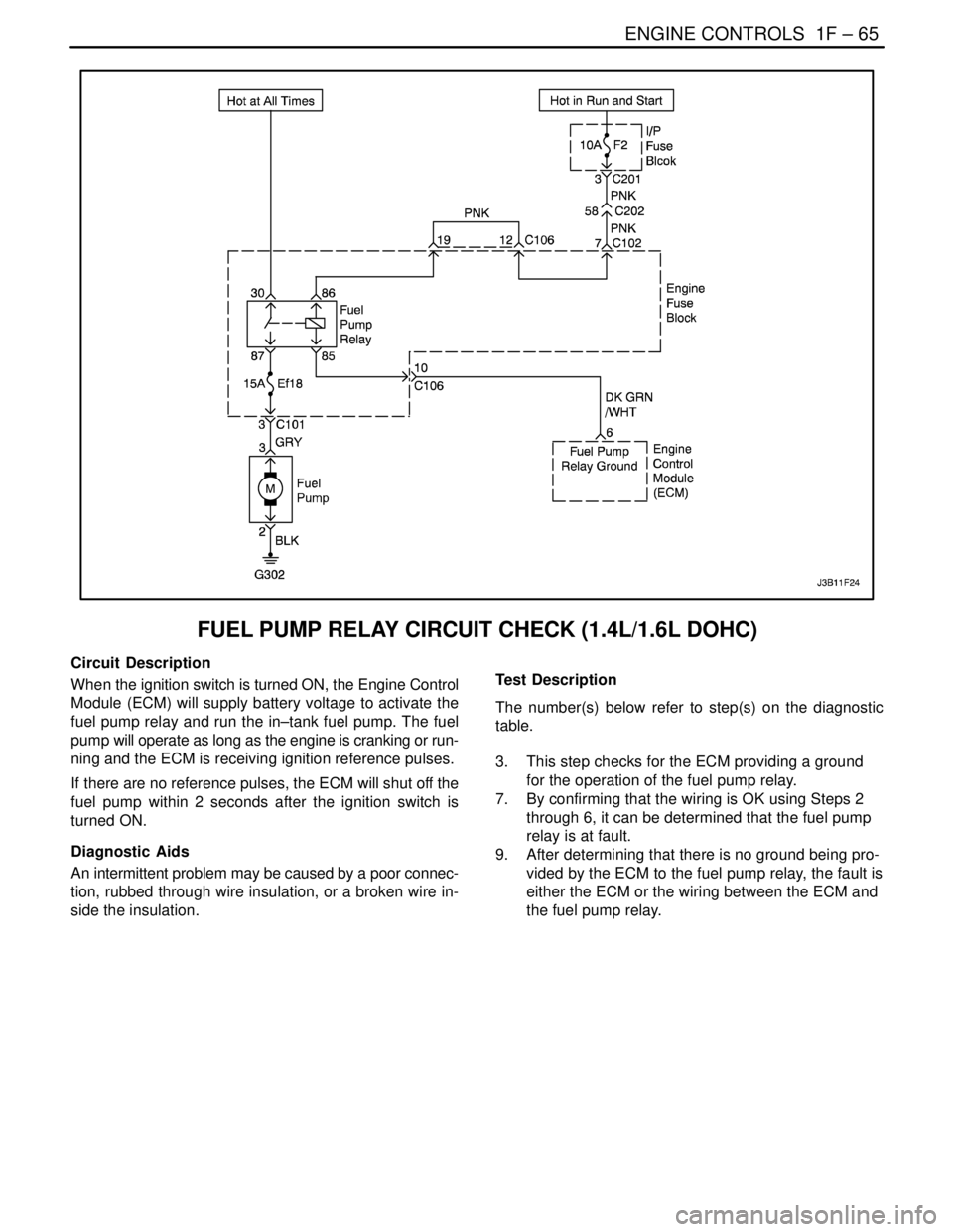
FUEL PUMP RELAY CIRCUIT CHECK (1.4L/1.6L DOHC)
Circuit Description
When the ignition switch is turned ON, the Engine Control
Module (ECM) will supply battery voltage to activate the
fuel pump relay and run the in–tank fuel pump. The fuel
pump will operate as long as the engine is cranking or run-
ning and the ECM is receiving ignition reference pulses.
If there are no reference pulses, the ECM will shut off the
fuel pump within 2 seconds after the ignition switch is
turned ON.
Diagnostic Aids
An intermittent problem may be caused by a poor connec-
tion, rubbed through wire insulation, or a broken wire in-
side the insulation.Test Description
The number(s) below refer to step(s) on the diagnostic
table.
3. This step checks for the ECM providing a ground
for the operation of the fuel pump relay.
7. By confirming that the wiring is OK using Steps 2
through 6, it can be determined that the fuel pump
relay is at fault.
9. After determining that there is no ground being pro-
vided by the ECM to the fuel pump relay, the fault is
either the ECM or the wiring between the ECM and
the fuel pump relay.
Page 312 of 2643

1F – 66IENGINE CONTROLS
DAEWOO V–121 BL4
Fuel Pump Relay Circuit Check (1.4L/1.6L DOHC)
StepActionValue(s)YesNo
11. Turn the ignition OFF for 10 seconds.
2. Turn the ignition ON.
3. Listen for in–tank fuel pump operation.
Does the fuel pump operate for the time specified?2 secSystem OKGo to Step 2
21. Turn the ignition OFF.
2. Disconnect the fuel pump relay.
3. Connect a test light between the fuel pump
relay connector terminal 30 and ground.
Turn the ignition ON. Is the test light on?–Go to Step 3Go to Step 8
31. Turn the ignition OFF.
2. Connect a test light between the fuel pump
relay connector terminal 86 and battery posi-
tive.
3. Turn the ignition ON.
4. With the ignition ON, the test light should light
for the time specified.
Is the test light on?2 secGo to Step 4Go to Step 9
41. Turn the ignition OFF.
2. Connect a test light between the fuel pump
relay connector terminal 30 and ground.
Is the test light on?–Go to Step 5Go to Step 11
5Check for an open or short to ground in the wire be-
tween the fuel pump relay connector terminal 87 and
the fuel pump connector terminal 3.
Is the problem found?–Go to Step 6Go to Step 7
61. Repair the wire between the fuel pump relay
connector terminal 87 and the fuel pump con-
nector terminal 3.
2. Install the fuel pump relay.
3. Turn the ignition OFF for 10 seconds.
4. Turn the ignition ON.
Does the fuel pump operate for the time specified?2 secSystem OK–
71. Replace the fuel pump relay.
2. Turn the ignition OFF for 10 seconds.
3. Turn the ignition ON.
Does the fuel pump operate for the time specified?2 secSystem OK–
8Check for an open wire between the fuel pump relay
connector terminal 30 and the battery.
Is the problem found?–Go to Step 13–
9Check for an open wire between the fuel pump relay
connector terminal 86 to the engine control module
(ECM) connector terminal 6.
Is the problem found.–Go to Step 10Go to Step 12
101. Repair the wire between the fuel pump relay
connector terminal 86 to the ECM connector
terminal 6.
2. Install the fuel pump relay.
3. Turn the ignition OFF for 10 seconds.
4. Turn the ignition ON.
Does the fuel pump operate for the time specified?2 secSystem OK–
Page 314 of 2643
1F – 68IENGINE CONTROLS
DAEWOO V–121 BL4
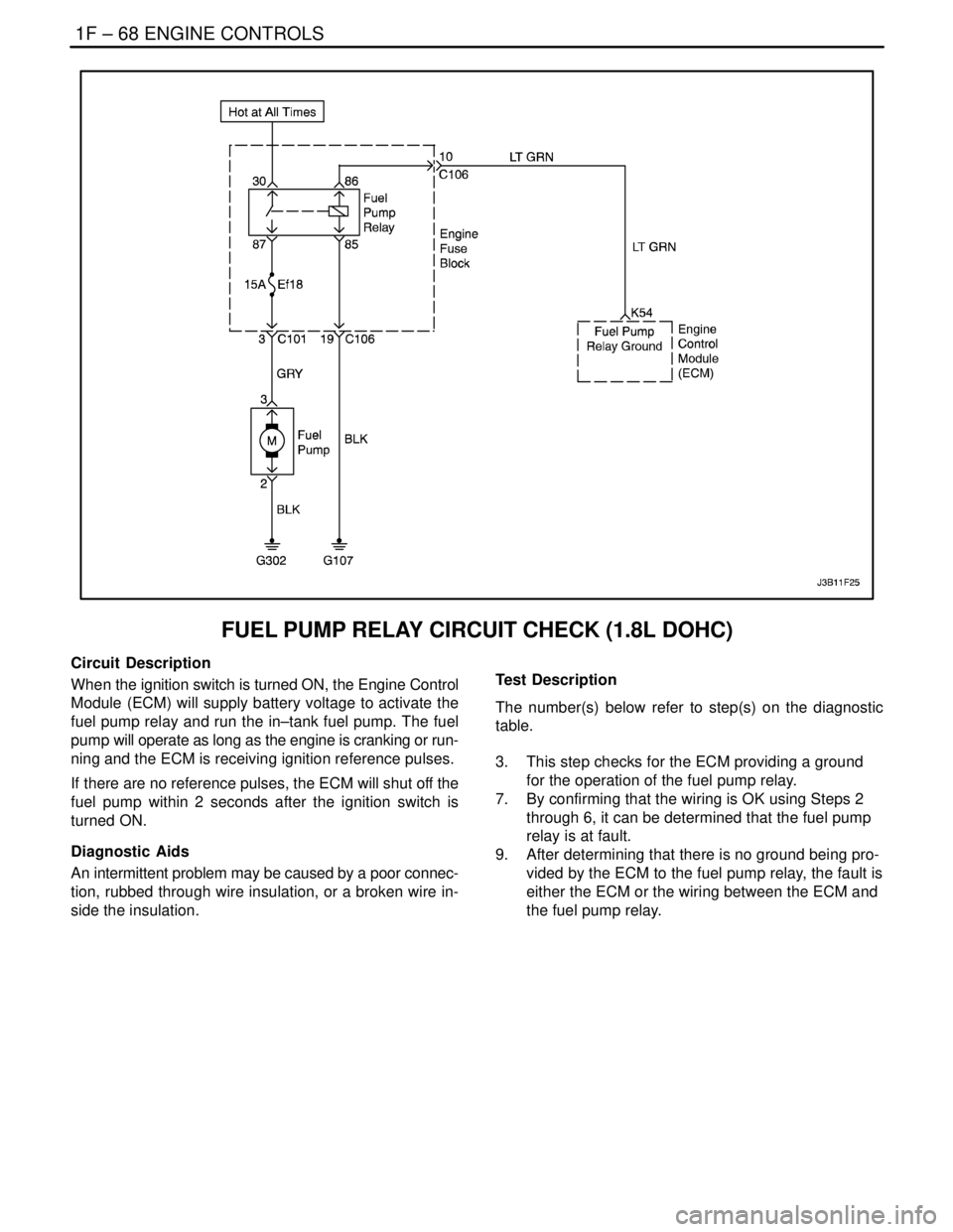
FUEL PUMP RELAY CIRCUIT CHECK (1.8L DOHC)
Circuit Description
When the ignition switch is turned ON, the Engine Control
Module (ECM) will supply battery voltage to activate the
fuel pump relay and run the in–tank fuel pump. The fuel
pump will operate as long as the engine is cranking or run-
ning and the ECM is receiving ignition reference pulses.
If there are no reference pulses, the ECM will shut off the
fuel pump within 2 seconds after the ignition switch is
turned ON.
Diagnostic Aids
An intermittent problem may be caused by a poor connec-
tion, rubbed through wire insulation, or a broken wire in-
side the insulation.Test Description
The number(s) below refer to step(s) on the diagnostic
table.
3. This step checks for the ECM providing a ground
for the operation of the fuel pump relay.
7. By confirming that the wiring is OK using Steps 2
through 6, it can be determined that the fuel pump
relay is at fault.
9. After determining that there is no ground being pro-
vided by the ECM to the fuel pump relay, the fault is
either the ECM or the wiring between the ECM and
the fuel pump relay.
Page 315 of 2643

ENGINE CONTROLS 1F – 69
DAEWOO V–121 BL4
Fuel Pump Relay Circuit Check (1.8L DOHC)
StepActionValue(s)YesNo
11. Turn the ignition OFF for 10 seconds.
2. Turn the ignition ON.
3. Listen for in–tank fuel pump operation.
Does the fuel pump operate for the time specified?2 secSystem OKGo to Step 2
21. Turn the ignition OFF.
2. Disconnect the fuel pump relay.
3. Connect a test light between the fuel pump
relay connector terminal 30 and ground.
Turn the ignition ON. Is the test light on?–Go to Step 3Go to Step 8
31. Turn the ignition OFF.
2. Connect a test light between the fuel pump
relay connector terminal 85 and battery posi-
tive.
3. Turn the ignition ON.
4. With the ignition ON, the test light should light
for the time specified.
Is the test light on?2 secGo to Step 4Go to Step 9
41. Turn the ignition OFF.
2. Connect a test light between the fuel pump
relay connector terminal 30 and ground.
Is the test light on?–Go to Step 5Go to Step 11
5Check for an open or short to ground in the wire be-
tween the fuel pump relay connector terminal 87 and
the fuel pump connector terminal 3.
Is the problem found?–Go to Step 6Go to Step 7
61. Repair the wire between the fuel pump relay
connector terminal 87 and the fuel pump con-
nector terminal 3.
2. Install the fuel pump relay.
3. Turn the ignition OFF for 10 seconds.
4. Turn the ignition ON.
Does the fuel pump operate for the time specified?2 secSystem OK–
71. Replace the fuel pump relay.
2. Turn the ignition OFF for 10 seconds.
3. Turn the ignition ON.
Does the fuel pump operate for the time specified?2 secSystem OK–
8Check for an open wire between the fuel pump relay
connector terminal 30 and the battery.
Is the problem found?–Go to Step 13–
9Check for an open wire between the fuel pump relay
connector terminal 85 to the engine control module
(ECM) connector terminal K54
Is the problem found.–Go to Step 10Go to Step 12
101. Repair the wire between the fuel pump relay
connector terminal 85 to the ECM connector
terminal K54.
2. Install the fuel pump relay.
3. Turn the ignition OFF for 10 seconds.
4. Turn the ignition ON.
Does the fuel pump operate for the time specified?2 secSystem OK–
Page 404 of 2643

1F – 158IENGINE CONTROLS
DAEWOO V–121 BL4
DIAGNOSTIC TROUBLE CODE (DTC) P0171
FUEL TRIM SYSTEM TOO LEAN
System Description
If the adaptation value threshold is permanently exceed-
ed, the deviation of the adaptive terms enables to detect
a slow default coming out. Two time counters (one for the
rich side and another one for the lean side) are increased
while the lambda controller exceeds the adaptation
thresholds. As soon as one of the time counters reaches
its maximum value, the error is detected.
The aim of this test is to simulate a failure that would result
in exceeding the adaptive terms. Two kinds of failure must
be created.
S A lean side deviation: P0171
S A rich side deviation : P0172
It is thus necessary to determine, for each kind of failure,
the limit good and the limit bad. For a given failure, mea-
sure the emission threshold until the legal emission
thresholds are exceeded.
Note that the problem is due to the emission thresholds re-
quired, it is not simple to disturb the system so that the
emission thresholds will be exceeded. The tuning has
been made thanks to a dedicated calibration but, as such
a procedure is not permitted by the regulation, it is neces-
sary to create some material malfunction (fuel pressure
regulator, fuel injector, air leakage...).
Conditions for Setting the DTC
S DTCs P0107, P0108, P0112, P0113, P0117,
P0118, P0122, P0123, P0131, P0132, P0337,
P0338, P0341, P0342, P0400, P1319, P1402,
P1404, P1405, P1671 and P1672 are not set.
S Coolant temperature is greater than 20°C (68°F).
(1.4L DOHC)
S Coolant temperature is greater than 80°C (176°F).
(1.6L DOHC)
S Manifold Absolute Pressure (MAP) is greater than
70 kPa (10.2 psi).
S System is in closed loop.
Action Taken When the DTC Sets
S The Malfunction Indicator Lamp (MIL) will illuminate
after three consecutive trip with a fail.
S The ECM will record operating conditions at the
time the diagnostic fail. This information will be
stored in the Freeze Frame and Failure Records
buffers.S A history DTC is stored.
Conditions for Clearing the MIL/DTC
S The MIL will turn off after four consecutive ignition
cycles in which the diagnostic runs without a fault.
S A history DTC will clear after 40 consecutive warm
up cycles without a fault.
S DTC(s) can be cleared by using the scan tool.
S Disconnecting the ECM battery feed for 10 sec-
onds.
Diagnostic Aids
Important : After repairs, use the scan tool Fuel Trim Re-
set function to reset the long–term fuel trim to 128 (0%).
S Fuel pressure – The system will be lean if the pres-
sure is too low. It may be necessary to monitor fuel
pressure while driving the vehicle at various road
speeds and/or loads to confirm.
S Map sensor – An output that causes the ECM to
sense a lower than normal manifold pressure (high
vacuum) can cause the system to go lean. Discon-
necting the MAP sensor will allow the ECM to sub-
stitute a fixed (default) value for the MAP sensor. If
the lean condition is gone when the sensor is dis-
connected, substitute a known good sensor and
recheck.
S Fuel contamination – Water, in even small amounts,
near the in–tank fuel pump inlet can be delivered to
the injector. The water causes a lean exhaust and
can set DTC P0171.
Check for poor O2S or MAP sensor connection at the
ECM. Inspect the harness connectors for the following
conditions:
S Backed–out terminals
S Improper mating
S Broken locks
S Improperly formed
S Damaged terminals
S Poor terminal–to–wire connection
Inspect the wiring harness for damage. If the harness ap-
pears to be OK, observe the O2S display on the scan tool
while moving the connectors and the wiring harness re-
lated to the engine harness. A change in the display will
indicate the location of the fault.
Check the brake power booster check valve for possible
leaks.