2004 CHRYSLER VOYAGER lock
[x] Cancel search: lockPage 1362 of 2585
INSTALLATION
INSTALLATION - CRANKSHAFT SPROCKET
CAUTION: The crankshaft sprocket is set to a pre-
determined depth from the factory for correct tim-
ing belt tracking. If removed, use of Special Tool
6792 is required to set the sprocket to original
installation depth. An incorrectly installed sprocket
will result in timing belt and engine damage.
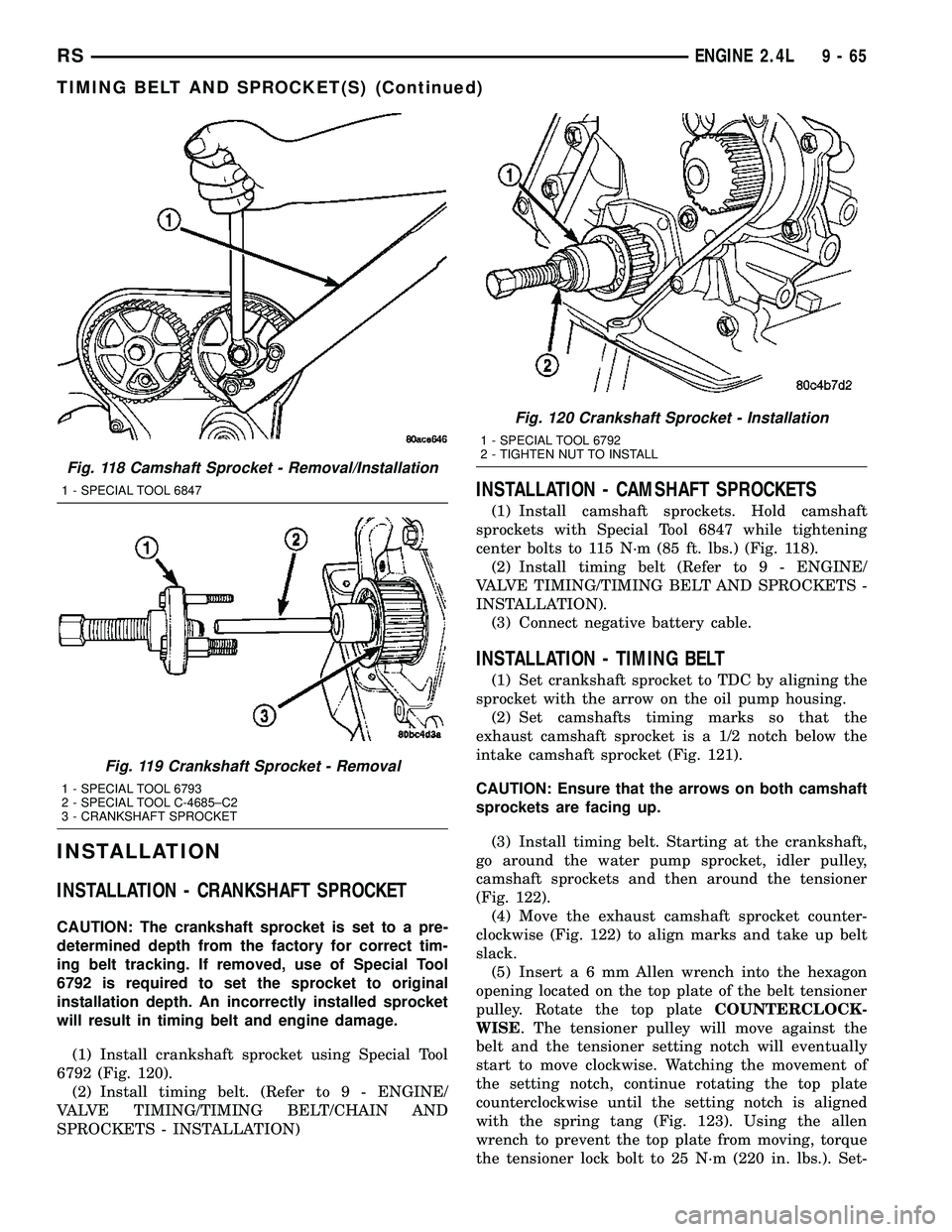
(1) Install crankshaft sprocket using Special Tool
6792 (Fig. 120).
(2) Install timing belt. (Refer to 9 - ENGINE/
VALVE TIMING/TIMING BELT/CHAIN AND
SPROCKETS - INSTALLATION)
INSTALLATION - CAMSHAFT SPROCKETS
(1) Install camshaft sprockets. Hold camshaft
sprockets with Special Tool 6847 while tightening
center bolts to 115 N´m (85 ft. lbs.) (Fig. 118).
(2) Install timing belt (Refer to 9 - ENGINE/
VALVE TIMING/TIMING BELT AND SPROCKETS -
INSTALLATION).
(3) Connect negative battery cable.
INSTALLATION - TIMING BELT
(1) Set crankshaft sprocket to TDC by aligning the
sprocket with the arrow on the oil pump housing.
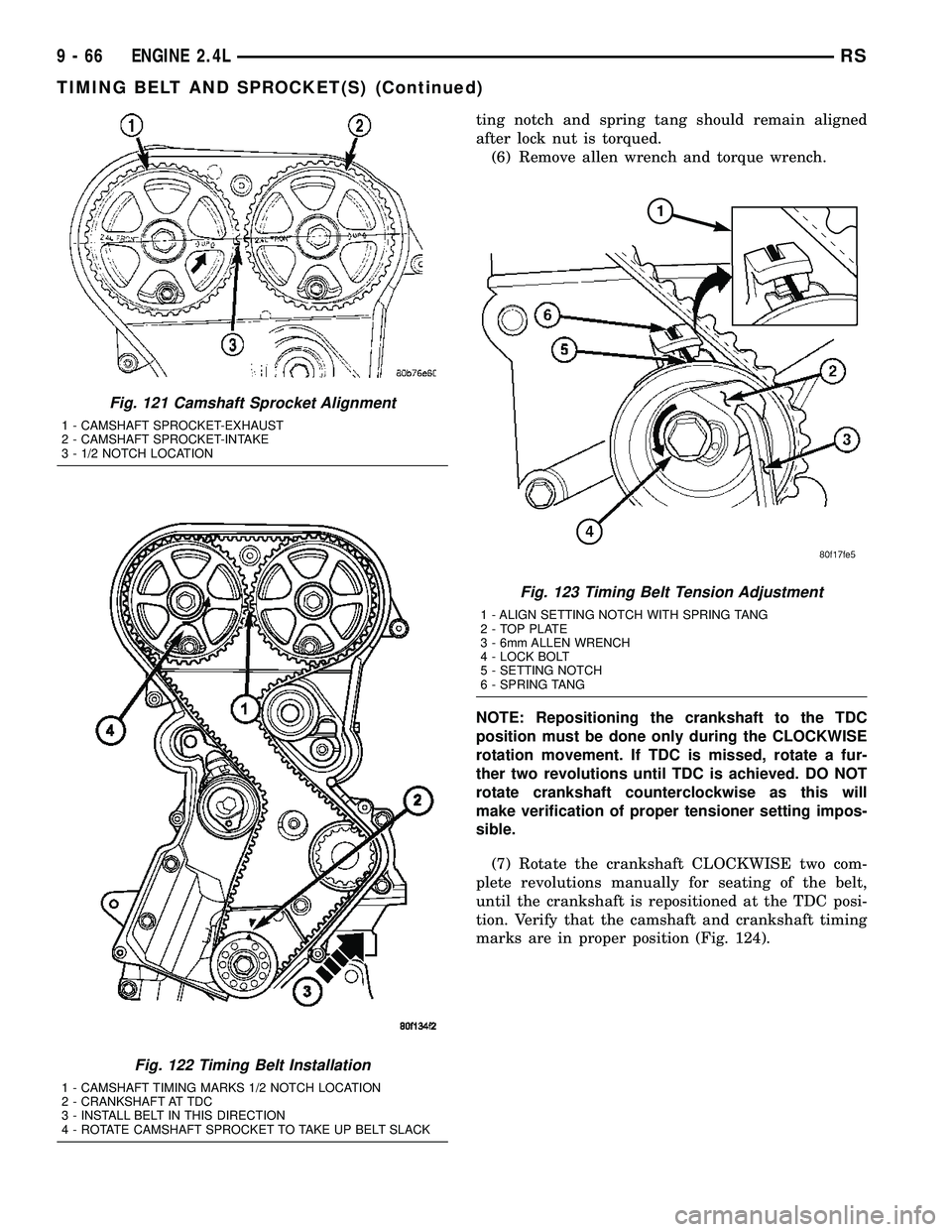
(2) Set camshafts timing marks so that the
exhaust camshaft sprocket is a 1/2 notch below the
intake camshaft sprocket (Fig. 121).
CAUTION: Ensure that the arrows on both camshaft
sprockets are facing up.
(3) Install timing belt. Starting at the crankshaft,
go around the water pump sprocket, idler pulley,
camshaft sprockets and then around the tensioner
(Fig. 122).
(4) Move the exhaust camshaft sprocket counter-
clockwise (Fig. 122) to align marks and take up belt
slack.
(5) Inserta6mmAllen wrench into the hexagon
opening located on the top plate of the belt tensioner
pulley. Rotate the top plateCOUNTERCLOCK-
WISE. The tensioner pulley will move against the
belt and the tensioner setting notch will eventually
start to move clockwise. Watching the movement of
the setting notch, continue rotating the top plate
counterclockwise until the setting notch is aligned
with the spring tang (Fig. 123). Using the allen
wrench to prevent the top plate from moving, torque
the tensioner lock bolt to 25 N´m (220 in. lbs.). Set-
Fig. 118 Camshaft Sprocket - Removal/Installation
1 - SPECIAL TOOL 6847
Fig. 119 Crankshaft Sprocket - Removal
1 - SPECIAL TOOL 6793
2 - SPECIAL TOOL C-4685±C2
3 - CRANKSHAFT SPROCKET
Fig. 120 Crankshaft Sprocket - Installation
1 - SPECIAL TOOL 6792
2 - TIGHTEN NUT TO INSTALL
RSENGINE 2.4L9-65
TIMING BELT AND SPROCKET(S) (Continued)
Page 1363 of 2585
ting notch and spring tang should remain aligned
after lock nut is torqued.
(6) Remove allen wrench and torque wrench.
NOTE: Repositioning the crankshaft to the TDC
position must be done only during the CLOCKWISE
rotation movement. If TDC is missed, rotate a fur-
ther two revolutions until TDC is achieved. DO NOT
rotate crankshaft counterclockwise as this will
make verification of proper tensioner setting impos-
sible.
(7) Rotate the crankshaft CLOCKWISE two com-
plete revolutions manually for seating of the belt,
until the crankshaft is repositioned at the TDC posi-
tion. Verify that the camshaft and crankshaft timing
marks are in proper position (Fig. 124).
Fig. 121 Camshaft Sprocket Alignment
1 - CAMSHAFT SPROCKET-EXHAUST
2 - CAMSHAFT SPROCKET-INTAKE
3 - 1/2 NOTCH LOCATION
Fig. 122 Timing Belt Installation
1 - CAMSHAFT TIMING MARKS 1/2 NOTCH LOCATION
2 - CRANKSHAFT AT TDC
3 - INSTALL BELT IN THIS DIRECTION
4 - ROTATE CAMSHAFT SPROCKET TO TAKE UP BELT SLACK
Fig. 123 Timing Belt Tension Adjustment
1 - ALIGN SETTING NOTCH WITH SPRING TANG
2 - TOP PLATE
3 - 6mm ALLEN WRENCH
4 - LOCK BOLT
5 - SETTING NOTCH
6 - SPRING TANG
9 - 66 ENGINE 2.4LRS
TIMING BELT AND SPROCKET(S) (Continued)
Page 1364 of 2585
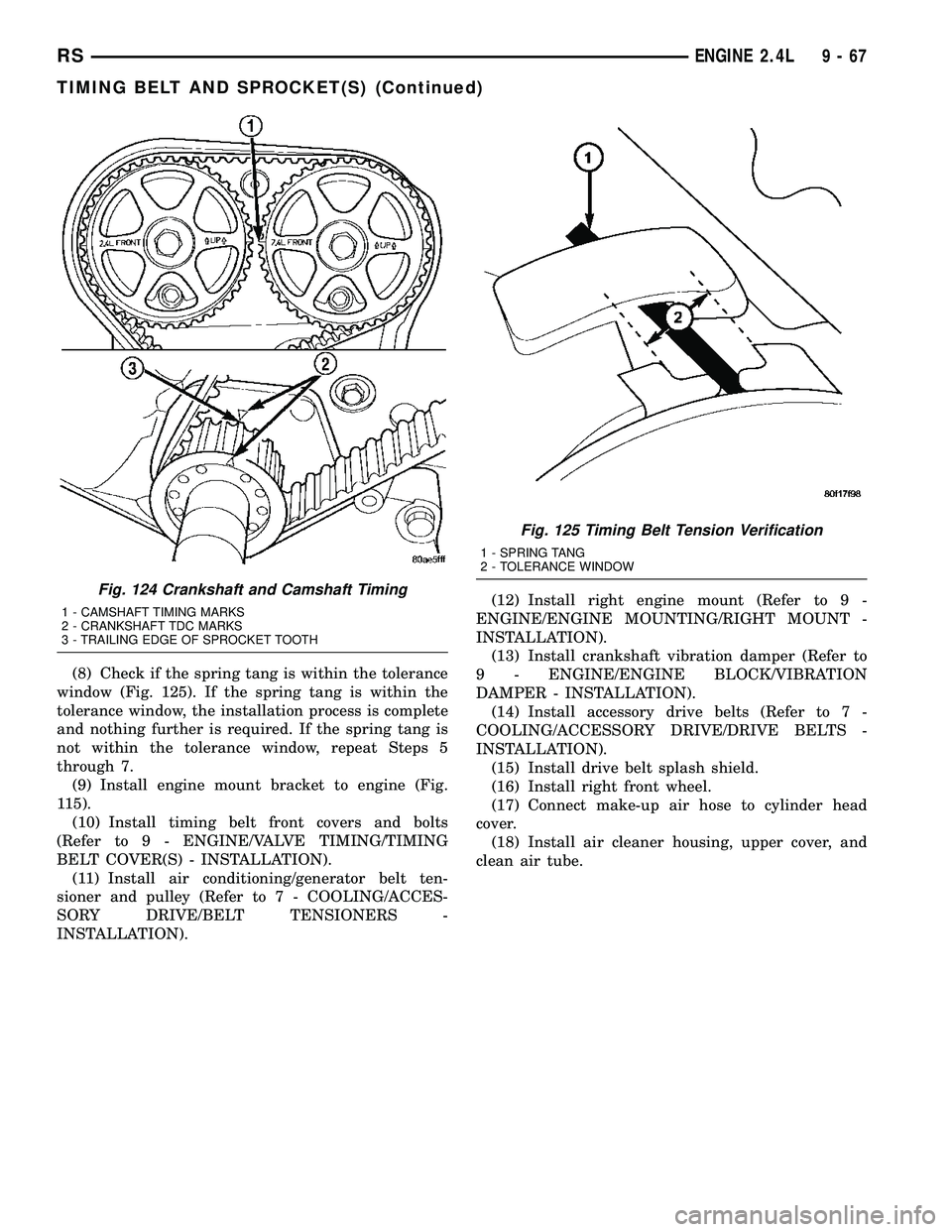
(8) Check if the spring tang is within the tolerance
window (Fig. 125). If the spring tang is within the
tolerance window, the installation process is complete
and nothing further is required. If the spring tang is
not within the tolerance window, repeat Steps 5
through 7.
(9) Install engine mount bracket to engine (Fig.
115).
(10) Install timing belt front covers and bolts
(Refer to 9 - ENGINE/VALVE TIMING/TIMING
BELT COVER(S) - INSTALLATION).
(11) Install air conditioning/generator belt ten-
sioner and pulley (Refer to 7 - COOLING/ACCES-
SORY DRIVE/BELT TENSIONERS -
INSTALLATION).(12) Install right engine mount (Refer to 9 -
ENGINE/ENGINE MOUNTING/RIGHT MOUNT -
INSTALLATION).
(13) Install crankshaft vibration damper (Refer to
9 - ENGINE/ENGINE BLOCK/VIBRATION
DAMPER - INSTALLATION).
(14) Install accessory drive belts (Refer to 7 -
COOLING/ACCESSORY DRIVE/DRIVE BELTS -
INSTALLATION).
(15) Install drive belt splash shield.
(16) Install right front wheel.
(17) Connect make-up air hose to cylinder head
cover.
(18) Install air cleaner housing, upper cover, and
clean air tube.
Fig. 124 Crankshaft and Camshaft Timing
1 - CAMSHAFT TIMING MARKS
2 - CRANKSHAFT TDC MARKS
3 - TRAILING EDGE OF SPROCKET TOOTH
Fig. 125 Timing Belt Tension Verification
1 - SPRING TANG
2 - TOLERANCE WINDOW
RSENGINE 2.4L9-67
TIMING BELT AND SPROCKET(S) (Continued)
Page 1366 of 2585
INSTALLATION
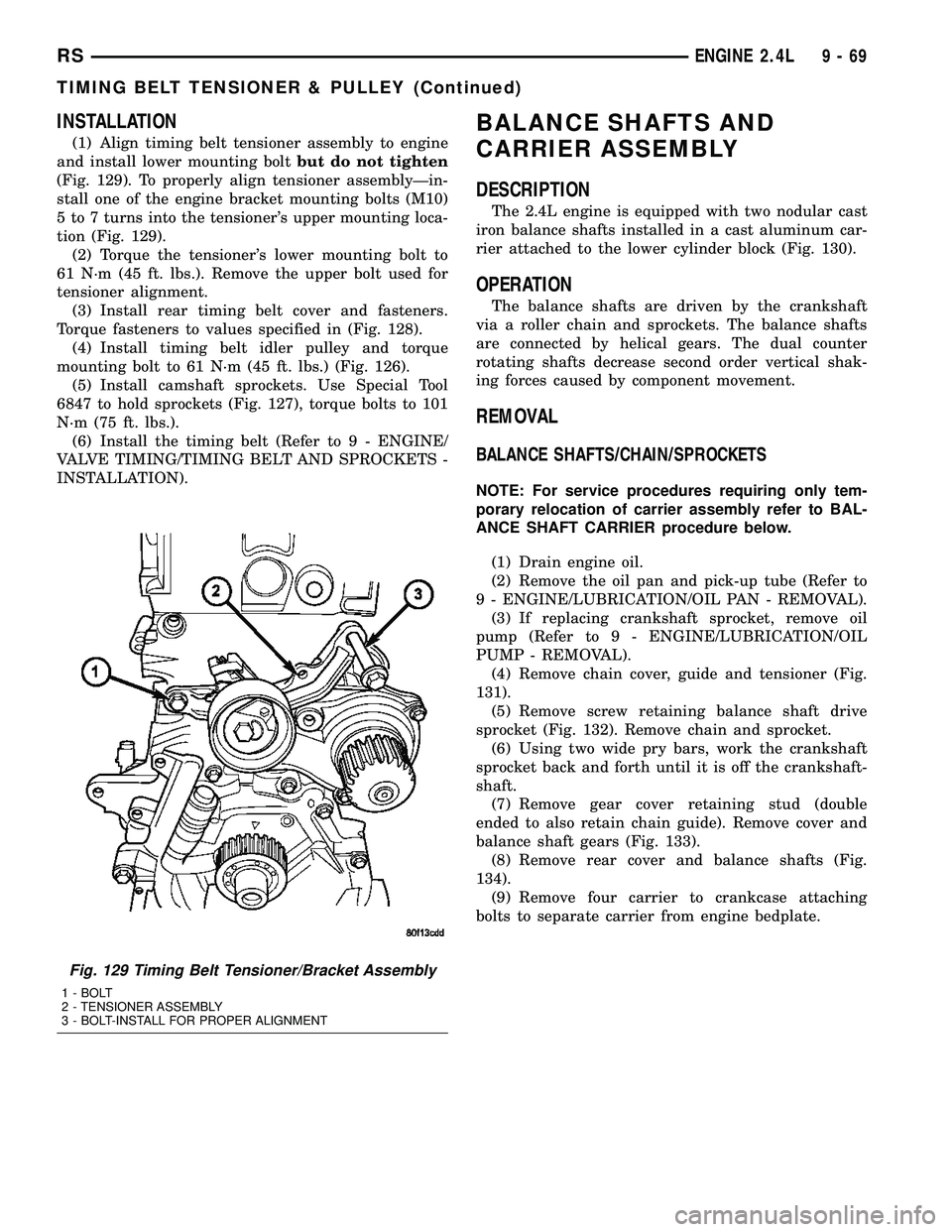
(1) Align timing belt tensioner assembly to engine
and install lower mounting boltbut do not tighten
(Fig. 129). To properly align tensioner assemblyÐin-
stall one of the engine bracket mounting bolts (M10)
5 to 7 turns into the tensioner's upper mounting loca-
tion (Fig. 129).
(2) Torque the tensioner's lower mounting bolt to
61 N´m (45 ft. lbs.). Remove the upper bolt used for
tensioner alignment.
(3) Install rear timing belt cover and fasteners.
Torque fasteners to values specified in (Fig. 128).
(4) Install timing belt idler pulley and torque
mounting bolt to 61 N´m (45 ft. lbs.) (Fig. 126).
(5) Install camshaft sprockets. Use Special Tool
6847 to hold sprockets (Fig. 127), torque bolts to 101
N´m (75 ft. lbs.).
(6) Install the timing belt (Refer to 9 - ENGINE/
VALVE TIMING/TIMING BELT AND SPROCKETS -
INSTALLATION).
BALANCE SHAFTS AND
CARRIER ASSEMBLY
DESCRIPTION
The 2.4L engine is equipped with two nodular cast
iron balance shafts installed in a cast aluminum car-
rier attached to the lower cylinder block (Fig. 130).
OPERATION
The balance shafts are driven by the crankshaft
via a roller chain and sprockets. The balance shafts
are connected by helical gears. The dual counter
rotating shafts decrease second order vertical shak-
ing forces caused by component movement.
REMOVAL
BALANCE SHAFTS/CHAIN/SPROCKETS
NOTE: For service procedures requiring only tem-
porary relocation of carrier assembly refer to BAL-
ANCE SHAFT CARRIER procedure below.
(1) Drain engine oil.
(2) Remove the oil pan and pick-up tube (Refer to
9 - ENGINE/LUBRICATION/OIL PAN - REMOVAL).
(3) If replacing crankshaft sprocket, remove oil
pump (Refer to 9 - ENGINE/LUBRICATION/OIL
PUMP - REMOVAL).
(4) Remove chain cover, guide and tensioner (Fig.
131).
(5) Remove screw retaining balance shaft drive
sprocket (Fig. 132). Remove chain and sprocket.
(6) Using two wide pry bars, work the crankshaft
sprocket back and forth until it is off the crankshaft-
shaft.
(7) Remove gear cover retaining stud (double
ended to also retain chain guide). Remove cover and
balance shaft gears (Fig. 133).
(8) Remove rear cover and balance shafts (Fig.
134).
(9) Remove four carrier to crankcase attaching
bolts to separate carrier from engine bedplate.
Fig. 129 Timing Belt Tensioner/Bracket Assembly
1 - BOLT
2 - TENSIONER ASSEMBLY
3 - BOLT-INSTALL FOR PROPER ALIGNMENT
RSENGINE 2.4L9-69
TIMING BELT TENSIONER & PULLEY (Continued)
Page 1370 of 2585
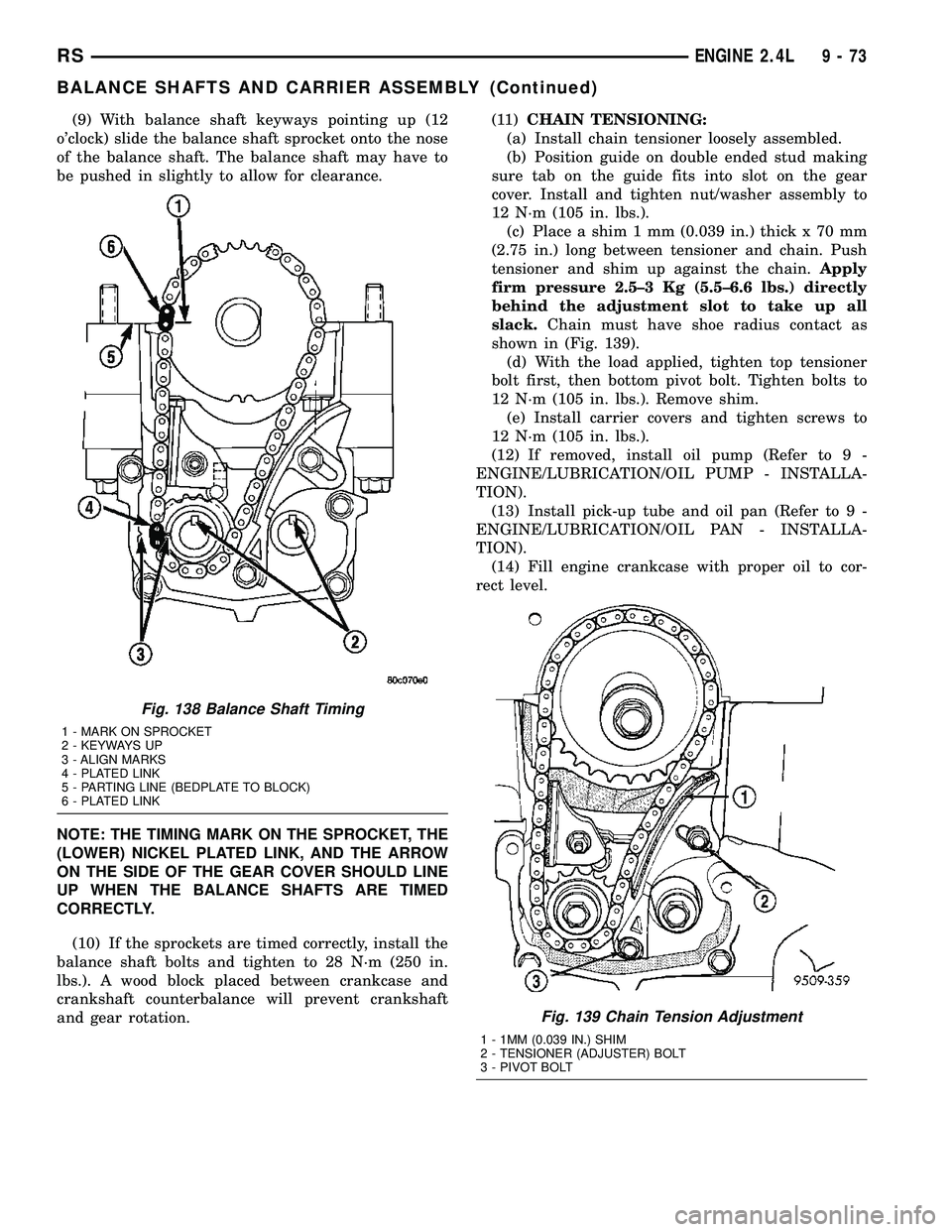
(9) With balance shaft keyways pointing up (12
o'clock) slide the balance shaft sprocket onto the nose
of the balance shaft. The balance shaft may have to
be pushed in slightly to allow for clearance.
NOTE: THE TIMING MARK ON THE SPROCKET, THE
(LOWER) NICKEL PLATED LINK, AND THE ARROW
ON THE SIDE OF THE GEAR COVER SHOULD LINE
UP WHEN THE BALANCE SHAFTS ARE TIMED
CORRECTLY.
(10) If the sprockets are timed correctly, install the
balance shaft bolts and tighten to 28 N´m (250 in.
lbs.). A wood block placed between crankcase and
crankshaft counterbalance will prevent crankshaft
and gear rotation.(11)CHAIN TENSIONING:
(a) Install chain tensioner loosely assembled.
(b) Position guide on double ended stud making
sure tab on the guide fits into slot on the gear
cover. Install and tighten nut/washer assembly to
12 N´m (105 in. lbs.).
(c) Place a shim 1 mm (0.039 in.) thick x 70 mm
(2.75 in.) long between tensioner and chain. Push
tensioner and shim up against the chain.Apply
firm pressure 2.5±3 Kg (5.5±6.6 lbs.) directly
behind the adjustment slot to take up all
slack.Chain must have shoe radius contact as
shown in (Fig. 139).
(d) With the load applied, tighten top tensioner
bolt first, then bottom pivot bolt. Tighten bolts to
12 N´m (105 in. lbs.). Remove shim.
(e) Install carrier covers and tighten screws to
12 N´m (105 in. lbs.).
(12) If removed, install oil pump (Refer to 9 -
ENGINE/LUBRICATION/OIL PUMP - INSTALLA-
TION).
(13) Install pick-up tube and oil pan (Refer to 9 -
ENGINE/LUBRICATION/OIL PAN - INSTALLA-
TION).
(14) Fill engine crankcase with proper oil to cor-
rect level.
Fig. 138 Balance Shaft Timing
1 - MARK ON SPROCKET
2 - KEYWAYS UP
3 - ALIGN MARKS
4 - PLATED LINK
5 - PARTING LINE (BEDPLATE TO BLOCK)
6 - PLATED LINK
Fig. 139 Chain Tension Adjustment
1 - 1MM (0.039 IN.) SHIM
2 - TENSIONER (ADJUSTER) BOLT
3 - PIVOT BOLT
RSENGINE 2.4L9-73
BALANCE SHAFTS AND CARRIER ASSEMBLY (Continued)
Page 1371 of 2585
ENGINE 3.3/3.8L
TABLE OF CONTENTS
page page
ENGINE 3.3/3.8L
DESCRIPTION.........................76
DIAGNOSIS AND TESTING
DIAGNOSIS AND TESTING - ENGINE
DIAGNOSIS - INTRODUCTION...........76
DIAGNOSIS AND TESTING - ENGINE
DIAGNOSIS - PERFORMANCE...........78
DIAGNOSIS AND TESTING - ENGINE
DIAGNOSIS - MECHANICAL.............80
DIAGNOSIS AND TESTING - ENGINE OIL
LEAK INSPECTION....................82
DIAGNOSIS AND TESTING - CYLINDER
COMPRESSION PRESSURE TEST........83
DIAGNOSIS AND TESTING - CYLINDER
COMBUSTION PRESSURE LEAKAGE
TEST...............................83
STANDARD PROCEDURE
STANDARD PROCEDURE - MEASURING
BEARING CLEARANCE USING
PLASTIGAGE........................84
STANDARD PROCEDURE - FORM-IN-
PLACE GASKETS AND SEALERS.........84
STANDARD PROCEDURE - ENGINE
GASKET SURFACE PREPARATION........85
STANDARD PROCEDURE - HYDROSTATIC
LOCKED ENGINE.....................85
STANDARD PROCEDURE - REPAIR OF
DAMAGED OR WORN THREADS.........86
STANDARD PROCEDURE - ENGINE CORE
AND OIL GALLERY PLUGS..............86
REMOVAL - ENGINE ASSEMBLY...........86
INSTALLATION - ENGINE ASSEMBLY........89
SPECIFICATIONS
3.3/3.8L ENGINE......................91
SPECIFICATIONS - TORQUE............95
SPECIAL TOOLS
3.3/3.8L ENGINE......................95
AIR CLEANER ELEMENT
REMOVAL.............................98
INSTALLATION.........................98
AIR CLEANER HOUSING
REMOVAL.............................99
INSTALLATION.........................99
CYLINDER HEAD
DESCRIPTION.........................99
DIAGNOSIS AND TESTINGÐCYLINDER HEAD
GASKET............................99
REMOVAL - CYLINDER HEAD............100
CLEANING...........................100INSPECTION.........................101
INSTALLATION - CYLINDER HEAD.........101
CYLINDER HEAD COVER(S)
DESCRIPTION........................102
CYLINDER HEAD COVER - RIGHT
REMOVAL............................102
INSTALLATION........................103
CYLINDER HEAD COVER - LEFT
REMOVAL............................103
INSTALLATION........................103
INTAKE/EXHAUST VALVES & SEATS
DESCRIPTION........................104
OPERATION..........................104
STANDARD PROCEDURE - REFACING
VALVESANDVALVESEATS ............104
REMOVAL............................105
CLEANING...........................105
INSPECTION.........................105
INSTALLATION........................106
VALVE SPRINGS
DESCRIPTION........................106
OPERATION..........................106
REMOVAL
REMOVAL - CYLINDER HEAD OFF.......106
REMOVAL - CYLINDER HEAD ON........106
INSPECTION.........................108
INSTALLATION
INSTALLATION - CYLINDER HEAD OFF . . . 108
INSTALLATION - CYLINDER HEAD ON....108
ROCKER ARMS
DESCRIPTION
DESCRIPTION - ROCKER ARMS.........109
DESCRIPTION - PUSHRODS...........109
OPERATION
OPERATION - ROCKER ARMS..........109
OPERATION - PUSHRODS.............109
REMOVAL - ROCKER ARMS AND SHAFT....109
DISASSEMBLY - ROCKER ARMS AND SHAFT. . 109
ASSEMBLY - ROCKER ARMS AND SHAFT . . . 109
INSTALLATION - ROCKER ARMS AND SHAFT..110
VALVE STEM SEALS
DESCRIPTION........................111
REMOVAL............................112
INSTALLATION........................112
ENGINE BLOCK
DESCRIPTION........................112
STANDARD PROCEDURE - CYLINDER BORE
HONING............................112
CLEANING...........................112
9 - 74 ENGINE 3.3/3.8LRS
Page 1372 of 2585
INSPECTION..........................112
HYDRAULIC LIFTERS (CAM IN BLOCK)
DESCRIPTION........................113
DIAGNOSIS AND TESTING - HYDRAULIC
LIFTERS...........................113
REMOVAL............................114
INSTALLATION........................114
CAMSHAFT & BEARINGS (IN BLOCK)
DESCRIPTION........................115
OPERATION..........................115
REMOVAL............................115
INSPECTION..........................115
INSTALLATION........................115
PISTON & CONNECTING ROD
DESCRIPTION........................116
STANDARD PROCEDURE
STANDARD PROCEDURE - FITTING
CONNECTING RODS..................116
STANDARD PROCEDURE - FITTING
PISTONS...........................117
REMOVAL............................117
INSTALLATION........................118
CONNECTING ROD BEARINGS
STANDARD PROCEDURE - MEASURING
CONNECTING ROD BEARING CLEARANCE
. . 120
PISTON RINGS
STANDARD PROCEDURE - PISTON RING
FITTING............................121
REMOVAL............................121
INSTALLATION........................121
CRANKSHAFT MAIN BEARINGS
STANDARD PROCEDURE - MAIN BEARING
FITTING............................123
REMOVAL - CRANKSHAFT MAIN BEARINGS . 124
INSTALLATION - CRANKSHAFT MAIN
BEARINGS..........................124
CRANKSHAFT
DESCRIPTION
DESCRIPTION - 3.3L..................125
DESCRIPTION - 3.8L..................125
STANDARD PROCEDURE - MEASURING
CRANKSHAFT END PLAY..............125
REMOVAL............................125
INSTALLATION........................126
CRANKSHAFT OIL SEAL - FRONT
REMOVAL............................127
INSTALLATION........................127
CRANKSHAFT OIL SEAL - REAR
REMOVAL............................128
INSTALLATION........................129
CRANKSHAFT REAR OIL SEAL RETAINER
REMOVAL............................129
INSTALLATION........................129
VIBRATION DAMPER
REMOVAL............................130
INSTALLATION........................130FLEX PLATE
REMOVAL............................131
INSTALLATION........................131
ENGINE MOUNTING
DESCRIPTION........................131
FRONT MOUNT
REMOVAL............................131
INSTALLATION........................131
LEFT MOUNT
REMOVAL............................133
INSTALLATION........................133
REAR MOUNT
REMOVAL............................133
INSTALLATION........................134
RIGHT MOUNT
REMOVAL............................135
INSTALLATION........................135
LUBRICATION
DESCRIPTION........................136
OPERATION..........................136
DIAGNOSIS AND TESTING - ENGINE OIL
PRESSURE.........................136
OIL
STANDARD PROCEDURE
STANDARD PROCEDURE - ENGINE OIL
AND FILTER CHANGE.................137
STANDARD PROCEDURE - ENGINE OIL
LEVEL CHECK.......................137
OIL COOLER & LINES
DESCRIPTION........................138
OPERATION..........................138
REMOVAL............................138
INSTALLATION........................138
OIL FILTER
REMOVAL............................139
INSTALLATION........................139
OIL FILTER ADAPTER
REMOVAL............................139
INSTALLATION........................139
OIL PAN
REMOVAL............................140
CLEANING...........................140
INSPECTION.........................140
INSTALLATION........................140
OIL PRESSURE RELIEF VALVE
REMOVAL............................141
INSTALLATION........................141
OIL PRESSURE SWITCH
DESCRIPTION........................141
OPERATION..........................141
REMOVAL............................141
INSTALLATION........................141
OIL PUMP
DESCRIPTION........................142
REMOVAL............................142
DISASSEMBLY........................142
CLEANING...........................142
RSENGINE 3.3/3.8L9-75
Page 1373 of 2585
INSPECTION.........................142
ASSEMBLY...........................143
INSTALLATION........................144
INTAKE MANIFOLD
DESCRIPTION........................144
DIAGNOSIS AND TESTING - INTAKE
MANIFOLD LEAKS....................145
INTAKE MANIFOLD - UPPER
STANDARD PROCEDURE
STANDARD PROCEDURE - MANIFOLD
STRIPPED THREAD REPAIR............145
STANDARD PROCEDURE - INTAKE
MANIFOLD VACUUM PORT REPAIR......145
REMOVAL - UPPER INTAKE MANIFOLD.....145
CLEANING...........................146
INSPECTION.........................146
INSTALLATION - UPPER INTAKE MANIFOLD . 147
INTAKE MANIFOLD - LOWER
REMOVAL - LOWER INTAKE MANIFOLD....148
CLEANING...........................148
INSPECTION.........................148
INSTALLATION - LOWER INTAKE MANIFOLD . 149
EXHAUST MANIFOLD - RIGHT
REMOVAL............................150
CLEANING...........................151INSPECTION.........................151
INSTALLATION........................151
EXHAUST MANIFOLD - LEFT
REMOVAL............................152
CLEANING...........................152
INSPECTION.........................152
INSTALLATION........................152
VALVE TIMING
STANDARD PROCEDURE
STANDARD PROCEDURE - VALVE TIMING
VERIFICATION.......................153
STANDARD PROCEDURE - MEASURING
TIMING CHAIN WEAR.................153
TIMING CHAIN COVER
REMOVAL............................153
INSTALLATION........................155
TIMING CHAIN AND SPROCKETS
REMOVAL
REMOVAL - TIMING CHAIN AND
CAMSHAFT SPROCKET...............156
REMOVAL - CRANKSHAFT SPROCKET . . . 156
INSTALLATION
INSTALLATION - CRANKSHAFT SPROCKET. . 156
INSTALLATION - TIMING CHAIN AND
CAMSHAFT SPROCKET...............157
ENGINE 3.3/3.8L
DESCRIPTION
The 3.3 Liter (201 cu. in.) and 3.8 Liter (231 cu.
in.) engines are 60É V-6 engines with cast iron cylin-
der blocks and aluminum cylinder heads (Fig. 1). The
engine uses a single, block mounted camshaft with
pushrods to actuate the valves. These engines do not
have provisions for a free wheeling valve train.
The firing order is 1±2±3±4±5±6. The cylinders are
numbered from the front of the engine to the rear.
The front cylinder bank is numbered 2, 4, and 6. The
rear cylinder bank is numbered 1, 3, and 5.
The engine identification number is located on the
rear of the cylinder block just below the cylinder
head (Fig. 2).
DIAGNOSIS AND TESTING
DIAGNOSIS AND TESTING - ENGINE
DIAGNOSIS - INTRODUCTION
Engine diagnosis is helpful in determining the
causes of malfunctions not detected and remedied by
routine maintenance.These malfunctions may be classified as either
mechanical (e.g., a strange noise), or performance
(e.g., engine idles rough and stalls).
Refer to the Engine Mechanical and the Engine
Performance diagnostic charts, for possible causes
and corrections of malfunctions (Refer to 9 - ENGINE
- DIAGNOSIS AND TESTING - MECHANICAL)
(Refer to 9 - ENGINE - DIAGNOSIS AND TESTING
- PERFORMANCE).
For fuel system diagnosis, (Refer to 14 - FUEL
SYSTEM/FUEL DELIVERY - DIAGNOSIS AND
TESTING).
Additional tests and diagnostic procedures may be
necessary for specific engine malfunctions that can-
not be isolated with the Service Diagnosis charts.
Information concerning additional tests and diagno-
sis is provided within the following:
²Cylinder Compression Pressure Test
²Cylinder Combustion Pressure Leakage Test
²Engine Cylinder Head Gasket Failure Diagnosis
²Intake Manifold Leakage Diagnosis
²Hydraulic Lash Adjuster Noise Diagnosis
²Engine Oil Leak Inspection
9 - 76 ENGINE 3.3/3.8LRS