Page 224 of 341

Perform maintenance services as prescribed in the main-
tenance schedules manual. When your vehicle is used for
trailer towing, never exceed the gross axle weight rating
(GAWR) by the addition of:
²The tongue weight of the trailer.
²The weight of any other type of cargo or equipment
put in or on your vehicle.
²Remember that everything put in or on the trailer adds
to the load on your vehicle.
Warranty Requirements
The Manufacturer's Passenger Vehicle Warranty will
apply to vehicles used to tow trailers for non-commercial
use. However the following conditions must be met:
²The maximum frontal area of the trailer cannot exceed
20 square feet (1.86 square meters).
²If using a manual transaxle vehicle for trailer towing,
all starts must be in FIRST gear to avoid excessive
clutch slippage.
²The trailer tongue load must be considered as part of
the combined weight of occupants and cargo, and
should never exceed the weight referenced on the Tire
and Loading Information placard. Refer to the Tire±
Safety Information Section in this manual.
²The ªDº range can be selected when towing. However,
if frequent shifting occurs while in this range, the ª3º
range must be selected.
NOTE:Using the ª3º range while operating the vehicle
under heavy operating conditions will improve perfor-
mance and extend transaxle life by reducing excessive
shifting and heat build up.
224 STARTING AND OPERATING
Page 225 of 341

WARNING!
Connecting trailer brakes to your vehicle's hydraulic
brake lines can overload your brake system and
cause it to fail. You might not have brakes when you
need them and could have an accident.
²Do not attempt to tow a trailer while using a compact
spare tire.
²Whenever you pull a trailer, regardless of the trailer
size, stop lights and turn signals on the trailer are
recommended for motoring safety.
²The automatic transaxle fluid and filter should be
changed if you REGULARLY tow a trailer for more
than 45 minutes of continuous operation. See Schedule
ªBº in section 8 of this manual for transaxle fluid
change intervals.NOTE:Check the automatic transaxle fluid level before
towing.
NOTE:For vehicles equipped with Autostick. By using
the Autostick modes, and selecting a specific gear range,
frequent shifting can be avoided. The highest gear range
should be selected that allows for adequate performance.
For example, choose ª4º if the desired speed can be
maintained. Choose ª3º or ª2º if needed to maintain the
desired speed.
NOTE:Extended driving at high RPM should be
avoided to prevent excess heat generation. A reduction in
vehicle speed may be required to avoid extended driving
at high RPM. Return to a higher gear range or vehicle
speed when road conditions and RPM level allows.
STARTING AND OPERATING 225
5
Page 253 of 341

²Extensive engine idling.
²Driving in dusty conditions.
²Short trips of less than 10 miles (16 km).
²More than 50% of your driving is at sustained high
speeds during hot weather, above 90ÉF (32ÉC).
²Trailer towing.
²Taxi, Police or delivery service (commercial service).
²Off-Road or desert operation.
NOTE:IfANYof these apply to you, then change your
engine oil every 3,000 miles (4 800 km) or 3 months,
whichever comes first and follow maintenance schedule
ªBºÐALL ENGINES in the maintenance schedule sec-
tion of this manual.
If none of these apply to you, and your vehicle is
equipped with a Non±Turbo Charged Engine thenchange your engine oil at every interval shown on
schedule ªAºÐNON TURBO CHARGED ENGINES in
the maintenance schedule section of this manual.
If none of these apply to you, and your vehicle is
equipped with a Turbo Charged Engine change your
engine oil at every interval shown on schedule
ªAºÐTURBO CHARGED ENGINES in the maintenance
schedule section of this manual.
NOTE:Under no circumstances should oil change in-
tervals exceed 6000 miles (10 000 km) or 6 months
whichever comes first.
Engine Oil Selection
For best performance and maximum protection under all
types of operating conditions, the manufacturer only
recommends engine oils that are API certified and meet
the requirements of DaimlerChrysler Material Standard
MS-6395.
MAINTAINING YOUR VEHICLE 253
7
Page 275 of 341

If the fluid is cold, the fluid level should be between the
lower two holes, into the area marked ªLOWº.
If the fluid level shows low, add sufficient transmission
fluid to bring to the proper level.
CAUTION!
Do not overfill. Dirt and water in the transaxle can
cause serious damage. To prevent dirt and water
from entering the transaxle after checking or replen-
ishing fluid, make certain that the dipstick cap is
seated properly.
Fluid And Filter Changes
Automatic transmission fluid and filter should be
changed as follows:Maintenance schedule ªAºÐNon Turbo Charged En-
gines± No change necessary.
Maintenance schedule ªAºÐTurbo Charged Engines±
No change necessary.
Maintenance schedule ªBºÐAll Engines± Every 60,000
miles (96 000 km) change fluid and filter under the
following conditions:
²Police, taxi, limousine, commercial type operation, or
trailer towing where the vehicle is drivenregularlyfor
more than 45 minutes of continuous operation.
NOTE:Refer to Section 8 of this manual for mainte-
nance schedules.
If the transaxle is disassembled for any reason, the fluid
and filter should be changed.
MAINTAINING YOUR VEHICLE 275
7
Page 294 of 341

EMISSION CONTROL SYSTEM MAINTENANCE
The ªScheduledº maintenance services, listed inbold
typemust be done at the times or mileages specified to
assure the continued proper functioning of the emission
control system. These, and all other maintenance services
included in this manual, should be done to provide best
vehicle performance and reliability. More frequent main-
tenance may be needed for vehicles in severe operating
conditions such as dusty areas and very short trip
driving.
Inspection and service also should be done any time a
malfunction is suspected.
NOTE:Maintenance, replacement, or repair of the emis-
sion control devices and systems on your vehicle may be
performed by any automotive repair establishment or
individual using any automotive part which has been
certified pursuant to U.S. EPA or, in the State of Califor-
nia, California Air Resources Board regulations.
MAINTENANCE SCHEDULE
There are three maintenance schedules that showre-
quiredservice for your vehicle.
First is ScheduleªBºÐALL ENGINES. It is for vehicles
that are operated under the conditions that are listed
below and at the beginning of the schedule.
²Day and night temperatures are below 32É F (0É C).
²Stop and go driving.
²Extensive engine idling.
²Driving in dusty conditions.
²Short trips of less than 10 miles (16 km).
²More than 50% of your driving is at sustained high
speeds during hot weather, above 90É F (32É C).
²Trailer towing.²L
²Taxi, police, or delivery service (commercial ser-
vice).²L
294 MAINTENANCE SCHEDULES
8
M
A
I
N
T
E
N
A
N
C
E
S
C
H
E
D
U
L
E
S
Page 297 of 341

SCHEDULE ªBºÐALL ENGINES
Follow schedule ªBºÐAll Engines if you usually operate
your vehicle under one or more of the following condi-
tions.
Change the automatic transmission fluid and filter every
60,000 miles (96 000 km) if the vehicle is usually operated
under one or more of the conditions marked with anL.
Change the manual transaxle fluid every 48,000 miles (77
000 km) if the vehicle is usually operated under one or
more of the conditions marked with an ².
²Day and night temperatures are below32É F (0É C).
²Stop and go driving.
²Extensive engine idling.
²Driving in dusty conditions.
²Short trips of less than 10 miles (16.2 km).
²More than 50% of your driving is at sustained high
speeds during hot weather, above 90É F (32É C ).
²Trailer towing.²L
²Taxi, police, or delivery service (commercial ser-
vice).²L
²Off-road or desert operation.
²If equipped for and operating with E-85 (ethanol)
fuel.
NOTE:IfANYof these apply to you then change your
engine oil every 3,000 miles (5 000 km) or 3 months,
whichever comes first and follow schedule ªBÐAll En-
ginesº of the9Maintenance Schedules9section of this
manual.
MAINTENANCE SCHEDULES 297
8
M
A
I
N
T
E
N
A
N
C
E
S
C
H
E
D
U
L
E
S
Page 300 of 341
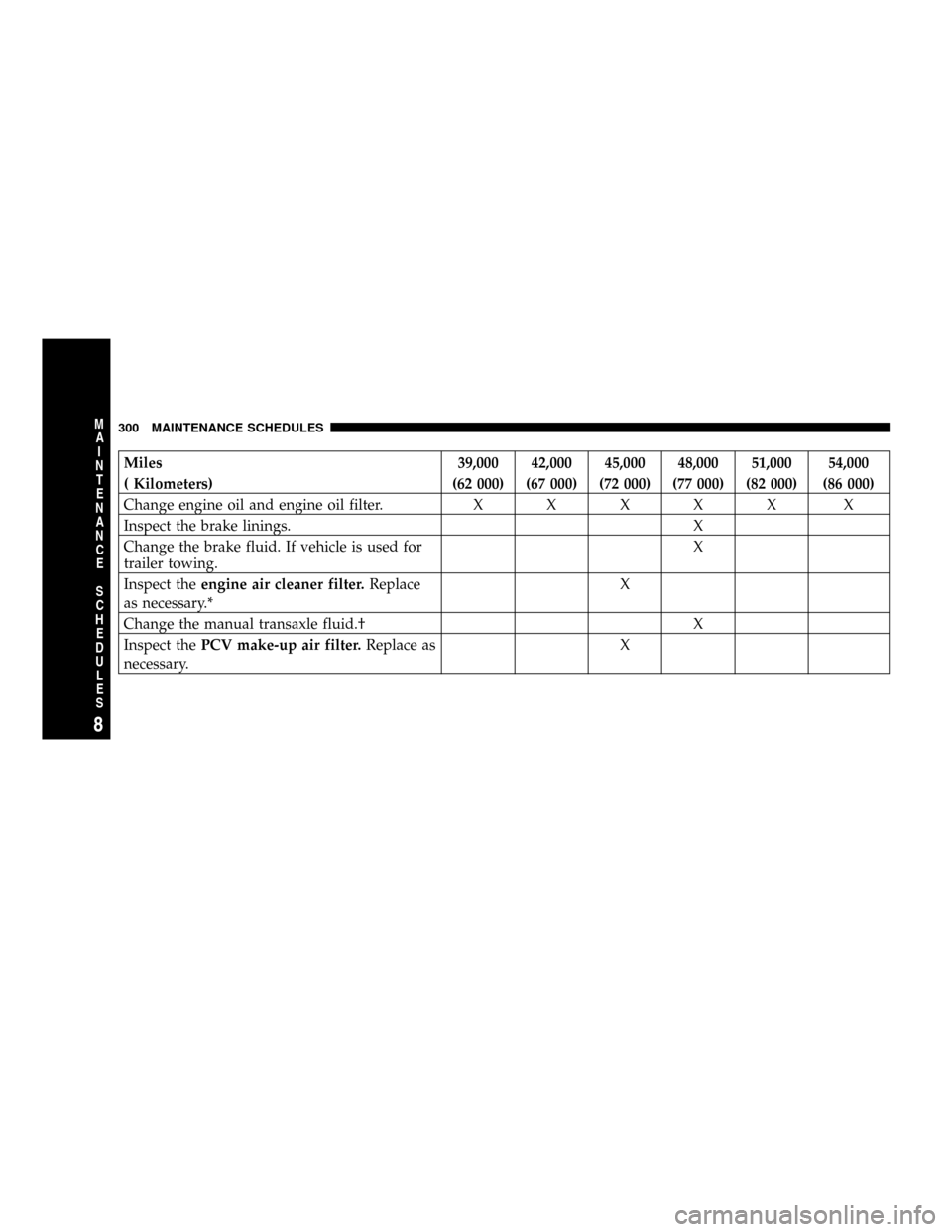
Miles 39,000 42,000 45,000 48,000 51,000 54,000
( Kilometers) (62 000) (67 000) (72 000) (77 000) (82 000) (86 000)
Change engine oil and engine oil filter.XXXXX X
Inspect the brake linings. X
Change the brake fluid. If vehicle is used for
trailer towing.X
Inspect theengine air cleaner filter.Replace
as necessary.*X
Change the manual transaxle fluid.² X
Inspect thePCV make-up air filter.Replace as
necessary.X
300 MAINTENANCE SCHEDULES
8
M
A
I
N
T
E
N
A
N
C
E
S
C
H
E
D
U
L
E
S
Page 303 of 341
Miles 93,000 96,000 99,000 102,000 105,000
(Kilometers) (150 000) (154 000) (159 000) (164 000) (168 000)
Change engine oil and engine oil filter.XXXXX
Inspect the brake linings. X
Change the brake fluid. If vehicle is used for trailer
towing.X
Inspect theengine air cleaner filterand replace as
necessary.*X
Change the manual transaxle fluid.² X
Flush and replace the engine coolant at 60 months
or 102,000 miles.X
Inspect thePCV make-up air filter.Replace as nec-
essary.X
MAINTENANCE SCHEDULES 303
8
M
A
I
N
T
E
N
A
N
C
E
S
C
H
E
D
U
L
E
S