Page 184 of 277
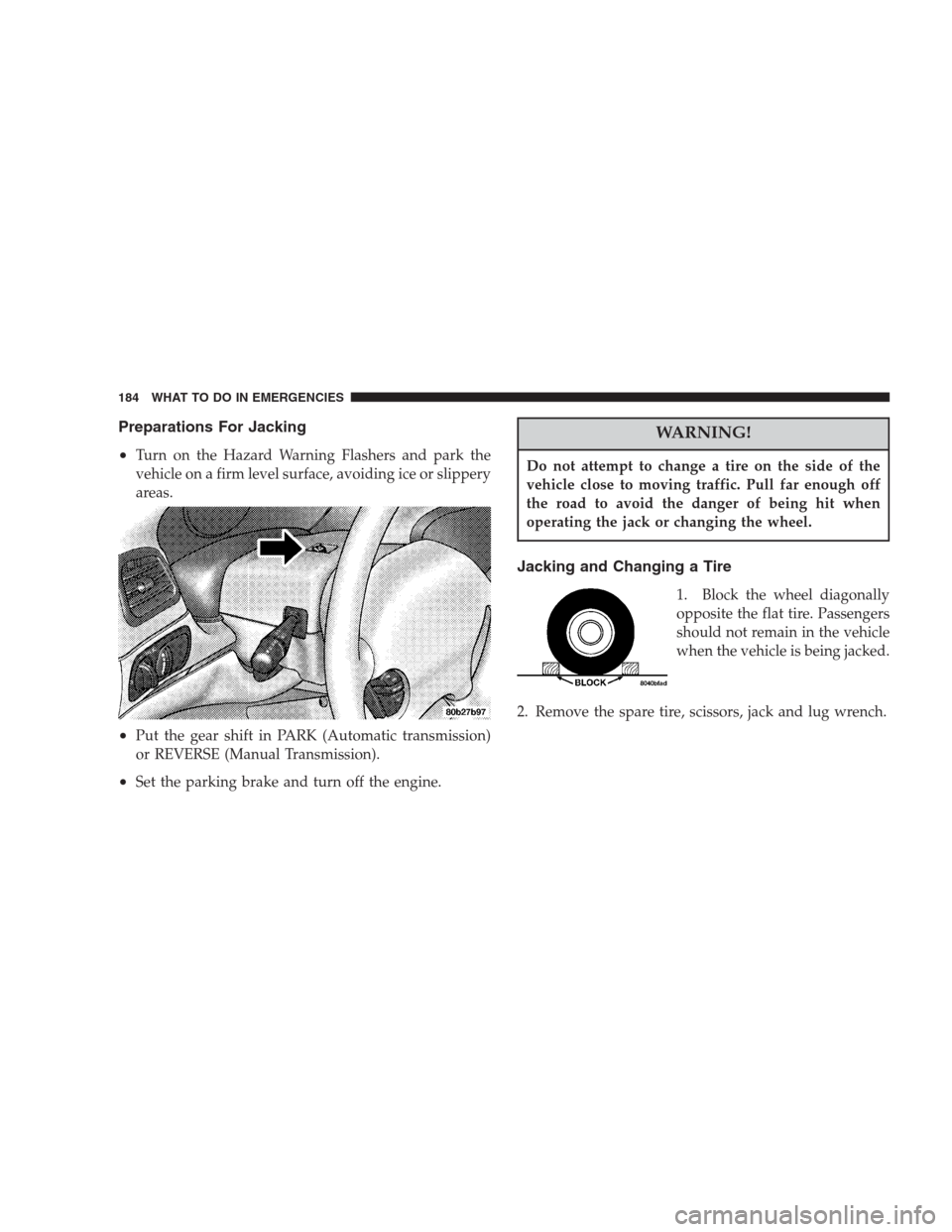
Preparations For Jacking
•
Turn on the Hazard Warning Flashers and park the
vehicle on a firm level surface, avoiding ice or slippery
areas.
•Put the gear shift in PARK (Automatic transmission)
or REVERSE (Manual Transmission).
•Set the parking brake and turn off the engine.
WARNING!
Do not attempt to change a tire on the side of the
vehicle close to moving traffic. Pull far enough off
the road to avoid the danger of being hit when
operating the jack or changing the wheel.
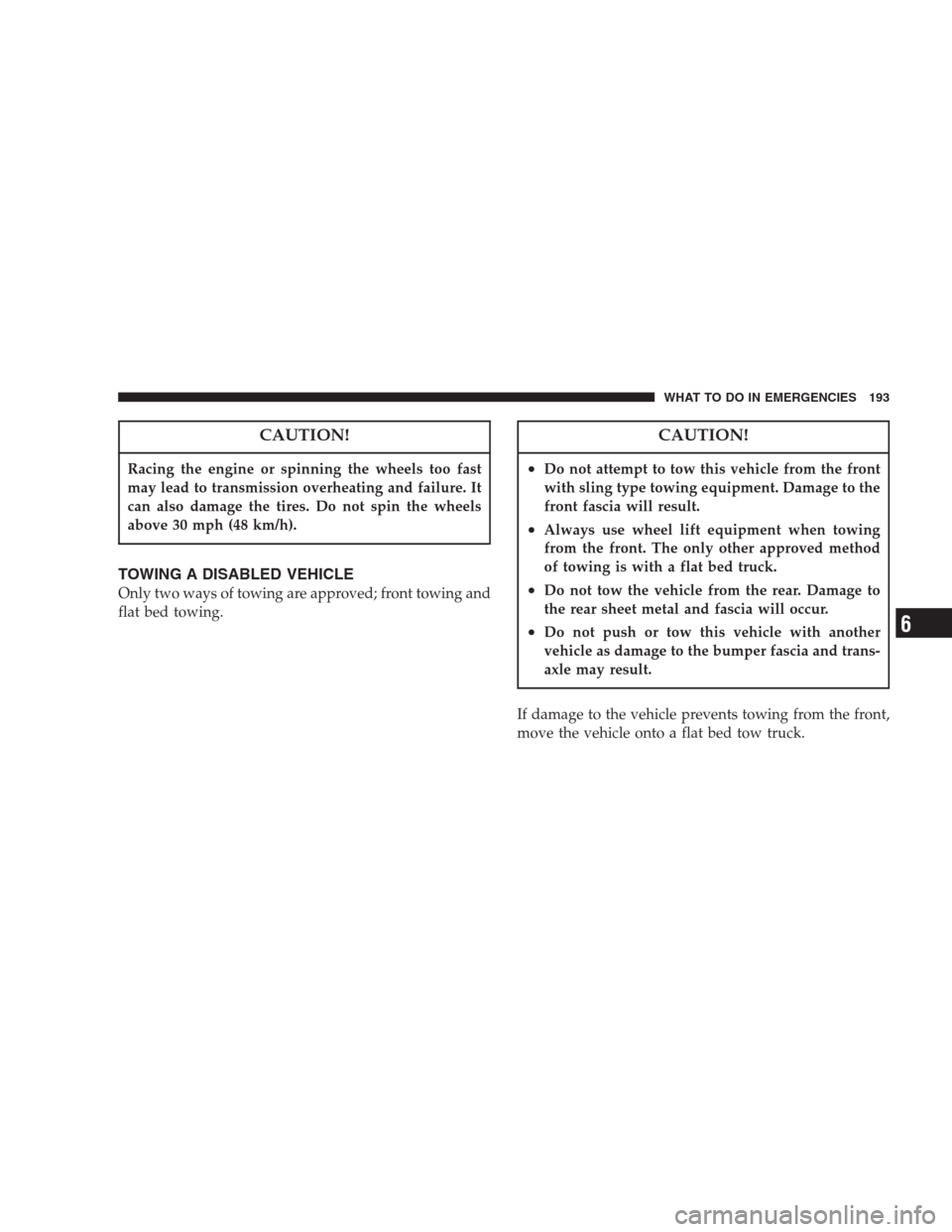
Jacking and Changing a Tire
1. Block the wheel diagonally
opposite the flat tire. Passengers
should not remain in the vehicle
when the vehicle is being jacked.
2. Remove the spare tire, scissors, jack and lug wrench.
184 WHAT TO DO IN EMERGENCIES
Page 193 of 277
CAUTION!
Racing the engine or spinning the wheels too fast
may lead to transmission overheating and failure. It
can also damage the tires. Do not spin the wheels
above 30 mph (48 km/h).
TOWING A DISABLED VEHICLE
Only two ways of towing are approved; front towing and
flat bed towing.
CAUTION!
•Do not attempt to tow this vehicle from the front
with sling type towing equipment. Damage to the
front fascia will result.
•Always use wheel lift equipment when towing
from the front. The only other approved method
of towing is with a flat bed truck.
•Do not tow the vehicle from the rear. Damage to
the rear sheet metal and fascia will occur.
•Do not push or tow this vehicle with another
vehicle as damage to the bumper fascia and trans-
axle may result.
If damage to the vehicle prevents towing from the front,
move the vehicle onto a flat bed tow truck.
WHAT TO DO IN EMERGENCIES 193
6
Page 221 of 277
Automatic Transaxle
All front wheel drive vehicles have a transaxle and
differential assembly contained within a single housing.
Selection of Lubricant
It is important that the proper lubricant is used in the
transaxle to assure optimum transaxle performance. Use
only the manufacturer’s recommended transmission
fluid. Refer to the Recommended Fluids, Lubricants and
Genuine Parts section for correct fluid type. It is impor-
tant that the transmission fluid be maintained at the
prescribed level using the recommended fluid.
CAUTION!
Using a transmission fluid other than the manufac-
turer’s recommended fluid may cause deterioration
in transmission shift quality and/or torque converter
shudder. Using a transmission fluid other than that
recommended by the manufacturer will result in
more frequent fluid and filter changes. Refer to the
Recommended Fluids, Lubricants and Genuine Parts
section for correct fluid type.
MAINTAINING YOUR VEHICLE 221
7
Page 223 of 277
CAUTION!
Do not overfill. Dirt and water in the transaxle can
cause serious damage. To prevent dirt and water
from entering the transaxle after checking or replen-
ishing fluid, make certain that the dipstick cap is
seated properly.
Fluid and Filter Changes
Automatic transmission fluid and filter should be
changed as follows:
Maintenance schedule “A”— No change necessary.
Maintenance schedule “B”–Every 60,000 miles (96 000
km) change fluid and filter under the following condi-
tions:
•Police, taxi, limousine, commercial type operation, or
trailer towing where the vehicle is drivenregularlyfor
more than 45 minutes of continuous operation.
NOTE:Refer to Section 8 of this manual for mainte-
nance schedules.If the transaxle is disassembled for any reason, the fluid
and filter should be changed.
Special Additives
The manufacturer recommends against the addition of
any fluid additives to the transaxle. The only exception to
this policy is the use of special dyes to aid in detecting
fluid leaks. The use of transmission sealers should be
avoided as they may adversely affect seals.
Appearance Care And Protection From Corrosion
Protection of Body and Paint from Corrosion
Vehicle body care requirements vary according to geo-
graphic locations and usage. Chemicals that make roads
passable in snow and ice, and those that are sprayed on
trees and road surfaces during other seasons, are highly
corrosive to the metal in your vehicle. Outside parking,
which exposes your vehicle to airborne contaminants,
road surfaces on which the vehicle is operated, extreme
hot or cold weather and other extreme conditions will
have an adverse effect on paint, metal trim, and under-
body protection.
MAINTAINING YOUR VEHICLE 223
7
Page 228 of 277
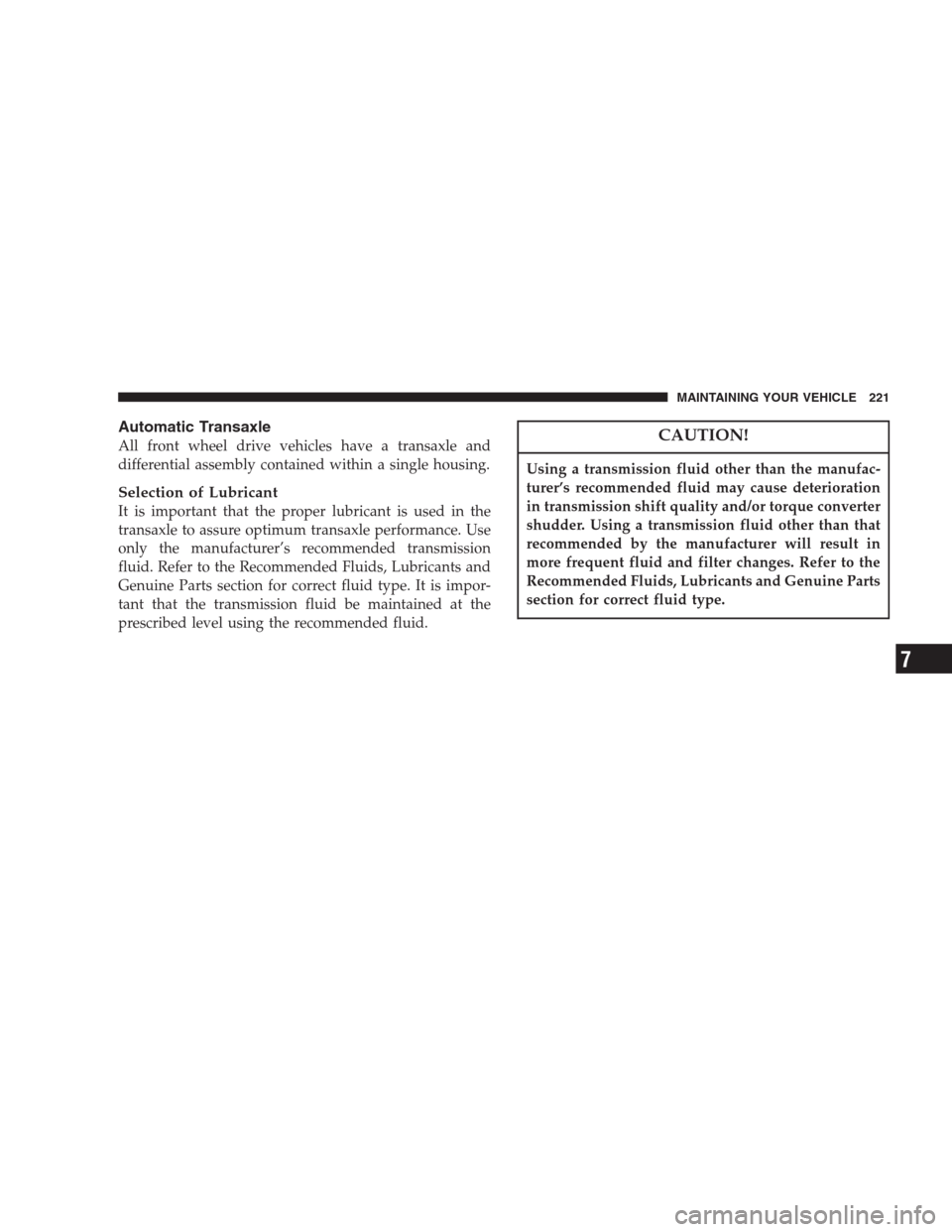
Underhood Fuses
A Power Distribution center is located in the engine
compartment. This center contains fuses and relays for
circuits that operate only under the hood. A label which
identifies these components is located on the underside
of the cover.CAUTION!
When replacing a blown fuse, it is important to use
only a fuse having the correct amperage rating. The
use of a fuse with a rating other than indicated may
result in a dangerous electrical system overload. If a
properly rated fuse continues to blow, it indicates a
problem in the circuit that must be corrected.
Interior Fuses
Cavity Fuse Circuits
1 10 Amp
RedTransmission Controller, Gauges,
Autostick
2 10 Amp
RedRight High Beam Headlight
3 10 Amp
RedLeft High Beam Headlight
4 10 Amp
RedRadio, CD Player
5 10 Amp
RedWasher Motor
6 15 Amp
Lt. BluePower Outlet
228 MAINTAINING YOUR VEHICLE
Page 237 of 277
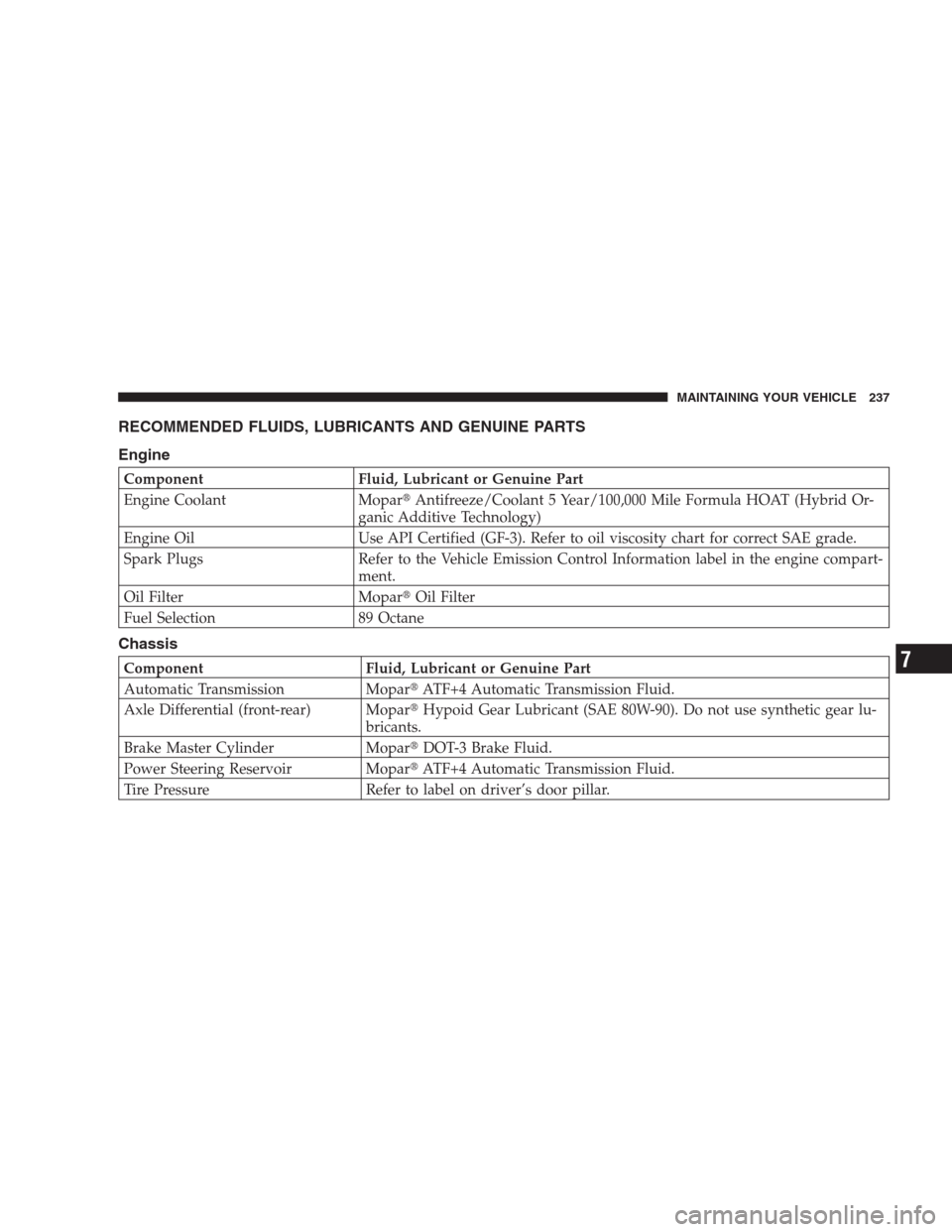
RECOMMENDED FLUIDS, LUBRICANTS AND GENUINE PARTS
Engine
Component Fluid, Lubricant or Genuine Part
Engine Coolant Mopar�Antifreeze/Coolant 5 Year/100,000 Mile Formula HOAT (Hybrid Or-
ganic Additive Technology)
Engine Oil Use API Certified (GF-3). Refer to oil viscosity chart for correct SAE grade.
Spark Plugs Refer to the Vehicle Emission Control Information label in the engine compart-
ment.
Oil Filter Mopar�Oil Filter
Fuel Selection 89 Octane
Chassis
Component Fluid, Lubricant or Genuine Part
Automatic Transmission Mopar�ATF+4 Automatic Transmission Fluid.
Axle Differential (front-rear) Mopar�Hypoid Gear Lubricant (SAE 80W-90). Do not use synthetic gear lu-
bricants.
Brake Master Cylinder Mopar�DOT-3 Brake Fluid.
Power Steering Reservoir Mopar�ATF+4 Automatic Transmission Fluid.
Tire Pressure Refer to label on driver’s door pillar.
MAINTAINING YOUR VEHICLE 237
7
Page 242 of 277
Once a Month
•
Check tire pressure and look for unusual wear or
damage.
•Inspect the battery and clean and tighten the terminals
as required.
•Check the fluid levels of coolant reservoir, brake
master cylinder, power steering and transaxle and add
as needed.
•Check all lights and all other electrical items for correct
operation.
•Check rubber seals on each side of the radiator for
proper fit.
At Each Oil Change
•
Change the engine oil filter.
•Inspect the exhaust system.
•Inspect the brake hoses.
•Inspect the CV joints and front and rear suspension
components.
•Check the automatic transmission fluid level.
•Check the coolant level, hoses, and clamps.
•Rotate the tires at each oil change interval shown on
Schedule “A” 6,000 miles (10 000 km) or every other
interval shown on Schedule “B” 6,000 miles (10 000
km).
242 MAINTENANCE SCHEDULES
8
M
A
I
N
T
E
N
A
N
C
E
S
C
H
E
D
U
L
E
S
Page 243 of 277

SCHEDULE “B”
Follow schedule “B” if you usually operate your vehicle
under one or more of the following conditions. Change
the automatic transmission fluid and filter every 60,000
miles (96 000 km) if the vehicle is usually operated under
one or more of the conditions marked with an�.
•Day or night temperatures are below 32° F (0° C).
•Stop and go driving.
•Extensive engine idling.
•Driving in dusty conditions.
•Short trips of less than 10 miles (16.2 km).
•More than 50% of your driving is at sustained high
speeds during hot weather, above 90° F (32° C).�
•Trailer towing.�
•Taxi, police or delivery service (commercial ser-
vices).�
•Off-road or desert operation.
•If equipped for and operating with E-85 (ethanol)
fuel.
NOTE:IfANYof these apply to you then change your
engine oil every 3,000 miles (5 000 km) or 3 months,
whichever comes first and follow schedule “B” of the
�Maintenance Schedules�section of this manual.
SCHEDULE “B” 243
8
M
A
I
N
T
E
N
A
N
C
E
S
C
H
E
D
U
L
E
S