Page 195 of 277
MAINTAINING YOUR VEHICLE
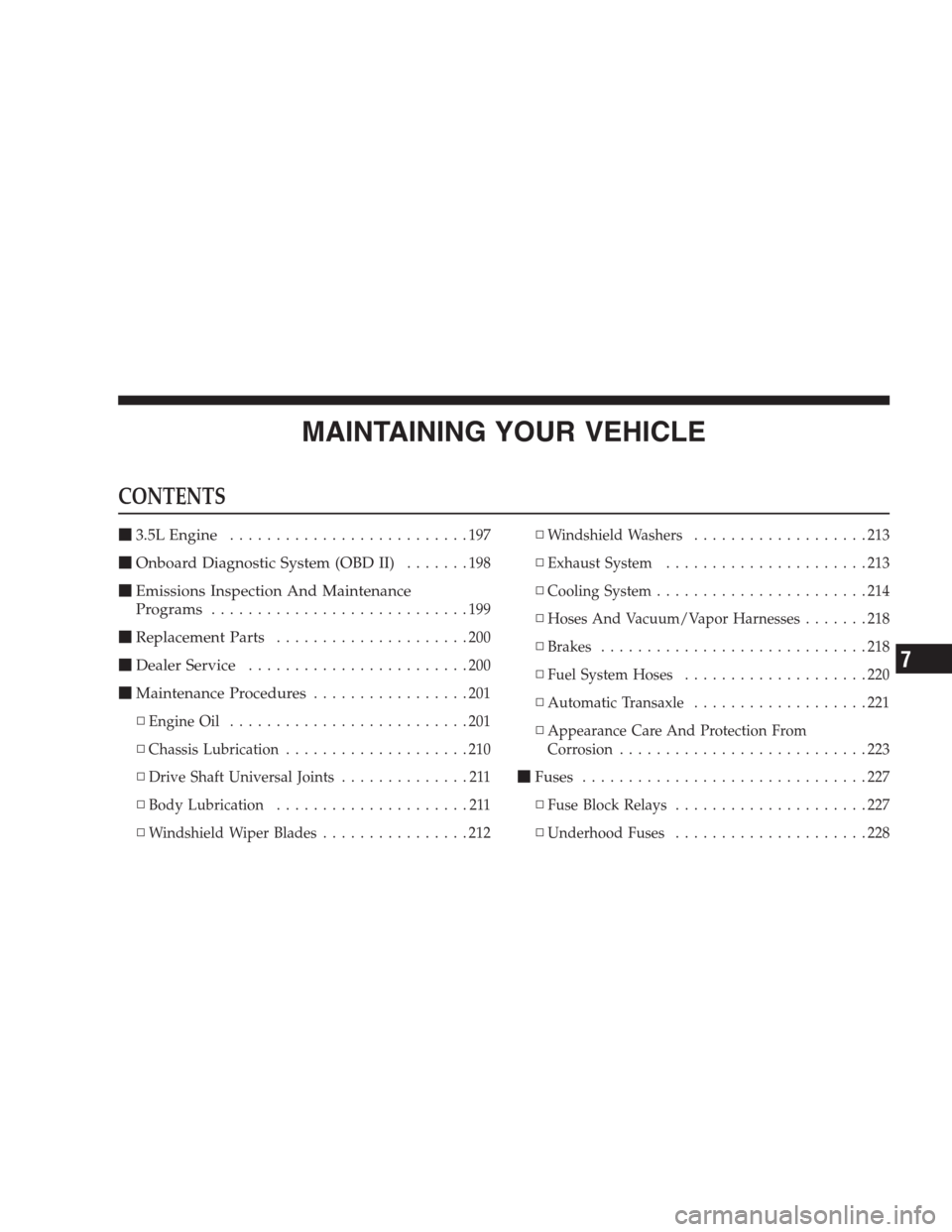
CONTENTS
�3.5L Engine..........................197
�Onboard Diagnostic System (OBD II).......198
�Emissions Inspection And Maintenance
Programs
............................199
�Replacement Parts.....................200
�Dealer Service........................200
�Maintenance Procedures.................201
▫Engine Oil..........................201
▫Chassis Lubrication....................210
▫Drive Shaft Universal Joints..............211
▫Body Lubrication.....................211
▫Windshield Wiper Blades................212▫Windshield Washers...................213
▫Exhaust System......................213
▫Cooling System.......................214
▫Hoses And Vacuum/Vapor Harnesses.......218
▫Brakes.............................218
▫Fuel System Hoses....................220
▫Automatic Transaxle...................221
▫Appearance Care And Protection From
Corrosion...........................223
�Fuses...............................227
▫Fuse Block Relays.....................227
▫Underhood Fuses.....................228
7
Page 212 of 277
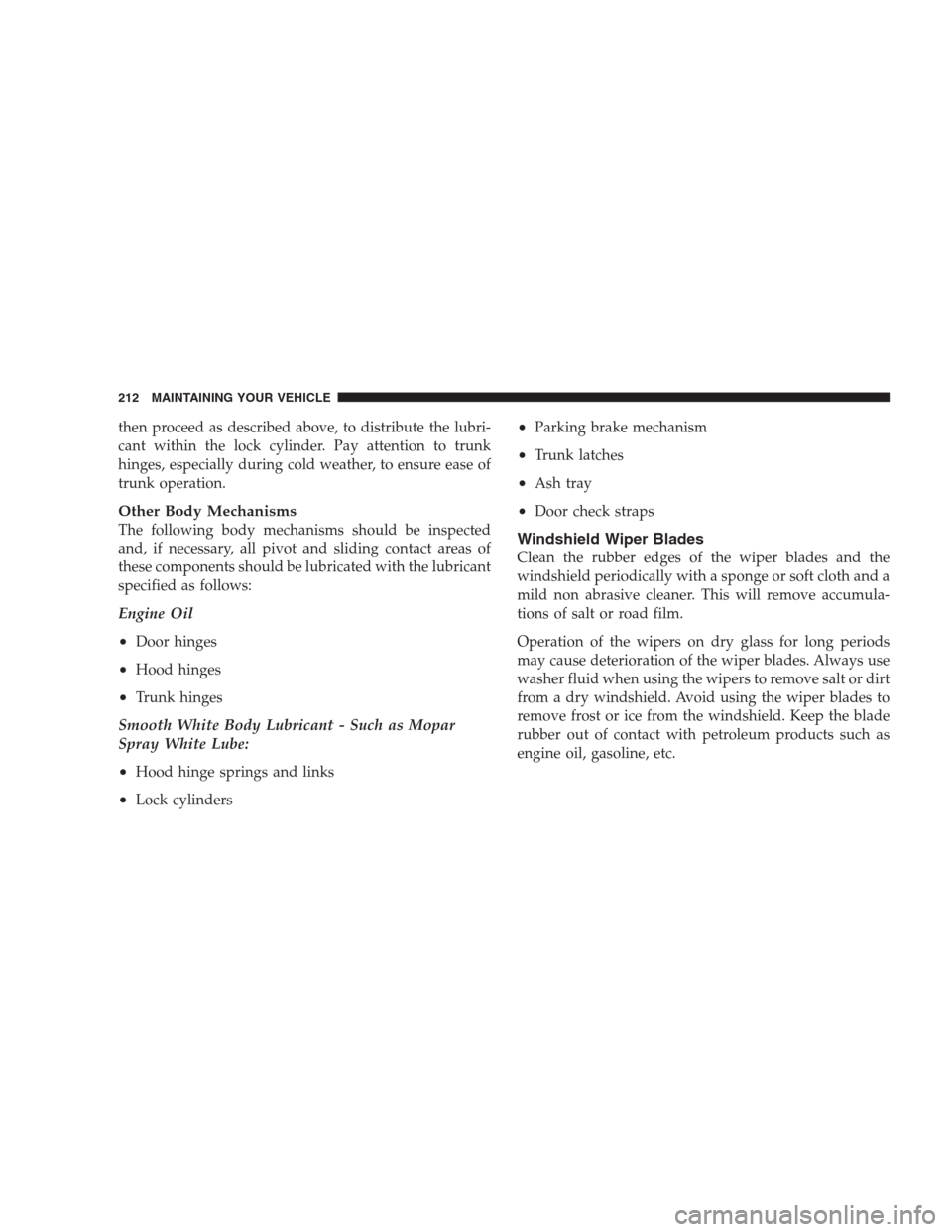
then proceed as described above, to distribute the lubri-
cant within the lock cylinder. Pay attention to trunk
hinges, especially during cold weather, to ensure ease of
trunk operation.
Other Body Mechanisms
The following body mechanisms should be inspected
and, if necessary, all pivot and sliding contact areas of
these components should be lubricated with the lubricant
specified as follows:
Engine Oil
•
Door hinges
•Hood hinges
•Trunk hinges
Smooth White Body Lubricant - Such as Mopar
Spray White Lube:
•
Hood hinge springs and links
•Lock cylinders
•Parking brake mechanism
•Trunk latches
•Ash tray
•Door check straps
Windshield Wiper Blades
Clean the rubber edges of the wiper blades and the
windshield periodically with a sponge or soft cloth and a
mild non abrasive cleaner. This will remove accumula-
tions of salt or road film.
Operation of the wipers on dry glass for long periods
may cause deterioration of the wiper blades. Always use
washer fluid when using the wipers to remove salt or dirt
from a dry windshield. Avoid using the wiper blades to
remove frost or ice from the windshield. Keep the blade
rubber out of contact with petroleum products such as
engine oil, gasoline, etc.
212 MAINTAINING YOUR VEHICLE
Page 218 of 277
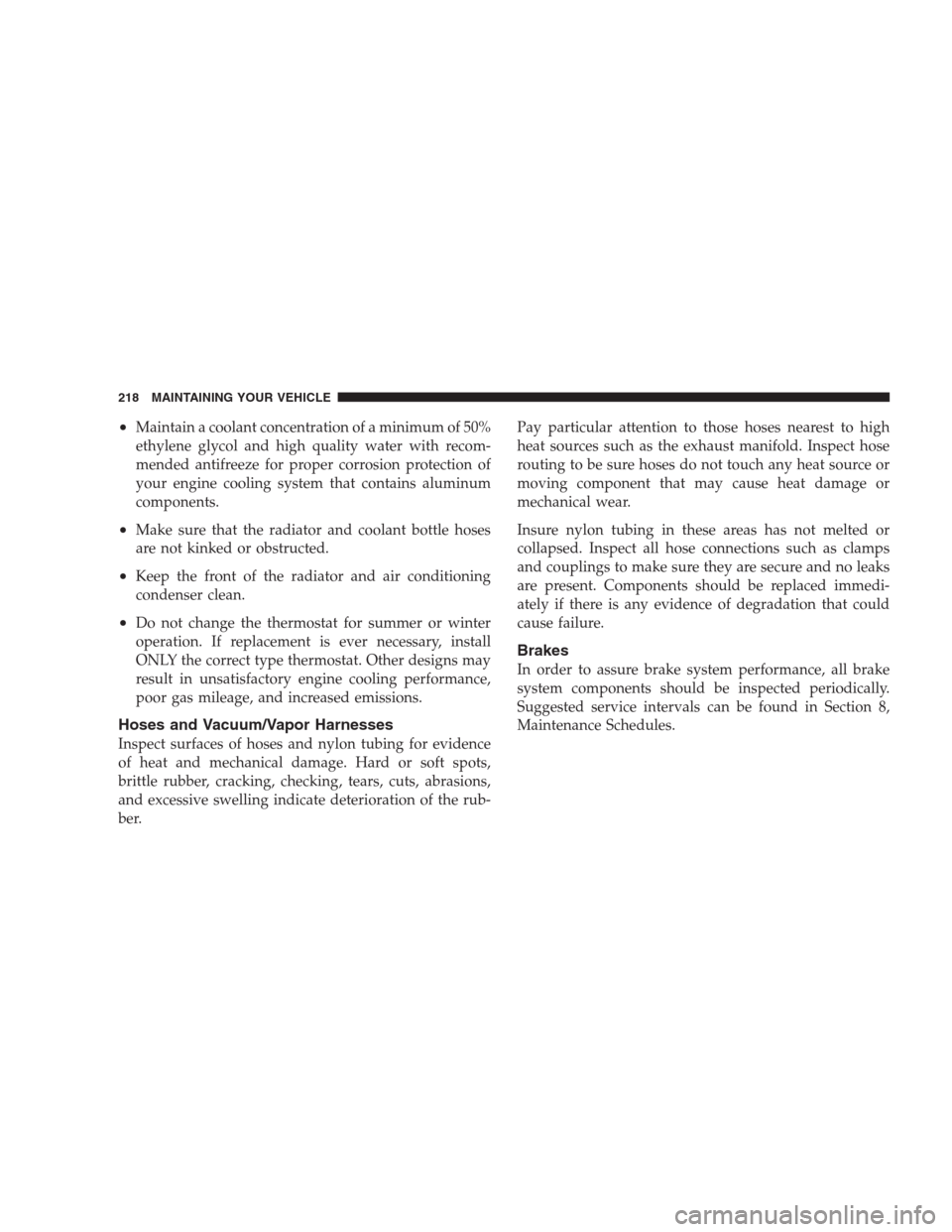
•Maintain a coolant concentration of a minimum of 50%
ethylene glycol and high quality water with recom-
mended antifreeze for proper corrosion protection of
your engine cooling system that contains aluminum
components.
•Make sure that the radiator and coolant bottle hoses
are not kinked or obstructed.
•Keep the front of the radiator and air conditioning
condenser clean.
•Do not change the thermostat for summer or winter
operation. If replacement is ever necessary, install
ONLY the correct type thermostat. Other designs may
result in unsatisfactory engine cooling performance,
poor gas mileage, and increased emissions.
Hoses and Vacuum/Vapor Harnesses
Inspect surfaces of hoses and nylon tubing for evidence
of heat and mechanical damage. Hard or soft spots,
brittle rubber, cracking, checking, tears, cuts, abrasions,
and excessive swelling indicate deterioration of the rub-
ber.Pay particular attention to those hoses nearest to high
heat sources such as the exhaust manifold. Inspect hose
routing to be sure hoses do not touch any heat source or
moving component that may cause heat damage or
mechanical wear.
Insure nylon tubing in these areas has not melted or
collapsed. Inspect all hose connections such as clamps
and couplings to make sure they are secure and no leaks
are present. Components should be replaced immedi-
ately if there is any evidence of degradation that could
cause failure.
Brakes
In order to assure brake system performance, all brake
system components should be inspected periodically.
Suggested service intervals can be found in Section 8,
Maintenance Schedules.
218 MAINTAINING YOUR VEHICLE
Page 219 of 277
WARNING!
Riding the brakes can lead to brake failure and
possibly an accident. Driving with your foot resting
or riding on the brake pedal can result in abnormally
high brake temperatures, excessive lining wear, and
possible brake damage. You wouldn’t have your full
braking capacity in an emergency.
Brake and Power Steering System Hoses
When servicing the vehicle for scheduled maintenance,
inspect surface of hoses for evidence of heat and me-
chanical damage. Hard and brittle rubber, cracking,
checking, tears, cuts, abrasion, and excessive swelling
suggest deterioration of the rubber. Particular attention
should be made to examining those hose surfaces nearest
to high heat sources, such as the exhaust manifold.
Inspect all hose clamps and couplings to make sure they
are secure and no leaks are present.
NOTE:Often, fluids such as oil, power steering fluid,
and brake fluid are used during assembly plant opera-
tions to ease the assembly of hoses to couplings. There-
fore, oil wetness at the hose-coupling area is not neces-
sarily an indication of leakage. Actual dripping of hot
fluid when systems are under pressure (during vehicle
operation) should be noted before hose is replaced based
on leakage.
NOTE:Inspection of brake hoses should be done
whenever the brake system is serviced and every engine
oil change.
WARNING!
Worn brake hoses can burst and cause brake failure.
You could have an accident. If you see any signs of
cracking, scuffing, or worn spots, have the brake
hoses replaced immediately.
Brake Master CylinderThe fluid level in the master cylinder should be checked
when performing under hood services, or immediately if
the brake system warning lamp shows system failure.
MAINTAINING YOUR VEHICLE 219
7
Page 220 of 277
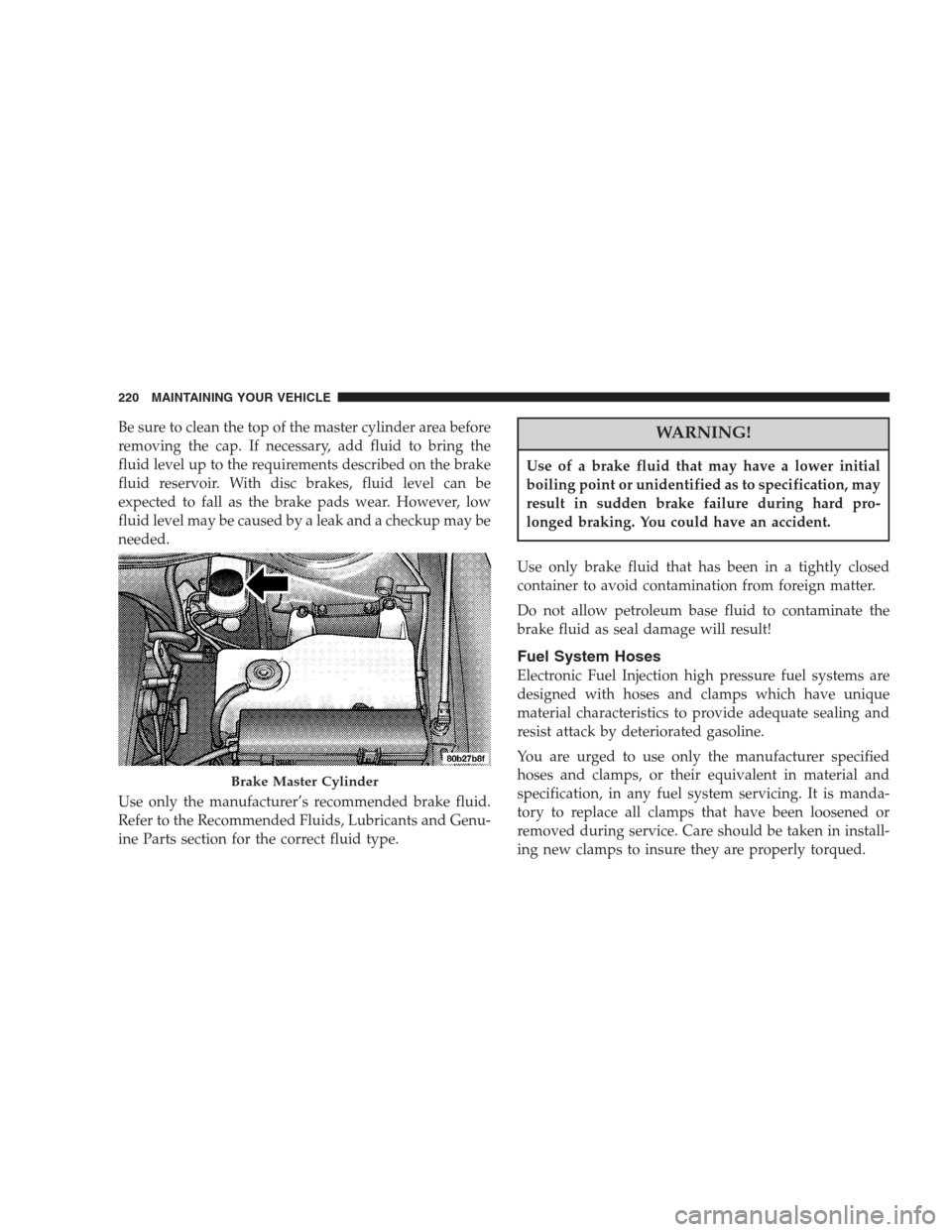
Be sure to clean the top of the master cylinder area before
removing the cap. If necessary, add fluid to bring the
fluid level up to the requirements described on the brake
fluid reservoir. With disc brakes, fluid level can be
expected to fall as the brake pads wear. However, low
fluid level may be caused by a leak and a checkup may be
needed.
Use only the manufacturer’s recommended brake fluid.
Refer to the Recommended Fluids, Lubricants and Genu-
ine Parts section for the correct fluid type.WARNING!
Use of a brake fluid that may have a lower initial
boiling point or unidentified as to specification, may
result in sudden brake failure during hard pro-
longed braking. You could have an accident.
Use only brake fluid that has been in a tightly closed
container to avoid contamination from foreign matter.
Do not allow petroleum base fluid to contaminate the
brake fluid as seal damage will result!
Fuel System Hoses
Electronic Fuel Injection high pressure fuel systems are
designed with hoses and clamps which have unique
material characteristics to provide adequate sealing and
resist attack by deteriorated gasoline.
You are urged to use only the manufacturer specified
hoses and clamps, or their equivalent in material and
specification, in any fuel system servicing. It is manda-
tory to replace all clamps that have been loosened or
removed during service. Care should be taken in install-
ing new clamps to insure they are properly torqued.
Brake Master Cylinder
220 MAINTAINING YOUR VEHICLE
Page 222 of 277
Fluid Level Check
The fluid level in the automatic transaxle should be
checked whenever the vehicle is serviced. Operation with
an improper fluid level will greatly reduce the life of the
transaxle and of the fluid.
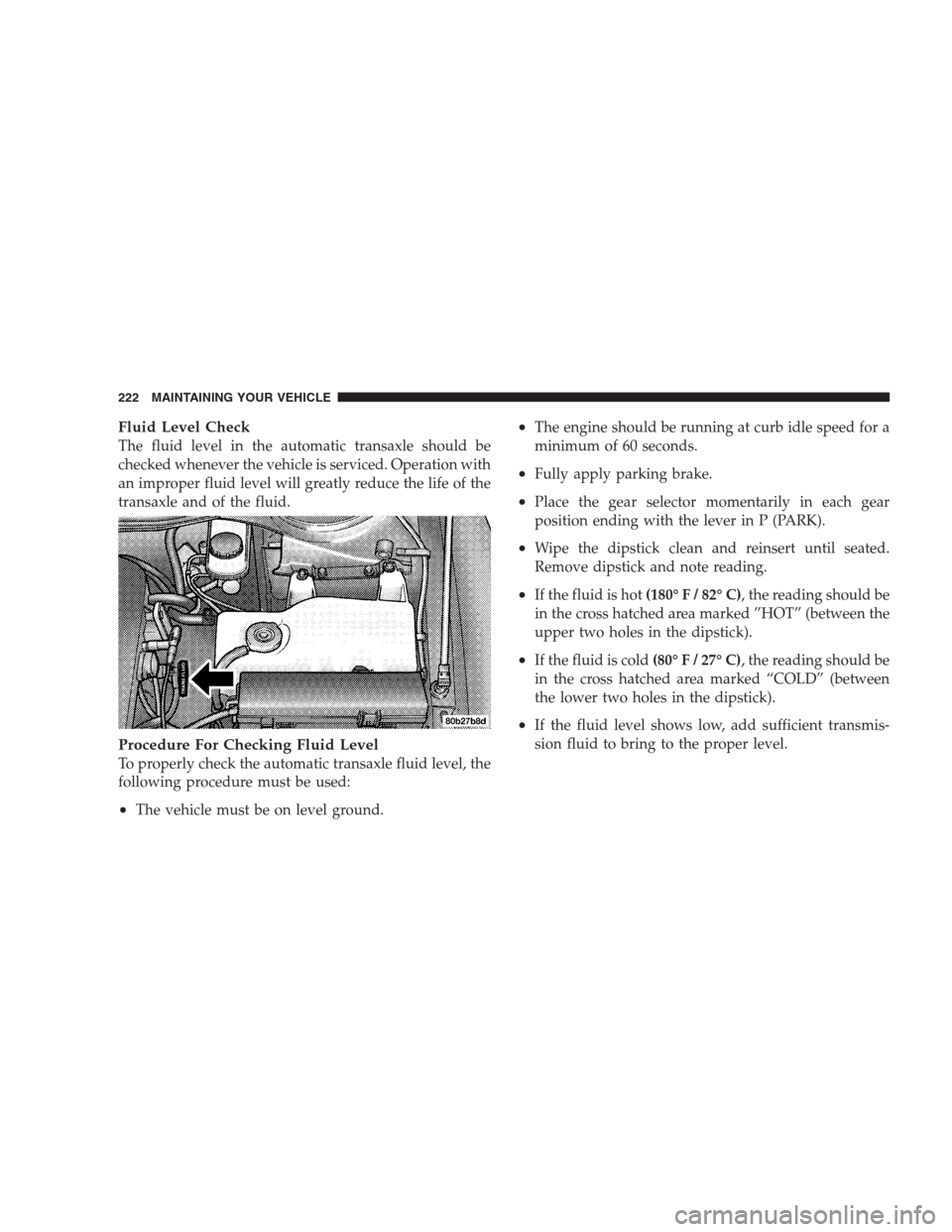
Procedure For Checking Fluid Level
To properly check the automatic transaxle fluid level, the
following procedure must be used:
•The vehicle must be on level ground.
•The engine should be running at curb idle speed for a
minimum of 60 seconds.
•Fully apply parking brake.
•Place the gear selector momentarily in each gear
position ending with the lever in P (PARK).
•Wipe the dipstick clean and reinsert until seated.
Remove dipstick and note reading.
•If the fluid is hot(180° F / 82° C), the reading should be
in the cross hatched area marked ”HOT” (between the
upper two holes in the dipstick).
•If the fluid is cold(80° F / 27° C), the reading should be
in the cross hatched area marked “COLD” (between
the lower two holes in the dipstick).
•If the fluid level shows low, add sufficient transmis-
sion fluid to bring to the proper level.
222 MAINTAINING YOUR VEHICLE
Page 229 of 277
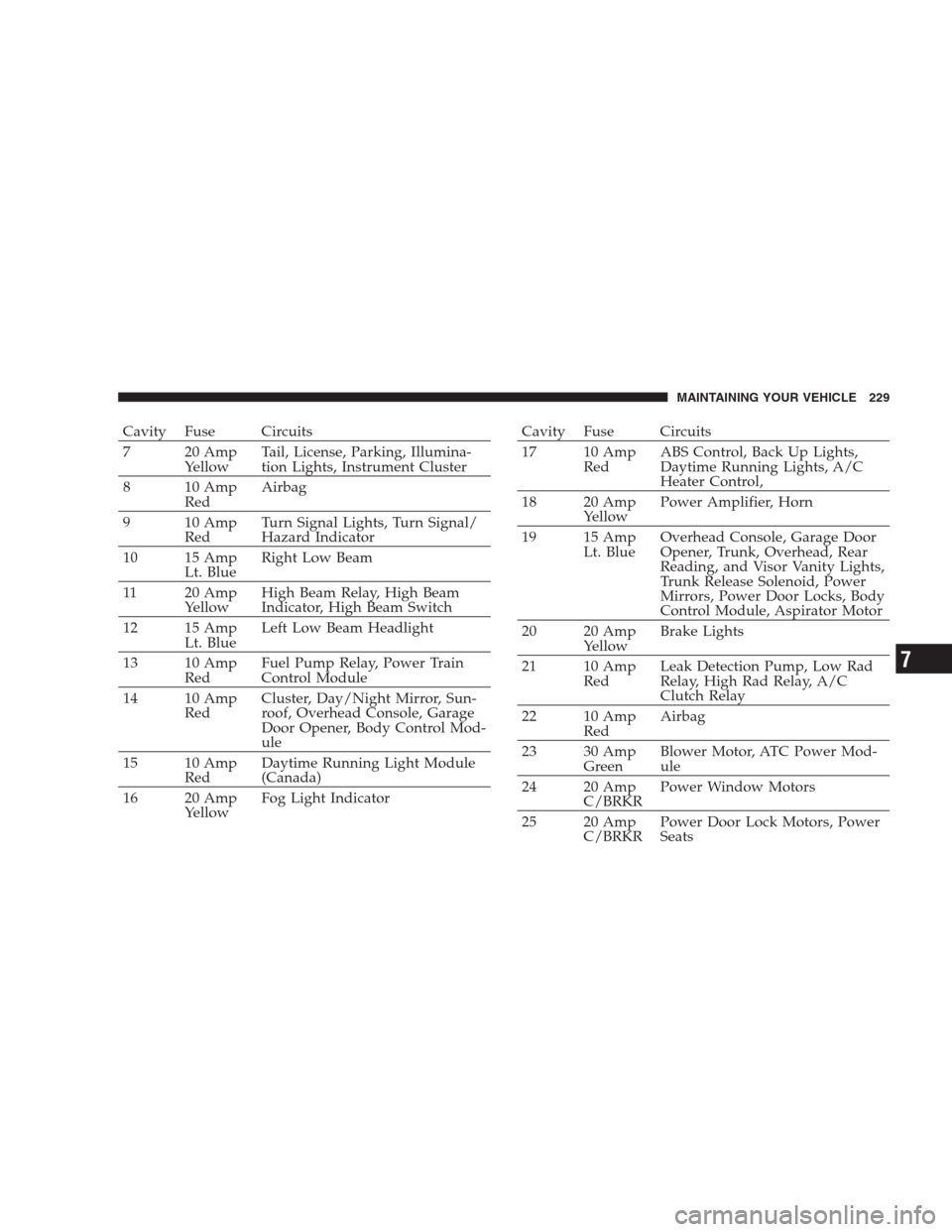
Cavity Fuse Circuits
7 20 Amp
YellowTail, License, Parking, Illumina-
tion Lights, Instrument Cluster
8 10 Amp
RedAirbag
9 10 Amp
RedTurn Signal Lights, Turn Signal/
Hazard Indicator
10 15 Amp
Lt. BlueRight Low Beam
11 20 Amp
YellowHigh Beam Relay, High Beam
Indicator, High Beam Switch
12 15 Amp
Lt. BlueLeft Low Beam Headlight
13 10 Amp
RedFuel Pump Relay, Power Train
Control Module
14 10 Amp
RedCluster, Day/Night Mirror, Sun-
roof, Overhead Console, Garage
Door Opener, Body Control Mod-
ule
15 10 Amp
RedDaytime Running Light Module
(Canada)
16 20 Amp
YellowFog Light IndicatorCavity Fuse Circuits
17 10 Amp
RedABS Control, Back Up Lights,
Daytime Running Lights, A/C
Heater Control,
18 20 Amp
YellowPower Amplifier, Horn
19 15 Amp
Lt. BlueOverhead Console, Garage Door
Opener, Trunk, Overhead, Rear
Reading, and Visor Vanity Lights,
Trunk Release Solenoid, Power
Mirrors, Power Door Locks, Body
Control Module, Aspirator Motor
20 20 Amp
YellowBrake Lights
21 10 Amp
RedLeak Detection Pump, Low Rad
Relay, High Rad Relay, A/C
Clutch Relay
22 10 Amp
RedAirbag
23 30 Amp
GreenBlower Motor, ATC Power Mod-
ule
24 20 Amp
C/BRKRPower Window Motors
25 20 Amp
C/BRKRPower Door Lock Motors, Power
Seats
MAINTAINING YOUR VEHICLE 229
7
Page 237 of 277
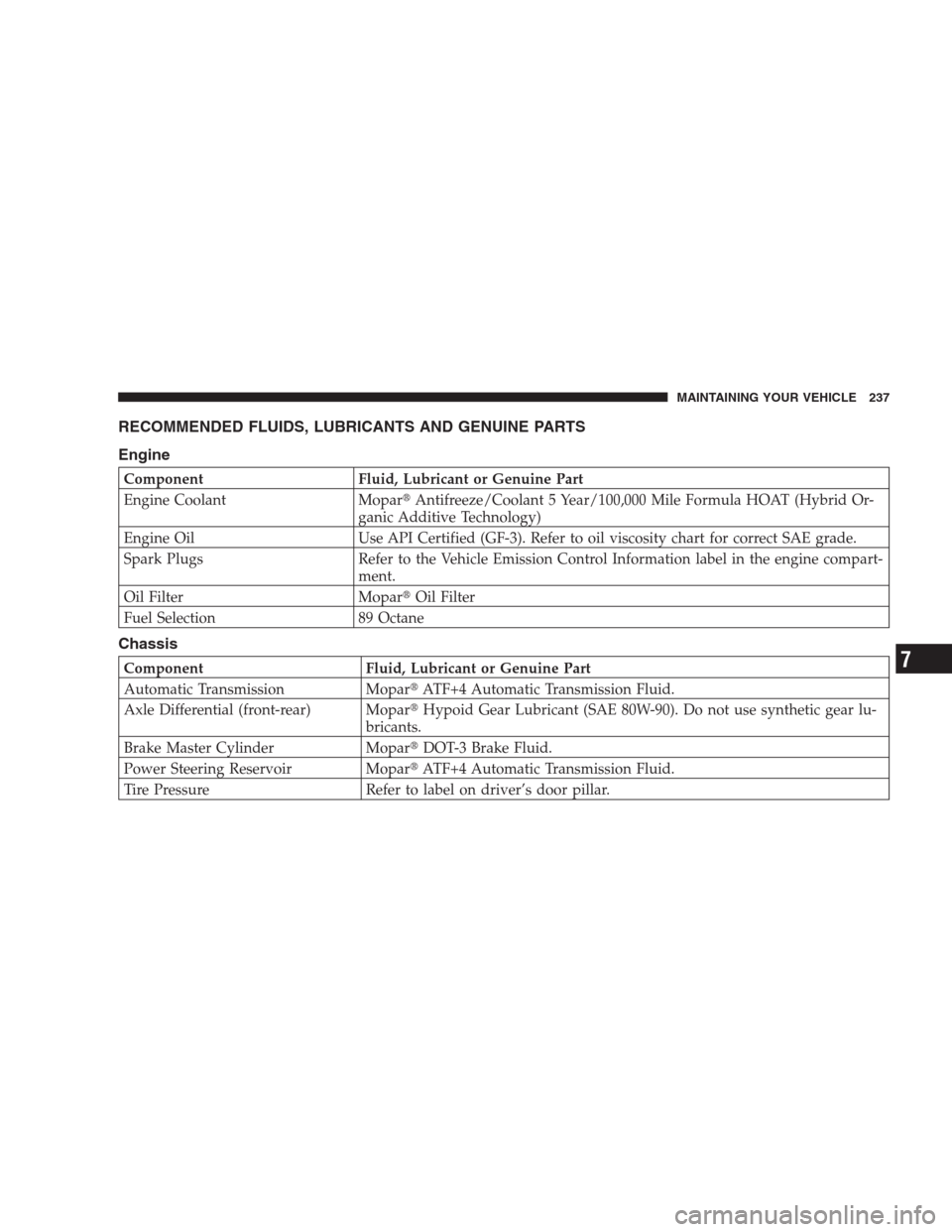
RECOMMENDED FLUIDS, LUBRICANTS AND GENUINE PARTS
Engine
Component Fluid, Lubricant or Genuine Part
Engine Coolant Mopar�Antifreeze/Coolant 5 Year/100,000 Mile Formula HOAT (Hybrid Or-
ganic Additive Technology)
Engine Oil Use API Certified (GF-3). Refer to oil viscosity chart for correct SAE grade.
Spark Plugs Refer to the Vehicle Emission Control Information label in the engine compart-
ment.
Oil Filter Mopar�Oil Filter
Fuel Selection 89 Octane
Chassis
Component Fluid, Lubricant or Genuine Part
Automatic Transmission Mopar�ATF+4 Automatic Transmission Fluid.
Axle Differential (front-rear) Mopar�Hypoid Gear Lubricant (SAE 80W-90). Do not use synthetic gear lu-
bricants.
Brake Master Cylinder Mopar�DOT-3 Brake Fluid.
Power Steering Reservoir Mopar�ATF+4 Automatic Transmission Fluid.
Tire Pressure Refer to label on driver’s door pillar.
MAINTAINING YOUR VEHICLE 237
7