Page 214 of 277
WARNING!
Exhaust gases can injure or kill. They contain carbon
monoxide which is colorless and odorless. Breathing
it can make you unconscious and can eventually
poison you. Follow the above precautions to keep
your exhaust system as safe as possible.
Cooling System
WARNING!
•When working near the radiator cooling fan, dis-
connect the fan motor lead or turn the ignition key
to the OFF position. The fan is controlled by
engine coolant temperature and Air Conditioning
pressure. It can start at any time the ignition key is
in the ON position.
•You or others can be badly burned by hot coolant
or steam from your radiator. If you see or hear
steam coming from under the hood, don’t open
the hood until the radiator has had time to cool.
Never try to open a cooling system pressure cap
when the radiator or coolant bottle is hot.
Coolant Checks
Check coolant protection every 12 months (before the
onset of freezing weather, where applicable). If the cool-
ant is dirty or rusty in appearance, the system should be
drained, flushed and refilled with fresh coolant.
214 MAINTAINING YOUR VEHICLE
Page 218 of 277
•Maintain a coolant concentration of a minimum of 50%
ethylene glycol and high quality water with recom-
mended antifreeze for proper corrosion protection of
your engine cooling system that contains aluminum
components.
•Make sure that the radiator and coolant bottle hoses
are not kinked or obstructed.
•Keep the front of the radiator and air conditioning
condenser clean.
•Do not change the thermostat for summer or winter
operation. If replacement is ever necessary, install
ONLY the correct type thermostat. Other designs may
result in unsatisfactory engine cooling performance,
poor gas mileage, and increased emissions.
Hoses and Vacuum/Vapor Harnesses
Inspect surfaces of hoses and nylon tubing for evidence
of heat and mechanical damage. Hard or soft spots,
brittle rubber, cracking, checking, tears, cuts, abrasions,
and excessive swelling indicate deterioration of the rub-
ber.Pay particular attention to those hoses nearest to high
heat sources such as the exhaust manifold. Inspect hose
routing to be sure hoses do not touch any heat source or
moving component that may cause heat damage or
mechanical wear.
Insure nylon tubing in these areas has not melted or
collapsed. Inspect all hose connections such as clamps
and couplings to make sure they are secure and no leaks
are present. Components should be replaced immedi-
ately if there is any evidence of degradation that could
cause failure.
Brakes
In order to assure brake system performance, all brake
system components should be inspected periodically.
Suggested service intervals can be found in Section 8,
Maintenance Schedules.
218 MAINTAINING YOUR VEHICLE
Page 223 of 277
CAUTION!
Do not overfill. Dirt and water in the transaxle can
cause serious damage. To prevent dirt and water
from entering the transaxle after checking or replen-
ishing fluid, make certain that the dipstick cap is
seated properly.
Fluid and Filter Changes
Automatic transmission fluid and filter should be
changed as follows:
Maintenance schedule “A”— No change necessary.
Maintenance schedule “B”–Every 60,000 miles (96 000
km) change fluid and filter under the following condi-
tions:
•Police, taxi, limousine, commercial type operation, or
trailer towing where the vehicle is drivenregularlyfor
more than 45 minutes of continuous operation.
NOTE:Refer to Section 8 of this manual for mainte-
nance schedules.If the transaxle is disassembled for any reason, the fluid
and filter should be changed.
Special Additives
The manufacturer recommends against the addition of
any fluid additives to the transaxle. The only exception to
this policy is the use of special dyes to aid in detecting
fluid leaks. The use of transmission sealers should be
avoided as they may adversely affect seals.
Appearance Care And Protection From Corrosion
Protection of Body and Paint from Corrosion
Vehicle body care requirements vary according to geo-
graphic locations and usage. Chemicals that make roads
passable in snow and ice, and those that are sprayed on
trees and road surfaces during other seasons, are highly
corrosive to the metal in your vehicle. Outside parking,
which exposes your vehicle to airborne contaminants,
road surfaces on which the vehicle is operated, extreme
hot or cold weather and other extreme conditions will
have an adverse effect on paint, metal trim, and under-
body protection.
MAINTAINING YOUR VEHICLE 223
7
Page 240 of 277
EMISSION CONTROL SYSTEM MAINTENANCE
The “Scheduled” maintenance services, listed inbold
typemust be done at the times or mileages specified to
assure the continued proper functioning of the emission
control system. These, and all other maintenance services
included in this manual, should be done to provide best
vehicle performance and reliability. More frequent main-
tenance may be needed for vehicles in severe operating
conditions such as dusty areas and very short trip
driving.
Inspection and service also should be done any time a
malfunction is suspected.
NOTE:Maintenance, replacement, or repair of the
emission control devices and systems on your vehicle
may be performed by any automotive repair establish-
ment or individual using any automotive part which has
been certified pursuant to U.S. EPA or, in the State of
California, California Air Resources Board regulations.
MAINTENANCE SCHEDULES
There are two maintenance schedules that show the
requiredservice for your vehicle.
First is Schedule“B”. It is for vehicles that are operated
under the conditions that are listed below and at the
beginning of the schedule.
•Day or night temperatures are below 32° F (0° C).
•Stop and go driving.
•Extensive engine idling.
•Driving in dusty conditions.
•Short trips of less than 10 miles (16 km).
•More than 50% of your driving is at sustained high
speeds during hot weather, above 90° F (32° C).�
•Trailer towing.�
•Taxi, police, or delivery service (commercial ser-
vice).�
•Off-road or desert operation.
240 MAINTENANCE SCHEDULES
8
M
A
I
N
T
E
N
A
N
C
E
S
C
H
E
D
U
L
E
S
Page 266 of 277
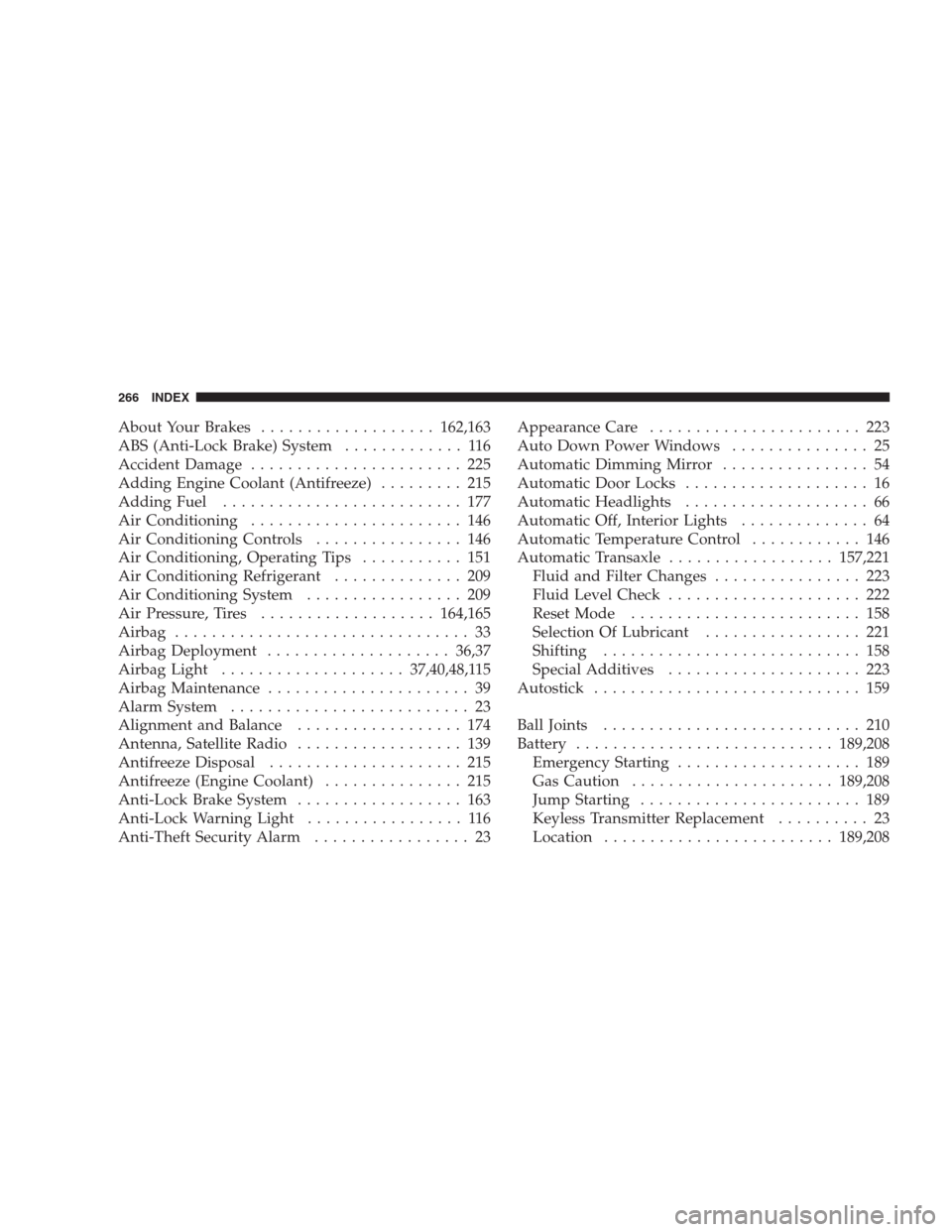
About Your Brakes...................162,163
ABS (Anti-Lock Brake) System............. 116
Accident Damage....................... 225
Adding Engine Coolant (Antifreeze)......... 215
Adding Fuel.......................... 177
Air Conditioning....................... 146
Air Conditioning Controls................ 146
Air Conditioning, Operating Tips........... 151
Air Conditioning Refrigerant.............. 209
Air Conditioning System................. 209
Air Pressure, Tires...................164,165
Airbag................................ 33
Airbag Deployment....................36,37
Airbag Light....................37,40,48,115
Airbag Maintenance...................... 39
Alarm System.......................... 23
Alignment and Balance.................. 174
Antenna, Satellite Radio.................. 139
Antifreeze Disposal..................... 215
Antifreeze (Engine Coolant)............... 215
Anti-Lock Brake System.................. 163
Anti-Lock Warning Light................. 116
Anti-Theft Security Alarm................. 23Appearance Care....................... 223
Auto Down Power Windows............... 25
Automatic Dimming Mirror................ 54
Automatic Door Locks.................... 16
Automatic Headlights.................... 66
Automatic Off, Interior Lights.............. 64
Automatic Temperature Control............ 146
Automatic Transaxle..................157,221
Fluid and Filter Changes................ 223
Fluid Level Check..................... 222
Reset Mode......................... 158
Selection Of Lubricant................. 221
Shifting............................ 158
Special Additives..................... 223
Autostick............................. 159
Ball Joints............................ 210
Battery............................189,208
Emergency Starting.................... 189
Gas Caution......................189,208
Jump Starting........................ 189
Keyless Transmitter Replacement.......... 23
Location.........................189,208
266 INDEX
Page:
< prev 1-8 9-16 17-24