2004 CHRYSLER 300 M air condition
[x] Cancel search: air conditionPage 150 of 277
Hot Weather Automatic Recirculation
The system will automatically recirculate the air inside
the vehicle when the interior is very warm. This will
provide maximum cooling. The system will also occa-
sionally return to REC on hot, humid days to maintain
occupant comfort. See Operating Tips chart at the end of
this section for suggested control settings in different
weather conditions.
Side Window Demisters
Side window demisters are located on the instrument
panel. These non adjustable outlets direct air toward the
side windows in any mode except Panel or Panel Recir-
culation. The air is directed toward the area of the side
windows through which you view the outside rearview
mirrors.
Rear Seat Air Outlets
The center console on vehicles with bucket seats has
upper and lower outlets located on the rear of the
console.
Air is directed through the outlets in all Modes. A control
can be used to direct the flow of air to either the upper or
lower outlets.
On vehicles with 50/50 bench seats, air is routed under
the seats.
150 UNDERSTANDING YOUR INSTRUMENT PANEL
Page 157 of 277

After Starting
The idle speed will automatically decrease as the engine
warms up.
ENGINE BLOCK HEATER — Optional U.S. and
Standard Canada
These heaters use a common power cord which is stored
under the hood, behind the Air Cleaner housing. Plug the
cord into any 110 volt AC outlet and both heaters will be
energized. Use the heaters when temperatures below 0°F
(-18°C) are expected to last for several days.
AUTOMATIC TRANSAXLE
Brake/Transmission Interlock
This interlock system prevents you from moving the gear
selector out of the Park position unless the brake pedal is
pressed. This system is active only while the key is in the
RUN position.
CAUTION!
Damage to the transaxle may occur if the following
precautions are not observed:
•Shift into PARK only after the vehicle has come to a
complete stop.
•Shift into or out of REVERSE only after the vehicle has
come to a complete stop and the engine is at idle
speed.
•Do not shift from REVERSE, PARK or NEUTRAL into
any forward gear when the engine is above idle speed.
•Before shifting into any gear, make sure your foot is
firmly on the brake pedal.
The electronically controlled transaxle provides a precise
shift schedule. The transaxle electronics are self-
calibrating. Therefore, the first few shifts on a new
vehicle may be somewhat abrupt. This is a normal
condition, and precision shifts will develop within a few
shift cycles.
STARTING AND OPERATING 157
5
Page 166 of 277
![CHRYSLER 300 M 2004 1.G Owners Manual period. The cold inflation pressure must not exceed the
maximum values molded into the tire side wall.
Tire pressure may increase from 2 to 6 psi [.13 to.41 bars]
(13 to 40 kPa) during operation. Do N](/manual-img/25/8462/w960_8462-165.png "CHRYSLER 300 M 2004 1.G Owners Manual period. The cold inflation pressure must not exceed the
maximum values molded into the tire side wall.
Tire pressure may increase from 2 to 6 psi [.13 to.41 bars]
(13 to 40 kPa) during operation. Do N")
period. The cold inflation pressure must not exceed the
maximum values molded into the tire side wall.
Tire pressure may increase from 2 to 6 psi [.13 to.41 bars]
(13 to 40 kPa) during operation. Do NOT reduce this
normal pressure build up or your tire pressure will be too
low.
The tire pressures shown on the tire label apply only to
the tire sizes listed on the label.
Tire Pressure Monitor System — If Equipped
The Tire Pressure Monitor System (TPM) monitors the
pressure in all 4 road tires and the full size spare. The
TPM system uses wireless technology to monitor tire
pressure levels. Sensors, mounted to each wheel as part
of the valve stem, transmit tire pressure readings to a
receiver located in the overhead console. The tire pres-
sure status is shown in the Electronic Vehicle Information
Center (EVIC) display. Pressure in the spare tire, al-
though monitored, is not displayed in the EVIC. Refer to
“Understanding the Features of Your Vehicle, Electronic
Vehicle Information Center (EVIC)” for more informa-
tion. The TPM system functions even when the EVIC is
not set on the tire pressure display screen.The TPM system informs you of a low or high tire
pressure condition. If this occurs, correct your tire infla-
tion pressure as soon as possible, and inspect all of your
tires. Be sure to use a high quality gauge when adjusting
pressure. The TPM system is designed to periodically
monitor your tire pressure but cannot be expected to
function as a tire pressure gauge. There can be a delay
between the instant you adjust the air pressure in a tire
and when the system updates the display. The TPM
system is not intended to provide you with notification of
rapid air loss.
The following chart indicates the TPM system pressure
levels. A threshold is the level at which the TPM system
provides you with an indication.
300M 300M Special
High Pressure
Threshold45 psi (310 kPa) 45 psi (310 kPa)
Placard Pressure 30 psi (207 kPa) 32 psi (220 kPa)
Low Pressure
Threshold24 psi (165 kPa) 26 psi (179 kPa)
NOTE:A TPM system does not replace normal tire
maintenance.
166 STARTING AND OPERATING
Page 182 of 277
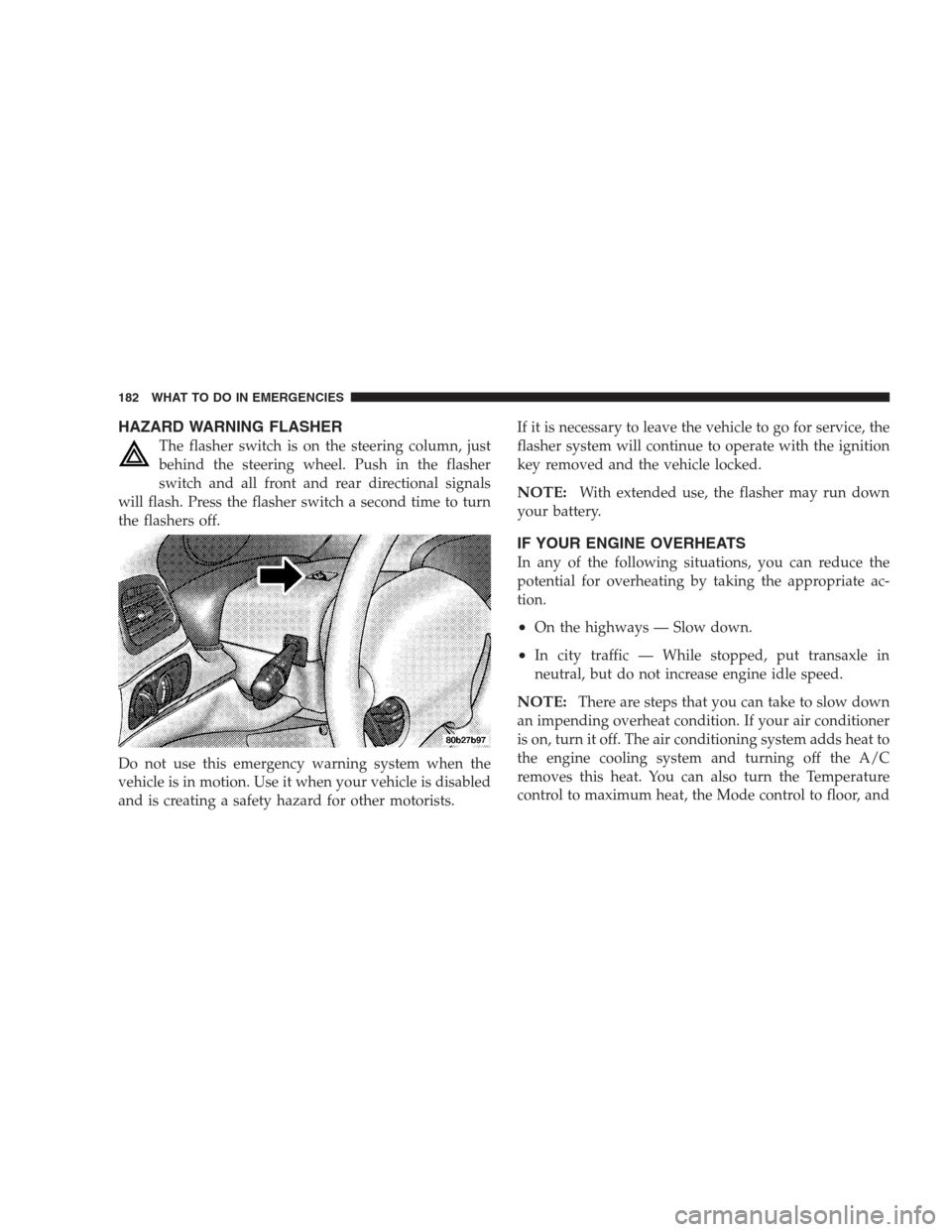
HAZARD WARNING FLASHER
The flasher switch is on the steering column, just
behind the steering wheel. Push in the flasher
switch and all front and rear directional signals
will flash. Press the flasher switch a second time to turn
the flashers off.
Do not use this emergency warning system when the
vehicle is in motion. Use it when your vehicle is disabled
and is creating a safety hazard for other motorists.If it is necessary to leave the vehicle to go for service, the
flasher system will continue to operate with the ignition
key removed and the vehicle locked.
NOTE:With extended use, the flasher may run down
your battery.
IF YOUR ENGINE OVERHEATS
In any of the following situations, you can reduce the
potential for overheating by taking the appropriate ac-
tion.
•On the highways — Slow down.
•In city traffic — While stopped, put transaxle in
neutral, but do not increase engine idle speed.
NOTE:There are steps that you can take to slow down
an impending overheat condition. If your air conditioner
is on, turn it off. The air conditioning system adds heat to
the engine cooling system and turning off the A/C
removes this heat. You can also turn the Temperature
control to maximum heat, the Mode control to floor, and
182 WHAT TO DO IN EMERGENCIES
Page 183 of 277
the fan control to High. This allows the heater core to act
as a supplement to the radiator and aids in removing heat
from the engine cooling system.
CAUTION!
Driving with a hot cooling system could damage
your vehicle. If temperature gauge reads “H”, pull
over and stop the vehicle. Idle the vehicle with the
air conditioner turned off until the pointer drops
back into the normal range. If the pointer remains on
the “H”, turn the engine off immediately, and call for
service.
WARNING!
A hot engine cooling system is dangerous. You or
others could be badly burned by steam or boiling
coolant. You may want to call a service center if your
vehicle overheats. If you decide to look under the
hood yourself, see Section 7, Maintenance, of this
manual. Follow the warnings under the Cooling
System Pressure Cap paragraph.
JACKING AND TIRE CHANGING
WARNING!
Getting under a jacked-up vehicle is dangerous. The
vehicle could slip off the jack and fall on you. You
could be crushed. Never get any part of your body
under a vehicle that is on a jack. Never start or run
the engine while the vehicle is on a jack. If you need
to get under a raised vehicle, take it to a service
center where it can be raised on a lift.
WHAT TO DO IN EMERGENCIES 183
6
Page 205 of 277
performance may be impaired by supplemental addi-
tives.
Disposing of Used Engine Oil
Care should be taken in disposing of used engine oil from
your vehicle. Used oil, indiscriminately discarded, can
present a problem to the environment. Contact your
dealer, service station, or governmental agency for advice
on how and where used oil can be safely discarded in
your area.
Engine Oil Filter
The engine oil filter should be replaced at every engine
oil change.
Engine Oil Filter Selection
All of the manufacturer’s engines have a full-flow type
disposable oil filter. Use a filter of this type for replace-
ment. The quality of replacement filters varies consider-
ably. Only high quality filters should be used to assure
most efficient service. Mopar Engine Oil Filters are high
quality oil filters and are recommended.
Drive Belts — Check Condition and Tension
At the mileage shown in the maintenance schedules,
check all drive belts for condition and proper tension.
Improper belt tension can cause belt slippage and failure.
Inspect the drive belts for evidence of cuts, cracks, or
glazing and replace them if there is any sign of damage
which could result in belt failure. If adjustment is re-
quired, adjust the belts according to the specifications
and procedures shown in the Service Manual.
Special tools are required to properly measure tension
and to restore belt tension to factory specifications. Also,
check belt routing to make sure there is no interference
between the belts and other engine components.
Spark Plugs
Spark plugs must fire properly to assure engine perfor-
mance and emission control. New plugs should be in-
stalled at the mileage specified in the appropriate main-
tenance chart. The entire set should be replaced if there is
any malfunction due to a faulty spark plug. Check the
specifications section for the proper type of spark plug
for use in your vehicle.
MAINTAINING YOUR VEHICLE 205
7
Page 206 of 277
Engine Air Cleaner Filter
Under normal driving conditions, replace the air filter at
the intervals shown on Schedule “A”. If, however, you
drive the vehicle frequently under dusty or severe con-
ditions, the filter element should be inspected periodi-
cally and replaced if necessary at the intervals shown on
Schedule “B”.
WARNING!
The air cleaner can provide a measure of protection
in the case of engine backfire. Do not remove the air
cleaner unless such removal is necessary for repair or
maintenance. Make sure that no one is near the
engine compartment before starting the vehicle with
the air cleaner removed. Failure to do so can result in
serious personal injury.
Engine Fuel Filter
A plugged fuel filter can cause hard starting or limit the
speed at which a vehicle can be driven. Should an
excessive amount of dirt accumulate in the fuel tank,
frequent replacement of the fuel filter which is mounted
in the fuel tank may be necessary. See your dealer for
service.
Catalytic Converter
The catalytic converter requires the use of unleaded fuel
only. Leaded gasoline will destroy the effectiveness of the
catalyst as an emission control device.
Under normal operating conditions, the catalytic con-
verter will not require maintenance. However, it is im-
portant to keep the engine properly serviced to assure
proper catalyst operation and prevent possible catalyst
damage. If the Malfunction Indicator light is flashing,
immediate service is required.
206 MAINTAINING YOUR VEHICLE
Page 209 of 277
CAUTION!
It is essential when replacing the cables on the
battery that the positive cable is attached to the
positive post and the negative cable is attached to the
negative post. Battery posts are marked positive (+)
and negative (-) and identified on the battery case.
Cable clamps should be tight on the terminal posts
and free of corrosion. Apply grease to posts and
clamps after tightening. If a “fast charger” is used
while the battery is in the vehicle, disconnect both
vehicle battery cables before connecting the charger
to battery. Do not use a “fast charger” to provide
starting voltage as battery damage can result.
Air Conditioner
Check the air conditioning system at the start of the
warm weather season.
NOTE:If your air conditioning performance seems
lower than expected, check the front of the A/C con-
denser for an accumulation of dirt or insects. Clean with
a gentle water spray from behind the radiator andthrough the condenser as required. Fabric front fascia
protectors may reduce air flow to the condenser, reducing
air conditioning performance.
WARNING!
The air conditioning system contains refrigerant
under high pressure. To avoid risk of personal injury
or damage to the system, adding refrigerant or any
repair requiring lines to be disconnected should be
done by an experienced repairman.
Refrigerant Recovery and Recycling
The air conditioning system of your vehicle contains
R-134a, a refrigerant that does not deplete the ozone layer
in the upper atmosphere, the manufacturer recommends
that air conditioning service be done by facilities using
refrigerant recyling and recovery equipment that meets
SAE standard J1991.
MAINTAINING YOUR VEHICLE 209
7