Page 27 of 277

Trunk Emergency Release
The trunk of your vehicle is equipped with an emergency
release handle. It is located on the inside of the trunk lid,
near the latch, and is coated so that it glows in a darkened
trunk. Pull on the handle to open the trunk.
OCCUPANT RESTRAINTS
Some of the most important safety features in your
vehicle are the restraint systems. These include the front
and rear seat belts for the driver and all passengers, front
airbags for both the driver and front passenger and side
airbags, if equipped, for both the driver and right front
passenger. If you will be carrying children too small for
adult-size belts, your seat belts also can be used to hold
infant and child restraint systems.
Please pay close attention to the information in this
section. It tells you how to use your restraint system
properly to keep you and your passengers as safe as
possible.
WARNING!
In a collision, you and your passengers can suffer
much greater injuries if you are not properly buck-
led up. You can strike the interior of your vehicle or
other passengers, or you can be thrown out of the
vehicle. Always be sure you and others in your
vehicle are buckled up properly.
THINGS TO KNOW BEFORE STARTING YOUR VEHICLE 27
2
Page 47 of 277

ENGINE BREAK-IN RECOMMENDATIONS
The engine in your new vehicle does not require a long
break-in period.
Drive moderately during the first 300 miles (500 km).
After the initial 60 miles (100 km), speeds up to 50 or 55
mph (80 or 90 km/h) are desirable.
While cruising, brief full-throttle acceleration, within the
limits of local traffic laws, contributes to a good break-in.
Wide open throttle acceleration in low gear can be
detrimental and should be avoided.
The crankcase oil installed in the engine at the factory is
a high quality energy conserving type lubricant. Oil
changes should be consistent with expected climate con-
ditions under which vehicle operations will occur. The
recommended viscosity and quality grades are in Section
7 of this manual.
Do not use non-detergent or straight mineral oils.
A new engine may consume some oil during its first few
thousand miles of operation. This is a normal part of the
break-in and not an indication of a problem.
SAFETY TIPS
Exhaust Gas
WARNING!
Exhaust gases can injure or kill. They contain carbon
monoxide (CO) which is colorless and odorless.
Breathing it can make you unconscious and can
eventually poison you. To avoid breathing (CO)
follow the safety tips below.
•Do not run the engine in a closed garage or in confined
areas any longer than needed to move your vehicle in
or out of the area.
•If it is necessary to sit in a parked vehicle with the
engine running, adjust your heating or cooling con-
trols to force outside air into the vehicle. Set the blower
at high speed.
•To avoid drawing exhaust gases into the vehicle, close
the trunk while driving. However, if for some reason it
THINGS TO KNOW BEFORE STARTING YOUR VEHICLE 47
2
Page 113 of 277

INSTRUMENT CLUSTER DESCRIPTION
1. Fuel Gauge
When the ignition is in the ON position, the
pointer will show the level of fuel remaining in
the tank.
2. Low Fuel Warning Light
When the fuel level drops to about 2 gallons (8
liters), the Low Fuel symbol will light and re-
main lit until fuel is added. A warning chime will
sound when the light comes on.
3. Low Oil Pressure Light
This light indicates low engine oil pressure. The
light should come on briefly as a bulb check
when the engine is first started. If the light stays on or
comes on while driving, stop the vehicle and shut off
the engine. DO NOT operate the vehicle until the
cause is corrected.This light does not show how
much oil is in the engine.The engine oil level must be
checked under the hood.4. TRAC ON/OFF Lights
The Traction Control On light (TRAC ON) will come on
momentarily as a bulb check when the ignition switch is
first turned ON. If the light does not come on, have the
bulb replaced.
The TRAC ON light will also come on when the system
is controlling traction.
The Traction Control Off light (TRAC OFF) will come on
momentarily as a bulb check when the ignition switch is
first turned ON. If the light does not come on, have the
bulb checked.
The TRAC OFF light will come on when the Traction
Control switch has been used to turn the system off.
5. Trunk Ajar Light
This light indicates that the trunk is not latched
6. Tachometer
Measures engine revolutions-per-minute (R.P.M.). The
red numbers at the end on the scale show the maximum
permissible R.P.M. Ease off on the accelerator before
reaching the red area.
UNDERSTANDING YOUR INSTRUMENT PANEL 113
4
Page 167 of 277

CAUTION!
The TPM system has been optimized for the original
equipment tires and wheels. TPM system pressures
have been established for the tire size equipped on
your vehicle. Undesirable operation or sensor dam-
age may result when using replacement equipment
that is not of the same size, type, and/or style.
After-market wheels can cause sensor damage. Do
not use tire sealant or balance beads if your vehicle
is equipped with TPM system as damage to the
sensors may result.
Tire Pressure Monitor System Tire/Wheel Rotation
and Sensor Replacement — If Equipped
If a road tire and wheel is replaced by the spare, the TPM
system will detect the swap automatically (after the
ignition has been cycled) and display SPARE SWAP
DETECTED along with a chime. This could take up to 10
minutes with vehicle speed above 25 mph (40 km/h).The tire pressure sensorsmustbe retrained following a
wheel rotation or sensor replacement. Refer to “Under-
standing The Features of Your Vehicle, Electronic Vehicle
Information Center (EVIC), Customer Programmable
Features, Retrain Tire Sensors” for more information. It is
necessary to program the EVIC with the new sensor(s) or
the new position of each sensor as it is rotated to a
different corner of the vehicle.
If a wheel rotation is not followed by the retrain proce-
dure, the system will not properly inform you of the
correct vehicle location of a low or high tire pressure.
The retraining procedure requires the use of a training
magnet which is located in the left, rear corner of the
spare tire well under the spare tire cover in the trunk.
STARTING AND OPERATING 167
5
Page 212 of 277
then proceed as described above, to distribute the lubri-
cant within the lock cylinder. Pay attention to trunk
hinges, especially during cold weather, to ensure ease of
trunk operation.
Other Body Mechanisms
The following body mechanisms should be inspected
and, if necessary, all pivot and sliding contact areas of
these components should be lubricated with the lubricant
specified as follows:
Engine Oil
•
Door hinges
•Hood hinges
•Trunk hinges
Smooth White Body Lubricant - Such as Mopar
Spray White Lube:
•
Hood hinge springs and links
•Lock cylinders
•Parking brake mechanism
•Trunk latches
•Ash tray
•Door check straps
Windshield Wiper Blades
Clean the rubber edges of the wiper blades and the
windshield periodically with a sponge or soft cloth and a
mild non abrasive cleaner. This will remove accumula-
tions of salt or road film.
Operation of the wipers on dry glass for long periods
may cause deterioration of the wiper blades. Always use
washer fluid when using the wipers to remove salt or dirt
from a dry windshield. Avoid using the wiper blades to
remove frost or ice from the windshield. Keep the blade
rubber out of contact with petroleum products such as
engine oil, gasoline, etc.
212 MAINTAINING YOUR VEHICLE
Page 229 of 277
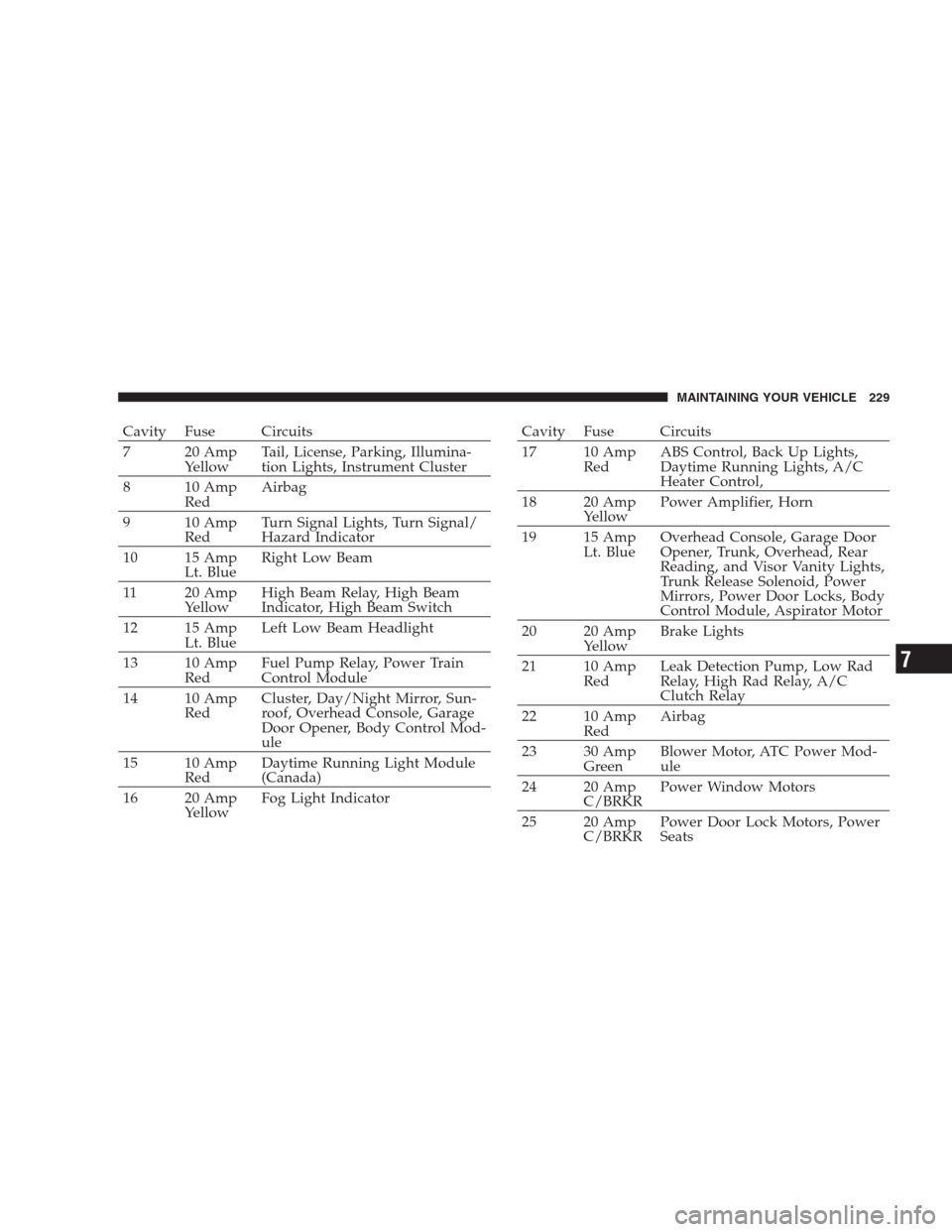
Cavity Fuse Circuits
7 20 Amp
YellowTail, License, Parking, Illumina-
tion Lights, Instrument Cluster
8 10 Amp
RedAirbag
9 10 Amp
RedTurn Signal Lights, Turn Signal/
Hazard Indicator
10 15 Amp
Lt. BlueRight Low Beam
11 20 Amp
YellowHigh Beam Relay, High Beam
Indicator, High Beam Switch
12 15 Amp
Lt. BlueLeft Low Beam Headlight
13 10 Amp
RedFuel Pump Relay, Power Train
Control Module
14 10 Amp
RedCluster, Day/Night Mirror, Sun-
roof, Overhead Console, Garage
Door Opener, Body Control Mod-
ule
15 10 Amp
RedDaytime Running Light Module
(Canada)
16 20 Amp
YellowFog Light IndicatorCavity Fuse Circuits
17 10 Amp
RedABS Control, Back Up Lights,
Daytime Running Lights, A/C
Heater Control,
18 20 Amp
YellowPower Amplifier, Horn
19 15 Amp
Lt. BlueOverhead Console, Garage Door
Opener, Trunk, Overhead, Rear
Reading, and Visor Vanity Lights,
Trunk Release Solenoid, Power
Mirrors, Power Door Locks, Body
Control Module, Aspirator Motor
20 20 Amp
YellowBrake Lights
21 10 Amp
RedLeak Detection Pump, Low Rad
Relay, High Rad Relay, A/C
Clutch Relay
22 10 Amp
RedAirbag
23 30 Amp
GreenBlower Motor, ATC Power Mod-
ule
24 20 Amp
C/BRKRPower Window Motors
25 20 Amp
C/BRKRPower Door Lock Motors, Power
Seats
MAINTAINING YOUR VEHICLE 229
7
Page 230 of 277
REPLACEMENT LIGHT BULBS
Interior Light Bulbs Bulb No.
Turn Signal...........................PC194
Climate Control.......................... 330
Overhead Console, Front Reading, Courtesy, Grab
Handle................................ 192
Trunk................................. 906
Exterior Light Bulbs Bulb No.
Low Beam Headlights..................9006XS
High Beam Headlights................9005XSLL
Park, Turn, & Side Marker.................3157
Fog Lights.............................. H3
Center Stop Light........................ 921
Tail, Stop, Turn & Side Marker..............3057
Back-Up..............................3057
License................................ 168
NOTE:If equipped with the optional (HID) High
Intensity Discharge Headlamp Light Bulb, please seek
dealer service for replacement.
NOTE:You will note on vehicles equipped with the
optional (HID) High Intensity Discharge Headlamp Light
Bulb that upon turning the lamps on there is a blue hue
to the lamps. This diminishes and becomes more white
after approximately 10 seconds as the system charges.
BULB REPLACEMENT
Headlight and Parking Light Removal
1. Remove the headlamp sight shield.
230 MAINTAINING YOUR VEHICLE
Page 234 of 277
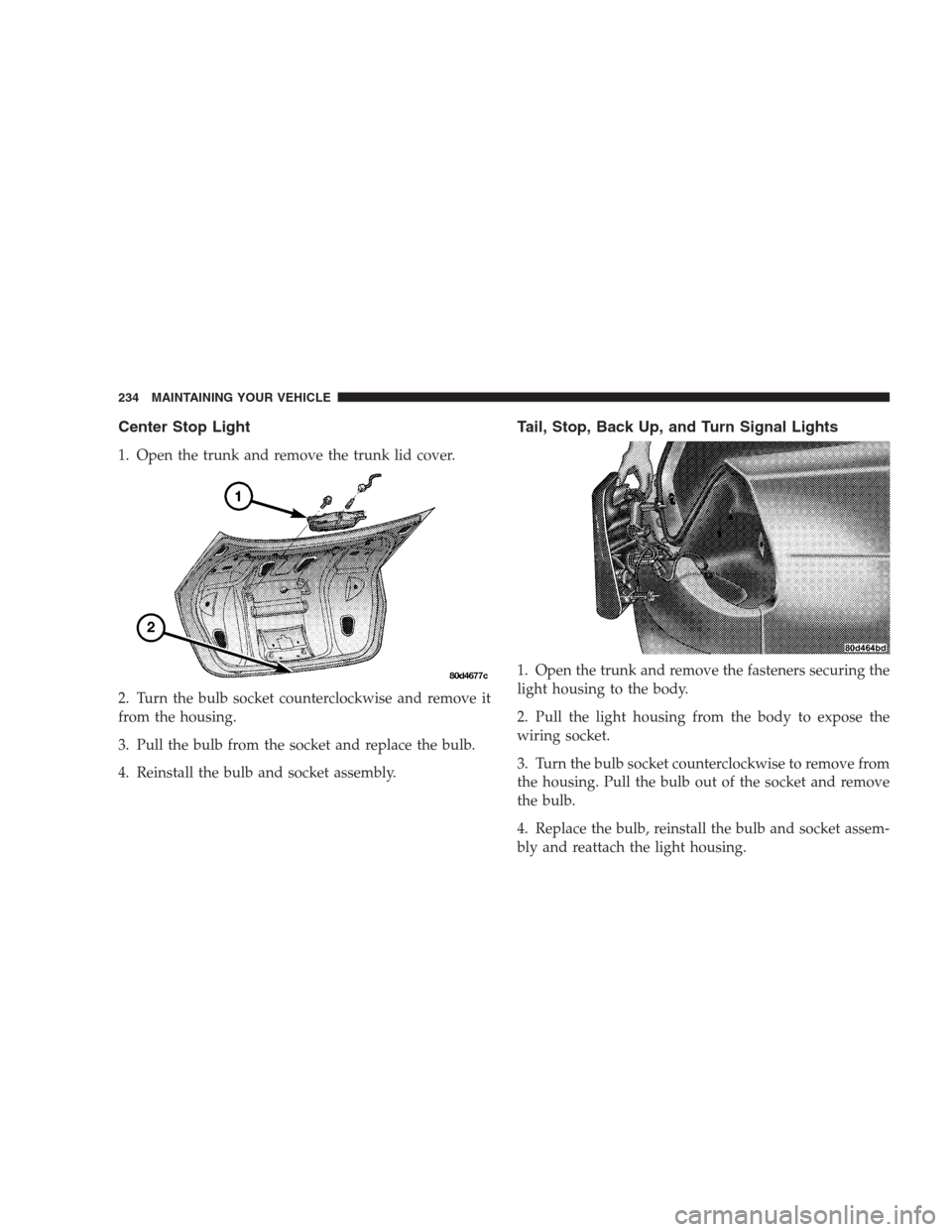
Center Stop Light
1. Open the trunk and remove the trunk lid cover.
2. Turn the bulb socket counterclockwise and remove it
from the housing.
3. Pull the bulb from the socket and replace the bulb.
4. Reinstall the bulb and socket assembly.
Tail, Stop, Back Up, and Turn Signal Lights
1. Open the trunk and remove the fasteners securing the
light housing to the body.
2. Pull the light housing from the body to expose the
wiring socket.
3. Turn the bulb socket counterclockwise to remove from
the housing. Pull the bulb out of the socket and remove
the bulb.
4. Replace the bulb, reinstall the bulb and socket assem-
bly and reattach the light housing.
234 MAINTAINING YOUR VEHICLE