2004 CHRYSLER 300 M steering wheel
[x] Cancel search: steering wheelPage 142 of 277
•Pressing the AM/FM button while in the tape or CD
mode will select the radio mode.
•If in the CD mode and the last CD is ejected, the radio
will tune to the last station selected.
Removing Discs from the CD Changer
If there is a single CD in the changer, press the EJT button
and the CD will eject. If the CD is not removed within 15
seconds, it will automatically reload into the CD changer.
To eject additional CDs from the changer, first select the
numbered button where the CD is located and then press
the EJT button.
CD Changer Operation with the Changer Off
The CD changer is able to load and eject discs with the
ignition power off. However, while the ignition is off, one
of the six numbered buttons must be pressed first.
REMOTE SOUND SYSTEM CONTROLS — IF
EQUIPPED
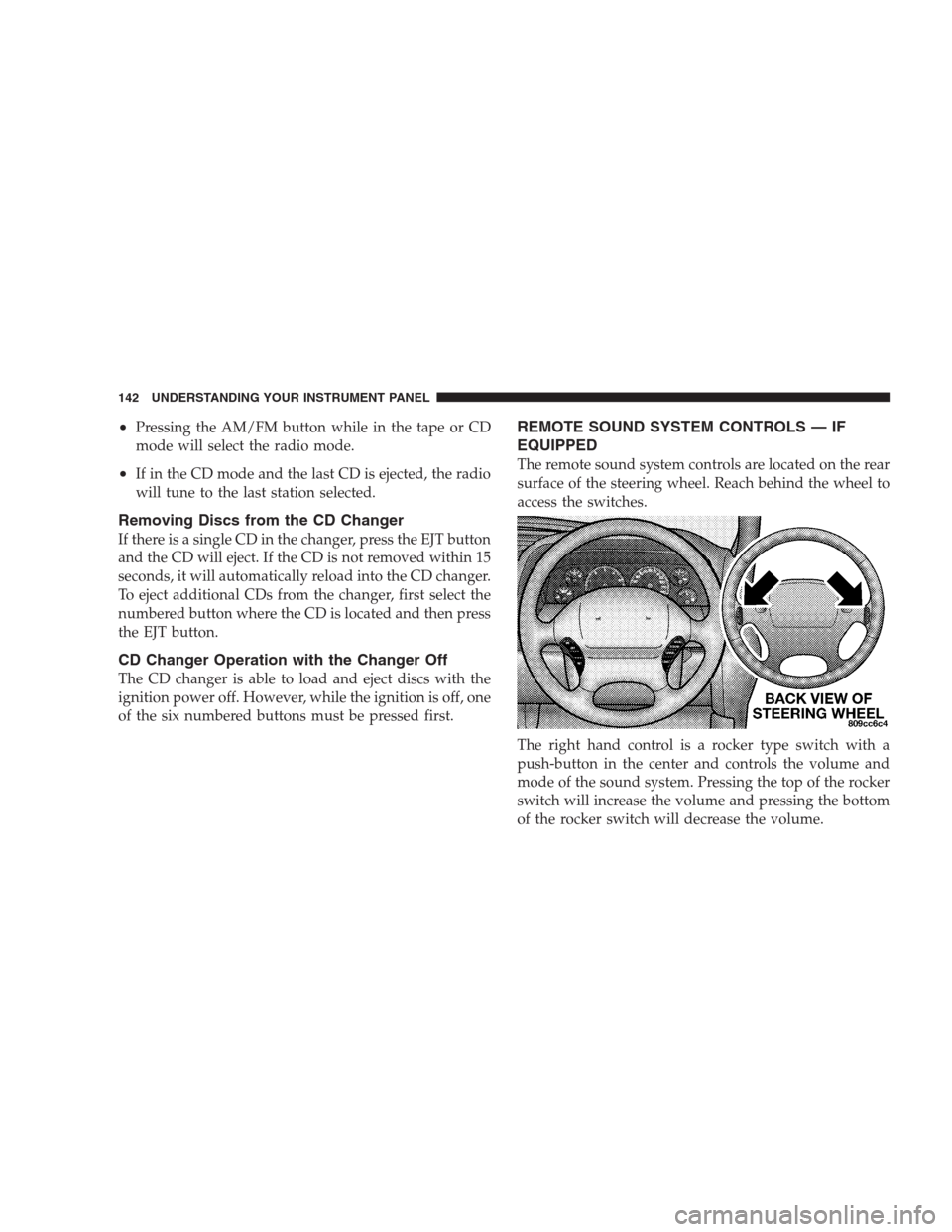
The remote sound system controls are located on the rear
surface of the steering wheel. Reach behind the wheel to
access the switches.
The right hand control is a rocker type switch with a
push-button in the center and controls the volume and
mode of the sound system. Pressing the top of the rocker
switch will increase the volume and pressing the bottom
of the rocker switch will decrease the volume.
142 UNDERSTANDING YOUR INSTRUMENT PANEL
Page 163 of 277

Anti-Lock Brake System (ABS)
The ABS gives increased vehicle stability and brake
performance under most braking conditions. The system
automatically “pumps” the brakes during severe braking
conditions to prevent wheel lock-up.
All vehicle wheels and tires must be the same size and
tires must be properly inflated to produce accurate
signals for the ABS computer. However, the system will
compensate when the compact spare is in use.
During stops where ABS is activated, a vibration of the
brake pedal may be felt and associated system noises
may be heard.
WARNING!
Pumping of the brake pedal will diminish the effec-
tiveness of Anti-lock brakes and may lead to an
accident. Pumping makes the stopping distance
longer. Just press firmly on your brake pedal when
you need to slow down or stop.
POWER STEERING
Your vehicle is equipped with power assisted steering as
standard equipment. The power assisted steering system
of your vehicle provides mechanical steering capability
in the event power assist is lost.
If for some reason the hydraulic pressure is interrupted,
it will still be possible to steer your vehicle. Under these
conditions you will observe a substantial increase in
steering effort.
TRACTION CONTROL
The Traction Control System reduces wheel slip and
maintains traction at the driving (front) wheels. The
system reduces wheel slip by engaging the brake on the
wheel that is losing traction while spinning. The traction
system operates at speeds below 35 mph (56 km/h).
The system is always in the “stand by” mode unless:
•The Traction Control switch has been used to turn the
system off;
•There is a Anti-Lock Brake System malfunction;
•There is a Traction Control System malfunction;
STARTING AND OPERATING 163
5
Page 172 of 277

These indicators are molded into the bottom of the tread
grooves and will appear as bands when the tread depth
becomes 1/16 inch (2 mm). When the indicators appear
in 2 or more adjacent grooves, the tire should be replaced.
Many states have laws requiring tire replacement at this
point.
Replacement Tires
The tires on your new vehicle provide a balance of many
characteristics. They should be inspected regularly for
wear and correct inflation pressure. The manufacturer
strongly recommends that you use tires equivalent to the
originals in size, quality and performance when replace-
ment is needed (see the paragraph on tread wear indica-
tors). Failure to use equivalent replacement tires may
adversely affect the safety, handling, and ride of your
vehicle. We recommend that you contact your original
equipment dealer on any questions you may have on tire
specifications or capability.
WARNING!
•Do not use a tire, wheel size or rating other than
that specified for your vehicle. Some combina-
tions of unapproved tires and wheels may change
suspension dimensions and performance charac-
teristics, resulting in changes to steering, han-
dling, and braking of your vehicle. This can cause
unpredictable handling and stress to steering and
suspension components. You could lose control
and have an accident resulting in serious injury or
death. Use only the tire and wheel sizes with load
ratings approved for your vehicle.
•Never use a tire smaller than the minimum tire
size listed on your vehicle’s tire label located on
the driver’s door. Using a smaller tire could result
in tire overloading and failure. You could lose
control and have an accident.
•Failure to equip your vehicle with tires having
adequate speed capability can result in sudden
tire failure and loss of vehicle control.
•Overloading your tires is dangerous. Like under
inflation, overloading can cause tire failure. Use
tires of the recommended load capacity for your
vehicle and never overload them.
172 STARTING AND OPERATING
Page 182 of 277
HAZARD WARNING FLASHER
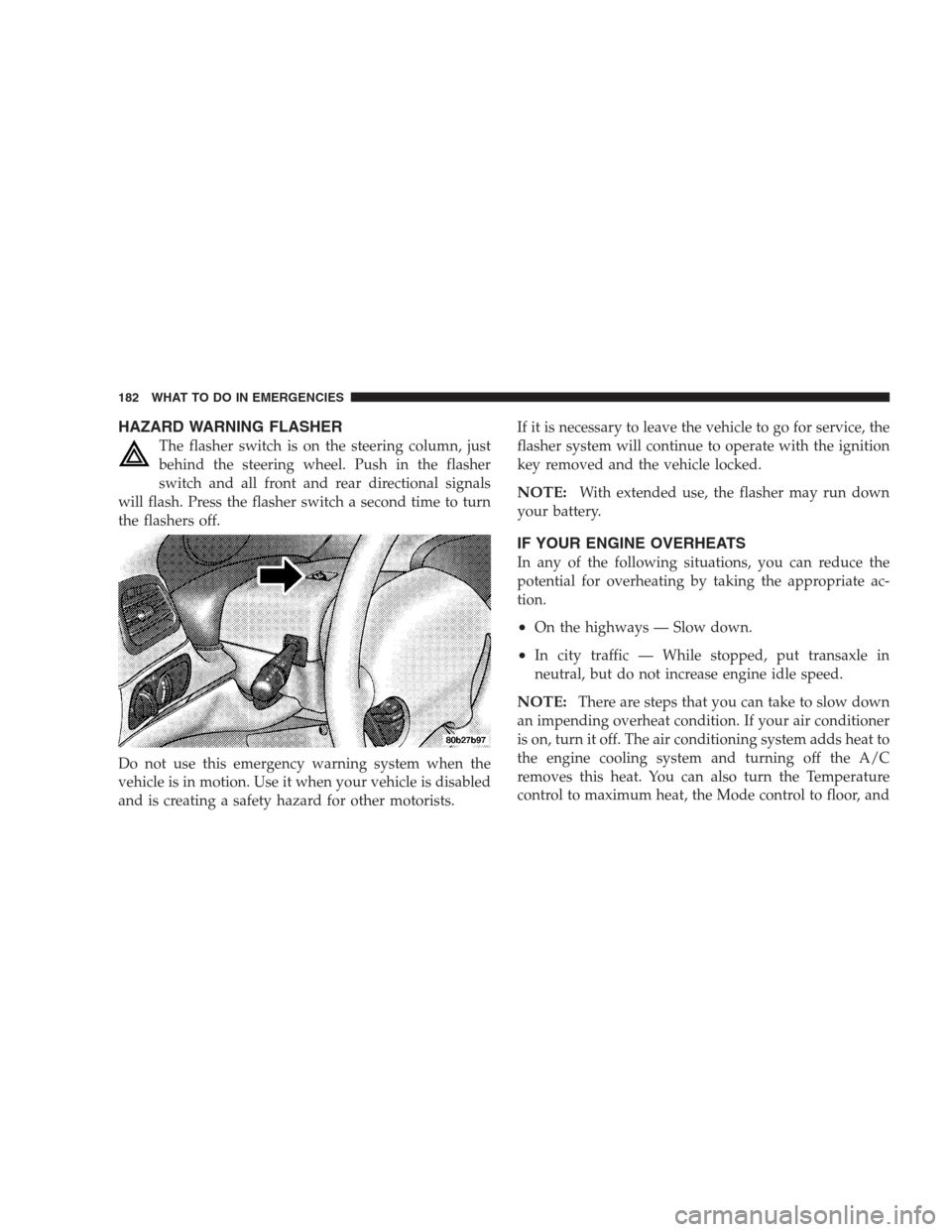
The flasher switch is on the steering column, just
behind the steering wheel. Push in the flasher
switch and all front and rear directional signals
will flash. Press the flasher switch a second time to turn
the flashers off.
Do not use this emergency warning system when the
vehicle is in motion. Use it when your vehicle is disabled
and is creating a safety hazard for other motorists.If it is necessary to leave the vehicle to go for service, the
flasher system will continue to operate with the ignition
key removed and the vehicle locked.
NOTE:With extended use, the flasher may run down
your battery.
IF YOUR ENGINE OVERHEATS
In any of the following situations, you can reduce the
potential for overheating by taking the appropriate ac-
tion.
•On the highways — Slow down.
•In city traffic — While stopped, put transaxle in
neutral, but do not increase engine idle speed.
NOTE:There are steps that you can take to slow down
an impending overheat condition. If your air conditioner
is on, turn it off. The air conditioning system adds heat to
the engine cooling system and turning off the A/C
removes this heat. You can also turn the Temperature
control to maximum heat, the Mode control to floor, and
182 WHAT TO DO IN EMERGENCIES
Page 192 of 277
WARNING!
Rapid acceleration on slippery surfaces is danger-
ous. Unequal traction can cause sudden pulling of
the front wheels. You could lose control of the
vehicle and possibly have an accident. Accelerate
slowly and carefully whenever there is likely to be
poor traction (ice, snow, wet, mud, loose sand, etc.).
Traction
When driving on wet or slushy roads, it is possible for a
wedge of water to build up between the tire and road
surface. This is known as hydroplaning and may cause
partial or complete loss of vehicle control and stopping
ability. To reduce this possibility, the following precau-
tions should be observed:
1. Slow down during rainstorms or when roads are
slushy.
2. Slow down if road has standing water or puddles.3. Replace tires when tread wear indicators first become
visible.
4. Keep tires properly inflated.
5. Maintain sufficient distance between your vehicle and
the vehicle in front of you to avoid a collision in a sudden
stop.
NOTE:If so equipped, turn on the Traction Control
System to accelerate on slippery surfaces.
FREEING A STUCK VEHICLE
If your vehicle is equipped with Traction Control, turn
the system off before attempting to “rock” the vehicle.
If your vehicle becomes stuck in mud, sand or snow, it
can often be moved by a rocking motion. Turn your
steering wheel right and left to clear the area around the
front wheels. Then shift back and forth between Reverse
and Drive. Usually the least accelerator pedal pressure to
maintain the rocking motion without spinning the
wheels is most effective.
192 WHAT TO DO IN EMERGENCIES
Page 208 of 277
replace it with a new valve. DO NOT ATTEMPT TO
CLEAN THE OLD PCV VALVE!
Check ventilation hose for indication of damage or
plugging deposits. Replace if necessary.
Maintenance-Free Battery
The top of the MAINTENANCE-FREE battery is perma-
nently sealed. You will never have to add water, nor is
periodic maintenance required.
NOTE:The battery is stored in a compartment in front
of the tire in the right front fender and is accessible
through the engine compartment. The tire and wheel
need not be removed to access the battery.
To access the battery:
1. Turn the steering wheel fully to the right.
2. Remove the battery access panel from the inner fender
shield.
3. Remove the air cleaner.
4. Remove the battery tie down bracket.
5. Move the battery into the opening and lift it out.
WARNING!
Battery fluid is a corrosive acid solution and can
burn or even blind you. Don’t allow battery fluid to
contact your eyes, skin or clothing. Don’t lean over a
battery when attaching clamps. If acid splashes in
eyes or on skin, flush the area immediately with
large amounts of water. Battery gas is flammable and
explosive. Keep flame or sparks away from the
battery. Don’t use a booster battery or any other
booster source with an output greater than 12 volts.
Don’t allow cable clamps to touch each other.
WARNING!
Battery posts, terminals and related accessories con-
tain lead and lead compounds. Wash hands after
handling.
208 MAINTAINING YOUR VEHICLE
Page 226 of 277
CAUTION!
The use of vinyl, leather or plastic protectants may
cause excessive gloss and/or discoloration of interior
trim parts.
Leather Seat Care and Cleaning
Leather is best preserved by regular cleaning with a
damp soft cloth. Small particles of dirt can act as an
abrasive and damage the leather surface and should be
removed immediately with a damp cloth. Stubborn soils
can be removed easily with a soft cloth and Mopar Total
Clean. Care should be taken to avoid soaking the leather
with any liquid. Please do not use polishes, oils, cleaning
fluids, solvents, detergents, or ammonia based cleaners
to clean the leather. Application of a leather conditioner is
not required to maintain the original condition.
Wooden Steering Wheel Care — If Equipped
If your vehicle is equipped with a wood steering wheel,
it is finished with a clear topcoat. Please take care to
avoid scratching the surface with sharp or abrasive
materials.
Cleaning Headlights
Your vehicle has plastic headlights that are lighter and
less susceptible to stone breakage than glass headlights.
Plastic is not as scratch resistant as glass and therefore
different lens cleaning procedures must be followed.
To minimize the possibility of scratching the lenses and
reducing light output, avoid wiping with a dry cloth. To
remove road dirt, wash with a mild soap solution fol-
lowed by rinsing.
Do not use abrasive cleaning components, solvents, steel
wool or other aggressive material to clean the lenses.
Glass Surfaces
All glass surfaces should be cleaned on a regular basis
with any commercial household-type glass cleaner.
Never use an abrasive type cleaner. Use caution when
cleaning inside rear windows equipped with electric
defrosters. Do not use scrapers or other sharp instru-
ments which may scratch the elements.
Instrument Panel Cover
The instrument panel cover has a low glare surface which
minimizes reflections in the windshield. Do not use
226 MAINTAINING YOUR VEHICLE
Page 275 of 277
Seat Belt Maintenance................... 227
Seat Belts.........................27,28,48
Adjustable Upper Shoulder Anchorage...... 32
Child Restraint........................ 45
Extender............................ 32
Inspection........................... 48
Reminder........................... 114
Seats................................. 57
Cleaning............................ 225
Glide-To-Exit......................... 58
Heated.............................. 59
Lumbar Support....................... 59
Power.............................. 57
Rear Folding......................... 62
Reclining............................ 58
Sentry Key............................. 9
Sentry Key Programming.................. 11
Sentry Key Replacement.................. 10
Service Assistance...................... 256
Service Contract........................ 258
Service Engine Soon Light................ 198
Service Manuals........................ 261
Setting the Clock....................... 118Shoulder Belts.......................... 32
Side Airbag............................ 38
Side View Mirror Adjustment............... 56
Side Window Demisters.................. 150
Signals, Turn........................... 68
Slippery Surfaces, Driving On............. 191
Snow Chains.......................... 170
Snow Tires............................ 170
Spare Tire............................ 169
Spark Plugs........................... 205
Speed Control.......................... 71
Speedometer.......................... 114
Starting.............................. 155
Steering
Linkage............................ 210
Power...........................163,210
Tilt Column.......................... 70
Steering Wheel Mounted Sound System
Controls............................ 142
Stuck, Freeing......................... 192
Sulfur in Gasoline...................... 177
Sun Roof............................86,87
Supplemental Restraint System - Airbag....... 33
INDEX 275
10