Page 151 of 516
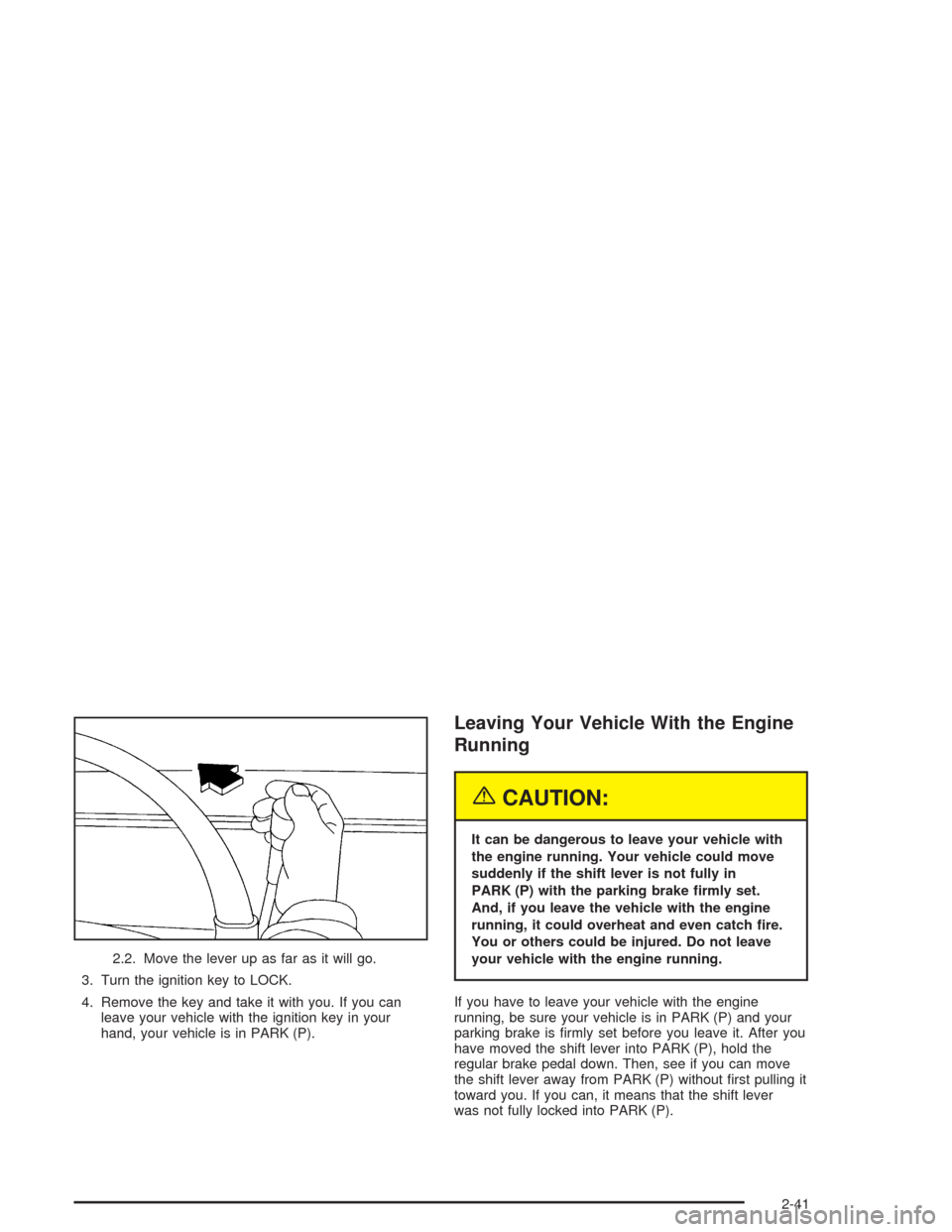
2.2. Move the lever up as far as it will go.
3. Turn the ignition key to LOCK.
4. Remove the key and take it with you. If you can
leave your vehicle with the ignition key in your
hand, your vehicle is in PARK (P).
Leaving Your Vehicle With the Engine
Running
{CAUTION:
It can be dangerous to leave your vehicle with
the engine running. Your vehicle could move
suddenly if the shift lever is not fully in
PARK (P) with the parking brake rmly set.
And, if you leave the vehicle with the engine
running, it could overheat and even catch re.
You or others could be injured. Do not leave
your vehicle with the engine running.
If you have to leave your vehicle with the engine
running, be sure your vehicle is in PARK (P) and your
parking brake is rmly set before you leave it. After you
have moved the shift lever into PARK (P), hold the
regular brake pedal down. Then, see if you can move
the shift lever away from PARK (P) without rst pulling it
toward you. If you can, it means that the shift lever
was not fully locked into PARK (P).
2-41
Page 154 of 516
Running Your Engine While You
Are Parked
It is better not to park with the engine running. But if
you ever have to, here are some things to know.
{CAUTION:
Idling the engine with the climate control
system off could allow dangerous exhaust into
your vehicle. See the earlier Caution under
Engine Exhaust on page 2-43.
Also, idling in a closed-in place can let deadly
carbon monoxide (CO) into your vehicle even if
the climate control fan is at the highest setting.
One place this can happen is a garage.
Exhaust — with CO — can come in easily.
NEVER park in a garage with the engine
running.
Another closed-in place can be a blizzard. See
Winter Driving on page 4-28.
{CAUTION:
It can be dangerous to get out of your vehicle if
the shift lever is not fully in PARK (P) with the
parking brake rmly set. Your vehicle can roll.
Do not leave your vehicle when the engine is
running unless you have to. If you have left the
engine running, the vehicle can move suddenly.
You or others could be injured. To be sure your
vehicle will not move, even when you are on
fairly level ground, always set your parking
brake and move the shift lever to PARK (P).
Follow the proper steps to be sure your vehicle will not
move. SeeShifting Into Park (P) on page 2-40.
If you are pulling a trailer, seeTowing a Trailer on
page 4-41.
2-44
Page 155 of 516
Mirrors
Manual Rearview Mirror
To reduce glare from lights behind you, pull the lever
toward you to the night position. To return the mirror to
the day position, push the lever away from you.
Outside Power Mirrors
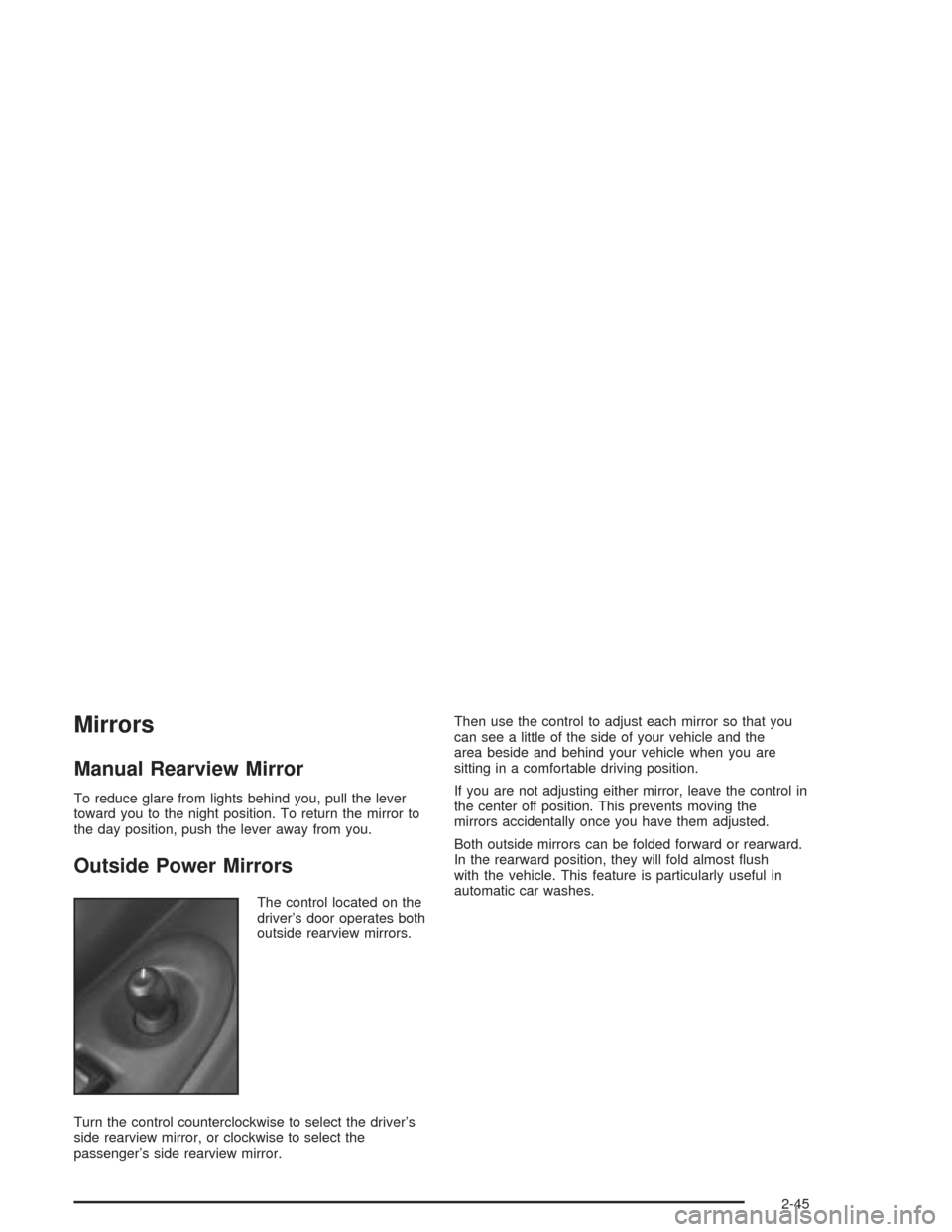
The control located on the
driver’s door operates both
outside rearview mirrors.
Turn the control counterclockwise to select the driver’s
side rearview mirror, or clockwise to select the
passenger’s side rearview mirror.Then use the control to adjust each mirror so that you
can see a little of the side of your vehicle and the
area beside and behind your vehicle when you are
sitting in a comfortable driving position.
If you are not adjusting either mirror, leave the control in
the center off position. This prevents moving the
mirrors accidentally once you have them adjusted.
Both outside mirrors can be folded forward or rearward.
In the rearward position, they will fold almost ush
with the vehicle. This feature is particularly useful in
automatic car washes.
2-45
Page 163 of 516
Cupholder(s)
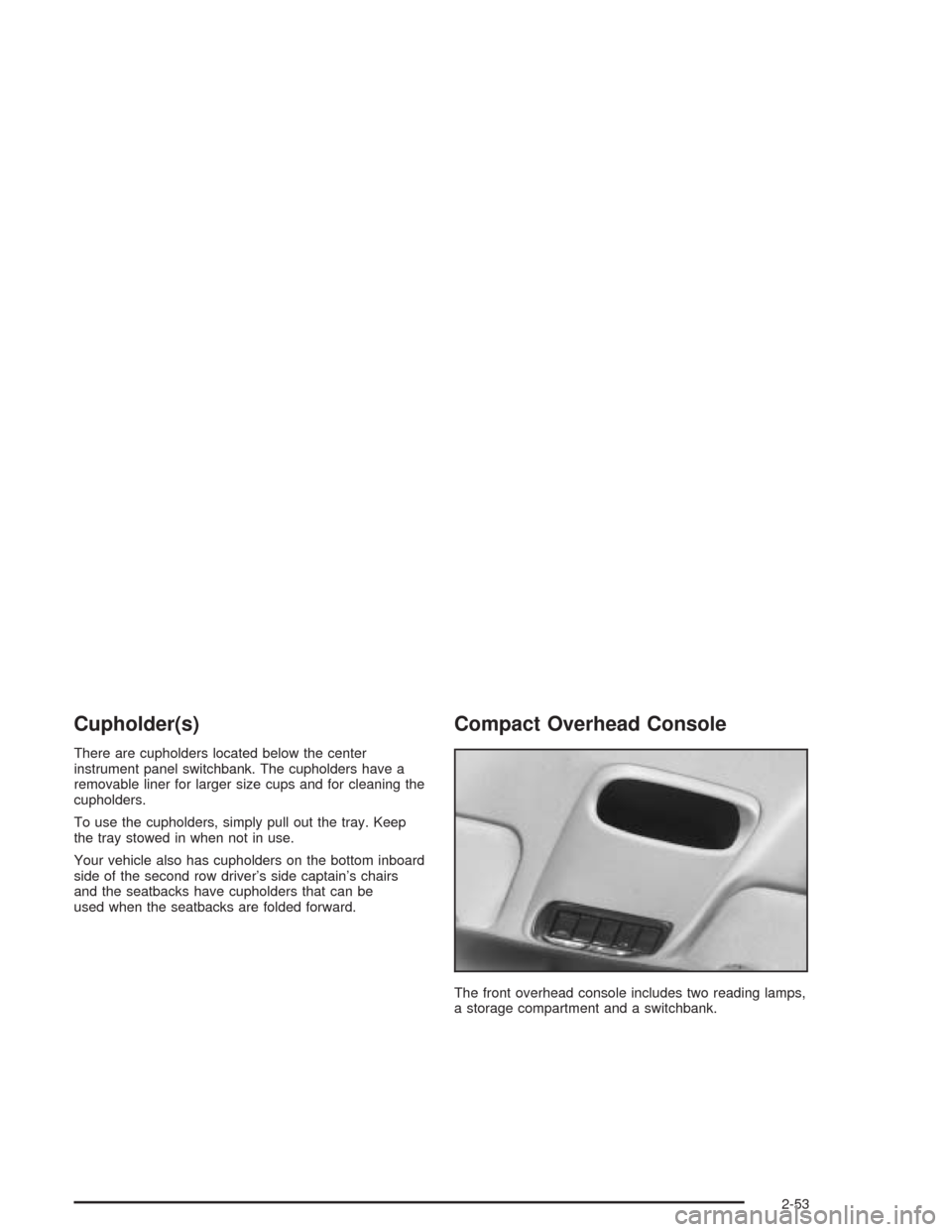
There are cupholders located below the center
instrument panel switchbank. The cupholders have a
removable liner for larger size cups and for cleaning the
cupholders.
To use the cupholders, simply pull out the tray. Keep
the tray stowed in when not in use.
Your vehicle also has cupholders on the bottom inboard
side of the second row driver’s side captain’s chairs
and the seatbacks have cupholders that can be
used when the seatbacks are folded forward.
Compact Overhead Console
The front overhead console includes two reading lamps,
a storage compartment and a switchbank.
2-53
Page 166 of 516
Front Seat Storage Net
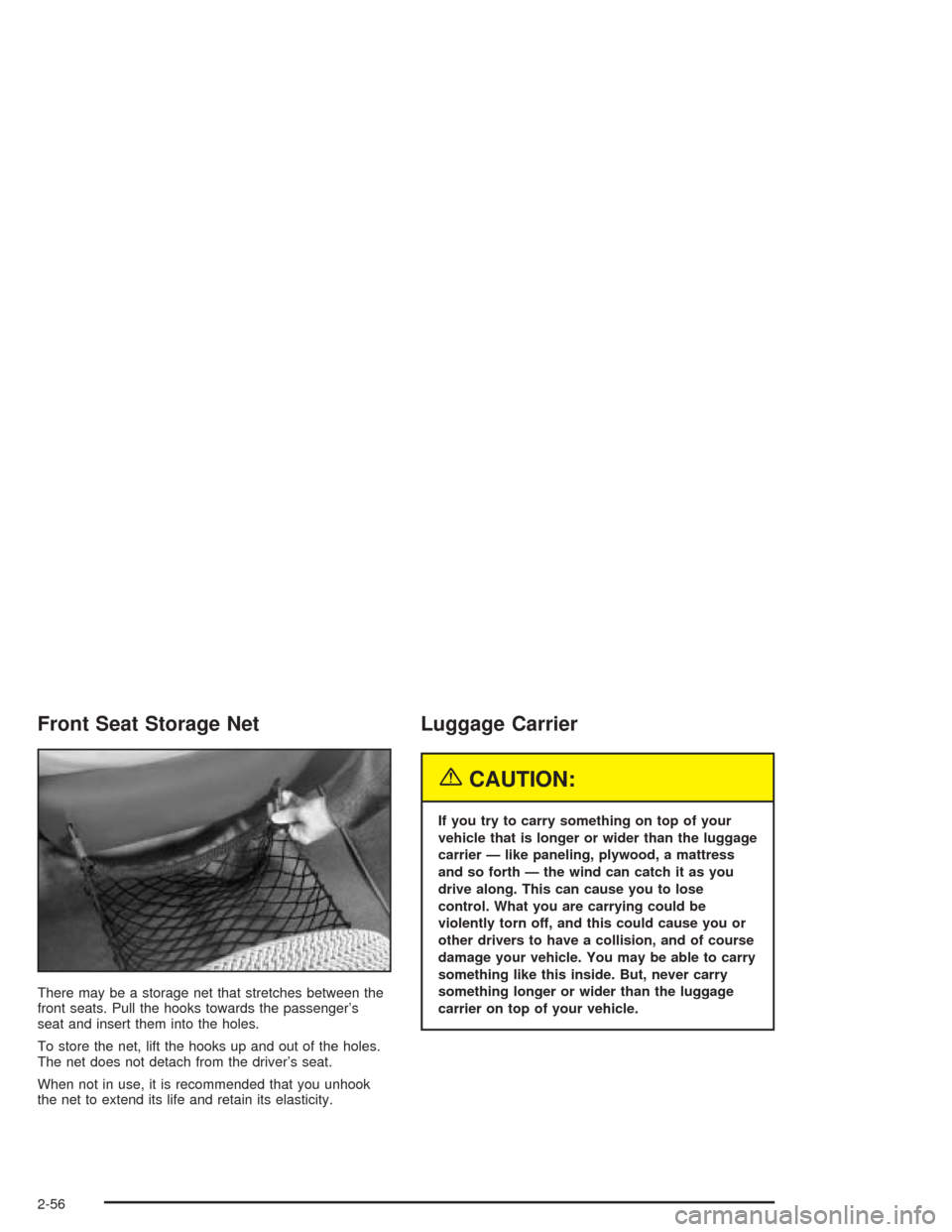
There may be a storage net that stretches between the
front seats. Pull the hooks towards the passenger’s
seat and insert them into the holes.
To store the net, lift the hooks up and out of the holes.
The net does not detach from the driver’s seat.
When not in use, it is recommended that you unhook
the net to extend its life and retain its elasticity.
Luggage Carrier
{CAUTION:
If you try to carry something on top of your
vehicle that is longer or wider than the luggage
carrier — like paneling, plywood, a mattress
and so forth — the wind can catch it as you
drive along. This can cause you to lose
control. What you are carrying could be
violently torn off, and this could cause you or
other drivers to have a collision, and of course
damage your vehicle. You may be able to carry
something like this inside. But, never carry
something longer or wider than the luggage
carrier on top of your vehicle.
2-56
Page 169 of 516
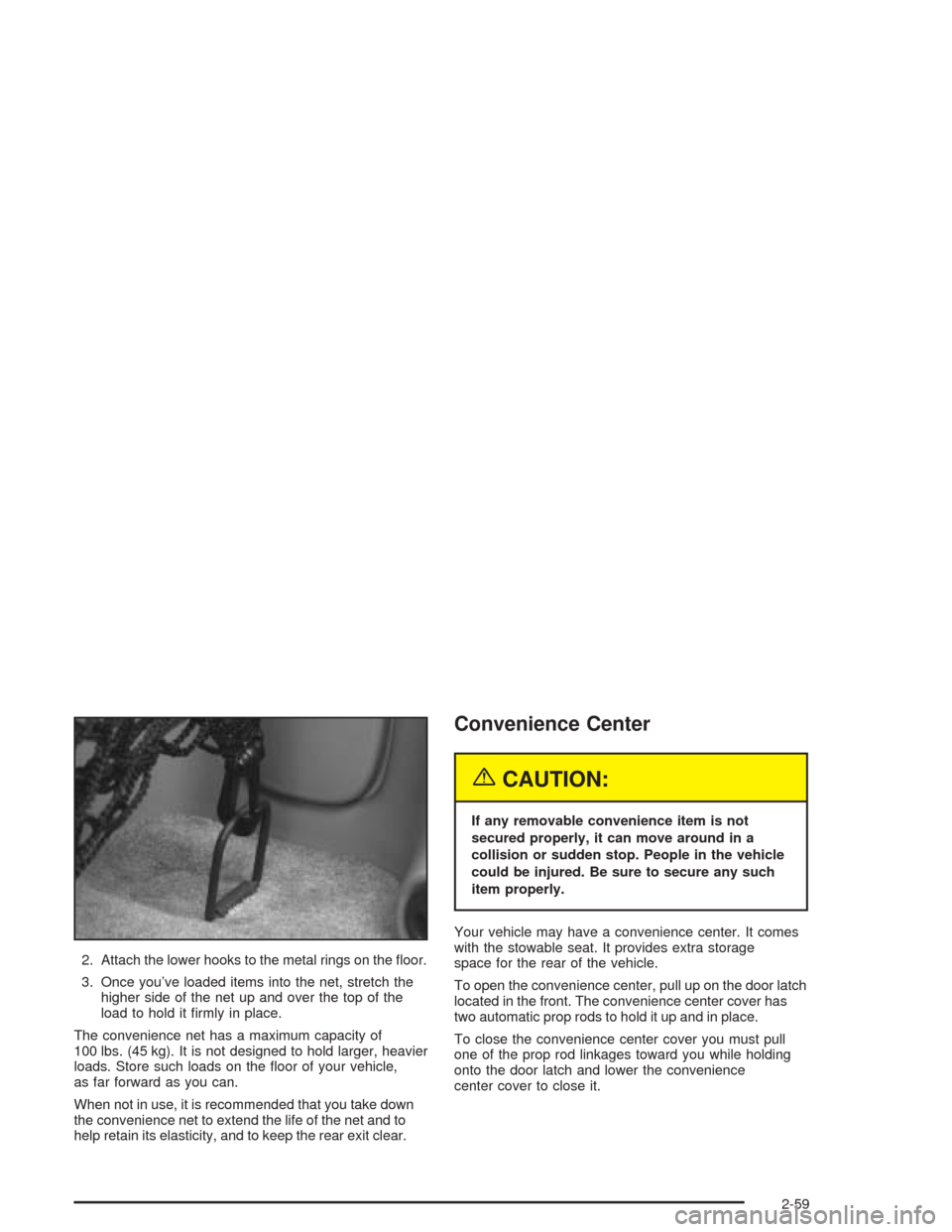
2. Attach the lower hooks to the metal rings on the oor.
3. Once you’ve loaded items into the net, stretch the
higher side of the net up and over the top of the
load to hold it rmly in place.
The convenience net has a maximum capacity of
100 lbs. (45 kg). It is not designed to hold larger, heavier
loads. Store such loads on the oor of your vehicle,
as far forward as you can.
When not in use, it is recommended that you take down
the convenience net to extend the life of the net and to
help retain its elasticity, and to keep the rear exit clear.
Convenience Center
{CAUTION:
If any removable convenience item is not
secured properly, it can move around in a
collision or sudden stop. People in the vehicle
could be injured. Be sure to secure any such
item properly.
Your vehicle may have a convenience center. It comes
with the stowable seat. It provides extra storage
space for the rear of the vehicle.
To open the convenience center, pull up on the door latch
located in the front. The convenience center cover has
two automatic prop rods to hold it up and in place.
To close the convenience center cover you must pull
one of the prop rod linkages toward you while holding
onto the door latch and lower the convenience
center cover to close it.
2-59
Page 170 of 516
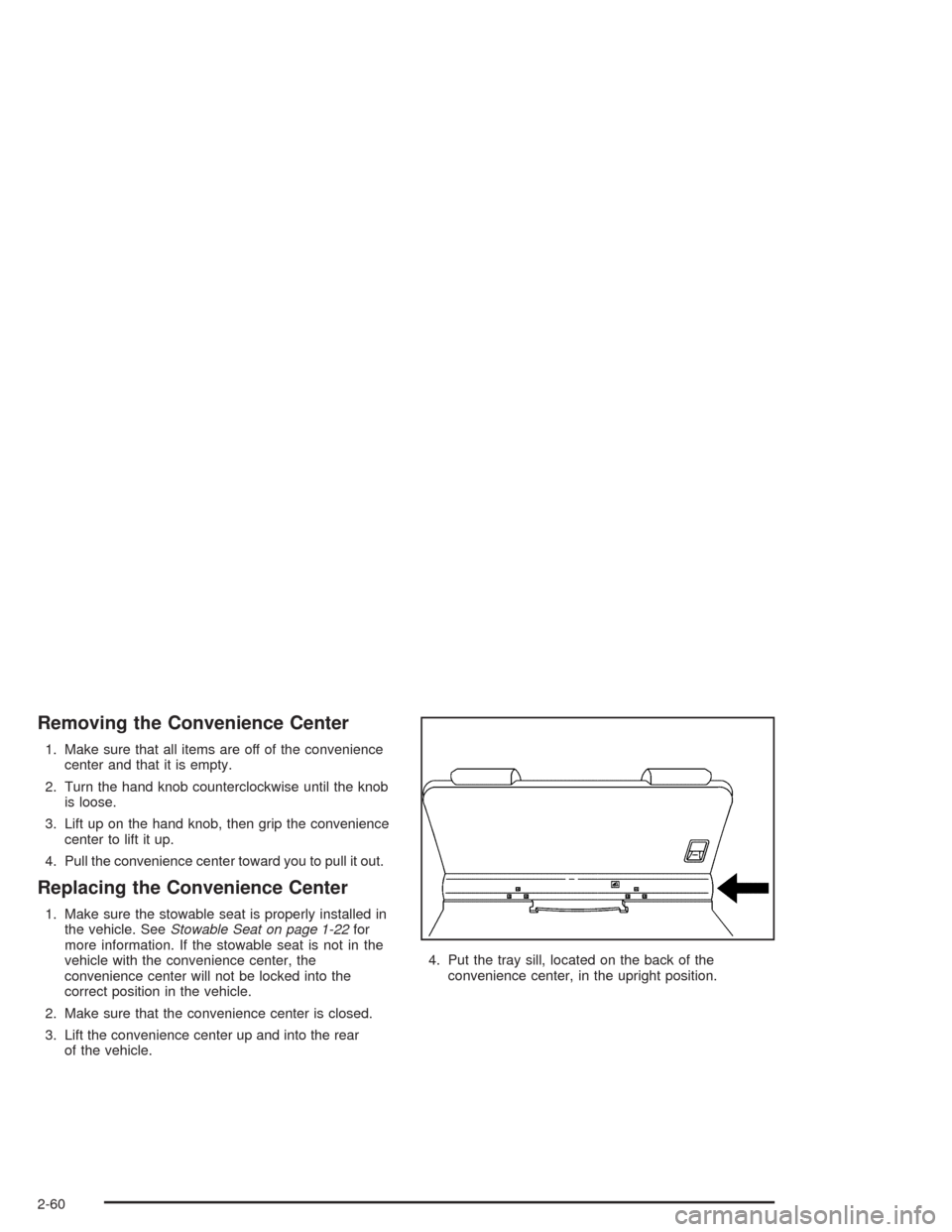
Removing the Convenience Center
1. Make sure that all items are off of the convenience
center and that it is empty.
2. Turn the hand knob counterclockwise until the knob
is loose.
3. Lift up on the hand knob, then grip the convenience
center to lift it up.
4. Pull the convenience center toward you to pull it out.
Replacing the Convenience Center
1. Make sure the stowable seat is properly installed in
the vehicle. SeeStowable Seat on page 1-22for
more information. If the stowable seat is not in the
vehicle with the convenience center, the
convenience center will not be locked into the
correct position in the vehicle.
2. Make sure that the convenience center is closed.
3. Lift the convenience center up and into the rear
of the vehicle.4. Put the tray sill, located on the back of the
convenience center, in the upright position.
2-60
Page 171 of 516
5. Slide the convenience center in and align it so that
the forks, located on the bottom rear of the
convenience center, slide into the seat anchors.
6. Press down on the front of the convenience center
so the center locates on the sill mounting bracket.
7. Turn the hand knob clockwise until it is tight.
8. Pull up on the convenience center to make sure it
is locked into place.
The tray sill can be folded down onto the stowable seat
to close the space between the two while the stowable
seat is folded down. To do this, ip the sill plate up and
over toward the stowable seat.
The cover of the convenience center can be left in its
upright position while the vehicle is moving.The convenience center has six hooks on the inside
cover for hanging items on. The prop rods can hold up
to 49 lbs. (21.8 kg) on the cover of the convenience
center while in its upright position.
The convenience center and the stowable seat both
have a maximum weight capacity of 400 lbs. (181.6 kg).
Notice:Overloading your vehicle may cause
damage. Repairs would not be covered by your
warranty. Do not overload your vehicle.
2-61