Page 434 of 584
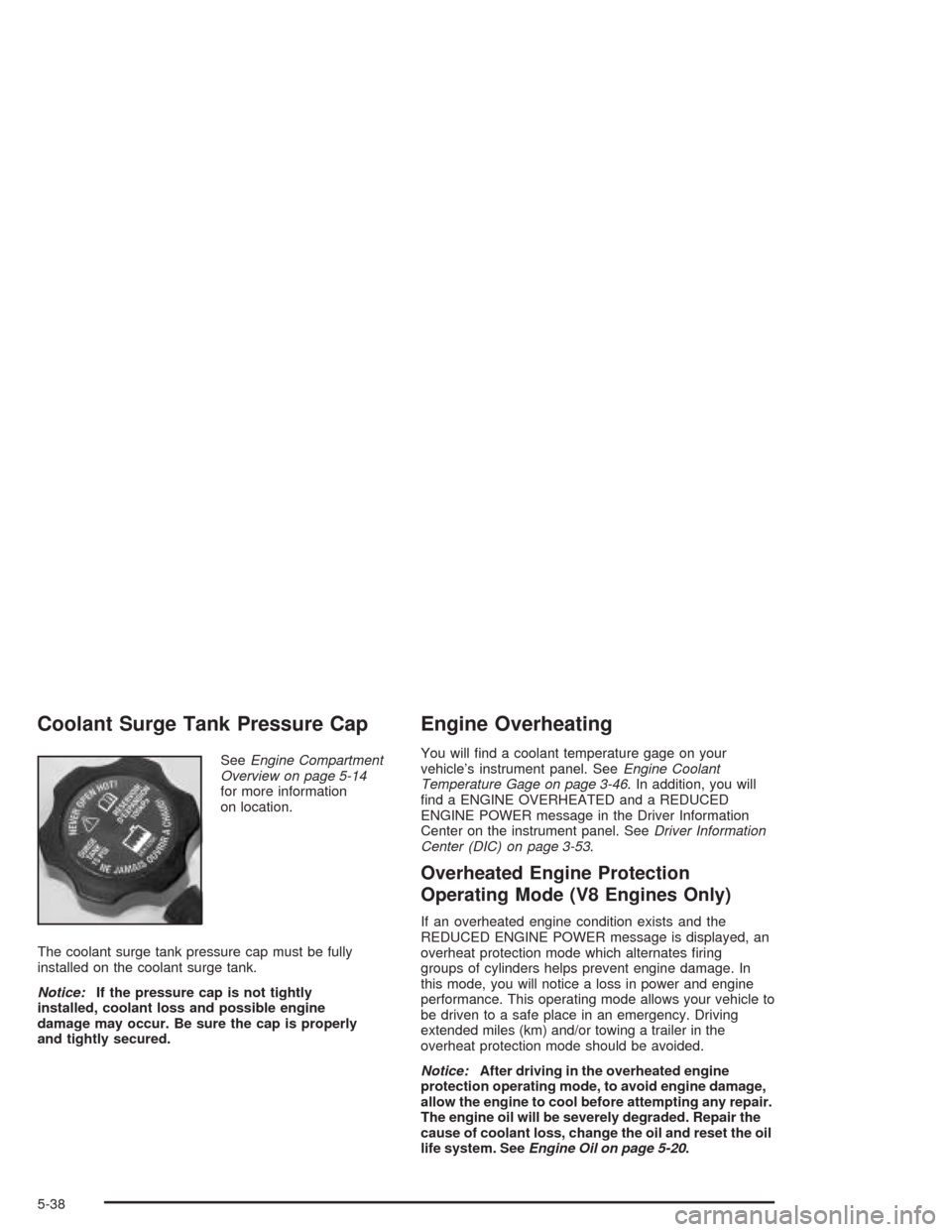
Coolant Surge Tank Pressure Cap
SeeEngine Compartment
Overview on page 5-14
for more information
on location.
The coolant surge tank pressure cap must be fully
installed on the coolant surge tank.
Notice:If the pressure cap is not tightly
installed, coolant loss and possible engine
damage may occur. Be sure the cap is properly
and tightly secured.
Engine Overheating
You will nd a coolant temperature gage on your
vehicle’s instrument panel. SeeEngine Coolant
Temperature Gage on page 3-46. In addition, you will
nd a ENGINE OVERHEATED and a REDUCED
ENGINE POWER message in the Driver Information
Center on the instrument panel. SeeDriver Information
Center (DIC) on page 3-53.
Overheated Engine Protection
Operating Mode (V8 Engines Only)
If an overheated engine condition exists and the
REDUCED ENGINE POWER message is displayed, an
overheat protection mode which alternates ring
groups of cylinders helps prevent engine damage. In
this mode, you will notice a loss in power and engine
performance. This operating mode allows your vehicle to
be driven to a safe place in an emergency. Driving
extended miles (km) and/or towing a trailer in the
overheat protection mode should be avoided.
Notice:After driving in the overheated engine
protection operating mode, to avoid engine damage,
allow the engine to cool before attempting any repair.
The engine oil will be severely degraded. Repair the
cause of coolant loss, change the oil and reset the oil
life system. SeeEngine Oil on page 5-20.
5-38
Page 437 of 584
Cooling System
When you decide it’s safe to lift the hood, here’s what
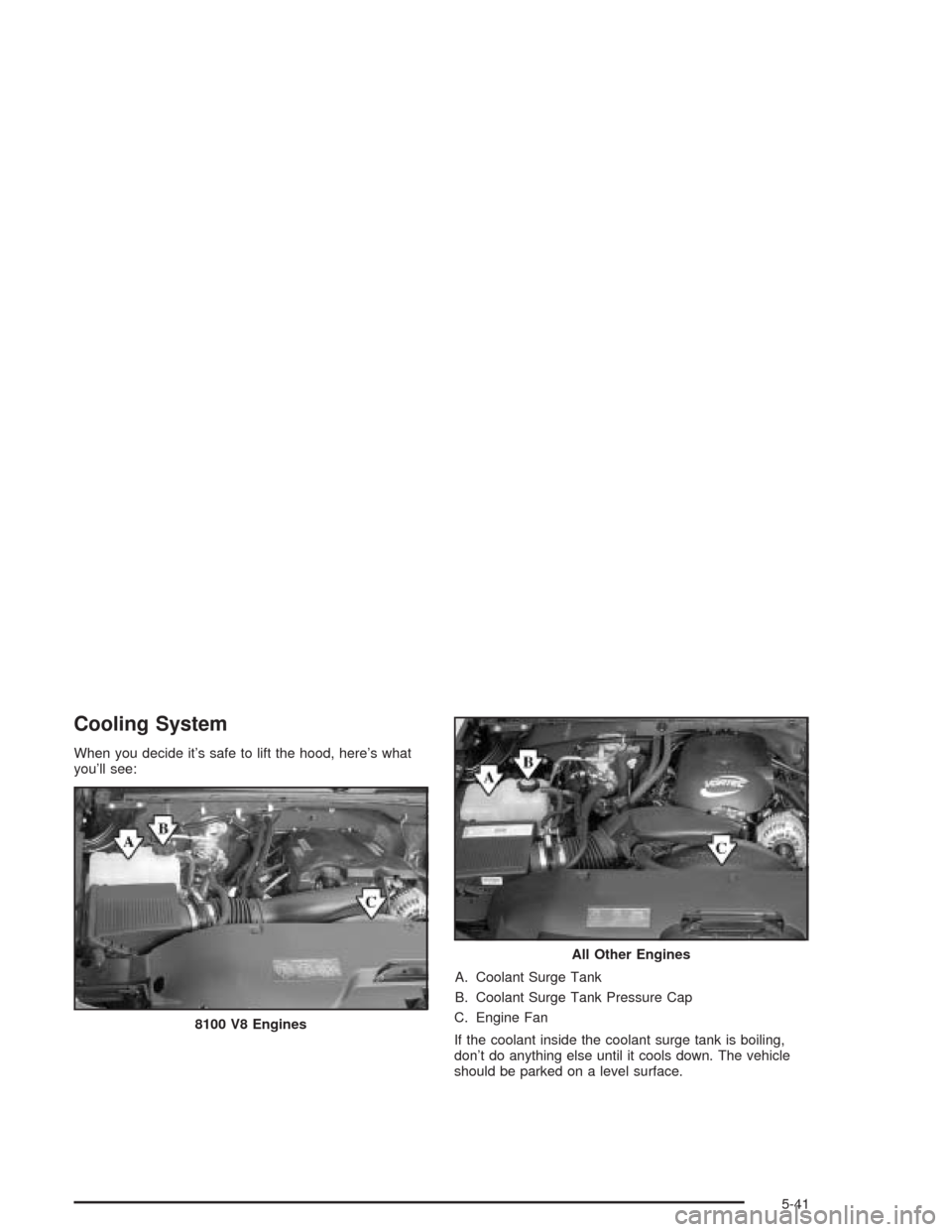
you’ll see:
A. Coolant Surge Tank
B. Coolant Surge Tank Pressure Cap
C. Engine Fan
If the coolant inside the coolant surge tank is boiling,
don’t do anything else until it cools down. The vehicle
should be parked on a level surface. 8100 V8 Engines
All Other Engines
5-41
Page 440 of 584

{CAUTION:
Adding only plain water to your cooling
system can be dangerous. Plain water, or
some other liquid such as alcohol, can boil
before the proper coolant mixture will. Your
vehicle’s coolant warning system is set for the
proper coolant mixture. With plain water or the
wrong mixture, your engine could get too hot
but you would not get the overheat warning.
Your engine could catch re and you or others
could be burned. Use a 50/50 mixture of clean,
drinkable water and a proper coolant.
Notice:In cold weather, water can freeze and crack
the engine, radiator, heater core and other parts.
Use the recommended coolant and the proper
coolant mixture.
{CAUTION:
You can be burned if you spill coolant on hot
engine parts. Coolant contains ethylene glycol
and it will burn if the engine parts are hot
enough. Do not spill coolant on a hot engine.
1. Park the vehicle on a
level surface. You can
remove the coolant
surge tank pressure
cap when the cooling
system, including
the coolant surge tank
pressure cap and
upper radiator hose, is
no longer hot.
2. Turn the pressure cap slowly counterclockwise (left)
about one full turn. If you hear a hiss, wait for that to
stop. A hiss means there is still some pressure left.
3. Then keep turning the pressure cap slowly, and
remove it.
5-44
Page 446 of 584
Checking Brake Fluid
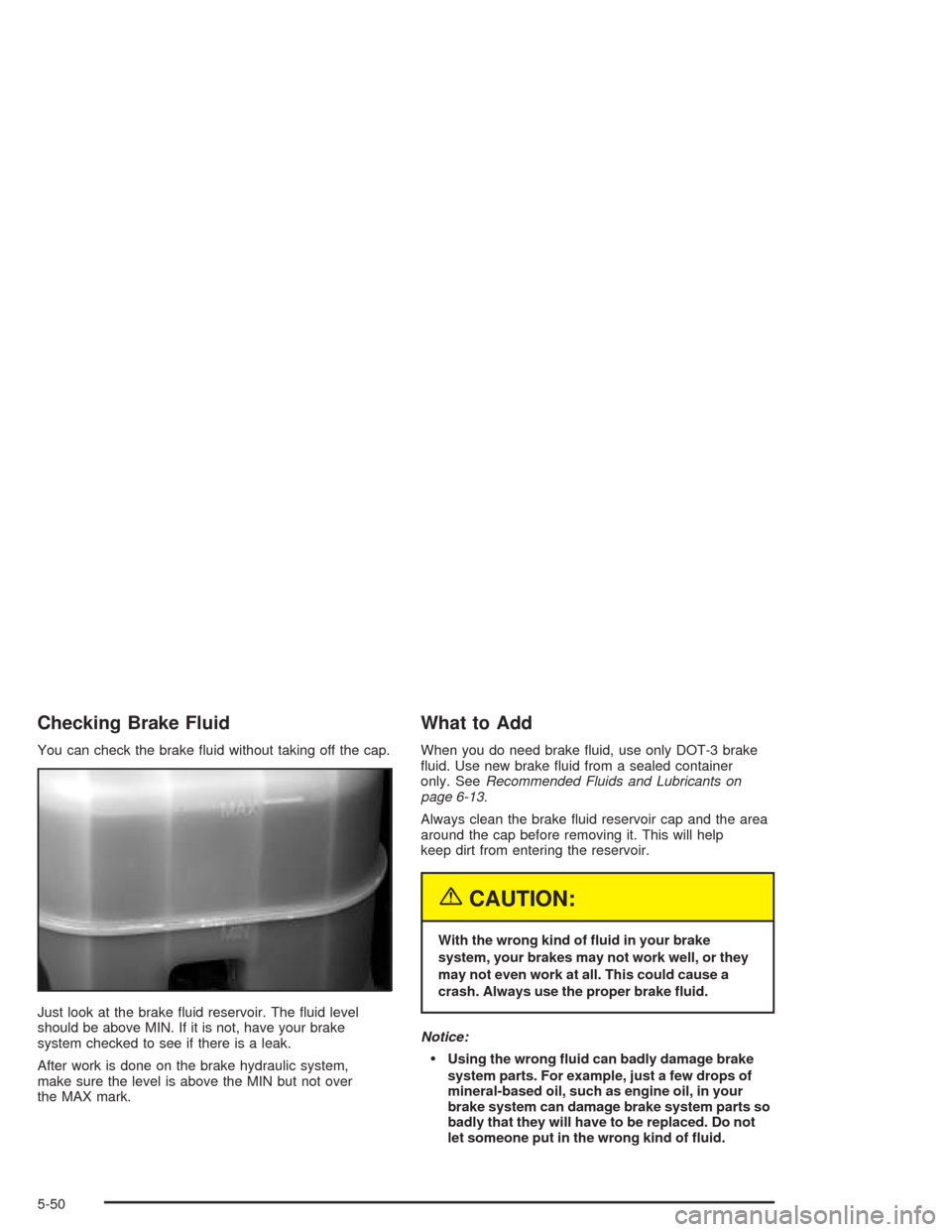
You can check the brake uid without taking off the cap.
Just look at the brake uid reservoir. The uid level
should be above MIN. If it is not, have your brake
system checked to see if there is a leak.
After work is done on the brake hydraulic system,
make sure the level is above the MIN but not over
the MAX mark.
What to Add
When you do need brake uid, use only DOT-3 brake
uid. Use new brake uid from a sealed container
only. SeeRecommended Fluids and Lubricants on
page 6-13.
Always clean the brake uid reservoir cap and the area
around the cap before removing it. This will help
keep dirt from entering the reservoir.
{CAUTION:
With the wrong kind of uid in your brake
system, your brakes may not work well, or they
may not even work at all. This could cause a
crash. Always use the proper brake uid.
Notice:
Using the wrong uid can badly damage brake
system parts. For example, just a few drops of
mineral-based oil, such as engine oil, in your
brake system can damage brake system parts so
badly that they will have to be replaced. Do not
let someone put in the wrong kind of uid.
5-50
Page 529 of 584
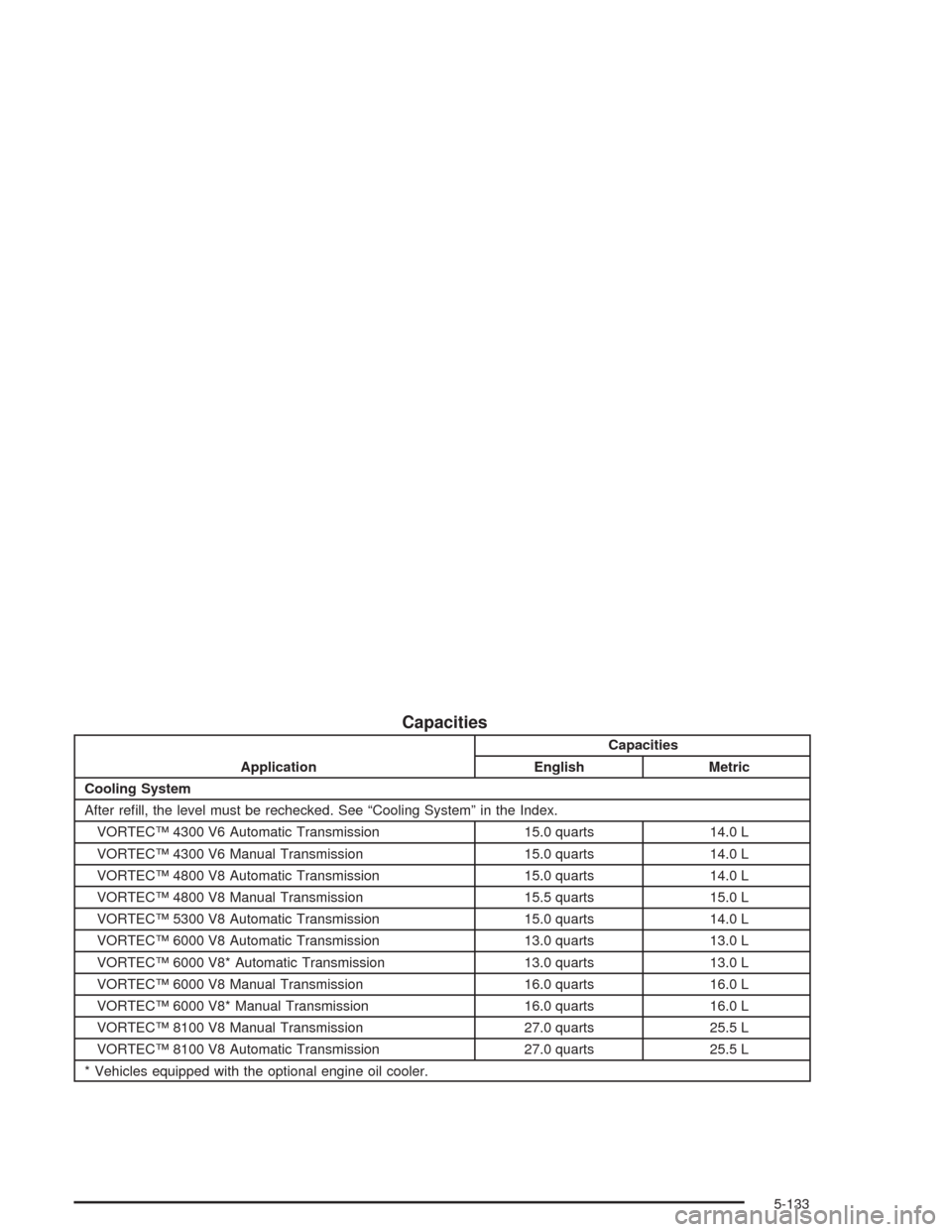
Capacities
ApplicationCapacities
English Metric
Cooling System
After rell, the level must be rechecked. See “Cooling System” in the Index.
VORTEC™ 4300 V6 Automatic Transmission 15.0 quarts 14.0 L
VORTEC™ 4300 V6 Manual Transmission 15.0 quarts 14.0 L
VORTEC™ 4800 V8 Automatic Transmission 15.0 quarts 14.0 L
VORTEC™ 4800 V8 Manual Transmission 15.5 quarts 15.0 L
VORTEC™ 5300 V8 Automatic Transmission 15.0 quarts 14.0 L
VORTEC™ 6000 V8 Automatic Transmission 13.0 quarts 13.0 L
VORTEC™ 6000 V8* Automatic Transmission 13.0 quarts 13.0 L
VORTEC™ 6000 V8 Manual Transmission 16.0 quarts 16.0 L
VORTEC™ 6000 V8* Manual Transmission 16.0 quarts 16.0 L
VORTEC™ 8100 V8 Manual Transmission 27.0 quarts 25.5 L
VORTEC™ 8100 V8 Automatic Transmission 27.0 quarts 25.5 L
* Vehicles equipped with the optional engine oil cooler.
5-133
Page 530 of 584
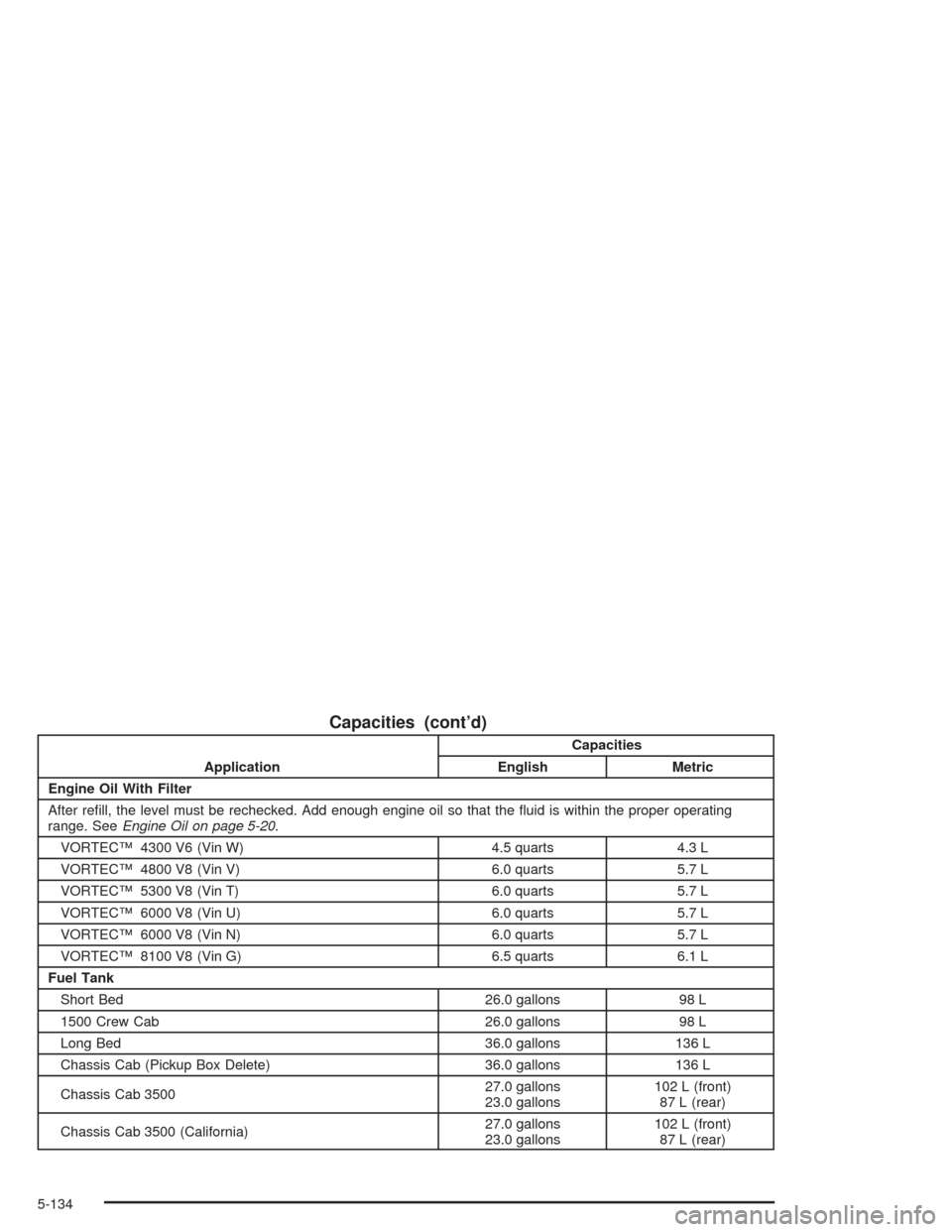
Capacities (cont’d)
ApplicationCapacities
English Metric
Engine Oil With Filter
After rell, the level must be rechecked. Add enough engine oil so that the uid is within the proper operating
range. SeeEngine Oil on page 5-20.
VORTEC™ 4300 V6 (Vin W) 4.5 quarts 4.3 L
VORTEC™ 4800 V8 (Vin V) 6.0 quarts 5.7 L
VORTEC™ 5300 V8 (Vin T) 6.0 quarts 5.7 L
VORTEC™ 6000 V8 (Vin U) 6.0 quarts 5.7 L
VORTEC™ 6000 V8 (Vin N) 6.0 quarts 5.7 L
VORTEC™ 8100 V8 (Vin G) 6.5 quarts 6.1 L
Fuel Tank
Short Bed 26.0 gallons 98 L
1500 Crew Cab 26.0 gallons 98 L
Long Bed 36.0 gallons 136 L
Chassis Cab (Pickup Box Delete) 36.0 gallons 136 L
Chassis Cab 350027.0 gallons
23.0 gallons102 L (front)
87 L (rear)
Chassis Cab 3500 (California)27.0 gallons
23.0 gallons102 L (front)
87 L (rear)
5-134
Page 534 of 584
Maintenance Schedule
Introduction
Important: Keep engine oil at the proper level and
change as recommended.
Have you purchased the GM Protection Plan? The Plan
supplements your new vehicle warranties. See your
Warranty and Owner Assistance booklet or your dealer
for details.
Maintenance Requirements
Notice:Maintenance intervals, checks, inspections,
replacement parts and recommended uids and
lubricants as prescribed in this manual are
necessary to keep your vehicle in good working
condition. Any damage caused by failure to follow
scheduled maintenance may not be covered
by warranty.
Your Vehicle and the Environment
Proper vehicle maintenance not only helps to keep your
vehicle in good working condition, but also helps the
environment. All recommended maintenance is
important. Improper vehicle maintenance can even
affect the quality of the air we breathe. Improper uid
levels or the wrong tire ination can increase the level of
emissions from your vehicle. To help protect our
environment, and to keep your vehicle in good condition,
be sure to maintain your vehicle properly.
6-2
Page 536 of 584
Owner Checks and Services on page 6-9tells you what
should be checked, when to check it and what
you can easily do to help keep your vehicle in
good condition.
The proper replacement parts, uids and lubricants to
use are listed inRecommended Fluids and Lubricants
on page 6-13andNormal Maintenance Replacement
Parts on page 6-16. When your vehicle is serviced,
make sure these are used. All parts should be replaced
and all necessary repairs done before you or anyone
else drives the vehicle. We recommend the use of
genuine GM parts.
Scheduled Maintenance
When the CHANGE ENGINE OIL message comes on, it
means that service is required for your vehicle. Have
your vehicle serviced as soon as possible within the next
600 miles (1 000 km). It is possible that, if you are
driving under the best conditions, the engine oil
life system may not indicate that vehicle service is
necessary for over a year. However, your engine oil and
lter must be changed at least once a year and at
this time the system must be reset. Your GM
Goodwrench dealer has GM-trained service technicians
who will perform this work using genuine GM parts
and reset the system.If the engine oil life system is ever reset accidentally,
you must service your vehicle within 3,000 miles
(5 000 km) since your last service. Remember to reset
the oil life system whenever the oil is changed. See
Engine Oil on page 5-20for information on the Engine
Oil Life System and resetting the system.
When the CHANGE ENGINE OIL message appears,
certain services, checks and inspections are required.
Required services are described in the following for
“MaintenanceI” and “MaintenanceII.” Generally,
it is recommended that your rst service be
MaintenanceI, your second service be MaintenanceII
and that you alternate MaintenanceIand MaintenanceII
thereafter. However, in some cases, MaintenanceII
may be required more often.
MaintenanceI— Use MaintenanceIif the CHANGE
ENGINE OIL message comes on within ten months
since vehicle was purchased or MaintenanceII
was performed.
MaintenanceII— Use MaintenanceIIif the previous
service performed was MaintenanceI. Always use
MaintenanceIIwhenever the message comes on ten
months or more since the last service or if the message
has not come on at all for one year.
6-4