2004 CHEVROLET SILVERADO tire size
[x] Cancel search: tire sizePage 477 of 584
Rim:A metal support for a tire and upon which the tire
beads are seated.
Sidewall:The portion of a tire between the tread and
the bead.
Speed Rating:An alphanumeric code assigned to a
tire indicating the maximum speed at which a tire
can operate.
Traction:The friction between the tire and the road
surface. The amount of grip provided.
Tread:The portion of a tire that comes into contact
with the road.
Treadwear Indicators:Narrow bands, sometimes
called “wear bars,” that show across the tread of a tire
when only 2/32 inch of tread remains. SeeWhen It
Is Time for New Tires on page 5-86.UTQGS:Uniform Tire Quality Grading Standards, a tire
information system that provides consumers with
ratings for a tire’s traction, temperature and treadwear.
Ratings are determined by tire manufacturers using
government testing procedures. The ratings are molded
into the sidewall of the tire. SeeUniform Tire Quality
Grading on page 5-88.
Vehicle Capacity Weight:The number of designated
seating positions multiplied by 150 lbs. (68 kg) plus
the rated cargo load. SeeLoading Your Vehicle
on page 4-56.
Vehicle Maximum Load on the Tire:Load on an
individual tire due to curb weight, accessory weight,
occupant weight and cargo weight.
Vehicle Placard:A label permanently attached to a
vehicle showing the original equipment tire size
and recommended ination pressure. SeeLoading Your
Vehicle on page 4-56.
5-81
Page 482 of 584

When It Is Time for New Tires
One way to tell when it’s
time for new tires is to
check the treadwear
indicators, which will
appear when your tires
have only 1/16 inch
(1.6 mm) or less of tread
remaining. Some
commercial truck tires
may not have
treadwear indicators.
You need a new tire if any of the following statements
are true:
You can see the indicators at three or more places
around the tire.
You can see cord or fabric showing through the
tire’s rubber.
The tread or sidewall is cracked, cut or snagged
deep enough to show cord or fabric.
The tire has a bump, bulge or split.
The tire has a puncture, cut or other damage that
can’t be repaired well because of the size or
location of the damage.
Buying New Tires
To nd out what kind and size of tires you need, look at
the Certication/Tire label or the Tire and Loading
Information label. SeeLoading Your Vehicle on
page 4-56, for more information about these labels and
where they can be found on your vehicle.
The tires installed on your vehicle when it was new had
a Tire Performance Criteria Specications (TPC
Spec) number on each tire’s sidewall. When you get
new tires, GM recommends that you get tires with that
same TPC Spec number. That way your vehicle will
continue to have tires that are designed to give proper
endurance, handling, speed rating, load range,
traction, ride, tire pressure monitoring system
performance and other things during normal service on
your vehicle. If your tires have an all-season tread
design, the TPC number will be followed by an “MS”
(for mud and snow).
When ever you replace your tires with those not having
a TPC Spec number, make sure they are the same
size, load range, speed rating and construction
type (bias, bias-belted or radial) as your original tires.
5-86
Page 483 of 584
{CAUTION:
Mixing tires could cause you to lose control
while driving. If you mix tires of different sizes
or types (radial and bias-belted tires), the
vehicle may not handle properly, and you
could have a crash. Using tires of different
sizes may also cause damage to your vehicle.
Be sure to use the same size and type tires on
all wheels.
Your vehicle may be equipped with a different
size spare than the road tires (those originally
installed on your vehicle). When new, your
vehicle included a spare tire and wheel
assembly with a similar overall diameter as
your vehicle’s road tires and wheels, so it is all
right to drive on it. Because this spare was
developed for use on your vehicle, it will not
affect vehicle handling.
{CAUTION:
If you use bias-ply tires on your vehicle, the
wheel rim anges could develop cracks after
many miles of driving. A tire and/or wheel
could fail suddenly, causing a crash. Use only
radial-ply tires with the wheels on your vehicle.
5-87
Page 487 of 584
Tire Chains
{CAUTION:
If your vehicle has dual wheels or P265/75R16,
LT265/75R16, P265/70R17 or P275/55R20 size
tires, don’t use tire chains. They can damage
your vehicle because there’s not enough
clearance. Tire chains used on a vehicle
without the proper amount of clearance can
cause damage to the brakes, suspension or
other vehicle parts. The area damaged by the
tire chains could cause you to lose control of
your vehicle and you or others may be injured
in a crash.
Use another type of traction device only if its
manufacturer recommends it for use on your
vehicle and tire size combination and road
conditions. Follow that manufacturer’s
CAUTION: (Continued)
CAUTION: (Continued)
instructions. To help avoid damage to your
vehicle, drive slowly, readjust or remove the
device if it’s contacting your vehicle, and don’t
spin your wheels.
If you do nd traction devices that will t,
install them on the rear tires.
Notice:If your vehicle does not have dual wheels
and is equipped with a tire size other than
P265/75R16, LT265/75R16, P265/70R17 or
P275/55R20, use tire chains only where legal and
only when you must. Use chains that are the proper
size for your tires. Install them on the tires of the
rear axle. Don’t use chains on the tires of the front
axle. Tighten them as tightly as possible with
the ends securely fastened. Drive slowly and follow
the chain manufacturer’s instructions. If you can
hear the chains contacting your vehicle, stop
and retighten them. If the contact continues, slow
down until it stops. Driving too fast or spinning the
wheels with chains on will damage your vehicle.
5-91
Page 509 of 584
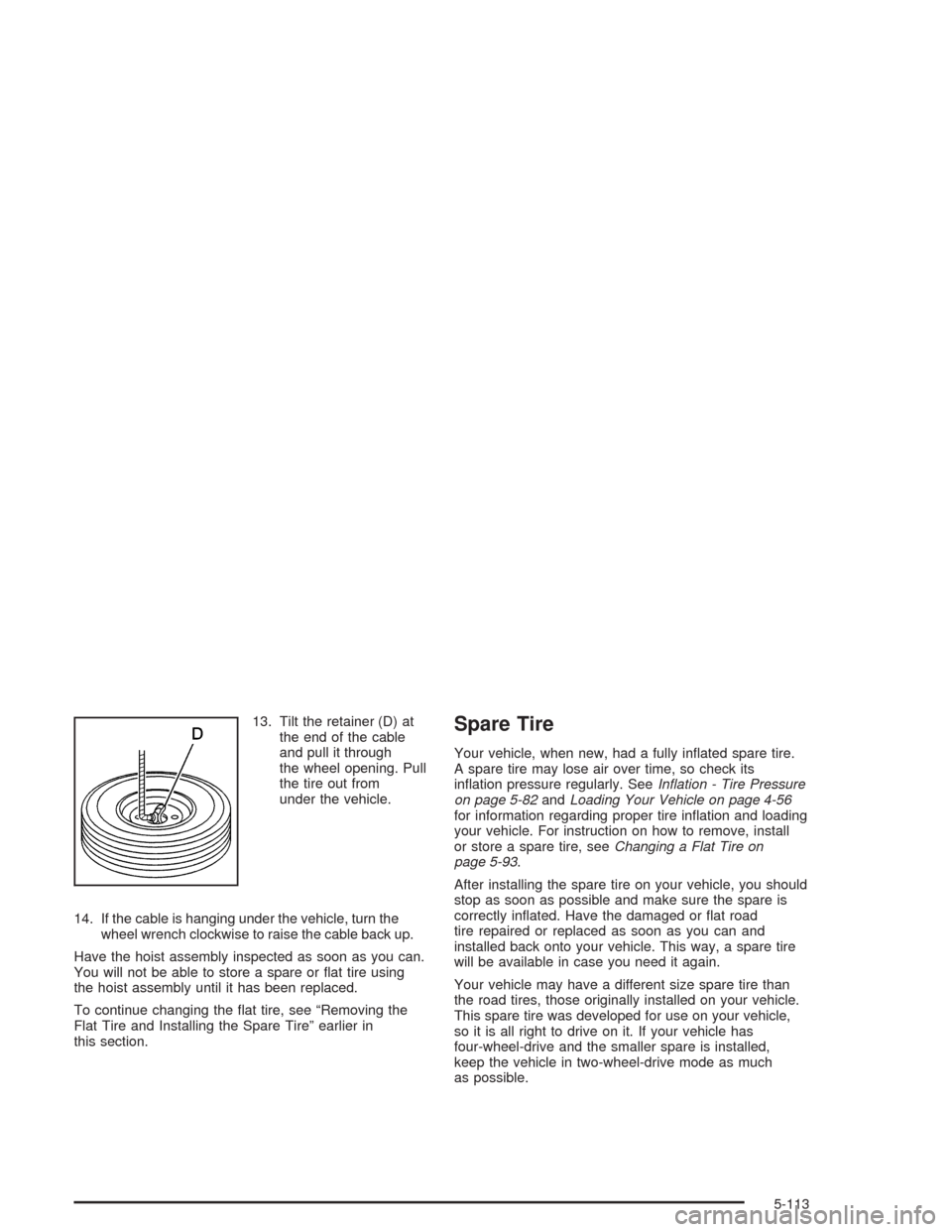
13. Tilt the retainer (D) at
the end of the cable
and pull it through
the wheel opening. Pull
the tire out from
under the vehicle.
14. If the cable is hanging under the vehicle, turn the
wheel wrench clockwise to raise the cable back up.
Have the hoist assembly inspected as soon as you can.
You will not be able to store a spare or at tire using
the hoist assembly until it has been replaced.
To continue changing the at tire, see “Removing the
Flat Tire and Installing the Spare Tire” earlier in
this section.Spare Tire
Your vehicle, when new, had a fully inated spare tire.
A spare tire may lose air over time, so check its
ination pressure regularly. SeeInation - Tire Pressure
on page 5-82andLoading Your Vehicle on page 4-56
for information regarding proper tire ination and loading
your vehicle. For instruction on how to remove, install
or store a spare tire, seeChanging a Flat Tire on
page 5-93.
After installing the spare tire on your vehicle, you should
stop as soon as possible and make sure the spare is
correctly inated. Have the damaged or at road
tire repaired or replaced as soon as you can and
installed back onto your vehicle. This way, a spare tire
will be available in case you need it again.
Your vehicle may have a different size spare tire than
the road tires, those originally installed on your vehicle.
This spare tire was developed for use on your vehicle,
so it is all right to drive on it. If your vehicle has
four-wheel-drive and the smaller spare is installed,
keep the vehicle in two-wheel-drive mode as much
as possible.
5-113
Page 582 of 584
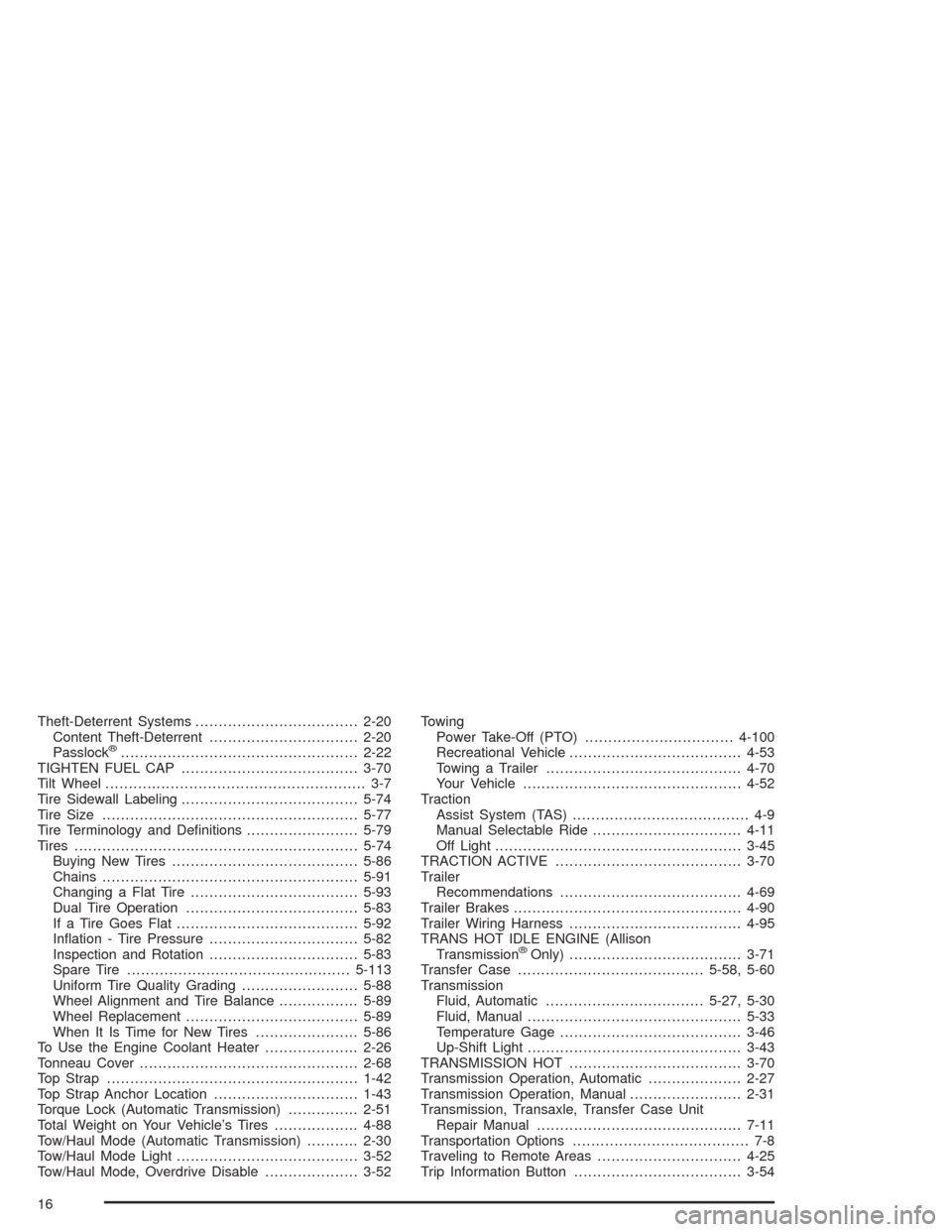
Theft-Deterrent Systems...................................2-20
Content Theft-Deterrent................................2-20
Passlock
®...................................................2-22
TIGHTEN FUEL CAP......................................3-70
Tilt Wheel........................................................ 3-7
Tire Sidewall Labeling......................................5-74
Tire Size.......................................................5-77
Tire Terminology and Denitions........................5-79
Tires.............................................................5-74
Buying New Tires........................................5-86
Chains.......................................................5-91
Changing a Flat Tire....................................5-93
Dual Tire Operation.....................................5-83
If a Tire Goes Flat.......................................5-92
Ination - Tire Pressure................................5-82
Inspection and Rotation................................5-83
Spare Tire................................................5-113
Uniform Tire Quality Grading.........................5-88
Wheel Alignment and Tire Balance.................5-89
Wheel Replacement.....................................5-89
When It Is Time for New Tires......................5-86
To Use the Engine Coolant Heater....................2-26
Tonneau Cover...............................................2-68
Top Strap......................................................1-42
Top Strap Anchor Location...............................1-43
Torque Lock (Automatic Transmission)...............2-51
Total Weight on Your Vehicle’s Tires..................4-88
Tow/Haul Mode (Automatic Transmission)...........2-30
Tow/Haul Mode Light.......................................3-52
Tow/Haul Mode, Overdrive Disable....................3-52Towing
Power Take-Off (PTO)................................4-100
Recreational Vehicle.....................................4-53
Towing a Trailer..........................................4-70
Your Vehicle...............................................4-52
Traction
Assist System (TAS)...................................... 4-9
Manual Selectable Ride................................4-11
Off Light.....................................................3-45
TRACTION ACTIVE........................................3-70
Trailer
Recommendations.......................................4-69
Trailer Brakes.................................................4-90
Trailer Wiring Harness.....................................4-95
TRANS HOT IDLE ENGINE (Allison
Transmission
®Only).....................................3-71
Transfer Case........................................5-58, 5-60
Transmission
Fluid, Automatic..................................5-27, 5-30
Fluid, Manual..............................................5-33
Temperature Gage.......................................3-46
Up-Shift Light..............................................3-43
TRANSMISSION HOT.....................................3-70
Transmission Operation, Automatic....................2-27
Transmission Operation, Manual........................2-31
Transmission, Transaxle, Transfer Case Unit
Repair Manual............................................7-11
Transportation Options...................................... 7-8
Traveling to Remote Areas...............................4-25
Trip Information Button....................................3-54
16