Page 319 of 584
Environmental Concerns
Off-road driving can provide wholesome and satisfying
recreation. However, it also raises environmental
concerns. GM recognizes these concerns and urge
every off-roader to follow these basic rules for protecting
the environment:
Always use established trails, roads and areas that
have been specially set aside for public off-road
recreational driving; obey all posted regulations.
Avoid any driving practice that could damage
the environment — shrubs, owers, trees,
grasses — or disturb wildlife (this includes
wheel-spinning, breaking down trees or
unnecessary driving through streams or
over soft ground).
Always carry a litter bag — make sure all refuse is
removed from any campsite before leaving.
Take extreme care with open res (where
permitted), camp stoves and lanterns.
Never park your vehicle over dry grass or other
combustible materials that could catch re from
the heat of the vehicle’s exhaust system.
Traveling to Remote Areas
It makes sense to plan your trip, especially when going
to a remote area. Know the terrain and plan your
route. You are much less likely to get bad surprises.
Get accurate maps of trails and terrain. Try to learn of
any blocked or closed roads.
It is also a good idea to travel with at least one other
vehicle. If something happens to one of them, the other
can help quickly.
Does your vehicle have a winch? If so, be sure to read
the winch instructions. In a remote area, a winch
can be handy if you get stuck. But you will want to know
how to use it properly.
Getting Familiar with Off-Road Driving
It is a good idea to practice in an area that is safe
and close to home before you go into the wilderness.
Off-road driving does require some new and different
driving skills. Here is what we mean.
Tune your senses to different kinds of signals. Your
eyes, for example, need to constantly sweep the terrain
for unexpected obstacles. Your ears need to listen
for unusual tire or engine sounds. With your arms,
hands, feet and body, you will need to respond to
vibrations and vehicle bounce.
4-25
Page 390 of 584
Heavy-DutyTrailer Wiring
Harness Package
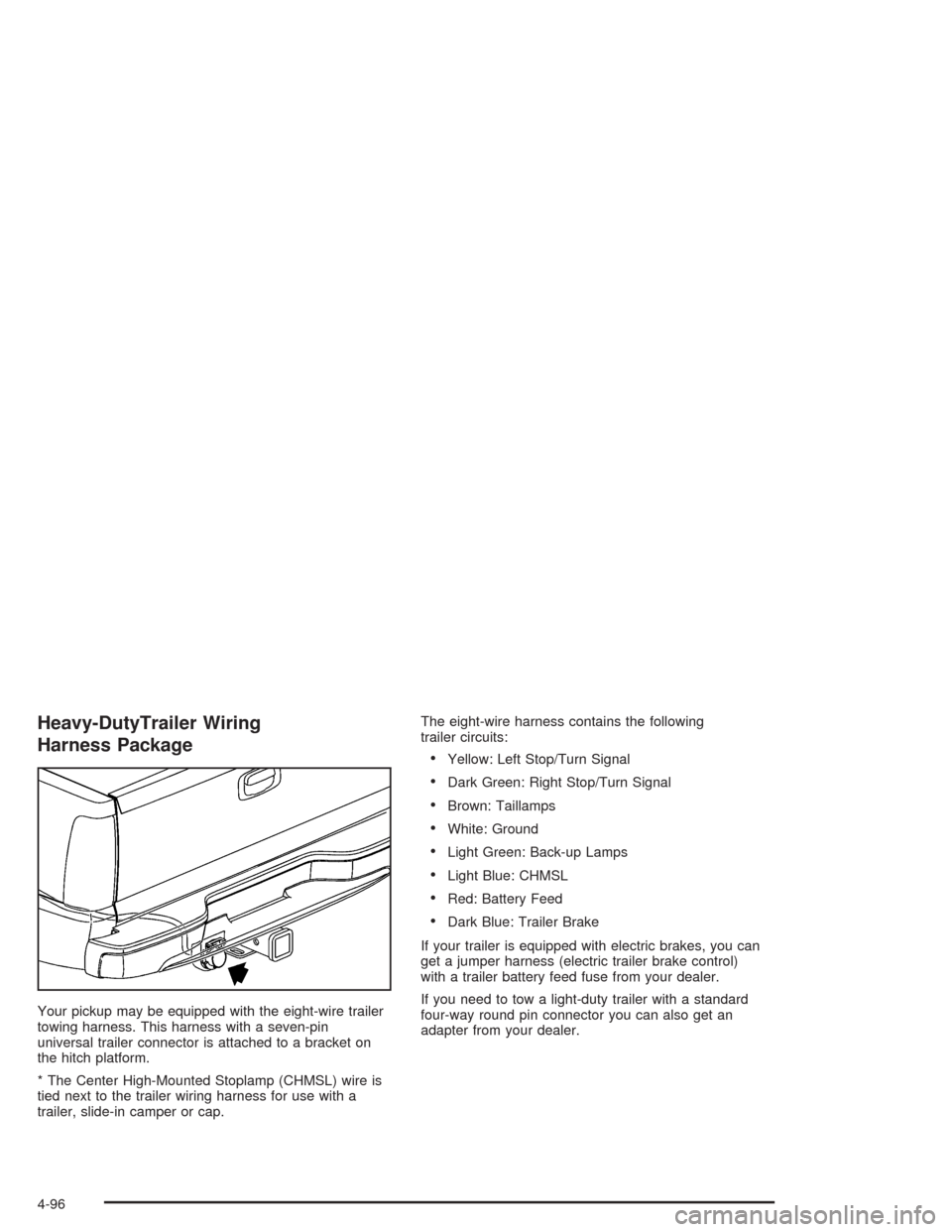
Your pickup may be equipped with the eight-wire trailer
towing harness. This harness with a seven-pin
universal trailer connector is attached to a bracket on
the hitch platform.
* The Center High-Mounted Stoplamp (CHMSL) wire is
tied next to the trailer wiring harness for use with a
trailer, slide-in camper or cap.The eight-wire harness contains the following
trailer circuits:
Yellow: Left Stop/Turn Signal
Dark Green: Right Stop/Turn Signal
Brown: Taillamps
White: Ground
Light Green: Back-up Lamps
Light Blue: CHMSL
Red: Battery Feed
Dark Blue: Trailer Brake
If your trailer is equipped with electric brakes, you can
get a jumper harness (electric trailer brake control)
with a trailer battery feed fuse from your dealer.
If you need to tow a light-duty trailer with a standard
four-way round pin connector you can also get an
adapter from your dealer.
4-96
Page 392 of 584
Instrument Panel Jumper Wiring Harness
{CAUTION:
Be sure to use only the correct trailer brake
harness, the one intended for use on your
vehicle. If you use some other trailer brake
harness, even if it seems to t, your trailer
brakes may not work at all. You could have a
crash in which you or others could be injured.
Use only the trailer brake harness intended for
your vehicle. If it is no longer available to you,
be sure to get a proper replacement from
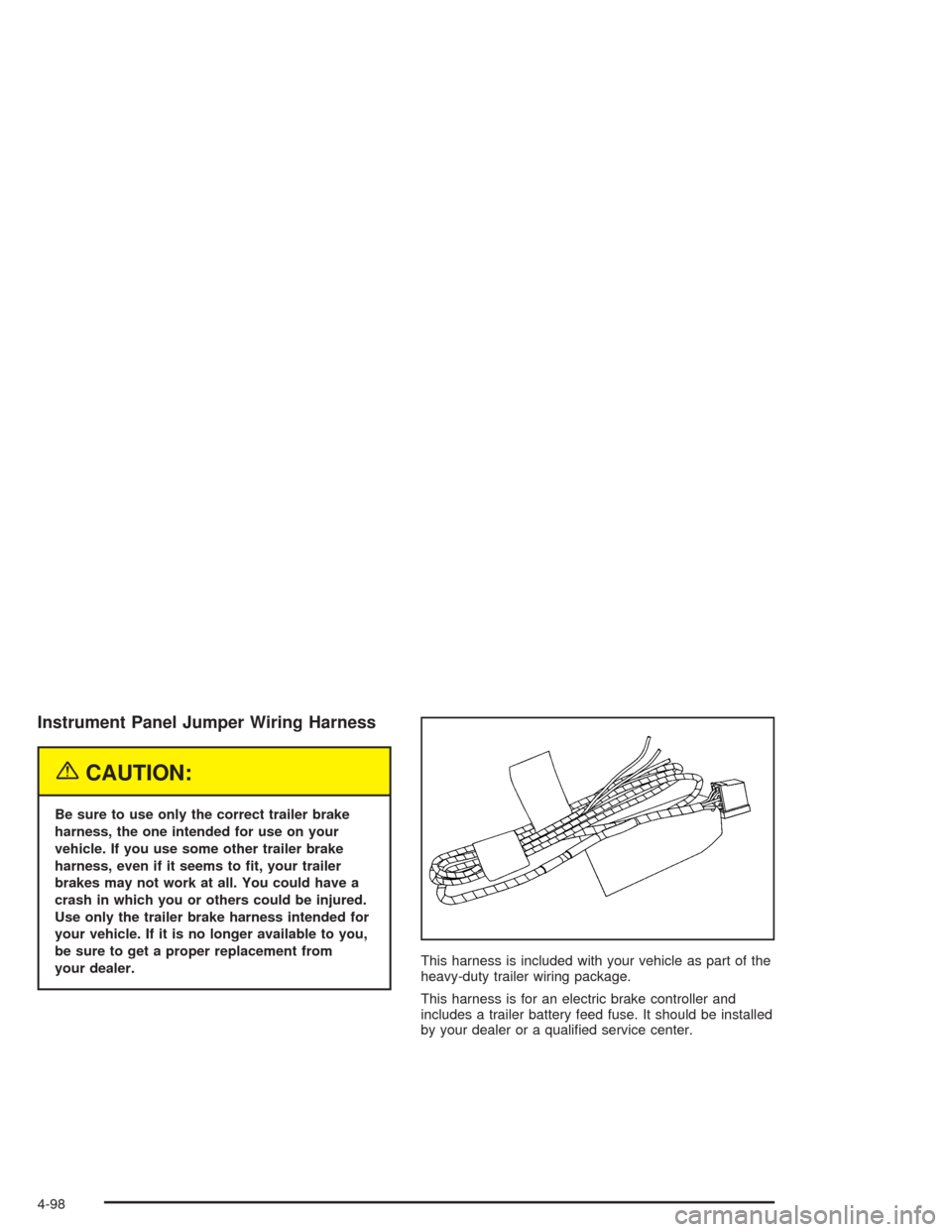
your dealer.This harness is included with your vehicle as part of the
heavy-duty trailer wiring package.
This harness is for an electric brake controller and
includes a trailer battery feed fuse. It should be installed
by your dealer or a qualied service center.
4-98
Page 394 of 584

Auxiliary Battery
The auxiliary battery provision can be used to supply
electrical power to additional equipment that you
may choose to add, such as a slide-in camper.
If your vehicle has this
provision, this relay will be
located on the passenger’s
side of the vehicle, next
to the auxiliary battery.
When using this provision, connection should only be
made to the upper stud (A) of the relay. Do not
make connections to the lower stud (B) of the relay.
The auxiliary battery circuit is protected by a megafuse
located behind the auxiliary battery.
Be sure to follow the proper installation instructions
that are included with any electrical equipment that
you install.Notice:Leaving electrical equipment on for
extended periods will drain the battery. Always turn
off electrical equipment when not in use and do
not use equipment that exceeds the maximum
amperage rating for the auxiliary battery provision.
Power Winches
If you wish to use a power winch on your vehicle, only
use it when your vehicle is stationary or anchored.
Power Take-Off (PTO)
Before using a PTO, if equipped, refer to the
manufacturer’s or installer’s instructions.
To engage a PTO on a vehicle with a manual
transmission do the following:
1. Hold the clutch pedal down.
2. Set the parking brake.
3. Shift the transmission into NEUTRAL (N).
4. Engage the PTO. Refer to the manufacturer’s
or installer’s for instructions on electrically
engaged PTOs.
5. For mobile operations, shift the transmission into
the gear you want, apply the regular brakes and
release the parking brake. For stationary operations,
leave the parking brake applied.
4-100
Page 398 of 584

Pickup Box Identication and Fender
Marker Lamps...........................................5-69
Taillamps.....................................................5-70
Replacement Bulbs.......................................5-72
Windshield Wiper Blade Replacement..............5-73
Tires..............................................................5-74
Ination - Tire Pressure.................................5-82
Dual Tire Operation.......................................5-83
Tire Inspection and Rotation...........................5-83
When It Is Time for New Tires.......................5-86
Buying New Tires.........................................5-86
Uniform Tire Quality Grading..........................5-88
Wheel Alignment and Tire Balance..................5-89
Wheel Replacement......................................5-89
Tire Chains..................................................5-91
If a Tire Goes Flat........................................5-92
Changing a Flat Tire.....................................5-93
Spare Tire.................................................5-113Appearance Care..........................................5-114
Cleaning the Inside of Your Vehicle...............5-114
Care of Safety Belts....................................5-117
Weatherstrips.............................................5-117
Cleaning the Outside of Your Vehicle.............5-117
Sheet Metal Damage...................................5-120
Finish Damage...........................................5-120
Underbody Maintenance...............................5-120
Chemical Paint Spotting...............................5-120
Vehicle Care/Appearance Materials................5-121
Vehicle Identication.....................................5-122
Vehicle Identication Number (VIN)................5-122
Service Parts Identication Label...................5-122
Electrical System..........................................5-123
Add-On Electrical Equipment.........................5-123
Windshield Wiper Fuses...............................5-123
Power Windows and Other Power Options......5-123
Fuses and Circuit Breakers..........................5-123
Capacities and Specications........................5-132
Section 5 Service and Appearance Care
5-2
Page 400 of 584

Doing Your Own Service Work
If you want to do some of your own service work, you
will want to use the proper service manual. It tells
you much more about how to service your vehicle than
this manual can. To order the proper service manual,
seeService Publications Ordering Information on
page 7-11.
Your vehicle has an air bag system. Before attempting
to do your own service work, seeServicing Your Air
Bag-Equipped Vehicle on page 1-83.
You should keep a record with all parts receipts and list
the mileage and the date of any service work you
perform. SeeMaintenance Record on page 6-19.{CAUTION:
You can be injured and your vehicle could be
damaged if you try to do service work on a
vehicle without knowing enough about it.
Be sure you have sufficient knowledge,
experience, the proper replacement parts
and tools before you attempt any vehicle
maintenance task.
Be sure to use the proper nuts, bolts and
other fasteners. “English” and “metric”
fasteners can be easily confused. If you
use the wrong fasteners, parts can later
break or fall off. You could be hurt.
5-4
Page 411 of 584
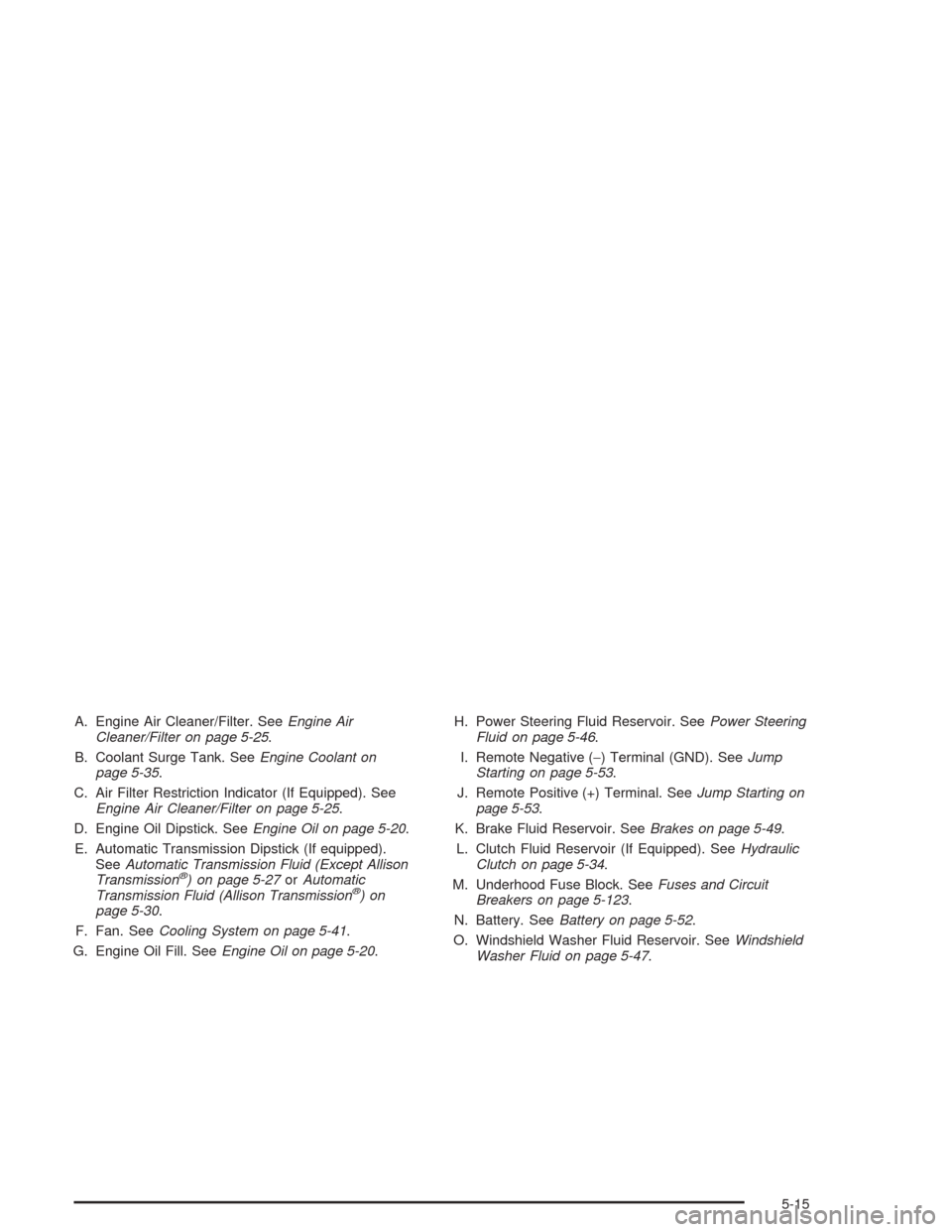
A. Engine Air Cleaner/Filter. SeeEngine Air
Cleaner/Filter on page 5-25.
B. Coolant Surge Tank. SeeEngine Coolant on
page 5-35.
C. Air Filter Restriction Indicator (If Equipped). See
Engine Air Cleaner/Filter on page 5-25.
D. Engine Oil Dipstick. SeeEngine Oil on page 5-20.
E. Automatic Transmission Dipstick (If equipped).
SeeAutomatic Transmission Fluid (Except Allison
Transmission
®) on page 5-27orAutomatic
Transmission Fluid (Allison Transmission®)on
page 5-30.
F. Fan. SeeCooling System on page 5-41.
G. Engine Oil Fill. SeeEngine Oil on page 5-20.H. Power Steering Fluid Reservoir. SeePower Steering
Fluid on page 5-46.
I. Remote Negative (−) Terminal (GND). SeeJump
Starting on page 5-53.
J. Remote Positive (+) Terminal. SeeJump Starting on
page 5-53.
K. Brake Fluid Reservoir. SeeBrakes on page 5-49.
L. Clutch Fluid Reservoir (If Equipped). SeeHydraulic
Clutch on page 5-34.
M. Underhood Fuse Block. SeeFuses and Circuit
Breakers on page 5-123.
N. Battery. SeeBattery on page 5-52.
O. Windshield Washer Fluid Reservoir. SeeWindshield
Washer Fluid on page 5-47.
5-15
Page 413 of 584
A. Engine Air Cleaner/Filter. SeeEngine Air
Cleaner/Filter on page 5-25.
B. Coolant Surge Tank. SeeEngine Coolant on
page 5-35.
C. Air Filter Restriction Indicator (If Equipped). See
Engine Air Cleaner/Filter on page 5-25.
D. Engine Oil Dipstick. SeeEngine Oil on page 5-20.
E. Automatic Transmission Dipstick (If Equipped).
SeeAutomatic Transmission Fluid (Except Allison
Transmission
®) on page 5-27orAutomatic
Transmission Fluid (Allison Transmission®)on
page 5-30.
F. Engine Oil Fill. SeeEngine Oil on page 5-20.
G. Fan. SeeCooling System on page 5-41.H. Remote Negative (−) Terminal (GND). SeeJump
Starting on page 5-53.
I. Power Steering Fluid Reservoir. SeePower Steering
Fluid on page 5-46.
J. Remote Positive (+) Terminal. SeeJump Starting on
page 5-53.
K. Brake Fluid Reservoir. SeeBrakes on page 5-49.
L. Clutch Fluid Reservoir (If Equipped). SeeHydraulic
Clutch on page 5-34.
M. Underhood Fuse Block. SeeFuses and Circuit
Breakers on page 5-123.
N. Battery. SeeBattery on page 5-52.
O. Windshield Washer Fluid Reservoir. SeeWindshield
Washer Fluid on page 5-47.
5-17