2004 CHEVROLET SILVERADO tow
[x] Cancel search: towPage 396 of 584
To use PTO speed control in variable mode (while
stationary) do the following:
1. Engage the PTO.
2. Vehicle speed must be less than 5 mph.
3. Make sure your foot is off the brake pedal
(and off the clutch for vehicles equipped with
a manual transmission).
4. Select the desired engine speed by using the foot
pedal, and select SET on the PTO switch or the
cruise control.
Variable Mode:PTO speed control mode can be used
for both stationary and mobile applications. This
mode allows PTO to be controlled in a fashion similar to
how cruise control sets vehicle speed. The operator
can set to an rpm (between 800 and 2,200) with
the cruise control feature or with the SET position on
the PTO switch. The operator is then able to increase
rpm in increments of 100, or “tap up” with the resume
position on the cruise control. Or, the operator can
decrease rpm in increments of 100 with the SET switch
on the PTO or the cruise control.
Vehicles not equipped with cruise control will not have
the “tap up” capability.
All engine speed values listed above are factory preset
values. With the exception of the TCC lockup speed
(1,100 rpm) and the “tap” increment (100 rpm), all
of these values are programmable and can be adjustedby your dealer or body uptter. If the PTO software
settings do not match the settings shown here, then
they may have already been altered in order to satisfy
the requirements of the installed PTO system and
body equipment.
When the PTO switch is turned on, the engine is limited
to 2200 rpms. If there are no accessories installed on
the vehicle, make sure the PTO switch is turned off.
Step-Bumper Pad
Your vehicle has a rear step bumper with a rear step
pad at the center of the bumper.
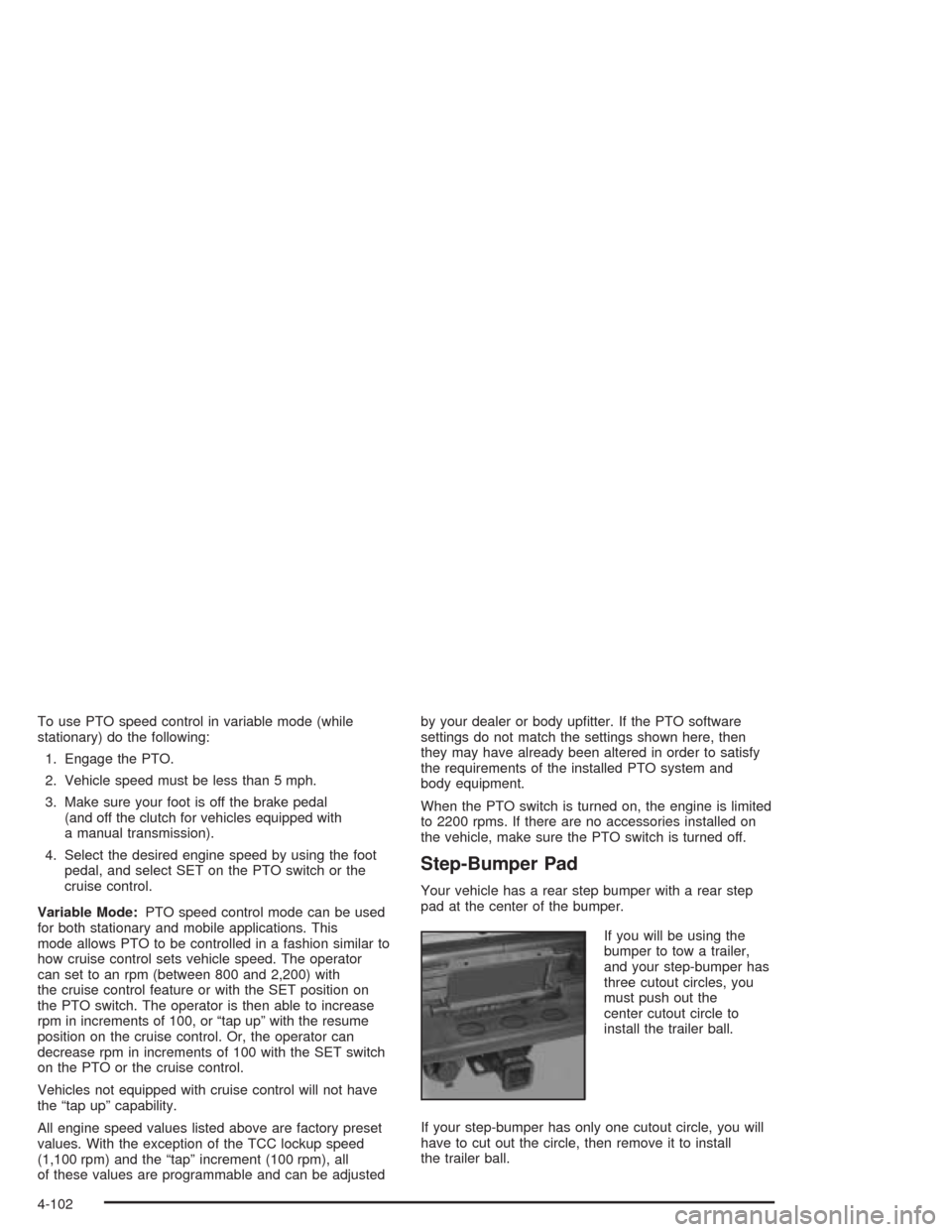
If you will be using the
bumper to tow a trailer,
and your step-bumper has
three cutout circles, you
must push out the
center cutout circle to
install the trailer ball.
If your step-bumper has only one cutout circle, you will
have to cut out the circle, then remove it to install
the trailer ball.
4-102
Page 416 of 584
Engine Oil
If your vehicle has a diesel engine, see “Engine Oil” in
the Diesel Engine Supplement.
If the CHECK OIL LEVEL light appears on the
instrument cluster (except vehicles equipped with the
4.3L engine), it means you need to check your engine oil
level right away.
For more information, seeDriver Information
Center (DIC) on page 3-53.
You should check your engine oil level regularly; this is
an added reminder.
Checking Engine Oil
It is a good idea to check your engine oil every time you
get fuel. In order to get an accurate reading, the oil
must be warm and the vehicle must be on level ground.
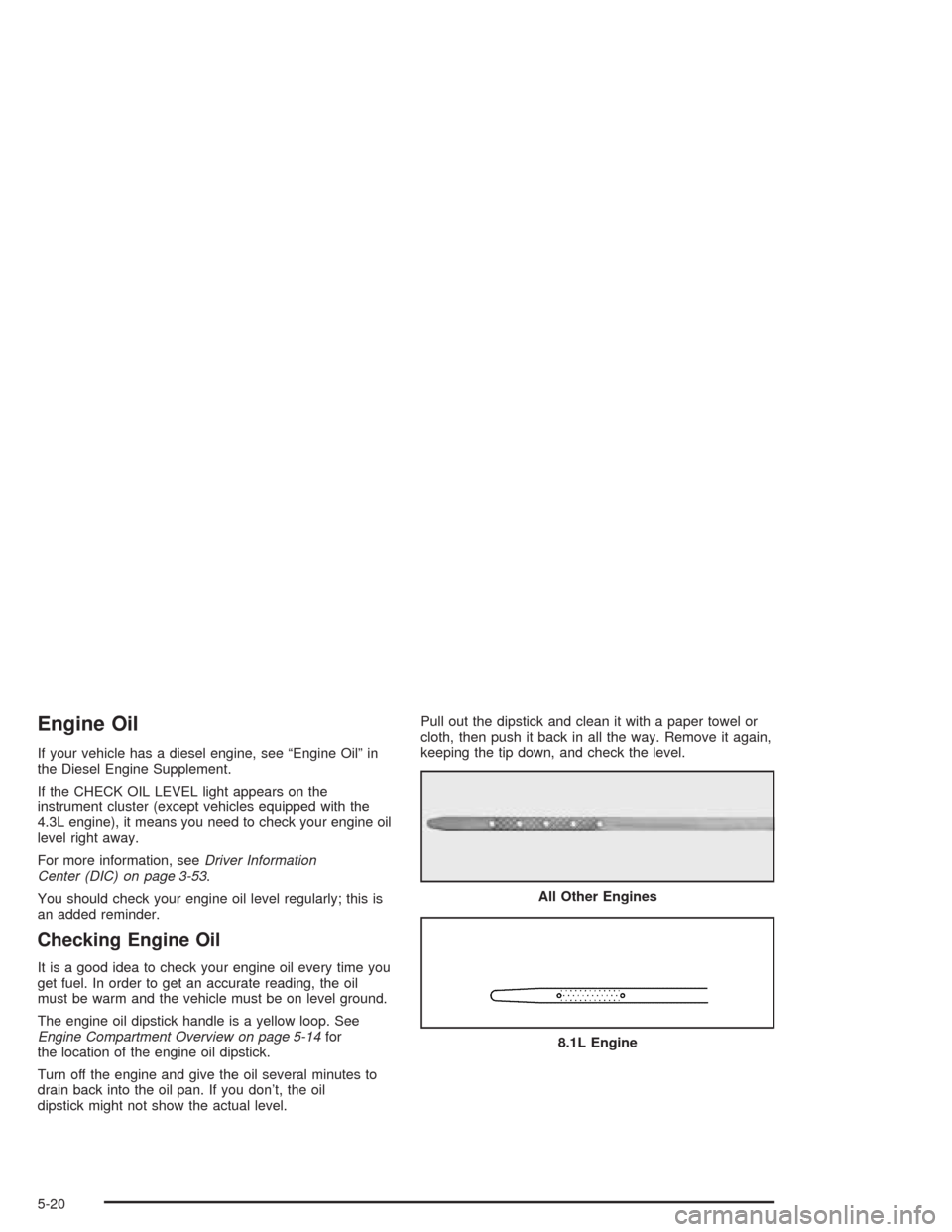
The engine oil dipstick handle is a yellow loop. See
Engine Compartment Overview on page 5-14for
the location of the engine oil dipstick.
Turn off the engine and give the oil several minutes to
drain back into the oil pan. If you don’t, the oil
dipstick might not show the actual level.Pull out the dipstick and clean it with a paper towel or
cloth, then push it back in all the way. Remove it again,
keeping the tip down, and check the level.
All Other Engines
8.1L Engine
5-20
Page 423 of 584

{CAUTION:
Operating the engine with the air cleaner/lter
off can cause you or others to be burned.
The air cleaner not only cleans the air, it helps
to stop ame if the engine backres. If it is not
there and the engine backres, you could be
burned. Do not drive with it off, and be careful
working on the engine with the air cleaner/
lter off.
Notice:If the air cleaner/lter is off, a backre can
cause a damaging engine re. And, dirt can
easily get into your engine, which will damage it.
Always have the air cleaner/lter in place when you
are driving.
Automatic Transmission Fluid
(Except Allison Transmission
®)
When to Check and Change
A good time to check your automatic transmission uid
level is when the engine oil is changed.
Change both the uid and lter every 50,000 miles
(83 000 km) if the vehicle’s GVWR is over 8,600 or if
the vehicle is mainly driven under one or more of
these conditions:
In heavy city traffic where the outside temperature
regularly reaches 90°F (32°C) or higher.
In hilly or mountainous terrain.
When doing frequent trailer towing.
Uses such as found in taxi, police or
delivery service.
If your vehicle’s GVWR is not over 8,600 and you do
not use your vehicle under any of these conditions,
change the uid and lter every 100,000 miles
(166 000 km).
SeeScheduled Maintenance on page 6-4.
5-27
Page 425 of 584

Checking the Fluid Level
Prepare your vehicle as follows:
Park your vehicle on a level place. Keep the
engine running.
With the parking brake applied, place the shift lever
in PARK (P).
With your foot on the brake pedal, move the shift
lever through each gear range, pausing for about
three seconds in each range. Then, position the shift
lever in PARK (P).
Let the engine run at idle for three minutes or more.
Then, without shutting off the engine, follow these steps:
The transmission dipstick
handle with the graphic is
located at the rear of
the engine compartment,
on the passenger’s side.SeeEngine Compartment Overview on page 5-14for
more information on location.
1. Flip the handle up and then pull out the dipstick
and wipe it with a clean rag or paper towel.
2. Push it back in all the way, wait three seconds and
then pull it back out again.
3. Check both sides of the dipstick, and read the lower
level. The uid level must be in the COLD area,
below the cross-hatched area, for a cold check or in
the HOT area or cross-hatched area for a hot
check. Be sure to keep the dipstick pointed down to
get an accurate reading.
4. If the uid level is in the acceptable range, push the
dipstick back in all the way; then ip the handle
down to lock the dipstick in place.
5-29
Page 426 of 584

How to Add Fluid
Refer to the Maintenance Schedule to determine what
kind of transmission uid to use. SeeRecommended
Fluids and Lubricants on page 6-13.
Add uid only after checking the transmission uid while
it is hot. (A cold check is used only as a reference.) If
the uid level is low, add only enough of the proper uid
to bring the level up to the HOT area for a hot check.
It doesn’t take much uid, generally less than one
pint (0.5 L).Don’t overll.
Notice:We recommend you use only uid labeled
DEXRON
®-III, because uid with that label is
made especially for your automatic transmission.
Damage caused by uid other than DEXRON
®-III is
not covered by your new vehicle warranty.
After adding uid, recheck the uid level as
described underHow to Check.
When the correct uid level is obtained, push the
dipstick back in all the way; then ip the handle
down to lock the dipstick in place.
Automatic Transmission Fluid
(Allison Transmission
®)
When to Check and Change
A good time to check your automatic transmission uid
level is when the engine oil is changed.
Change both the uid and lter every 25,000 miles
(41 500 km) if the vehicle is mainly driven under one or
more of these conditions:
In heavy city traffic where the outside temperature
regularly reaches 90°F (32°C) or higher.
In hilly or mountainous terrain.
When doing frequent trailer towing.
Uses such as found in taxi, police or
delivery service.
If you do not use your vehicle under any of
these conditions, change the uid and lter every
50,000 miles (83 000 km).
SeeScheduled Maintenance on page 6-4.
5-30
Page 427 of 584

How to Check
Because this operation can be a little difficult, you
may choose to have this done at the dealership
service department.
If you do it yourself, be sure to follow all the instructions
here, or you could get a false reading on the dipstick.
Notice:Too much or too little uid can damage
your transmission. Too much can mean that some
of the uid could come out and fall on hot engine
part or exhaust system parts, starting a re.
Too little uid could cause the transmission to
overheat. Be sure to get an accurate reading if you
check your transmission uid.
Wait at least 30 minutes before checking the
transmission uid level if you have been driving:
When outside temperatures are above 90°F (32°C).
At high speed for quite a while.
In heavy traffic – especially in hot weather.
While pulling a trailer.
Checking the Fluid Level
Prepare your vehicle as follows:
Park your vehicle on a level place. Keep the
engine running.
With the parking brake applied, place the shift lever
in PARK (P).
With your foot on the brake pedal, run the engine
for at least once minute and shift to DRIVE (D).
Then shift to NEUTRAL (N) and then REVERSE (R)
to ll the hydraulic system. Then, position the
shift lever in PARK (P).
Allow the engine to run at idle (500–800 rpm).
Slowly release the brake pedal.
Then, without shutting off the engine, follow these steps:
Cold Check Procedure
The purpose of the cold check is to determine if the
transmission has enough uid to be operated safely until
a hot check can be made. The uid level rises as uid
temperature increases. DO NOT ll above the COLD
CHECK band if the transmission uid is below normal
operating temperatures.
1. Pull out the dipstick and wipe it with a clean rag or
paper towel.
2. Push it back in all the way, wait three seconds and
then pull it back out again.
5-31
Page 428 of 584
3. Check the uid level reading. Repeat the check
procedure to verify the reading.
4. If the uid level is within the COLD CHECK band,
the transmission may be operated until the uid is
hot enough to perform a hot check. If the uid
level is not within the COLD CHECK band, add or
drain uid as necessary to bring the level into
the middle of the COLD CHECK band.
5. Perform a hot check at the rst opportunity after the
normal operating temperature of 160°F (71°C) to
200°F (93°C) is reached.
6. If the uid level is in the acceptable range, push the
dipstick back in all the way.
Hot Check Procedure
The uid must be hot to ensure an accurate check.
The uid level rises as temperature increases.
1. Operate the transmission in DRIVE (D) range until
the normal operating temperature of 160°F (71°C)
to 200°F (93°C) is reached.
2. Pull out the dipstick and wipe it with a clean rag or
paper towel.3. Push it back in all the way, wait three seconds and
then pull it back out again. Repeat the check
procedure to verify the reading.
4. Safe operating level is within the HOT RUN band
on the dipstick. The width of the HOT RUN band
represents approximately 1.06 quart (1.0 liter)
of uid at normal operating temperature.
5. If the uid level is not within the HOT RUN band,
add or drain uid as necessary to bring the uid
level to within the HOT RUN band.
6. If the uid level is in the acceptable range, push the
dipstick back in all the way.
Consistency of Readings
Always check the uid level at least twice using the
procedures described previously. Consistency
(repeatable readings) is important to maintaining proper
uid level. If inconsistent readings persist, check the
transmission breather to be sure it is clean and
unclogged. If readings are still inconsistent, contact
your dealer.
5-32
Page 434 of 584
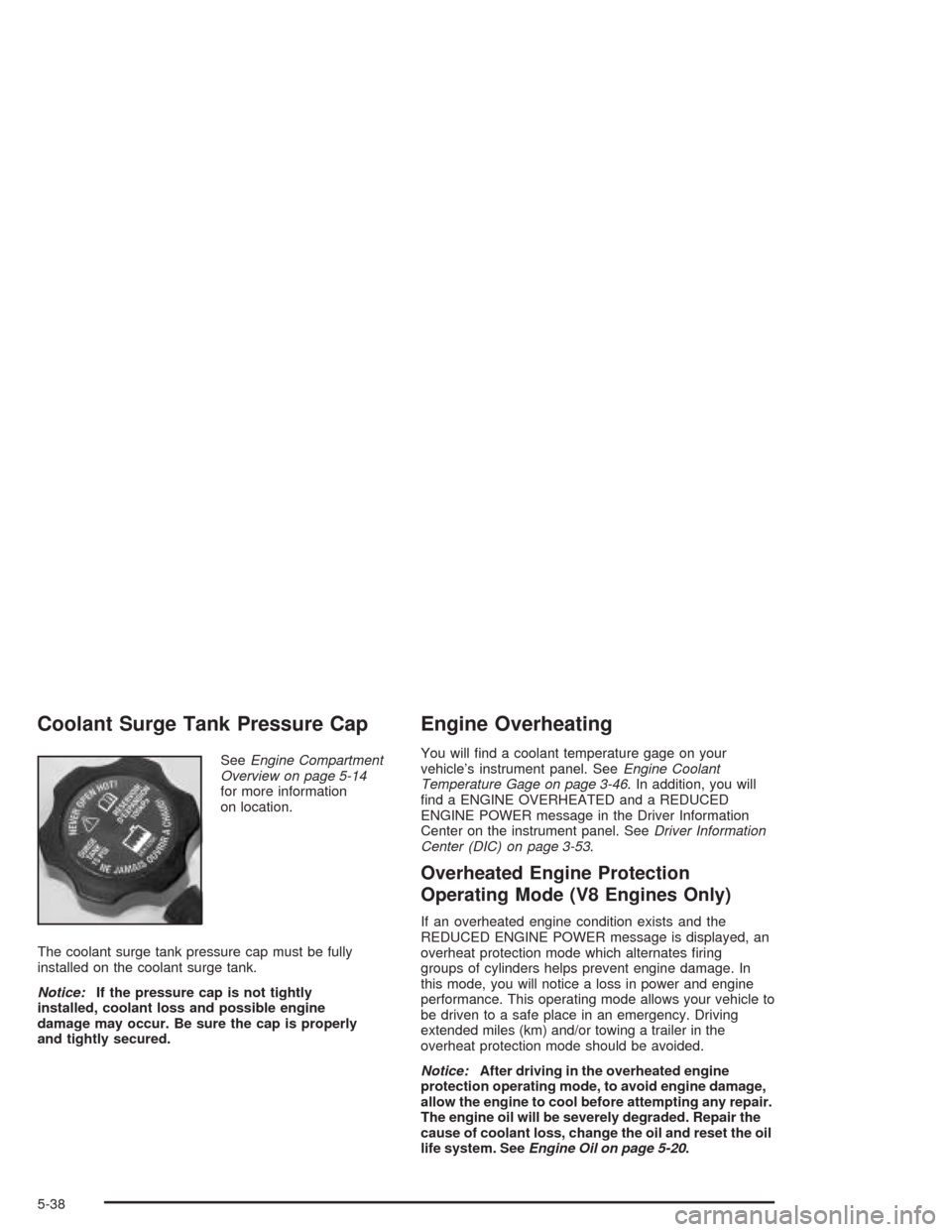
Coolant Surge Tank Pressure Cap
SeeEngine Compartment
Overview on page 5-14
for more information
on location.
The coolant surge tank pressure cap must be fully
installed on the coolant surge tank.
Notice:If the pressure cap is not tightly
installed, coolant loss and possible engine
damage may occur. Be sure the cap is properly
and tightly secured.
Engine Overheating
You will nd a coolant temperature gage on your
vehicle’s instrument panel. SeeEngine Coolant
Temperature Gage on page 3-46. In addition, you will
nd a ENGINE OVERHEATED and a REDUCED
ENGINE POWER message in the Driver Information
Center on the instrument panel. SeeDriver Information
Center (DIC) on page 3-53.
Overheated Engine Protection
Operating Mode (V8 Engines Only)
If an overheated engine condition exists and the
REDUCED ENGINE POWER message is displayed, an
overheat protection mode which alternates ring
groups of cylinders helps prevent engine damage. In
this mode, you will notice a loss in power and engine
performance. This operating mode allows your vehicle to
be driven to a safe place in an emergency. Driving
extended miles (km) and/or towing a trailer in the
overheat protection mode should be avoided.
Notice:After driving in the overheated engine
protection operating mode, to avoid engine damage,
allow the engine to cool before attempting any repair.
The engine oil will be severely degraded. Repair the
cause of coolant loss, change the oil and reset the oil
life system. SeeEngine Oil on page 5-20.
5-38