Page 44 of 338
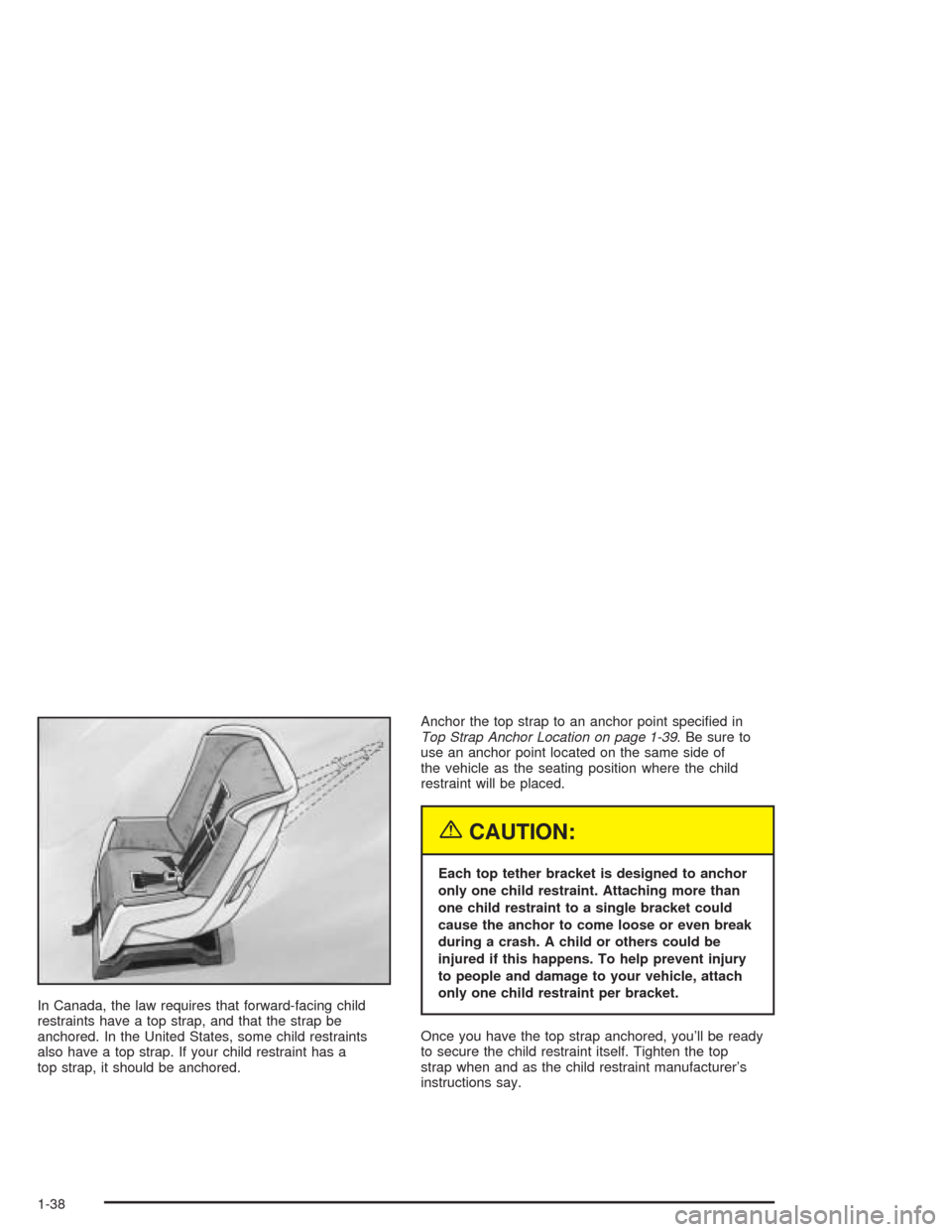
In Canada, the law requires that forward-facing child
restraints have a top strap, and that the strap be
anchored. In the United States, some child restraints
also have a top strap. If your child restraint has a
top strap, it should be anchored.Anchor the top strap to an anchor point specified in
Top Strap Anchor Location on page 1-39. Be sure to
use an anchor point located on the same side of
the vehicle as the seating position where the child
restraint will be placed.
{CAUTION:
Each top tether bracket is designed to anchor
only one child restraint. Attaching more than
one child restraint to a single bracket could
cause the anchor to come loose or even break
during a crash. A child or others could be
injured if this happens. To help prevent injury
to people and damage to your vehicle, attach
only one child restraint per bracket.
Once you have the top strap anchored, you’ll be ready
to secure the child restraint itself. Tighten the top
strap when and as the child restraint manufacturer’s
instructions say.
1-38
Page 46 of 338
Lower Anchorages and Top Tethers
for Children (LATCH System)
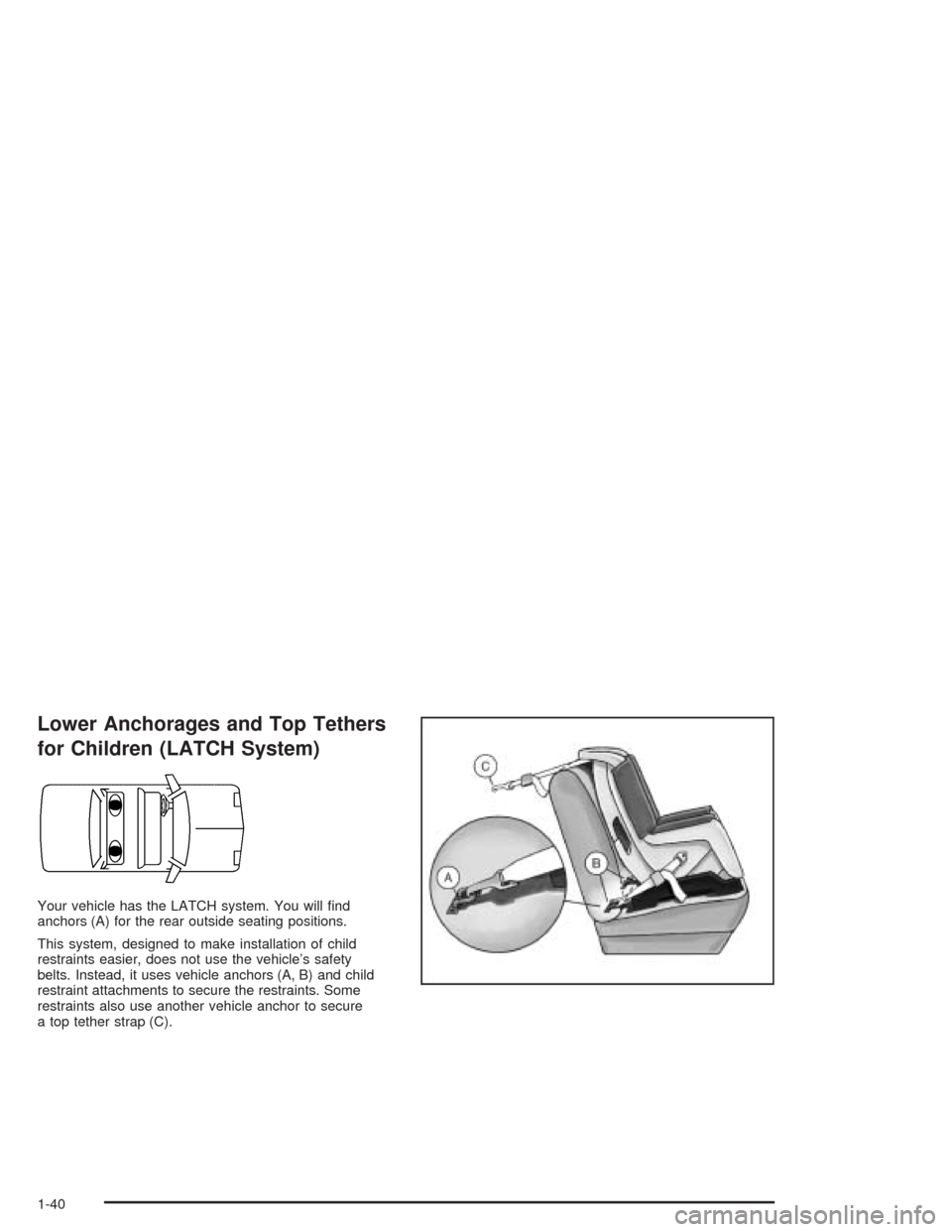
Your vehicle has the LATCH system. You will find
anchors (A) for the rear outside seating positions.
This system, designed to make installation of child
restraints easier, does not use the vehicle’s safety
belts. Instead, it uses vehicle anchors (A, B) and child
restraint attachments to secure the restraints. Some
restraints also use another vehicle anchor to secure
a top tether strap (C).
1-40
Page 48 of 338
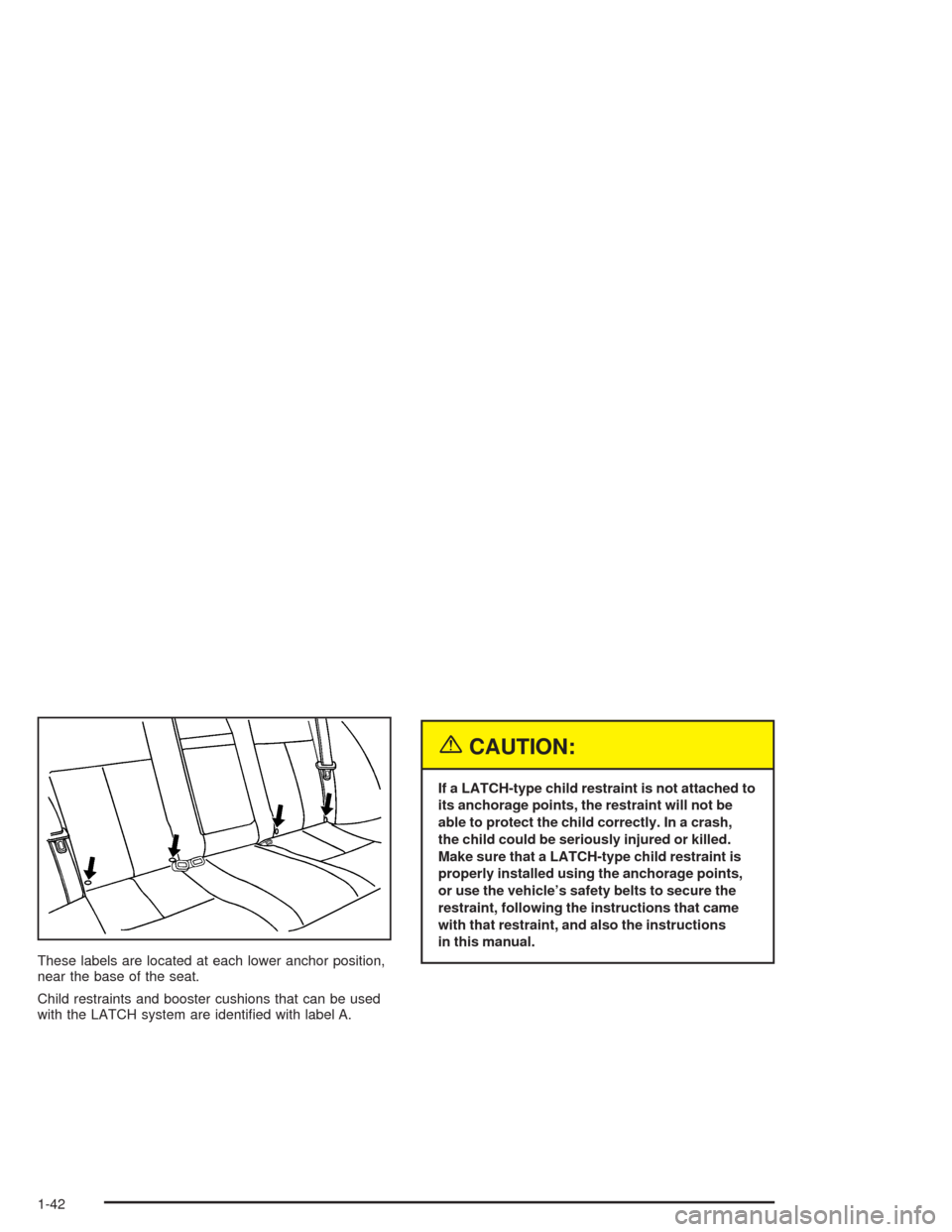
These labels are located at each lower anchor position,
near the base of the seat.
Child restraints and booster cushions that can be used
with the LATCH system are identified with label A.
{CAUTION:
If a LATCH-type child restraint is not attached to
its anchorage points, the restraint will not be
able to protect the child correctly. In a crash,
the child could be seriously injured or killed.
Make sure that a LATCH-type child restraint is
properly installed using the anchorage points,
or use the vehicle’s safety belts to secure the
restraint, following the instructions that came
with that restraint, and also the instructions
in this manual.
1-42
Page 49 of 338
Securing a Child Restraint Designed
for the LATCH System
1. Find the LATCH anchorages for the seating
position you want to use, where the bottom of the
seatback meets the back of the seat cushion.
SeeLower Anchorages and Top Tethers for
Children (LATCH System) on page 1-40.
2. Put the child restraint on the seat.
3. Attach and tighten the LATCH attachments on
the child restraint to the LATCH anchorages in
the vehicle. The child restraint instructions will
show you how.
4. If the child restraint is forward-facing, attach and
tighten the top tether to the top tether anchorage.
The child restraint instructions will show you
how. Also seeTop Strap on page 1-37.
5. Push and pull the child restraint in different
directions to be sure it is secure.
To remove the child restraint, simply unhook the
top tether from the top tether anchorage and then
disconnect the LATCH attachments from the LATCH
anchorages.
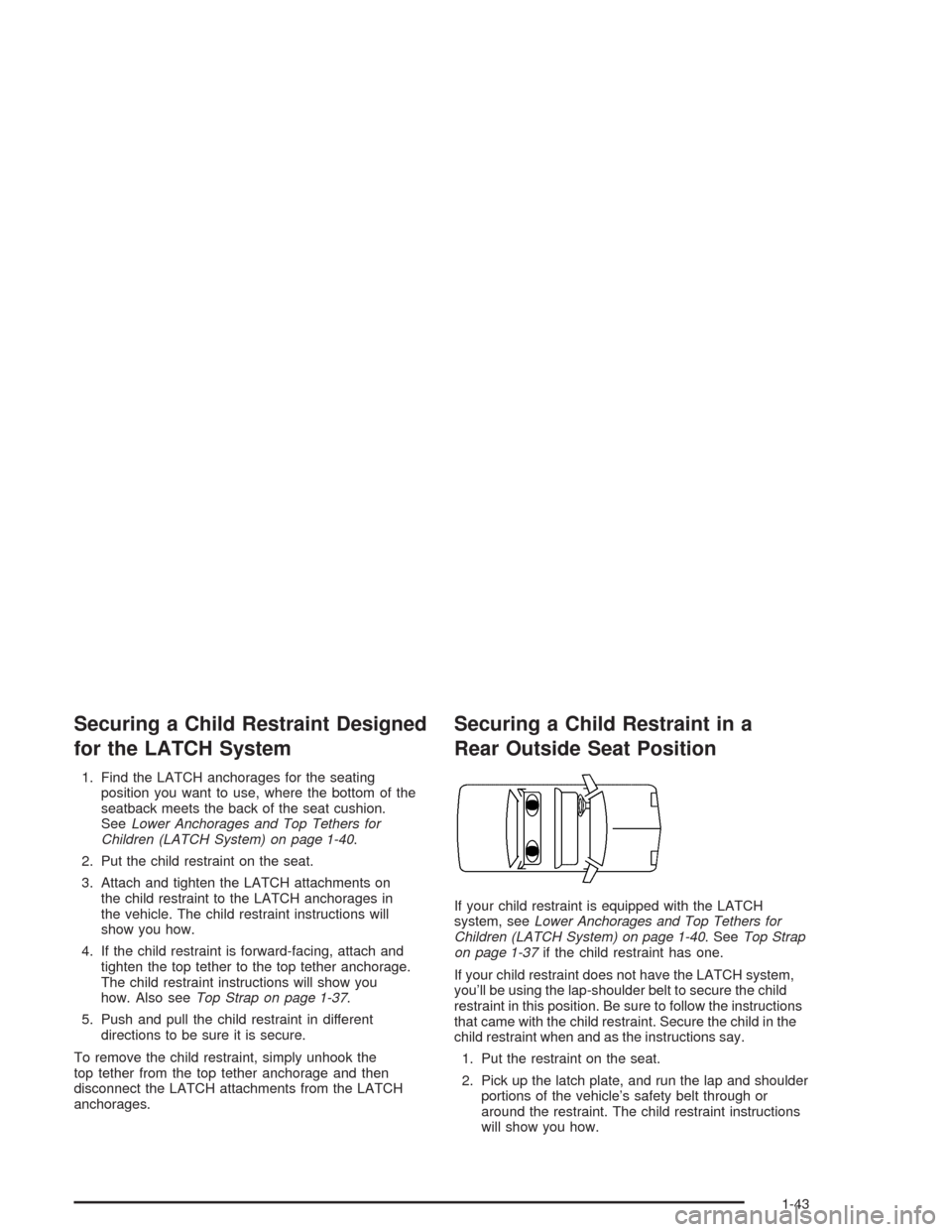
Securing a Child Restraint in a
Rear Outside Seat Position
If your child restraint is equipped with the LATCH
system, seeLower Anchorages and Top Tethers for
Children (LATCH System) on page 1-40. SeeTop Strap
on page 1-37if the child restraint has one.
If your child restraint does not have the LATCH system,
you’ll be using the lap-shoulder belt to secure the child
restraint in this position. Be sure to follow the instructions
that came with the child restraint. Secure the child in the
child restraint when and as the instructions say.
1. Put the restraint on the seat.
2. Pick up the latch plate, and run the lap and shoulder
portions of the vehicle’s safety belt through or
around the restraint. The child restraint instructions
will show you how.
1-43
Page 51 of 338
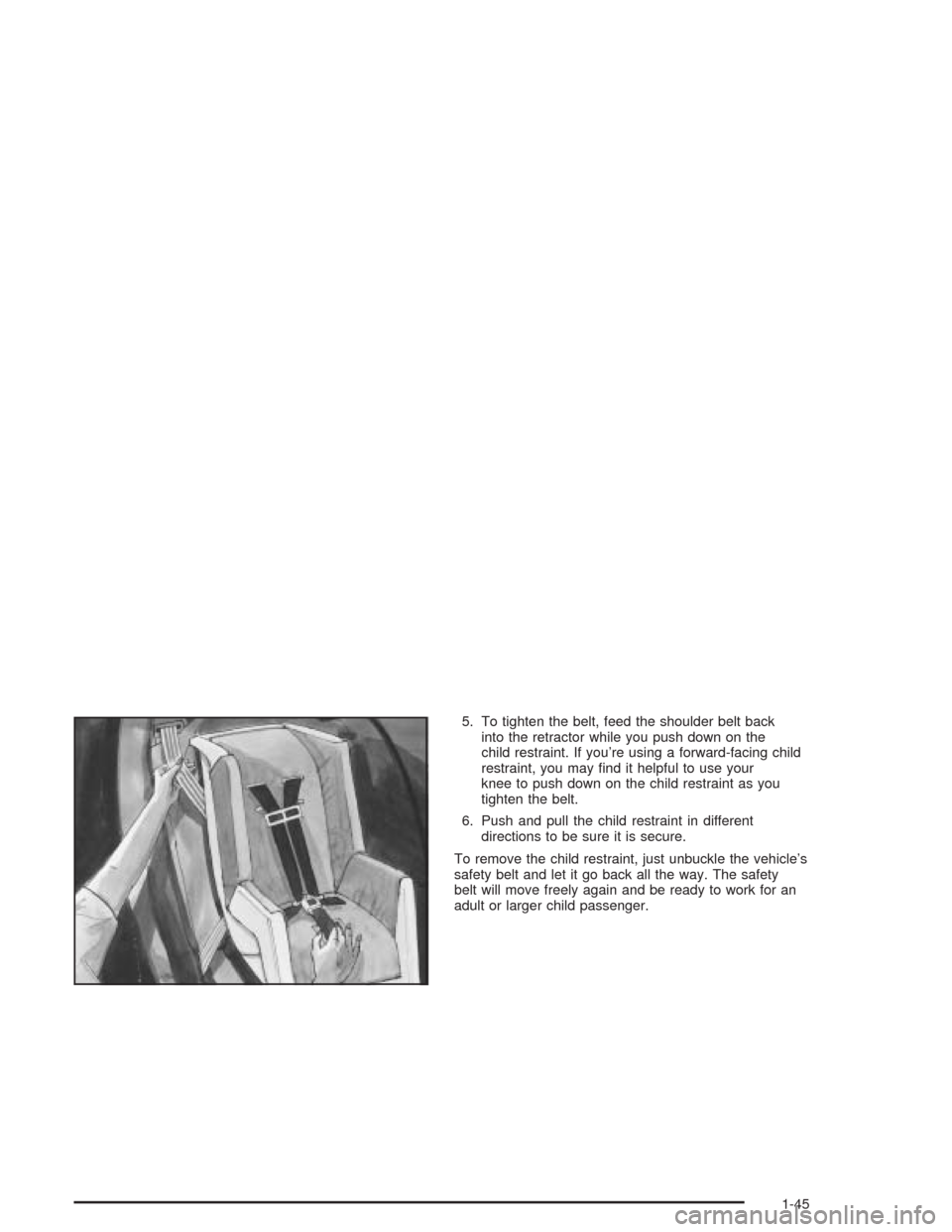
5. To tighten the belt, feed the shoulder belt back
into the retractor while you push down on the
child restraint. If you’re using a forward-facing child
restraint, you may find it helpful to use your
knee to push down on the child restraint as you
tighten the belt.
6. Push and pull the child restraint in different
directions to be sure it is secure.
To remove the child restraint, just unbuckle the vehicle’s
safety belt and let it go back all the way. The safety
belt will move freely again and be ready to work for an
adult or larger child passenger.
1-45
Page 52 of 338
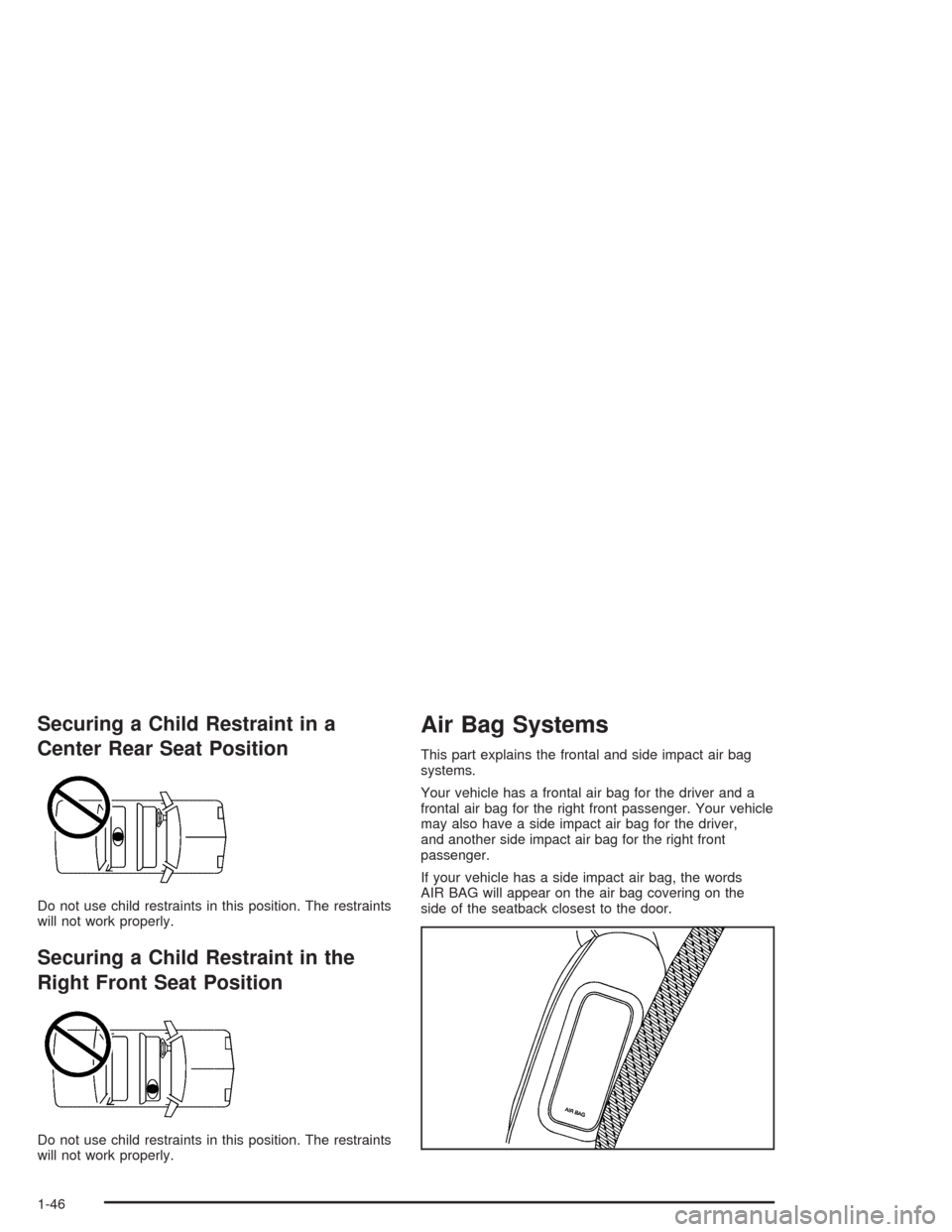
Securing a Child Restraint in a
Center Rear Seat Position
Do not use child restraints in this position. The restraints
will not work properly.
Securing a Child Restraint in the
Right Front Seat Position
Do not use child restraints in this position. The restraints
will not work properly.
Air Bag Systems
This part explains the frontal and side impact air bag
systems.
Your vehicle has a frontal air bag for the driver and a
frontal air bag for the right front passenger. Your vehicle
may also have a side impact air bag for the driver,
and another side impact air bag for the right front
passenger.
If your vehicle has a side impact air bag, the words
AIR BAG will appear on the air bag covering on the
side of the seatback closest to the door.
1-46
Page 54 of 338
{CAUTION:
Both frontal and side impact air bags inate
with great force, faster than the blink of an
eye. If you’re too close to an inating air bag,
as you would be if you were leaning forward,
it could seriously injure you. Safety belts
help keep you in position for air bag ination
before and during a crash. Always wear
your safety belt, even with frontal air bags.
The driver should sit as far back as possible
while still maintaining control of the vehicle.
Front occupants should not lean on or sleep
against the door.
{CAUTION:
Anyone who is up against, or very close to, any
air bag when it inates can be seriously injured
or killed. Air bags plus lap-shoulder belts offer
CAUTION: (Continued)
CAUTION: (Continued)
the best protection for adults, but not for young
children and infants. Neither the vehicle’s safety
belt system nor its air bag system is designed
for them. Young children and infants need the
protection that a child restraint system can
provide. Always secure children properly in
your vehicle. To read how, see the part of this
manual called “Older Children” or “Infants and
Young Children.”
There is an air bag
readiness light on the
instrument panel, which
shows AIR BAG.
The system checks the air bag electrical system for
malfunctions. The light tells you if there is an electrical
problem. SeeAir Bag Readiness Light on page 3-33.
1-48
Page 63 of 338
Keys...............................................................2-2
Remote Keyless Entry System.........................2-4
Remote Keyless Entry System Operation...........2-5
Doors and Locks.............................................2-7
Door Locks....................................................2-7
Central Door Unlocking System........................2-8
Power Door Locks..........................................2-9
Door Ajar Reminder........................................2-9
Rear Door Security Locks..............................2-10
Lockout Protection........................................2-10
Leaving Your Vehicle....................................2-11
Trunk..........................................................2-11
Windows........................................................2-13
Power Windows............................................2-14
Sun Visors...................................................2-14
Theft-Deterrent Systems..................................2-15
Theft-Deterrent System..................................2-15
Immobilizer..................................................2-17
Immobilizer Operation....................................2-17
Starting and Operating Your Vehicle................2-18
New Vehicle Break-In....................................2-18
Ignition Positions..........................................2-19
Starting Your Engine.....................................2-20Engine Coolant Heater..................................2-21
Automatic Transaxle Operation.......................2-22
Parking Brake..............................................2-26
Shifting Into Park (P).....................................2-27
Shifting Out of Park (P).................................2-28
Parking Over Things That Burn.......................2-29
Engine Exhaust............................................2-29
Running Your Engine While
You Are Parked........................................2-30
Mirrors...........................................................2-31
Manual Rearview Mirror.................................2-31
Automatic Dimming Rearview Mirror................2-31
Outside Power Mirrors...................................2-32
Outside Convex Mirror...................................2-33
Outside Heated Mirrors..................................2-33
Storage Areas................................................2-33
Glove Box...................................................2-33
Cupholder(s)................................................2-33
Coinholder(s)................................................2-33
Sunglasses Storage Compartment...................2-34
Center Console Storage Area.........................2-34
Rear Seat Armrest........................................2-34
Sunroof.........................................................2-35
Section 2 Features and Controls
2-1