2004 CHEVROLET CAVALIER maintenance
[x] Cancel search: maintenancePage 311 of 354
Long Trip/Highway Scheduled
Maintenance
The services shown in this schedule up to 100,000 miles
(166 000 km) should be repeated after 100,000 miles
(166 000 km) at the same intervals for the life of
this vehicle. The services shown at 150,000 miles
(240 000 km) should be repeated at the same interval
after 150,000 miles (240 000 km) for the life of this
vehicle.
SeePart B: Owner Checks and Services on page 6-18
andPart C: Periodic Maintenance Inspections on
page 6-23.
Footnotes
†The U.S. Environmental Protection Agency or the
California Air Resources Board has determined that the
failure to perform this maintenance item will not nullify
the emission warranty or limit recall liability prior to
the completion of the vehicle’s useful life. We, however,
urge that all recommended maintenance services be
performed at the indicated intervals and the
maintenance be recorded.
#Lubricate the suspension, steering linkage and the
transaxle shift linkage.
+A good time to check your brakes is during tire
rotation. See Brake System Inspection on page 6-24.++If you drive in a highly corrosive environment, your
brake calipers may require additional inspection and
service at every other tire rotation. See Caliper/Knuckle
Maintenance Inspection on page 6-24.
7,500 Miles (12 500 km)
❑Change engine oil and lter (or every 12 months,
whichever occurs rst).An Emission Control
Service.
❑Lubricate chassis components (or every 12 months,
whichever occurs rst).(See footnote #.)
❑Rotate tires. SeeTire Inspection and Rotation on
page 5-54for proper rotation pattern and additional
information.(See footnote +.)
15,000 Miles (25 000 km)
❑Change engine oil and lter (or every 12 months,
whichever occurs rst).An Emission Control
Service.
❑Lubricate chassis components (or every 12 months,
whichever occurs rst).(See footnote #.)
❑Inspect engine air cleaner lter. SeeEngine Air
Cleaner/Filter on page 5-17for more information.An
Emission Control Service. (See footnote †.)
❑Rotate tires. SeeTire Inspection and Rotation on
page 5-54for proper rotation pattern and additional
information.(See footnote +.) (Also see footnote ++.)
6-13
Page 317 of 354
Also look for any opened or broken air bag coverings,
and have them repaired or replaced. (The air bag
system does not need regular maintenance.)
Wiper Blade Check
Inspect wiper blades for wear or cracking. Replace
blade inserts that appear worn or damaged or that
streak or miss areas of the windshield. Also see
Cleaning the Outside of Your Vehicle on page 5-75.
Weatherstrip Lubrication
Silicone grease on weatherstrips will make them last
longer, seal better, and not stick or squeak. Apply
silicone grease with a clean cloth. During very cold,
damp weather more frequent application may be
required. SeePart D: Recommended Fluids and
Lubricants on page 6-25.
Manual Transaxle Check
It is not necessary to check the transaxle uid level.
Check for leaks. A uid leak is the only reason for uid
loss. Have the system inspected and repaired if
needed.
Automatic Transaxle Inspection
It is not necessary to check the transaxle uid level. A
transaxle uid leak is the only reason for uid loss.
Check for leaks. If a leak occurs, take the vehicle to your
dealer and have it repaired as soon as possible.
Hydraulic Clutch System Check
Check the uid level in the clutch reservoir. See
Hydraulic Clutch on page 5-19. A uid loss in this
system could indicate a problem. Have the system
inspected and repaired at once.
At Least Once a Year
Key Lock Cylinders Service
Lubricate the key lock cylinders with the lubricant
specied in Part D.
Body Lubrication Service
Lubricate all hood latch assemblies, secondary latch,
pivots, spring anchor, release pawl, hood and body door
hinges, rear compartment and any folding seat
hardware. Part D tells you what to use. More frequent
lubrication may be required when exposed to a corrosive
environment.
6-19
Page 321 of 354
Part C: Periodic Maintenance
Inspections
Listed in this part are inspections and services which
should be performed at least twice a year (for instance,
each spring and fall).You should let your dealer’s
service department do these jobs. Make sure any
necessary repairs are completed at once.
Proper procedures to perform these services may be
found in a service manual. SeeService Publications
Ordering Information on page 7-11.
Steering, Suspension and Front
Drive Axle Boot and Seal Inspection
Inspect the front and rear suspension and steering
system for damaged, loose or missing parts, signs of
wear or lack of lubrication. Inspect the power steering
lines and hoses for proper hook-up, binding, leaks,
cracks, chang, etc. Clean and then inspect the drive
axle boot seals for damage, tears or leakage. Replace
seals if necessary.
Exhaust System Inspection
Inspect the complete exhaust system. Inspect the body
near the exhaust system. Look for broken, damaged,
missing or out-of-position parts as well as open seams,
holes, loose connections or other conditions which
could cause a heat build-up in the oor pan or could let
exhaust fumes into the vehicle. SeeEngine Exhaust
on page 2-28.
Fuel System Inspection
Inspect the complete fuel system for damage or leaks.
Engine Cooling System Inspection
Inspect the hoses and have them replaced if they
are cracked, swollen or deteriorated. Inspect all pipes,
ttings and clamps; replace as needed. Clean the
outside of the radiator and air conditioning condenser.
To help ensure proper operation, a pressure test of
the cooling system and pressure cap is recommended
at least once a year.
Throttle System Inspection
Inspect the throttle system for interference or binding,
and for damaged or missing parts. Replace parts
as needed. Replace any components that have high
effort or excessive wear. Do not lubricate accelerator
and cruise control cables.
6-23
Page 322 of 354
Brake System Inspection
Inspect the complete system. Inspect brake lines and
hoses for proper hook-up, binding, leaks, cracks,
chang, etc. Inspect disc brake pads for wear and rotors
for surface condition. Also inspect drum brake linings
for wear and cracks. Inspect other brake parts, including
drums, wheel cylinders, calipers, parking brake, etc.
Check parking brake adjustment. You may need to have
your brakes inspected more often if your driving
habits or conditions result in frequent braking.
Caliper/Knuckle Maintenance
Inspection
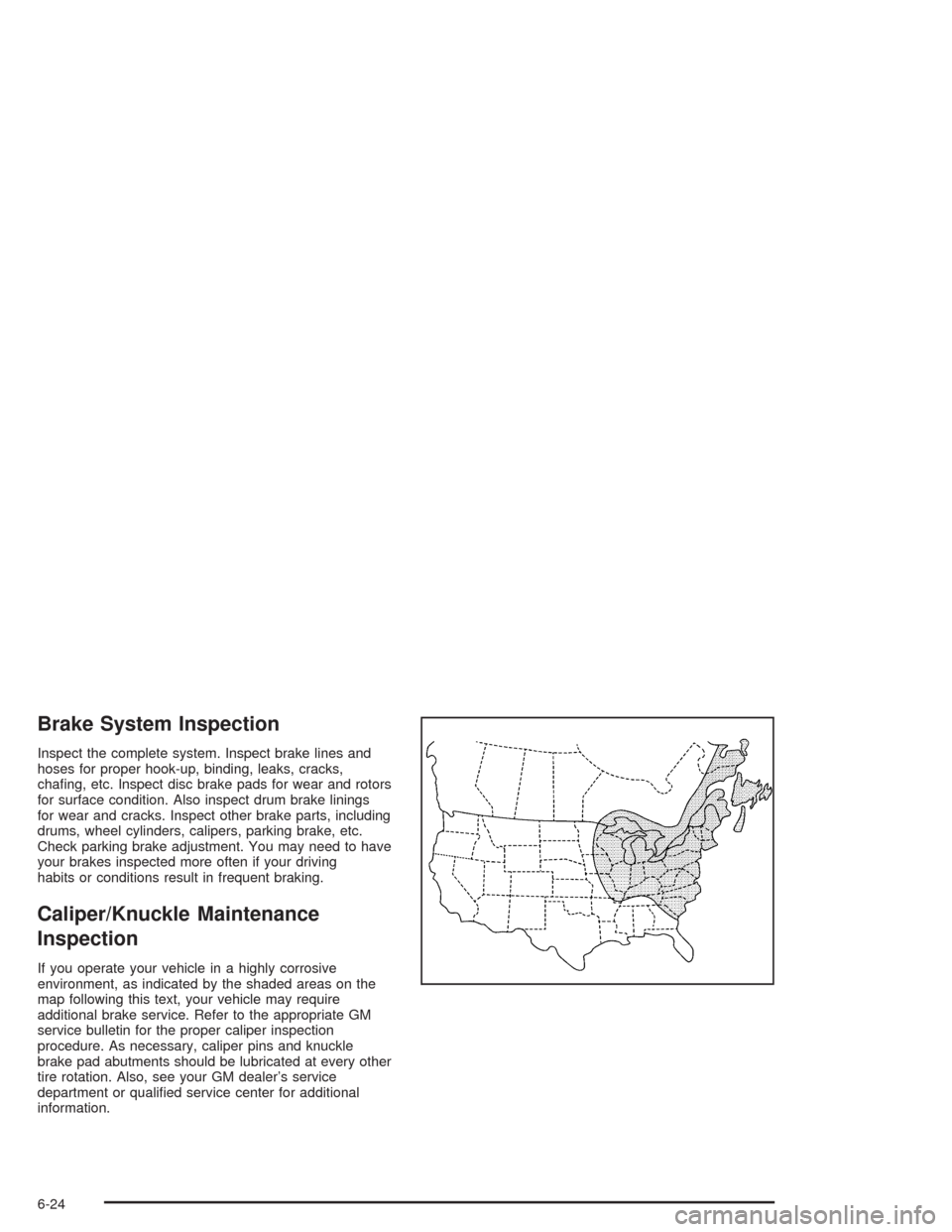
If you operate your vehicle in a highly corrosive
environment, as indicated by the shaded areas on the
map following this text, your vehicle may require
additional brake service. Refer to the appropriate GM
service bulletin for the proper caliper inspection
procedure. As necessary, caliper pins and knuckle
brake pad abutments should be lubricated at every other
tire rotation. Also, see your GM dealer’s service
department or qualied service center for additional
information.
6-24
Page 325 of 354
Part E: Maintenance Record
After the scheduled services are performed, record the date, odometer reading and who performed the service and
any additional information from “Owner Checks and Services” or “Periodic Maintenance” on the following record
pages. Also, you should retain all maintenance receipts.
Maintenance Record
DateOdometer
ReadingServiced ByMaintenance Record
6-27
Page 326 of 354
Maintenance Record (cont’d)
DateOdometer
ReadingServiced ByMaintenance Record
6-28
Page 329 of 354
STEP THREE:Both General Motors and your dealer are
committed to making sure you are completely satised
with your new vehicle. However, if you continue to remain
unsatised after following the procedure outlined in Steps
One and Two, you should le with the BBB Auto Line
Program to enforce any additional rights you may have.
Canadian owners refer to your Warranty and Owner
Assistance Information booklet for information on the
Canadian Motor Vehicle Arbitration Plan (CAMVAP).
The BBB Auto Line Program is an out of court program
administered by the Council of Better Business Bureaus
to settle automotive disputes regarding vehicle repairs or
the interpretation of the New Vehicle Limited Warranty.
Although you may be required to resort to this informal
dispute resolution program prior to ling a court action,
use of the program is free of charge and your case will
generally be heard within 40 days. If you do not agree
with the decision given in your case, you may reject it and
proceed with any other venue for relief available to you.
You may contact the BBB Auto Line Program using the
toll-free telephone number or write them at the following
address:
BBB Auto Line Program
Council of Better Business Bureaus, Inc.
4200 Wilson Boulevard
Suite 800
Arlington, VA 22203-1804
Telephone: 1-800-955-5100This program is available in all 50 states and the District
of Columbia. Eligibility is limited by vehicle age,
mileage and other factors. General Motors reserves the
right to change eligibility limitations and/or discontinue
its participation in this program.
Online Owner Center
The Owner Center is a resource for your GM ownership
needs. You can nd your specic vehicle information
all in one place.
The Owner Center allows you to:
Get e-mail service reminders.
Access information about your specic vehicle,
including tips and videos and an electronic
version of this owner’s manual. (United States only)
Keep track of your vehicle’s service history and
maintenance schedule.
Find GM dealers for service nationwide.
Receive special promotions and privileges only
available to members. (United States only)
Refer to the web for updated information.
To register your vehicle, visit www.MyGMLink.com.
(United States) or My GM Canada within
www.gmcanada.com (Canada).
7-3
Page 338 of 354
Transmission, Transaxle, Transfer
Case Unit Repair Manual
This manual provides information on unit repair service
procedures, adjustments, and specications for GM
transmissions, transaxles, and transfer cases.
RETAIL SELL PRICE: $50.00
Service Bulletins
Service Bulletins give technical service information
needed to knowledgeably service General Motors cars
and trucks. Each bulletin contains instructions to
assist in the diagnosis and service of your vehicle.
In Canada, information pertaining to Product Service
Bulletins can be obtained by contacting your General
Motors dealer or by calling 1-800-GM-DRIVE
(1-800-463-7483).
Owner’s Information
Owner publications are written specically for owners
and intended to provide basic operational information
about the vehicle. The owner’s manual will include
the Maintenance Schedule for all models.
In-Portfolio: Includes a Portfolio, Owner’s Manual, and
Warranty Booklet.
RETAIL SELL PRICE: $35.00
Without Portfolio: Owner’s Manual only.
RETAIL SELL PRICE: $25.00
Current and Past Model Order Forms
Service Publications are available for current and
past model GM vehicles. To request an order form,
please specify year and model name of the vehicle.
ORDER TOLL FREE: 1-800-551-4123
Monday-Friday 8:00 AM - 6:00 PM Eastern
Time
For Credit Card Orders Only
(VISA-MasterCard-Discover), visit Helm, Inc. on the
World Wide Web at: www.helminc.com
Or you can write to:
Helm, Incorporated
P. O. Box 07130
Detroit, MI 48207
Prices are subject to change without notice and without
incurring obligation. Allow ample time for delivery.
Note to Canadian Customers: All listed prices are
quoted in U.S. funds. Canadian residents are to make
checks payable in U.S. funds.
7-12