2004 CHEVROLET BLAZER warning light
[x] Cancel search: warning lightPage 239 of 446

City Driving
One of the biggest problems with city streets is the
amount of traffic on them. You will want to watch out for
what the other drivers are doing and pay attention to
traffic signals.Here are ways to increase your safety in city driving:
Know the best way to get to where you are
going. Get a city map and plan your trip into
an unknown part of the city just as you would for a
cross-country trip.
Try to use the freeways that rim and crisscross
most large cities. You will save time and energy.
SeeFreeway Driving on page 4-36.
Treat a green light as a warning signal. A traffic
light is there because the corner is busy enough
to need it. When a light turns green, and just before
you start to move, check both ways for vehicles
that have not cleared the intersection or may
be running the red light.
4-35
Page 244 of 446
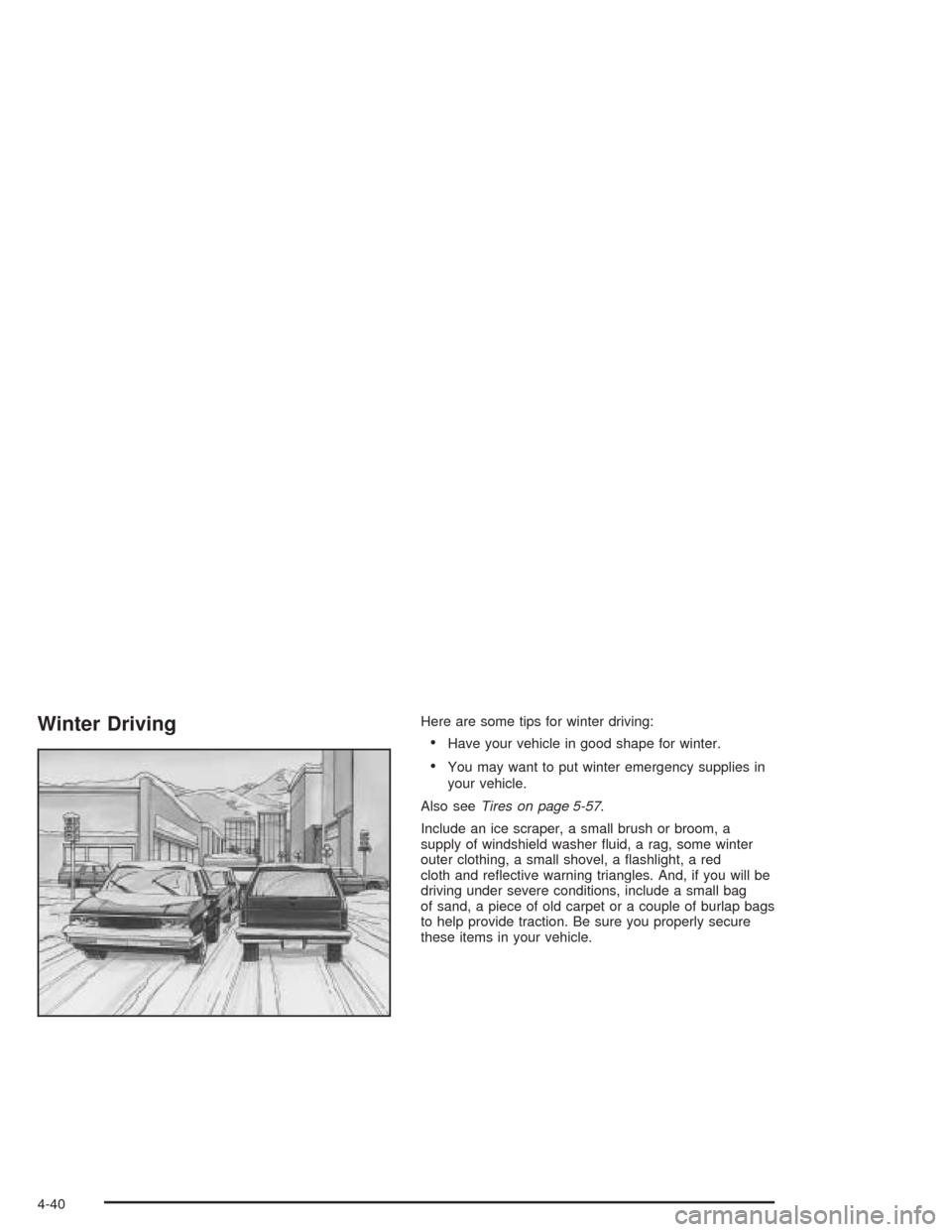
Winter DrivingHere are some tips for winter driving:
Have your vehicle in good shape for winter.
You may want to put winter emergency supplies in
your vehicle.
Also seeTires on page 5-57.
Include an ice scraper, a small brush or broom, a
supply of windshield washer uid, a rag, some winter
outer clothing, a small shovel, a ashlight, a red
cloth and reective warning triangles. And, if you will be
driving under severe conditions, include a small bag
of sand, a piece of old carpet or a couple of burlap bags
to help provide traction. Be sure you properly secure
these items in your vehicle.
4-40
Page 273 of 446
Driving On Grades
Reduce speed and shift to a lower gearbeforeyou start
down a long or steep downgrade. If you don’t shift
down, you might have to use your brakes so much that
they would get hot and no longer work well.
If you have an automatic transmission, you can tow in
DRIVE (D). You may want to shift the transmission
to THIRD (3) or, if necessary, a lower gear selection if
the transmission shifts too often (e.g., under heavy loads
and/or hilly conditions). Or, if you have a manual
transmission and you are towing a trailer, it’s better not
to use FIFTH (5) gear. Just drive in FOURTH (4)
gear (or, as you need to, a lower gear). SeeTow/Haul
Mode Light on page 3-35.
When towing at high altitude on steep uphill grades,
consider the following: Engine coolant will boil at a lower
temperature than at normal altitudes. If you turn your
engine off immediately after towing at high altitude
on steep uphill grades, your vehicle may show signs
similar to engine overheating. To avoid this, let the
engine run while parked (preferably on level ground)
with the automatic transmission in PARK (P) (or
the manual transmission out of gear and the parking
brake applied) for a few minutes before turning the
engine off. If you do get the overheat warning,
seeEngine Overheating on page 5-27.
Parking on Hills
{CAUTION:
You really should not park your vehicle, with a
trailer attached, on a hill. If something goes
wrong, your rig could start to move. People
can be injured, and both your vehicle and the
trailer can be damaged.
But if you ever have to park your rig on a hill, here’s
how to do it:
1. Apply your regular brakes, but don’t shift into
PARK (P) yet, or into gear for a manual
transmission. Then turn your wheels into the curb if
facing downhill or into traffic if facing uphill.
2. Have someone place chocks under the trailer
wheels.
3. When the wheel chocks are in place, release the
regular brakes until the chocks absorb the load.
4-69
Page 300 of 446
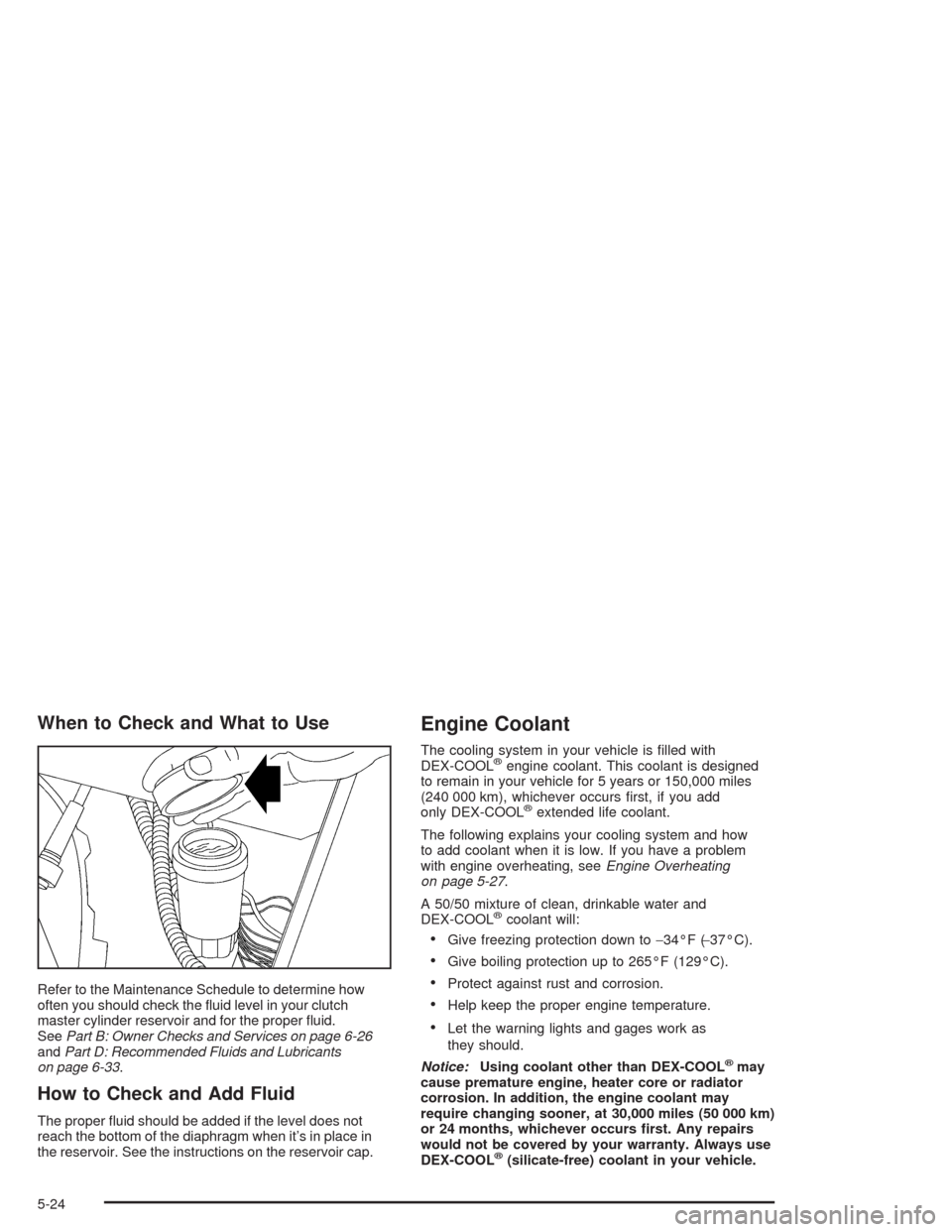
When to Check and What to Use
Refer to the Maintenance Schedule to determine how
often you should check the uid level in your clutch
master cylinder reservoir and for the proper uid.
SeePart B: Owner Checks and Services on page 6-26
andPart D: Recommended Fluids and Lubricants
on page 6-33.
How to Check and Add Fluid
The proper uid should be added if the level does not
reach the bottom of the diaphragm when it’s in place in
the reservoir. See the instructions on the reservoir cap.
Engine Coolant
The cooling system in your vehicle is lled with
DEX-COOL®engine coolant. This coolant is designed
to remain in your vehicle for 5 years or 150,000 miles
(240 000 km), whichever occurs rst, if you add
only DEX-COOL
®extended life coolant.
The following explains your cooling system and how
to add coolant when it is low. If you have a problem
with engine overheating, seeEngine Overheating
on page 5-27.
A 50/50 mixture of clean, drinkable water and
DEX-COOL
®coolant will:
Give freezing protection down to−34°F (−37°C).
Give boiling protection up to 265°F (129°C).
Protect against rust and corrosion.
Help keep the proper engine temperature.
Let the warning lights and gages work as
they should.
Notice:Using coolant other than DEX-COOL
®may
cause premature engine, heater core or radiator
corrosion. In addition, the engine coolant may
require changing sooner, at 30,000 miles (50 000 km)
or 24 months, whichever occurs rst. Any repairs
would not be covered by your warranty. Always use
DEX-COOL
®(silicate-free) coolant in your vehicle.
5-24
Page 317 of 446

Brake Wear
If you have four-wheel drive, your vehicle has four-wheel
disc brakes. If not, your vehicle has front disc brakes
and rear drum brakes.
Disc brake pads have built-in wear indicators that make a
high-pitched warning sound when the brake pads are
worn and new pads are needed. The sound may come
and go or be heard all the time your vehicle is moving
(except when you are pushing on the brake pedal rmly).
{CAUTION:
The brake wear warning sound means that soon
your brakes will not work well. That could lead
to an accident. When you hear the brake wear
warning sound, have your vehicle serviced.
Notice:Continuing to drive with worn-out brake
pads could result in costly brake repair.
Some driving conditions or climates may cause a brake
squeal when the brakes are rst applied or lightly applied.
This does not mean something is wrong with your brakes.
Properly torqued wheel nuts are necessary to help
prevent brake pulsation. When tires are rotated, inspect
brake pads for wear and evenly tighten wheel nuts in
the proper sequence to GM torque specications.If you have rear drum brakes, they do not have wear
indicators, but if you ever hear a rear brake rubbing
noise, have the rear brake linings inspected immediately.
Also, the rear brake drums should be removed and
inspected each time the tires are removed for rotation
or changing. When you have the front brake pads
replaced, have the rear brakes inspected, too.
Brake linings should always be replaced as complete
axle sets.
SeeBrake System Inspection on page 6-32.
Brake Pedal Travel
See your dealer if the brake pedal does not return to
normal height, or if there is a rapid increase in
pedal travel. This could be a sign of brake trouble.
Brake Adjustment
Every time you make a brake stop, your disc brakes
adjust for wear.
If you do not have four-wheel drive and your brake
pedal goes down farther than normal, your rear drum
brakes may need adjustment. Adjust them by backing
up and rmly applying the brakes a few times.
5-41
Page 431 of 446
A
About Driving Your Vehicle................................. 0-2
Adding Equipment to Your Air Bag-Equipped
Vehicle.......................................................1-58
Adding Washer Fluid.......................................5-38
Additional Program Information........................... 7-9
Additives, Fuel................................................. 5-6
Add-On Electrical Equipment............................5-98
Add-On Equipment..........................................4-60
Adjusting the Speakers
(Balance/Fade)....................3-40, 3-43, 3-52, 3-63
After Off-Road Driving.....................................4-30
Air Bag
Readiness Light..........................................3-25
Air Bag System..............................................1-52
Adding Equipment to Your Air
Bag-Equipped Vehicle...............................1-58
How Does an Air Bag Restrain?....................1-56
Servicing Your Air Bag-Equipped Vehicle.........1-58
What Makes an Air Bag Inate?....................1-56
What Will You See After an Air Bag Inates?.....1-56
When Should an Air Bag Inate?...................1-55
Where Are the Air Bags?..............................1-54
Air Cleaner/Filter, Engine.................................5-17
Airbag Sensing and Diagnostic Module (SDM)...... 7-9
AM ...............................................................3-72
AM-FM Radio.................................................3-38
Antenna, Fixed Mast.......................................3-74
Anti-lock Brake System..................................... 4-8Anti-Lock Brake, System Warning Light..............3-29
Appearance Care............................................5-89
Care of Safety Belts....................................5-92
Chemical Paint Spotting...............................5-95
Cleaning the Inside of Your Vehicle................5-90
Cleaning the Outside of Your Vehicle..............5-92
Finish Damage............................................5-95
Sheet Metal Damage...................................5-95
Underbody Maintenance...............................5-95
Vehicle Care/Appearance Materials................5-96
Weatherstrips..............................................5-92
Approaching a Hill..........................................4-20
Ashtrays........................................................3-17
Assist Handles...............................................2-57
Audio System(s).............................................3-37
AM-FM Radio.............................................3-38
Care of Your Cassette Tape Player................3-72
Care of Your CD Player...............................3-74
Care of Your CDs........................................3-74
Fixed Mast Antenna.....................................3-74
Radio with Cassette and CD.........................3-49
Radio with CD............................................3-41
Radio with Six-Disc CD................................3-60
Setting the Time for Radios with Radio
Data Systems (RDS)................................3-38
Setting the Time for Radios without
Radio Data Systems (RDS).......................3-37
Theft-Deterrent Feature................................3-72
Understanding Radio Reception.....................3-72
Automatic Headlamp System............................3-13
1
Page 432 of 446
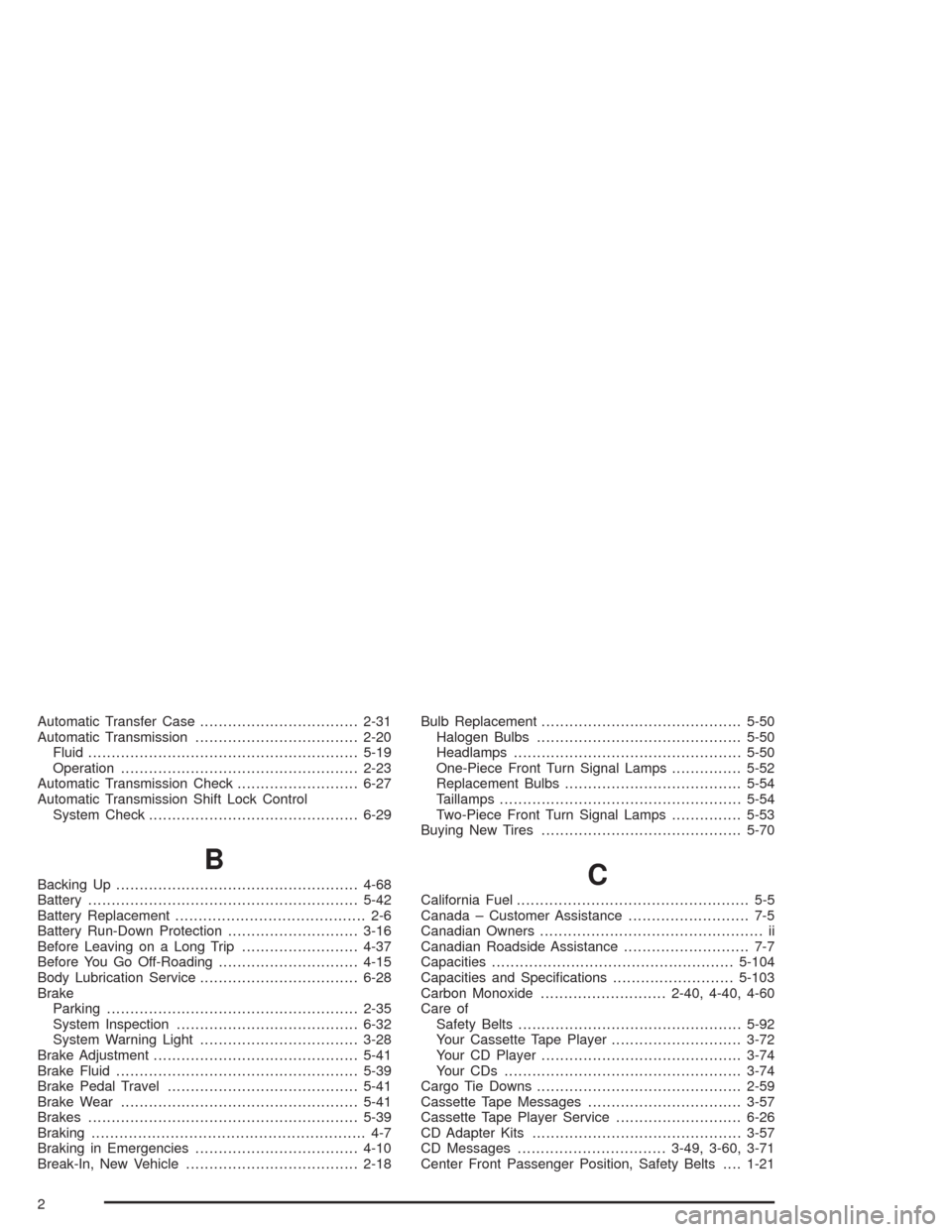
Automatic Transfer Case..................................2-31
Automatic Transmission...................................2-20
Fluid..........................................................5-19
Operation...................................................2-23
Automatic Transmission Check..........................6-27
Automatic Transmission Shift Lock Control
System Check.............................................6-29
B
Backing Up....................................................4-68
Battery..........................................................5-42
Battery Replacement......................................... 2-6
Battery Run-Down Protection............................3-16
Before Leaving on a Long Trip.........................4-37
Before You Go Off-Roading..............................4-15
Body Lubrication Service..................................6-28
Brake
Parking......................................................2-35
System Inspection.......................................6-32
System Warning Light..................................3-28
Brake Adjustment............................................5-41
Brake Fluid....................................................5-39
Brake Pedal Travel.........................................5-41
Brake Wear...................................................5-41
Brakes..........................................................5-39
Braking........................................................... 4-7
Braking in Emergencies...................................4-10
Break-In, New Vehicle.....................................2-18Bulb Replacement...........................................5-50
Halogen Bulbs............................................5-50
Headlamps.................................................5-50
One-Piece Front Turn Signal Lamps...............5-52
Replacement Bulbs......................................5-54
Taillamps....................................................5-54
Two-Piece Front Turn Signal Lamps...............5-53
Buying New Tires...........................................5-70C
California Fuel.................................................. 5-5
Canada – Customer Assistance.......................... 7-5
Canadian Owners................................................ ii
Canadian Roadside Assistance........................... 7-7
Capacities....................................................5-104
Capacities and Specications..........................5-103
Carbon Monoxide...........................2-40, 4-40, 4-60
Care of
Safety Belts................................................5-92
Your Cassette Tape Player............................3-72
Your CD Player...........................................3-74
Your CDs ...................................................3-74
Cargo Tie Downs............................................2-59
Cassette Tape Messages.................................3-57
Cassette Tape Player Service...........................6-26
CD Adapter Kits.............................................3-57
CD Messages................................3-49, 3-60, 3-71
Center Front Passenger Position, Safety Belts....1-21
2
Page 433 of 446
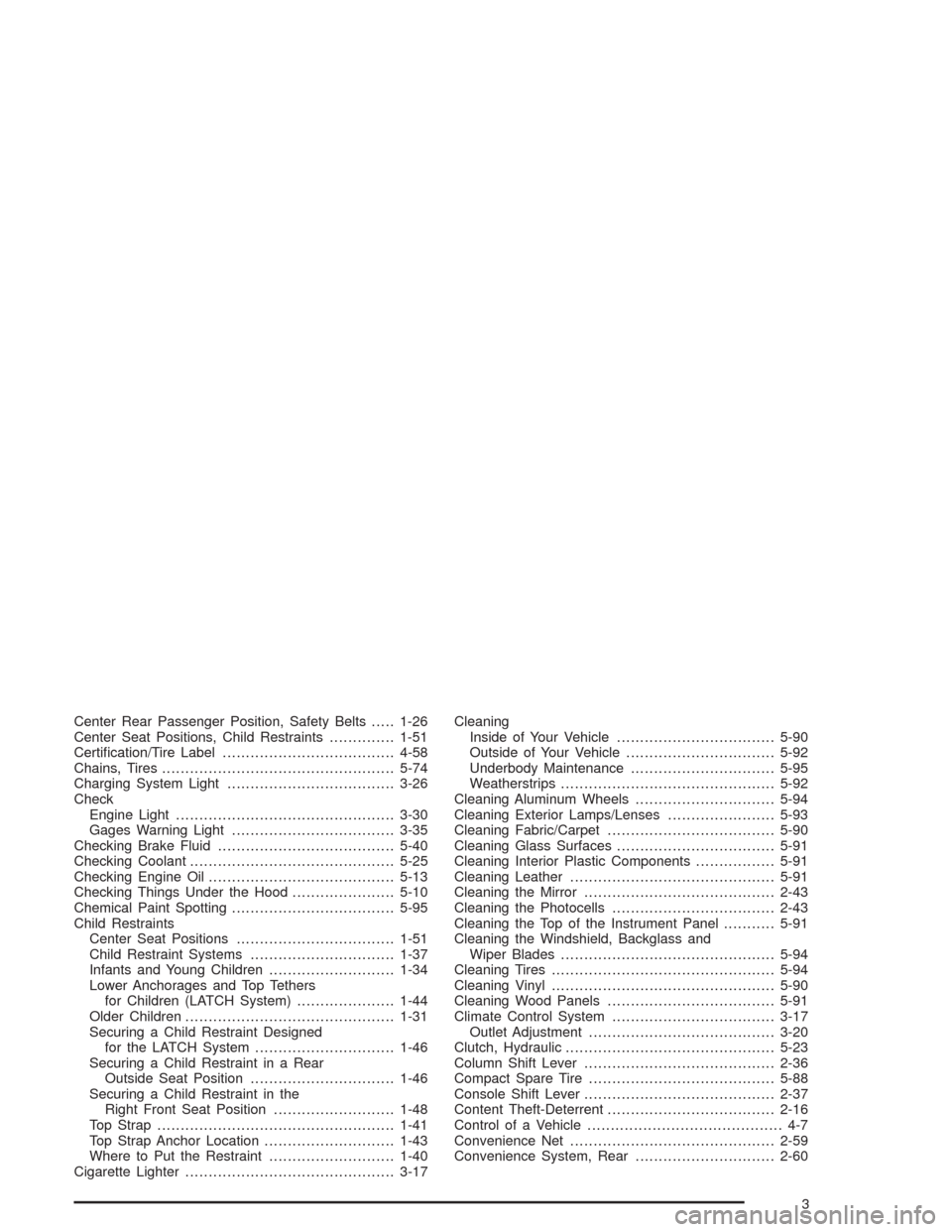
Center Rear Passenger Position, Safety Belts.....1-26
Center Seat Positions, Child Restraints..............1-51
Certication/Tire Label.....................................4-58
Chains, Tires..................................................5-74
Charging System Light....................................3-26
Check
Engine Light...............................................3-30
Gages Warning Light...................................3-35
Checking Brake Fluid......................................5-40
Checking Coolant............................................5-25
Checking Engine Oil........................................5-13
Checking Things Under the Hood......................5-10
Chemical Paint Spotting...................................5-95
Child Restraints
Center Seat Positions..................................1-51
Child Restraint Systems...............................1-37
Infants and Young Children...........................1-34
Lower Anchorages and Top Tethers
for Children (LATCH System).....................1-44
Older Children.............................................1-31
Securing a Child Restraint Designed
for the LATCH System..............................1-46
Securing a Child Restraint in a Rear
Outside Seat Position...............................1-46
Securing a Child Restraint in the
Right Front Seat Position..........................1-48
Top Strap...................................................1-41
Top Strap Anchor Location............................1-43
Where to Put the Restraint...........................1-40
Cigarette Lighter.............................................3-17Cleaning
Inside of Your Vehicle..................................5-90
Outside of Your Vehicle................................5-92
Underbody Maintenance...............................5-95
Weatherstrips..............................................5-92
Cleaning Aluminum Wheels..............................5-94
Cleaning Exterior Lamps/Lenses.......................5-93
Cleaning Fabric/Carpet....................................5-90
Cleaning Glass Surfaces..................................5-91
Cleaning Interior Plastic Components.................5-91
Cleaning Leather............................................5-91
Cleaning the Mirror.........................................2-43
Cleaning the Photocells...................................2-43
Cleaning the Top of the Instrument Panel...........5-91
Cleaning the Windshield, Backglass and
Wiper Blades..............................................5-94
Cleaning Tires................................................5-94
Cleaning Vinyl................................................5-90
Cleaning Wood Panels....................................5-91
Climate Control System...................................3-17
Outlet Adjustment........................................3-20
Clutch, Hydraulic.............................................5-23
Column Shift Lever.........................................2-36
Compact Spare Tire........................................5-88
Console Shift Lever.........................................2-37
Content Theft-Deterrent....................................2-16
Control of a Vehicle.......................................... 4-7
Convenience Net............................................2-59
Convenience System, Rear..............................2-60
3