Page 347 of 446
{CAUTION:
Mixing tires could cause you to lose control
while driving. If you mix tires of different sizes
or types (radial and bias-belted tires), the
vehicle may not handle properly, and you
could have a crash. Using tires of different
sizes may also cause damage to your vehicle.
Be sure to use the same size and type tires on
all wheels. It’s all right to drive with your
compact spare (if you have one). It was
developed for use on your vehicle.
{CAUTION:
If you use bias-ply tires on your vehicle, the
wheel rim anges could develop cracks after
many miles of driving. A tire and/or wheel
could fail suddenly, causing a crash. Use only
radial-ply tires with the wheels on your vehicle.
Uniform Tire Quality Grading
Quality grades can be found where applicable on the
tire sidewall between tread shoulder and maximum
section width. For example:
Treadwear 200 Traction AA Temperature A
The following information relates to the system
developed by the United States National Highway
Traffic Safety Administration, which grades tires by
treadwear, traction and temperature performance.
(This applies only to vehicles sold in the United States.)
The grades are molded on the sidewalls of most
passenger car tires. The Uniform Tire Quality Grading
system does not apply to deep tread, winter-type
snow tires, space-saver or temporary use spare tires,
tires with nominal rim diameters of 10 to 12 inches
(25 to 30 cm), or to some limited-production tires.
While the tires available on General Motors passenger
cars and light trucks may vary with respect to these
grades, they must also conform to federal safety
requirements and additional General Motors Tire
Performance Criteria (TPC) standards.
5-71
Page 353 of 446

Removing the Spare Tire and Tools
The jacking equipment you’ll need is stored along the
driver’s side inner rear quarter panel. In some cases, you
may have to remove the spare tire in order to reach the
jack. Your vehicle is also equipped with work gloves and
a plastic ground mat to assist in the changing of a at tire.
The following instructions explain how to remove the
spare tire, depending on where it is mounted on
your vehicle. SeeCompact Spare Tire on page 5-88
orSpare Tire on page 5-89.
1. To remove your jack cover, pull up on the latch(es)
on the cover (C). Remove the wheel blocks (D),
jack (G) and wheel wrench (F).Notice:If you remove or restow a tire from/to
the storage position under the vehicle when it is
supported by a jack, you could damage the tire
and/or your vehicle. Always remove or restow a
tire when the vehicle is on the ground.
2. To remove the
underbody-mounted
spare, insert the chisel
end of the wheel
wrench, on an angle,
into the hoist shaft hole
in the rear bumper.
Be sure the chisel end
of the wheel wrench
connects into the
hoist shaft.
3. Turn the wheel wrench counterclockwise to lower
the spare tire. Keep turning the wheel wrench until
the spare tire has been completely lowered. Tilt
the retainer at the end of the cable and pull it
through the wheel opening. Pull the tire out from
under the vehicle.
5-77
Page 354 of 446
Notice:If you drive away before the spare tire or
secondary latch system cable has been reinstalled,
you could damage your vehicle. Always reinstall
this cable before driving your vehicle.
If you have an inside-mounted spare tire, the tire must
be removed in order to have access to the jack
storage.
To remove an inside-mounted spare tire, reach into your
tire’s cover and unscrew the wing nut at the center of
the wheel. Remove it and the retainer. Unhook the
tire from the mounting bracket and remove the cover.
To remove a rear-mounted spare tire, rst make
sure that the carrier arm is fully-latched to the tailgate.
Then remove the spare tire cover.If you have this feature,
the locking wheel nut can
be removed by snapping
the rubber weather
cover off the face of the
lock case.
Insert the key and pull the
lock case straight off. It is
not necessary to turn
the key.
Put the spare tire near the at tire.
5-78
Page 356 of 446
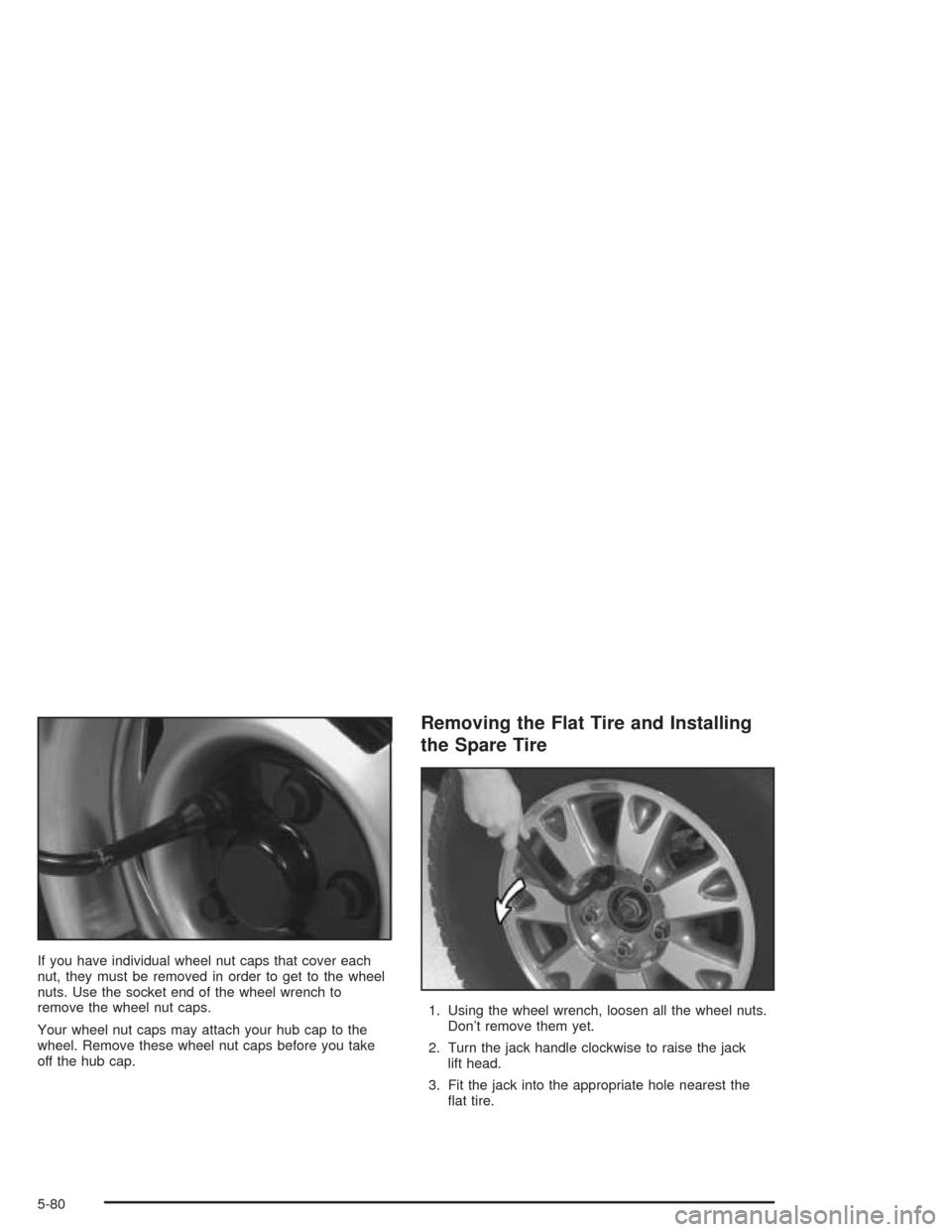
If you have individual wheel nut caps that cover each
nut, they must be removed in order to get to the wheel
nuts. Use the socket end of the wheel wrench to
remove the wheel nut caps.
Your wheel nut caps may attach your hub cap to the
wheel. Remove these wheel nut caps before you take
off the hub cap.
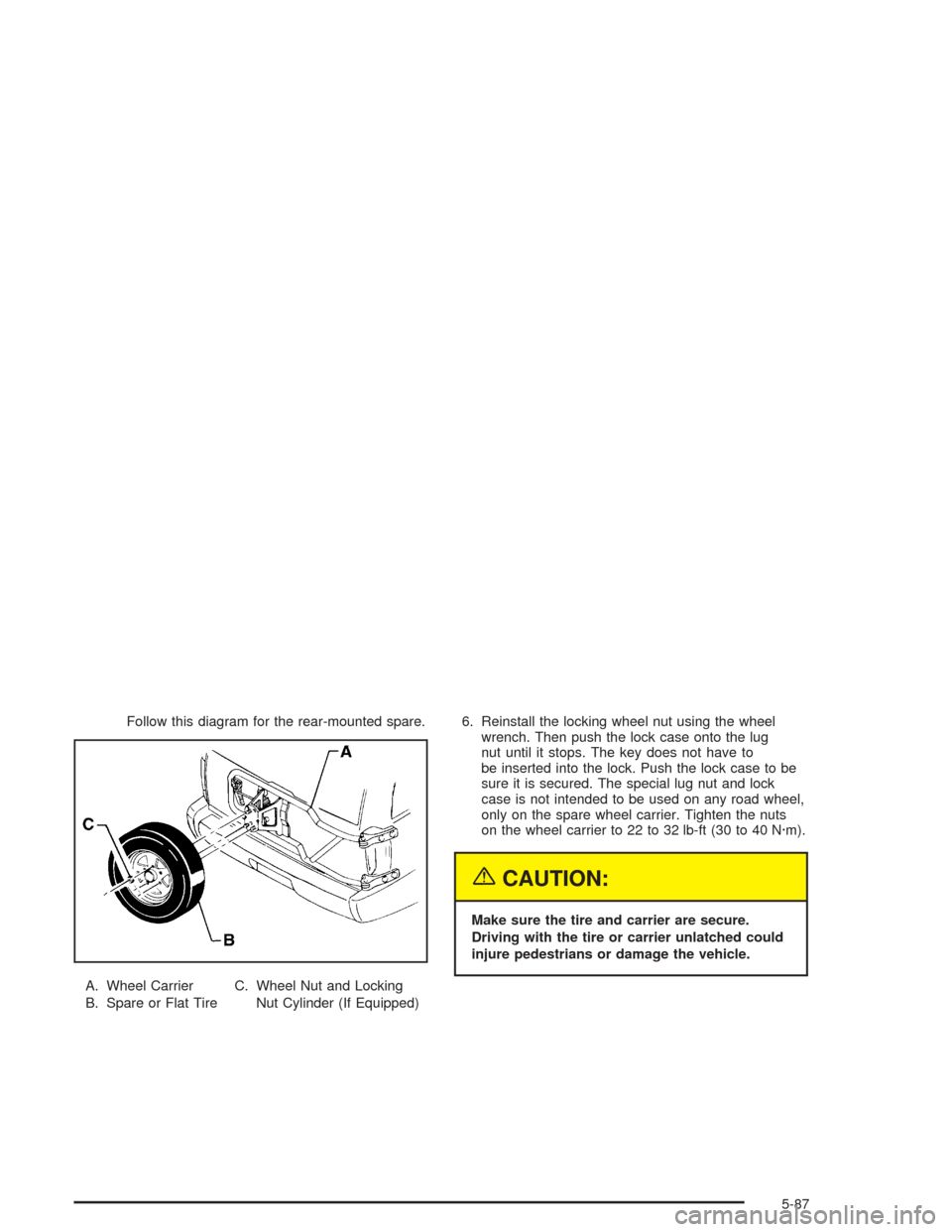
Removing the Flat Tire and Installing
the Spare Tire
1. Using the wheel wrench, loosen all the wheel nuts.
Don’t remove them yet.
2. Turn the jack handle clockwise to raise the jack
lift head.
3. Fit the jack into the appropriate hole nearest the
at tire.
5-80
Page 358 of 446
{CAUTION:
Raising your vehicle with the jack improperly
positioned can damage the vehicle and even
make the vehicle fall. To help avoid personal
injury and vehicle damage, be sure to t the
jack lift head into the proper location before
raising the vehicle.4. Raise the vehicle by turning the jack handle
clockwise. Raise the vehicle far enough off the
ground so there is enough room for the spare tire
to t underneath the wheel well.
5. Remove all the wheel nuts and take off the at tire.
6. Remove any rust or dirt
from the wheel bolts,
mounting surfaces
and spare wheel.
5-82
Page 361 of 446
Notice:Improperly tightened wheel nuts can lead
to brake pulsation and rotor damage. To avoid
expensive brake repairs, evenly tighten the wheel
nuts in the proper sequence and to the proper
torque specication.
Storing a Flat or Spare Tire and Tools
{CAUTION:
Storing a jack, a tire, or other equipment in the
passenger compartment of the vehicle could
cause injury. In a sudden stop or collision,
loose equipment could strike someone. Store
all these in the proper place.
Notice:An aluminum wheel with a at tire should
always be stored under the vehicle with the
hoist. However, storing it that way for an extended
period could damage the wheel. To avoid this,
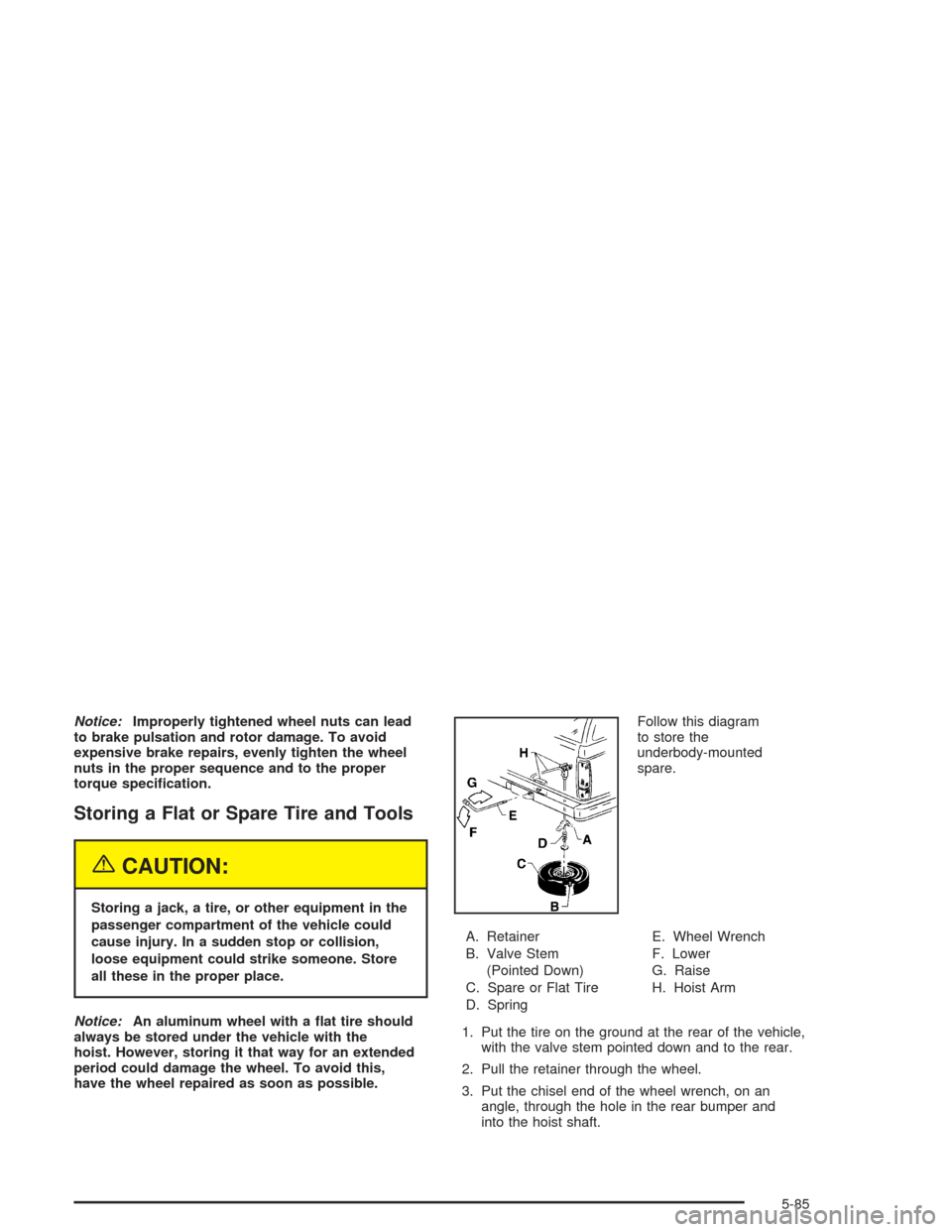
have the wheel repaired as soon as possible.Follow this diagram
to store the
underbody-mounted
spare.
A. Retainer
B. Valve Stem
(Pointed Down)
C. Spare or Flat Tire
D. SpringE. Wheel Wrench
F. Lower
G. Raise
H. Hoist Arm
1. Put the tire on the ground at the rear of the vehicle,
with the valve stem pointed down and to the rear.
2. Pull the retainer through the wheel.
3. Put the chisel end of the wheel wrench, on an
angle, through the hole in the rear bumper and
into the hoist shaft.
5-85
Page 362 of 446
4. Raise the tire fully against the underside of the
vehicle by turning the wrench clockwise until you
hear two clicks or feel it skip twice. The spare
tire hoist cannot be overtightened.
5. Make sure the tire is stored securely. Push, pull (A),
and then try to rotate or turn (B) the tire. If the tire
moves, use the wheel wrench to tighten the cable.Follow this diagram for the inside-mounted spare.
A. Spare or Flat Tire
B. Retainer
C. NutD. Wheel Carrier
E. Hook
5-86
Page 363 of 446
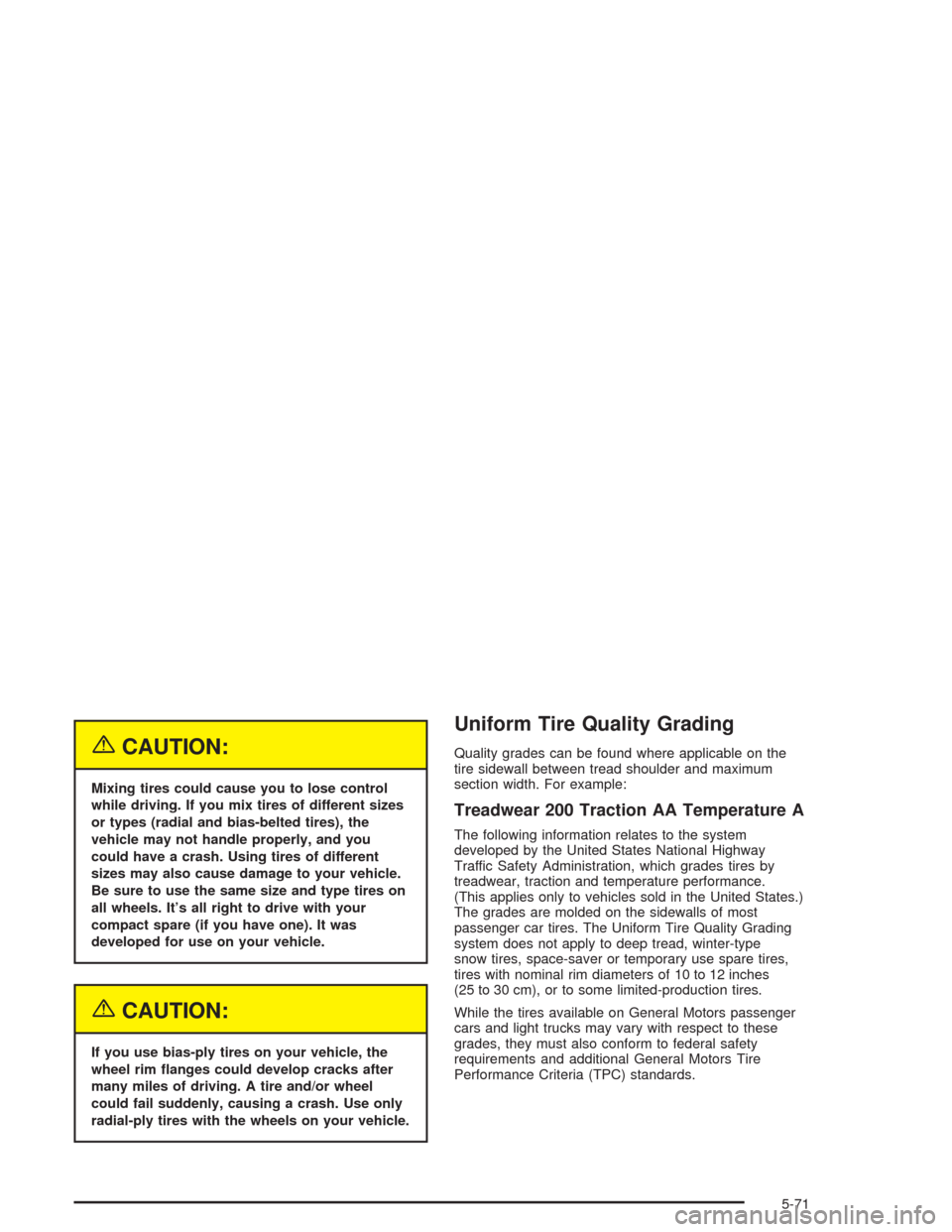
Follow this diagram for the rear-mounted spare.
A. Wheel Carrier
B. Spare or Flat TireC. Wheel Nut and Locking
Nut Cylinder (If Equipped)6. Reinstall the locking wheel nut using the wheel
wrench. Then push the lock case onto the lug
nut until it stops. The key does not have to
be inserted into the lock. Push the lock case to be
sure it is secured. The special lug nut and lock
case is not intended to be used on any road wheel,
only on the spare wheel carrier. Tighten the nuts
on the wheel carrier to 22 to 32 lb-ft (30 to 40 N·m).
{CAUTION:
Make sure the tire and carrier are secure.
Driving with the tire or carrier unlatched could
injure pedestrians or damage the vehicle.
5-87