2004 CHEVROLET ASTRO ECO mode
[x] Cancel search: ECO modePage 167 of 382

While listening to a CD, press the up arrow to hear the
next track on the CD. Press the down arrow to go
back to the start of the current track if more than eight
seconds have played. The SEEK button is inactive if the
CD mode on the front radio is in use.
To scan preset stations, press and hold either SEEK
arrow until SCAN appears on the radio display.
The radio will go to a station, play for a few seconds,
then go on to the next station. Press either SEEK arrow
again to stop scanning. The scan function is inactive
if the front radio is in use.
P.SET PROG (Preset Program):The front passengers
must be listening to something different for each of
these functions to work:
·Press this button to scan through the preset radio
stations set on the pushbuttons on the main radio.
The radio will go to a preset station, play for a
few seconds, then go on to the next preset station.
Press this button again to stop scanning.
TAPE CD:Press this button to play CD when listening
to the radio.
Theft-Deterrent Feature
THEFTLOCKžis designed to discourage theft of your
radio. It works by using a secret code to disable all radio
functions whenever battery power is interrupted.
The THEFTLOCK
žfeature for the radio may be used or
ignored. If ignored, the system plays normally and the
radio is not protected by the feature. If THEFTLOCK
žis
activated, your radio will not operate if stolen.
When THEFTLOCK
žis activated, LOC will appear on
the radio display to indicate a locked condition anytime
battery power has been interrupted. If your battery
loses power for any reason, you must unlock the radio
with the secret code before it will operate.
3-47
Page 206 of 382

If yours was built with trailering options, as many are,
it's ready for heavier trailers. But trailering is different
than just driving your vehicle by itself. Trailering means
changes in handling, acceleration, braking, durability
and fuel economy. Successful, safe trailering takes
correct equipment, and it has to be used properly.
That's the reason for this part. In it are many time-tested,
important trailering tips and safety rules. Many of
these are important for your safety and that of your
passengers. So please read this section carefully before
you pull a trailer.
If You Do Decide To Pull A Trailer
If you do, here are some important points:
·There are many different laws, including speed limit
restrictions, having to do with trailering. Make sure
your rig will be legal, not only where you live
but also where you'll be driving. A good source for
this information can be state or provincial police.
·Consider using a sway control. See ªHitchesº later
in this section.
·Don't tow a trailer at all during the ®rst 500 miles
(800 km) your new vehicle is driven. Your engine,
axle or other parts could be damaged.
·Then, during the ®rst 500 miles (800 km) that you
tow a trailer, don't drive over 50 mph (80 km/h)
and don't make starts at full throttle. This helps your
engine and other parts of your vehicle wear in at
the heavier loads.
·See also ªDriving on Gradesº later in this section.
Three important considerations have to do with weight:
·the weight of the trailer,
·the weight of the trailer tongue
·and the weight on your vehicle's tires.
Tow/Haul Mode
Tow/haul is designed to assist while your vehicle is
pulling a large or heavy load or trailer. Tow/haul is most
useful while pulling such a load in rolling terrain, in
stop-and-go traffic, or when you need improved
low-speed control, such as when parking. The purpose
of the tow/haul mode is to:
·Reduce the frequency and improve the predictability
of transmission shifts,
·provide the same solid shift feel when pulling a
heavy load as when the vehicle is unloaded, and
·improve control of vehicle speed while requiring less
throttle pedal activity.
4-36
Page 207 of 382
Press the button on the end of the shift lever to turn
tow/haul mode on and off. While activated, the indicator
light on the instrument panel will be on. Tow/haul
mode will turn off automatically when the ignition is
turned off. See
Tow/Haul Mode Light on page 3-36.
Tow/haul is most effective when the vehicle and trailer
combined weight is at least 75% of the vehicle's
Gross Combined Weight Rating (GCWR). See ªWeight
of the Trailerº later in this section.
Driving with tow/haul activated without a heavy load will
cause reduced fuel economy and unpleasant engine
and transmission driving characteristics, but will
not cause damage.
Weight of the Trailer
How heavy can a trailer safely be?
It depends on how you plan to use your rig. For
example, speed, altitude, road grades, outside
temperature and how much your vehicle is used to pull
a trailer are all important. And, it can also depend
on any special equipment that you have on your vehicle.
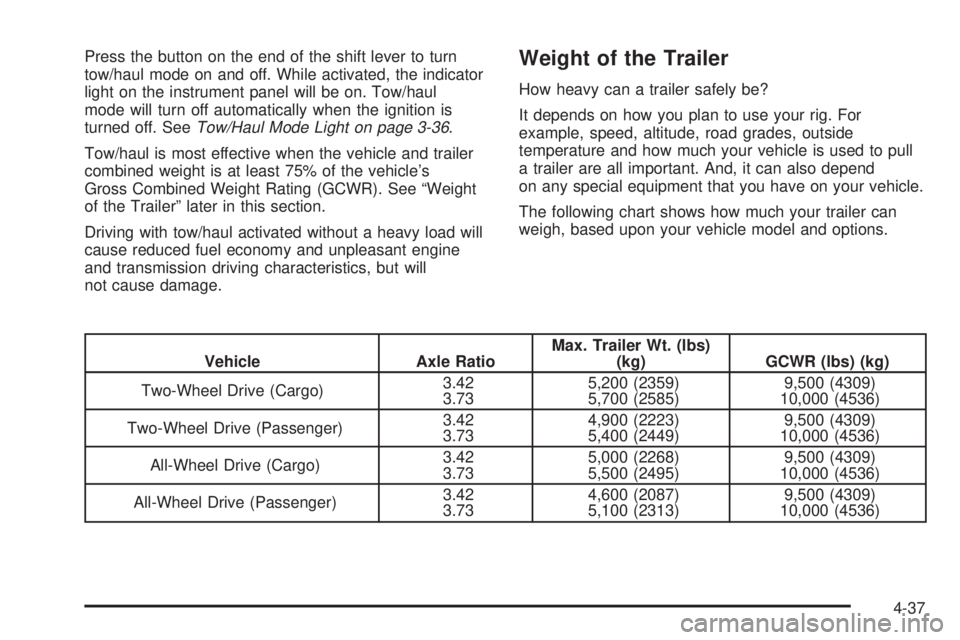
The following chart shows how much your trailer can
weigh, based upon your vehicle model and options.
Vehicle Axle RatioMax. Trailer Wt. (lbs)
(kg) GCWR (lbs) (kg)
Two-Wheel Drive (Cargo)3.42
3.735,200 (2359)
5,700 (2585)9,500 (4309)
10,000 (4536)
Two-Wheel Drive (Passenger)3.42
3.734,900 (2223)
5,400 (2449)9,500 (4309)
10,000 (4536)
All-Wheel Drive (Cargo)3.42
3.735,000 (2268)
5,500 (2495)9,500 (4309)
10,000 (4536)
All-Wheel Drive (Passenger)3.42
3.734,600 (2087)
5,100 (2313)9,500 (4309)
10,000 (4536)
4-37
Page 279 of 382
Maximum Loaded Vehicle Weight:The sum of curb
weight; accessory weight; vehicle capacity weight;
and production options weight.
Normal Occupant Weight:The number of occupants a
vehicle is designed to seat multiplied by 150 pounds
(68 kg). See
Loading Your Vehicle on page 4-30.
Occupant Distribution:Designated seating positions.
Outward Facing Sidewall:The side of a asymmetrical
tire that has a particular side that faces outward
when mounted on a vehicle. The side of the tire that
contains a whitewall, bears white lettering or bears
manufacturer, brand and or model name molding that is
higher or deeper than the same moldings on the
other sidewall of the tire.
Passenger (P-Metric) Tire:A tire used on passenger
cars and some light duty trucks and multipurpose
vehicles.
Recommended In¯ation Pressure:Vehicle
manufacturer's recommended tire in¯ation pressure and
shown on the tire placard. See
In¯ation - Tire Pressure
on page 5-66andLoading Your Vehicle on page 4-30.Radial Ply tire:A pneumatic tire in which the ply cords
that extend to the beads are laid at 90 degrees to the
centerline of the tread.
Rim:A metal support for a tire and upon which the tire
beads are seated.
Sidewall:The portion of a tire between the tread and
the bead.
Speed Rating:An alphanumeric code assigned to a
tire indicating the maximum speed at which a tire
can operate.
Traction:The friction between the tire and the road
surface. The amount of grip provided.
Tread:The portion of a tire that comes into contact
with the road.
Treadwear Indicators:Narrow bands, sometimes
called ªwear bars,º that show across the tread of a tire
when only 2/32 inch of tread remains. See
When It
Is Time for New Tires on page 5-69.
5-65
Page 363 of 382
Courtesy Transportation is available only at participating
dealers and all program options, such as shuttle
service, may not be available at every dealer. Please
contact you dealer for speci®c information about
availability. All Courtesy Transportation arrangements
will be administered by appropriate dealer personnel.
Canadian Vehicles:For warranty repairs during
the Complete Vehicle Coverage period of the General
Motors of Canada New Vehicle Limited Warranty,
alternative transportation may be available under the
Courtesy Transportation Program. Please consult
your dealer for details.
General Motors reserves the right to unilaterally modify,
change or discontinue Courtesy Transportation at
any time and to resolve all questions of claim eligibility
pursuant to the terms and conditions described
herein at its sole discretion.
Vehicle Data Collection and Event
Data Records
Your vehicle, like other modern motor vehicles, has a
number of sophisticated computer systems that monitor
and control several aspects of the vehicle's
performance. Your vehicle uses on-board vehicle
computers to monitor emission control components to
optimize fuel economy, to monitor conditions for
airbag deployment and, if so equipped, to provide
anti-lock braking and to help the driver control the
vehicle in difficult driving situations. Some information
may be stored during regular operations to facilitate
repair of detected malfunctions; other information
is stored only in a crash or near crash event by
computer systems commonly called event data
recorders (EDR).
In a crash or near crash event, computer systems, such
as the Airbag Sensing and Diagnostic Module (SDM)
in your vehicle may record information about the
condition of the vehicle and how it was operated, such
as engine speed, brake applications, throttle position,
vehicle speed, seat belt usage, airbag readiness, airbag
performance data, and the severity of a collision. This
information has been used to improve vehicle crash
performance and may be used to improve crash
performance of future vehicles and driving safety.
7-9
Page 376 of 382

Manual Seats................................................... 1-2
Manual Windows............................................2-14
Matching Transmitter(s) to Your Vehicle............... 2-4
Mexico, Central America and Caribbean Islands/
Countries (Except Puerto Rico and U.S. Virgin
Islands) ± Customer Assistance....................... 7-5
Mirrors
Manual Rearview Mirror................................2-30
Outside Convex Mirror.................................2-31
Outside Manual Mirror..................................2-30
Outside Power Mirrors..................................2-30
Model Reference................................................ vi
MyGMLink.com................................................ 7-3
N
New Vehicle Break-In......................................2-17
Normal Maintenance Replacement Parts...........5-104
O
Odometer......................................................3-25
Off-Road Recovery..........................................4-11
Oil
Engine.......................................................5-13
Pressure Gage............................................3-34Older Children, Restraints................................1-35
Online Owner Center........................................ 7-3
Operation Tips................................................3-20
Other Warning Devices...................................... 3-5
Outlet Adjustment............................................3-20
Outside
Convex Mirror.............................................2-31
Manual Mirror.............................................2-30
Power Mirrors.............................................2-30
Overhead Console..........................................2-36
Overseas ± Customer Assistance........................ 7-4
Owners, Canadian............................................... ii
Owner's Information........................................7-12
P
Park (P)
Shifting Into................................................2-25
Shifting Out of............................................2-27
Parking
Brake........................................................2-24
Over Things That Burn.................................2-28
Parking Brake and Automatic Transmission
Park (P) Mechanism Check...........................6-27
Parking on Hills..............................................4-43
Part A - Scheduled Maintenance Services............ 6-4
Part B - Owner Checks and Services................6-24
10
Page 377 of 382

Part C - Periodic Maintenance Inspections..........6-28
Part D - Recommended Fluids and Lubricants....6-30
Part E - Maintenance Record...........................6-32
Passenger Van Models....................................1-51
Passing.................................................4-12, 4-42
Passlock
ž......................................................2-16
Payload.........................................................4-35
Plan Ahead When Possible................................ 7-7
Playing a CD.................................................3-43
Playing the Radio...................................3-39, 3-41
Power
Accessory Outlets........................................3-16
Door Locks.................................................. 2-7
Electrical System.........................................5-96
Seat............................................................ 1-3
Steering Fluid.............................................5-37
Windows....................................................2-15
Power Steering................................................ 4-9
Programmable Automatic Door Locks.................. 2-7
Programming the HomeLink
žTransmitter...........2-31
Q
Questions and Answers About Safety Belts.........1-17
R
Radiator Pressure Cap....................................5-27
Radios..........................................................3-38AM-FM Radio.............................................3-39
Care of Your CD Player...............................3-50
Care of Your CDs........................................3-50
Radio with CD............................................3-41
Rear Seat Audio..........................................3-46
Setting the Time for Radios with HR and
MN Buttons.............................................3-38
Setting the Time for Radios with the
Set Button..............................................3-38
Theft-Deterrent............................................3-47
Understanding Reception..............................3-50
Reading Lamps..............................................2-36
Rear Air Conditioning System...........................3-21
Rear Axle......................................................5-48
Locking........................................................ 4-9
Rear Doors....................................................2-11
Rear Heating System......................................3-21
Rear Safety Belt Comfort Guides......................1-32
Rear Seat Audio (RSA)....................................3-46
Rear Seat Operation......................................... 1-7
Rear Seat Outside Passenger Positions.............1-29
Rear Seat Passengers, Safety Belts..................1-29
Rear Window Defogger....................................3-19
Rearview Mirrors.............................................2-30
Reclining Seatbacks.......................................... 1-4
Recreational Vehicle Towing.............................4-29
Reinstalling the Engine Cover...........................5-21
Remote Keyless Entry System, Operation............ 2-4
Removing the Engine Cover.............................5-17
11