2004 CADILLAC SEVILLE wheel alignment
[x] Cancel search: wheel alignmentPage 262 of 410
Wheel Alignment and Tire Balance..................5-75
Wheel Replacement......................................5-75
Tire Chains..................................................5-77
If a Tire Goes Flat........................................5-77
Changing a Flat Tire.....................................5-78
Compact Spare Tire......................................5-87
Appearance Care............................................5-87
Cleaning the Inside of Your Vehicle.................5-88
Care of Safety Belts......................................5-90
Weatherstrips...............................................5-90
Cleaning the Outside of Your Vehicle..............5-90
Sheet Metal Damage.....................................5-92
Finish Damage.............................................5-92
Underbody Maintenance................................5-93Chemical Paint Spotting.................................5-93
Vehicle Care/Appearance Materials..................5-94
Vehicle Identification......................................5-95
Vehicle Identification Number (VIN).................5-95
Service Parts Identification Label.....................5-95
Electrical System............................................5-96
Add-On Electrical Equipment..........................5-96
Headlamp Wiring..........................................5-96
Windshield Wiper Fuses................................5-96
Power Windows and Other Power Options.......5-96
Fuses and Circuit Breakers............................5-97
Removing the Rear Seat Cushion...................5-99
Capacities and Specifications........................5-104
Section 5 Service and Appearance Care
5-2
Page 331 of 410
Anytime you replace one or more tires or rotate your
tires, the TPM system will need to be reset. A special
tool is needed to reset the sensor identification
codes. See your dealer for service.
Your vehicle was delivered from the factory with
aluminum valve stem caps. If you ever have to replace
the valve stem caps on your vehicle, you should
replace them with aluminum or plastic caps.
The TPM system can alert you about a low or high tire
pressure condition, but it does not replace normal
tire maintenance. SeeTires on page 5-61.
Tire Inspection and Rotation
Tires should be rotated every 5,000 to 8,000 miles
(8 000 to 13 000 km).
Any time you notice unusual wear, rotate your tires as
soon as possible and check wheel alignment. Also
check for damaged tires or wheels. SeeWhen It Is Time
for New Tires on page 5-72andWheel Replacement
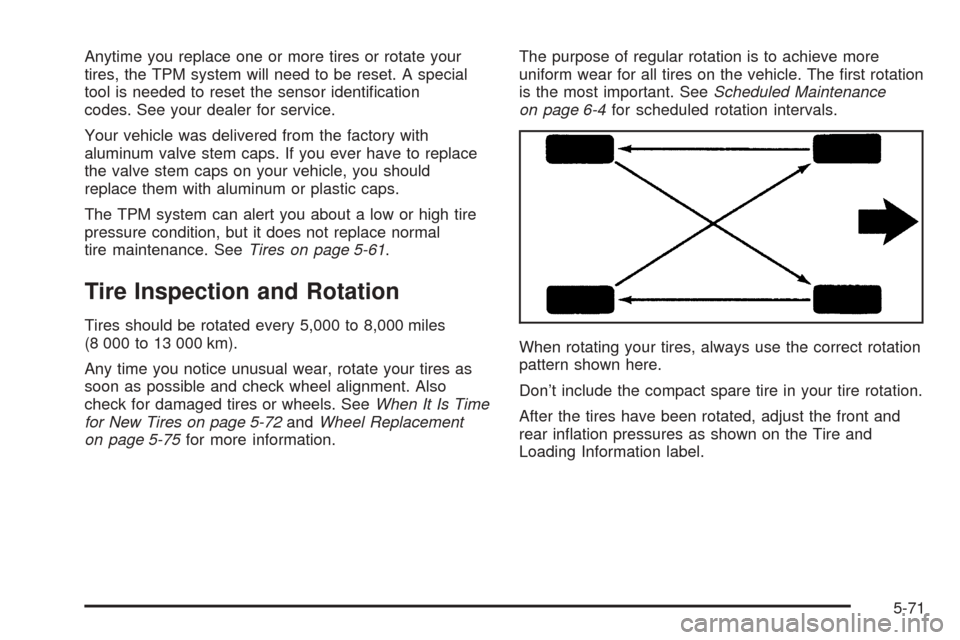
on page 5-75for more information.The purpose of regular rotation is to achieve more
uniform wear for all tires on the vehicle. The first rotation
is the most important. SeeScheduled Maintenance
on page 6-4for scheduled rotation intervals.
When rotating your tires, always use the correct rotation
pattern shown here.
Don’t include the compact spare tire in your tire rotation.
After the tires have been rotated, adjust the front and
rear inflation pressures as shown on the Tire and
Loading Information label.
5-71
Page 335 of 410
Temperature – A, B, C
The temperature grades are A (the highest), B, and C,
representing the tire’s resistance to the generation
of heat and its ability to dissipate heat when tested
under controlled conditions on a specified indoor
laboratory test wheel. Sustained high temperature can
cause the material of the tire to degenerate and
reduce tire life, and excessive temperature can lead to
sudden tire failure. The grade C corresponds to a
level of performance which all passenger car tires must
meet under the Federal Motor Vehicle Safety Standard
No. 109. Grades B and A represent higher levels of
performance on the laboratory test wheel than the
minimum required by law.
Warning: The temperature grade for this tire is
established for a tire that is properly inflated and not
overloaded. Excessive speed, underinflation, or
excessive loading, either separately or in combination,
can cause heat buildup and possible tire failure.
Wheel Alignment and Tire Balance
The wheels on your vehicle were aligned and balanced
carefully at the factory to give you the longest tire life
and best overall performance.
Scheduled wheel alignment and wheel balancing are
not needed. However, if you notice unusual tire wear or
your vehicle pulling one way or the other, the alignment
may need to be reset. If you notice your vehicle
vibrating when driving on a smooth road, your wheels
may need to be rebalanced.
Wheel Replacement
Replace any wheel that is bent, cracked or badly rusted
or corroded. If wheel nuts keep coming loose, the
wheel, wheel bolts and wheel nuts should be replaced.
If the wheel leaks air, replace it (except some
aluminum wheels, which can sometimes be repaired).
See your dealer if any of these conditions exist.
Your dealer will know the kind of wheel you need.
Each new wheel should have the same load-carrying
capacity, diameter, width, offset and be mounted
the same way as the one it replaces.
5-75
Page 408 of 410
Supplemental Inflatable Restraints (SIR) (cont.)
What Will You See After an Air Bag
Inflates?..................................................1-48
When Should an Air Bag Inflate?...................1-47
Where Are the Air Bags?..............................1-44
T
Tachometer....................................................3-40
Taillamps
Turn Signal Lamps......................................5-58
TCS Warning Light..........................................3-44
Testing the Alarm............................................2-21
Theft-Deterrent, Radio.....................................3-99
Theft-Deterrent Systems...................................2-20
PASS-Key
®III .............................................2-22
PASS-Key®III Operation..............................2-22
Tilt Wheel........................................................ 3-7
Tire Inflation Check........................................... 6-9
Tire Pressure Display......................................3-73
Tire Sidewall Labeling......................................5-61
Tire Size.......................................................5-65
Tire Terminology and Definitions........................5-65
Tires.............................................................5-61
Buying New Tires........................................5-73
Chains.......................................................5-77Tires (cont.)
Changing a Flat Tire....................................5-78
Compact Spare Tire.....................................5-87
If a Tire Goes Flat.......................................5-77
Inflation - Tire Pressure................................5-68
Inspection and Rotation................................5-71
Pressure Monitor Operation...........................5-69
Uniform Tire Quality Grading.........................5-74
Wheel Alignment and Tire Balance.................5-75
Wheel Replacement.....................................5-75
When It Is Time for New Tires......................5-72
To Use the Engine Coolant Heater....................2-28
Top Strap......................................................1-32
Top Strap Anchor Location...............................1-34
Torque Lock...................................................2-33
Total Weight on Your Vehicle’s Tires..................4-40
Towing
Recreational Vehicle.....................................4-30
Towing a Trailer..........................................4-37
Your Vehicle...............................................4-29
Traction
Control System (TCS).................................... 4-8
Control System Warning Light.......................3-44
Trailer Brakes.................................................4-41
Transaxle
Fluid, Automatic...........................................5-20
14
Page 410 of 410
W
Warning Lights, Gages and Indicators................3-37
Warnings
DIC Warnings and Messages........................3-55
Hazard Warning Flashers............................... 3-6
Other Warning Devices.................................. 3-7
Safety and Symbols......................................... iii
Vehicle Damage.............................................. iv
Washing Your Vehicle......................................5-90
Weather Band..............................................3-101
Weight of the Trailer........................................4-38
Weight of the Trailer Tongue.............................4-39
What Kind of Engine Oil to Use........................5-14
What to Do with Used Oil................................5-17
What to Use..................................5-24, 5-36, 5-37
Wheels
Alignment and Tire Balance..........................5-75
Replacement...............................................5-75
When to Add Engine Oil..................................5-14
When to Change Engine Oil
(GM Oil Life System)...................................5-16
When to Check..............................................5-68
When to Check and Change............................5-20
When to Check Power Steering Fluid................5-36
When You Are Ready to Leave
After Parking on a Hill:.................................4-44Where to Put the Restraint...............................1-32
Why Safety Belts Work..................................... 1-6
Window Lockout.............................................2-19
Windows.......................................................2-16
Power........................................................2-17
Windshield Washer.........................................3-13
Fluid..........................................................5-37
Windshield Wiper
Blade Replacement......................................5-60
Fuses........................................................5-96
Windshield Wipers..........................................3-11
Winter Driving................................................4-24
Wiper-Activated Headlamps..............................3-17
X
XM™ Satellite Radio Antenna System..............3-103
XM™ Satellite Radio Service
(48 Contiguous US States)..........3-76, 3-83, 3-100
Y
Your Vehicle and the Environment....................... 6-2
16