Page 296 of 410
Power Steering Fluid
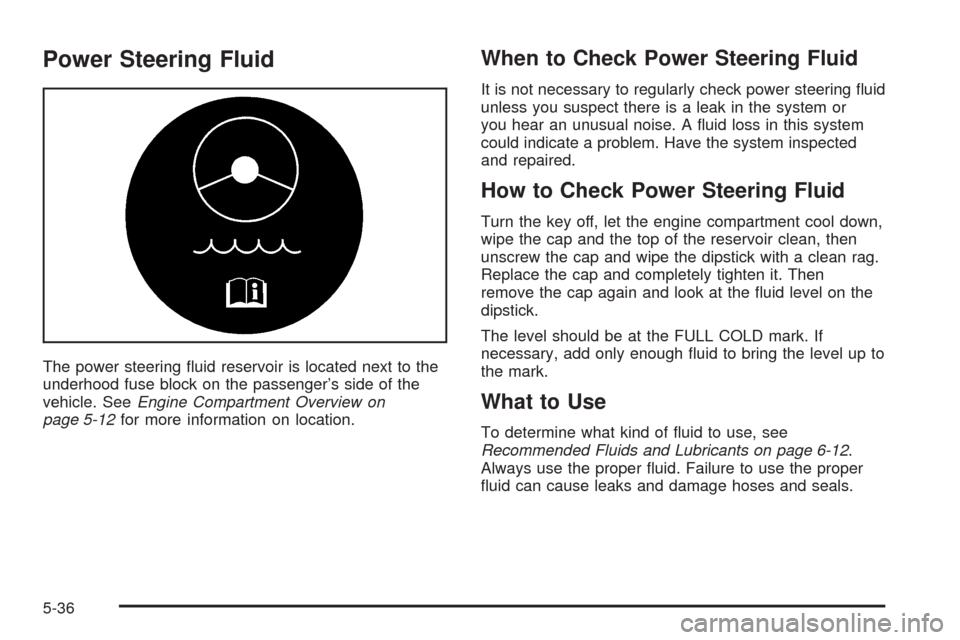
The power steering fluid reservoir is located next to the
underhood fuse block on the passenger’s side of the
vehicle. SeeEngine Compartment Overview on
page 5-12for more information on location.
When to Check Power Steering Fluid
It is not necessary to regularly check power steering fluid
unless you suspect there is a leak in the system or
you hear an unusual noise. A fluid loss in this system
could indicate a problem. Have the system inspected
and repaired.
How to Check Power Steering Fluid
Turn the key off, let the engine compartment cool down,
wipe the cap and the top of the reservoir clean, then
unscrew the cap and wipe the dipstick with a clean rag.
Replace the cap and completely tighten it. Then
remove the cap again and look at the fluid level on the
dipstick.
The level should be at the FULL COLD mark. If
necessary, add only enough fluid to bring the level up to
the mark.
What to Use
To determine what kind of fluid to use, see
Recommended Fluids and Lubricants on page 6-12.
Always use the proper fluid. Failure to use the proper
fluid can cause leaks and damage hoses and seals.
5-36
Page 297 of 410
Windshield Washer Fluid
What to Use
When you need windshield washer fluid, be sure to read
the manufacturer’s instructions before use. If you will
be operating your vehicle in an area where the
temperature may fall below freezing, use a fluid that has
sufficient protection against freezing.
Adding Washer Fluid
When your vehicle’s windshield washer fluid level
becomes low, a CHECK WASHER FLUID message will
appear on the Driver Information Center (DIC). You
will need to add fluid soon.
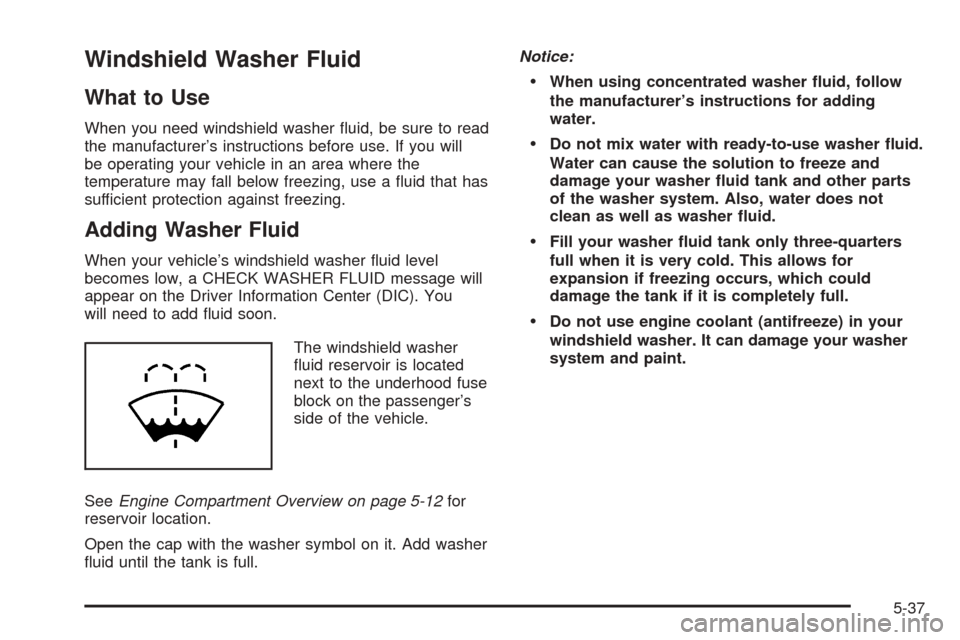
The windshield washer
fluid reservoir is located
next to the underhood fuse
block on the passenger’s
side of the vehicle.
SeeEngine Compartment Overview on page 5-12for
reservoir location.
Open the cap with the washer symbol on it. Add washer
fluid until the tank is full.Notice:
•When using concentrated washer fluid, follow
the manufacturer’s instructions for adding
water.
•Do not mix water with ready-to-use washer fluid.
Water can cause the solution to freeze and
damage your washer fluid tank and other parts
of the washer system. Also, water does not
clean as well as washer fluid.
•Fill your washer fluid tank only three-quarters
full when it is very cold. This allows for
expansion if freezing occurs, which could
damage the tank if it is completely full.
•Do not use engine coolant (antifreeze) in your
windshield washer. It can damage your washer
system and paint.
5-37
Page 304 of 410
4. Open the hoods and locate the positive (+) and
negative (−) terminal locations on the other
vehicle. Your vehicle has a remote (+) jump starting
terminal and a remote negative (−) jump starting
terminal. You should always use these remote
terminals instead of the terminals on the battery.
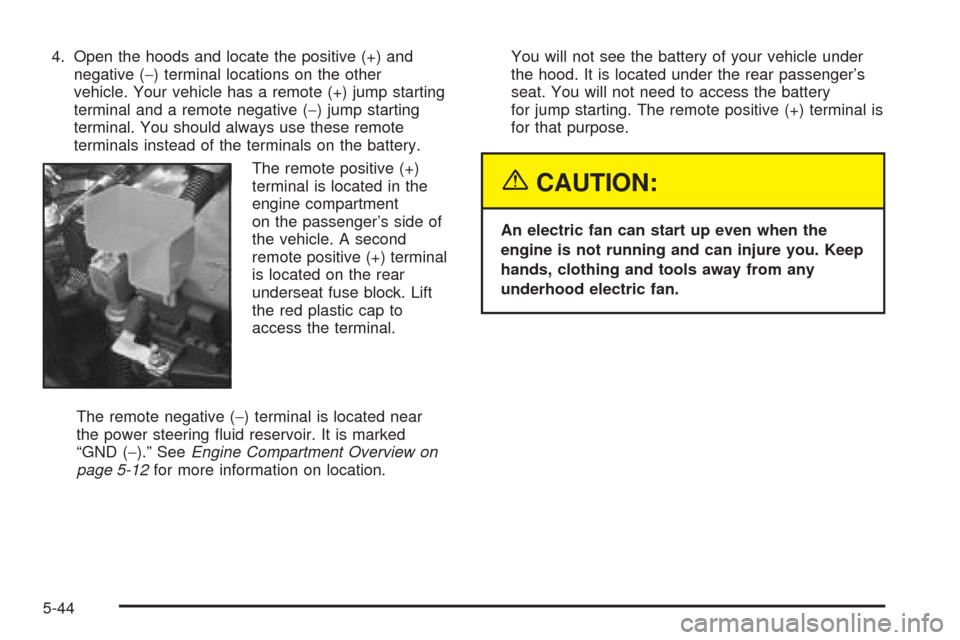
The remote positive (+)
terminal is located in the
engine compartment
on the passenger’s side of
the vehicle. A second
remote positive (+) terminal
is located on the rear
underseat fuse block. Lift
the red plastic cap to
access the terminal.
The remote negative (−) terminal is located near
the power steering fluid reservoir. It is marked
“GND (−).” SeeEngine Compartment Overview on
page 5-12for more information on location.You will not see the battery of your vehicle under
the hood. It is located under the rear passenger’s
seat. You will not need to access the battery
for jump starting. The remote positive (+) terminal is
for that purpose.
{CAUTION:
An electric fan can start up even when the
engine is not running and can injure you. Keep
hands, clothing and tools away from any
underhood electric fan.
5-44
Page 356 of 410
Electrical System
Add-On Electrical Equipment
Notice:Don’t add anything electrical to your
vehicle unless you check with your dealer first.
Some electrical equipment can damage your vehicle
and the damage wouldn’t be covered by your
warranty. Some add-on electrical equipment can
keep other components from working as they
should.
Your vehicle has an air bag system. Before attempting
to add anything electrical to your vehicle, see
Servicing Your Air Bag-Equipped Vehicle on page 1-50.
Headlamp Wiring
The headlamp wiring has an individual fuse. An
electrical overload will cause the lamps to go on and off,
or in some cases to remain off. If this happens, have
the headlamp wiring checked right away.
Windshield Wiper Fuses
The windshield wiper motor is protected by an internal
circuit breaker. If the wiper motor overheats due to
heavy snow, the wipers will stop until the motor cools
and will then restart.
A fuse powers the wiper motor. If the fuse blows, there
is an electrical problem. Be sure to have it fixed.
Power Windows and Other Power
Options
Circuit breakers protect the power windows and power
seats. When the current load is too heavy, the circuit
breaker opens and closes, protecting the circuit until the
problem is fixed or goes away.
5-96
Page 357 of 410
Fuses and Circuit Breakers
The wiring circuits in your vehicle are protected from
short circuits by a combination of fuses and circuit
breakers. This greatly reduces the chance of fires
caused by electrical problems.
Look at the silver-colored band inside the fuse. If the
band is broken or melted, replace the fuse. Be sure you
replace a bad fuse with a new one of the identical
size and rating. If a fuse should blow, see your dealer
for service immediately.
If you ever have a problem on the road and do not have
a spare fuse, you can “borrow” one that has the same
amperage. Pick some feature of your vehicle that
you can get along without – like the radio or cigarette
lighter – and use its fuse, if it is the correct amperage.
Replace it as soon as you can.
The fuses are located in two fuse blocks, one located
near the engine compartment on the passenger’s
side and the other under the rear seat on the driver’s
side. If a fuse should blow, have your vehicle serviced
by your dealer immediately.
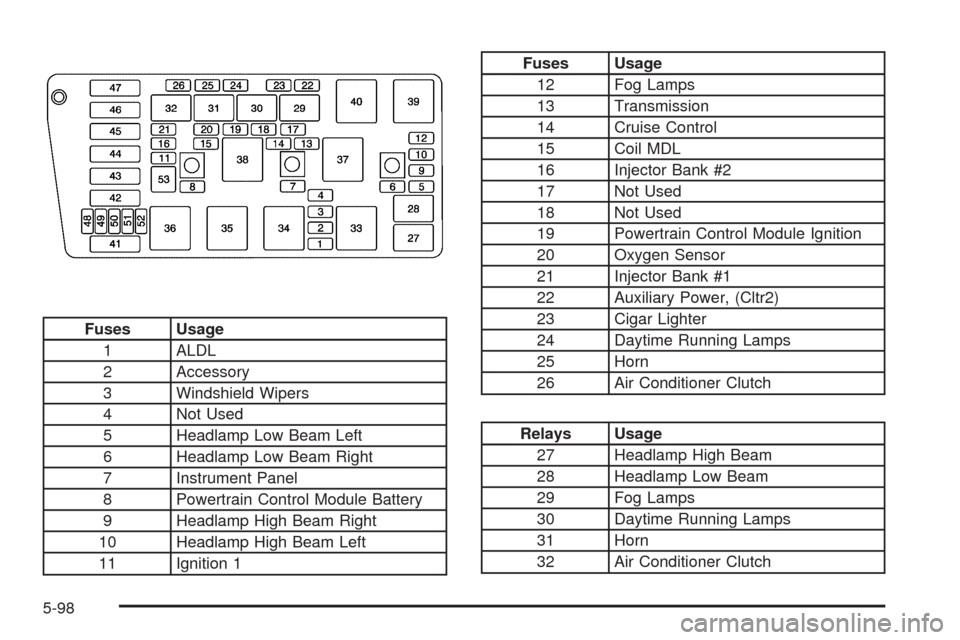
Underhood Fuse Block
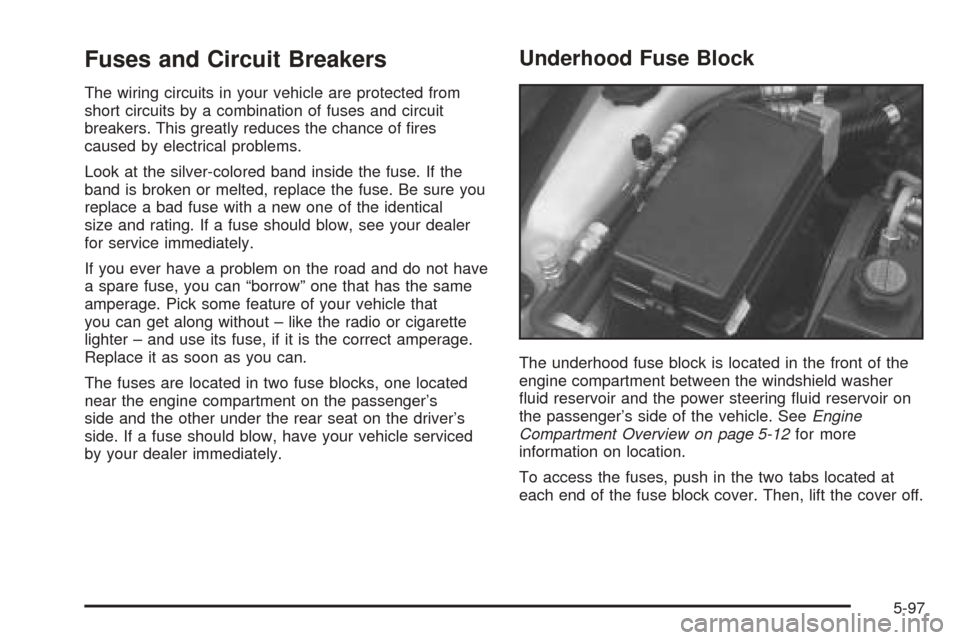
The underhood fuse block is located in the front of the
engine compartment between the windshield washer
fluid reservoir and the power steering fluid reservoir on
the passenger’s side of the vehicle. SeeEngine
Compartment Overview on page 5-12for more
information on location.
To access the fuses, push in the two tabs located at
each end of the fuse block cover. Then, lift the cover off.
5-97
Page 358 of 410
Fuses Usage
1 ALDL
2 Accessory
3 Windshield Wipers
4 Not Used
5 Headlamp Low Beam Left
6 Headlamp Low Beam Right
7 Instrument Panel
8 Powertrain Control Module Battery
9 Headlamp High Beam Right
10 Headlamp High Beam Left
11 Ignition 1
Fuses Usage
12 Fog Lamps
13 Transmission
14 Cruise Control
15 Coil MDL
16 Injector Bank #2
17 Not Used
18 Not Used
19 Powertrain Control Module Ignition
20 Oxygen Sensor
21 Injector Bank #1
22 Auxiliary Power, (Cltr2)
23 Cigar Lighter
24 Daytime Running Lamps
25 Horn
26 Air Conditioner Clutch
Relays Usage
27 Headlamp High Beam
28 Headlamp Low Beam
29 Fog Lamps
30 Daytime Running Lamps
31 Horn
32 Air Conditioner Clutch
5-98
Page 359 of 410
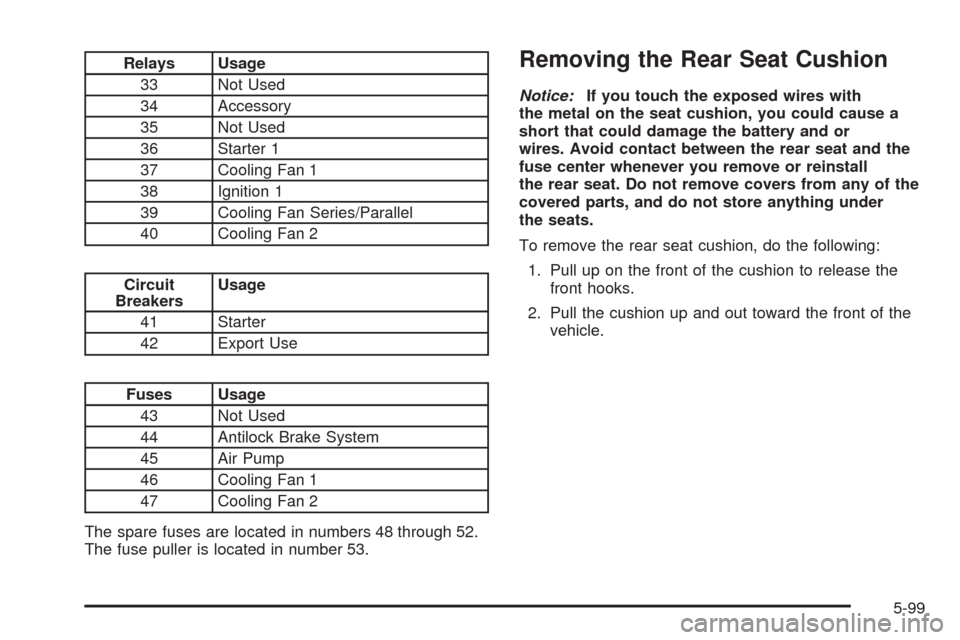
Relays Usage
33 Not Used
34 Accessory
35 Not Used
36 Starter 1
37 Cooling Fan 1
38 Ignition 1
39 Cooling Fan Series/Parallel
40 Cooling Fan 2
Circuit
BreakersUsage
41 Starter
42 Export Use
Fuses Usage
43 Not Used
44 Antilock Brake System
45 Air Pump
46 Cooling Fan 1
47 Cooling Fan 2
The spare fuses are located in numbers 48 through 52.
The fuse puller is located in number 53.
Removing the Rear Seat Cushion
Notice:If you touch the exposed wires with
the metal on the seat cushion, you could cause a
short that could damage the battery and or
wires. Avoid contact between the rear seat and the
fuse center whenever you remove or reinstall
the rear seat. Do not remove covers from any of the
covered parts, and do not store anything under
the seats.
To remove the rear seat cushion, do the following:
1. Pull up on the front of the cushion to release the
front hooks.
2. Pull the cushion up and out toward the front of the
vehicle.
5-99
Page 361 of 410
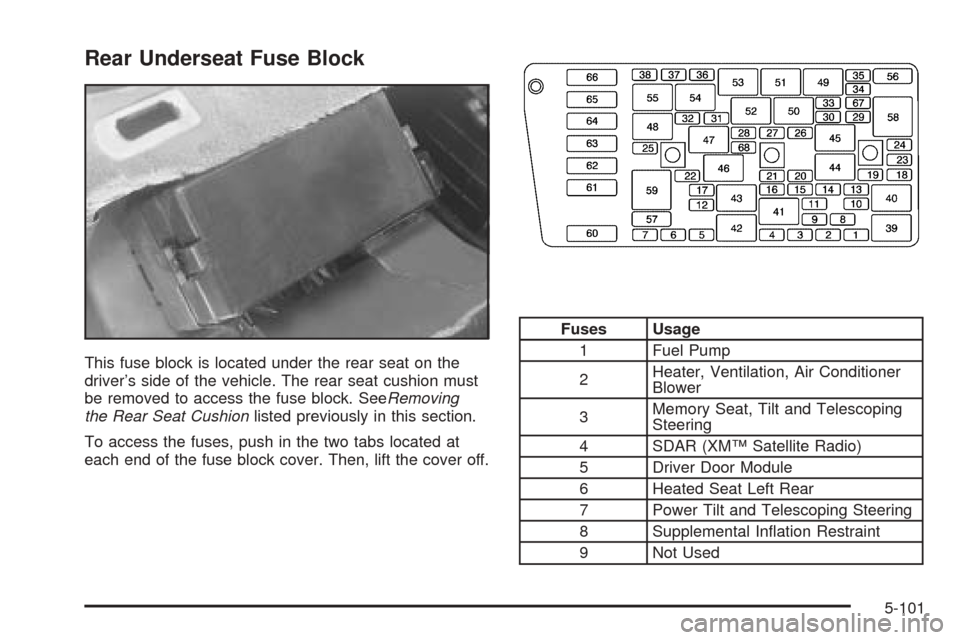
Rear Underseat Fuse Block
This fuse block is located under the rear seat on the
driver’s side of the vehicle. The rear seat cushion must
be removed to access the fuse block. SeeRemoving
the Rear Seat Cushionlisted previously in this section.
To access the fuses, push in the two tabs located at
each end of the fuse block cover. Then, lift the cover off.
Fuses Usage
1 Fuel Pump
2Heater, Ventilation, Air Conditioner
Blower
3Memory Seat, Tilt and Telescoping
Steering
4 SDAR (XM™ Satellite Radio)
5 Driver Door Module
6 Heated Seat Left Rear
7 Power Tilt and Telescoping Steering
8 Supplemental Inflation Restraint
9 Not Used
5-101