2004 BMW M3 COUPE tow
[x] Cancel search: towPage 136 of 170
136
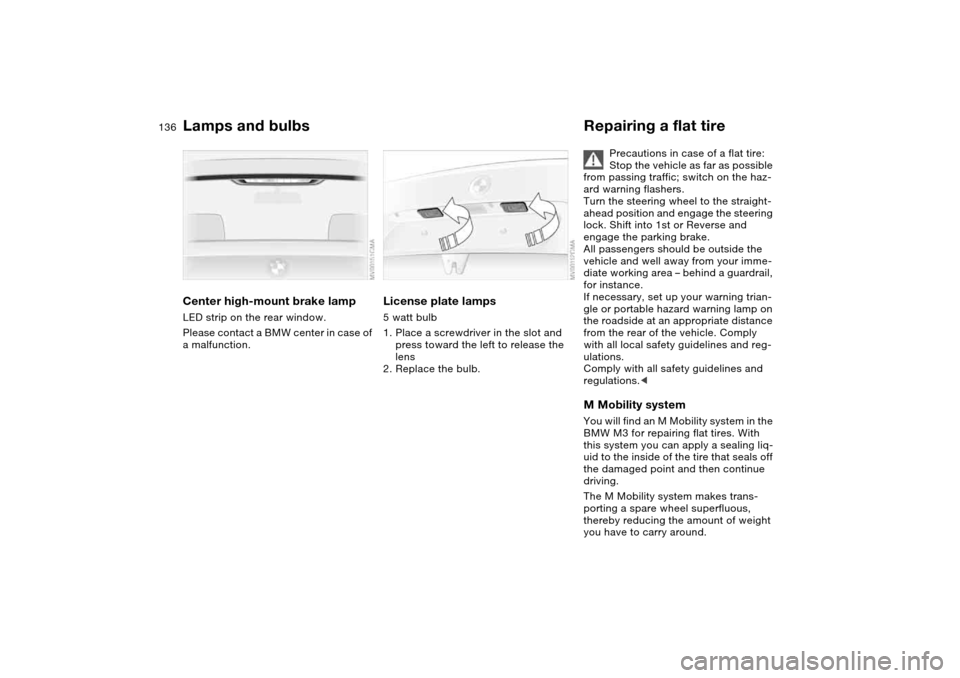
Center high-mount brake lampLED strip on the rear window.
Please contact a BMW center in case of
a malfunction.
License plate lamps5 watt bulb
1. Place a screwdriver in the slot and
press toward the left to release the
lens
2. Replace the bulb.
Repairing a flat tire
Precautions in case of a flat tire:
Stop the vehicle as far as possible
from passing traffic; switch on the haz-
ard warning flashers.
Turn the steering wheel to the straight-
ahead position and engage the steering
lock. Shift into 1st or Reverse and
engage the parking brake.
All passengers should be outside the
vehicle and well away from your imme-
diate working area – behind a guardrail,
for instance.
If necessary, set up your warning trian-
gle or portable hazard warning lamp on
the roadside at an appropriate distance
from the rear of the vehicle. Comply
with all local safety guidelines and reg-
ulations.
Comply with all safety guidelines and
regulations.<
M Mobility systemYou will find an M Mobility system in the
BMW M3 for repairing flat tires. With
this system you can apply a sealing liq-
uid to the inside of the tire that seals off
the damaged point and then continue
driving.
The M Mobility system makes trans-
porting a spare wheel superfluous,
thereby reducing the amount of weight
you have to carry around.
Lamps and bulbs
Page 139 of 170

139
4. Make sure that the screw on the rear
of the pressure gauge 3 is tightened
down. Turn on the M Mobility sys-
tem, position I, refer to illustration,
and allow minutes to elapse, to let
the sealant flow in. It does not matter
afterward, what the tire's inflation
pressure is
5. Turn the system off.
Disconnect the connector hose from
the sealant container and the wheel
valve. Stow the M Mobility system in
the luggage compartment.Distributing the sealantRight afterward, drive at least
1 1/4 miles / 2 km, so that the liquid
sealant distributes evenly throughout
the inside of the tire.
Do not exceed a maximum speed
of 40 mph / 60 km/h.
If possible, keep the vehicle speed
above 10 mph / 20 km/h. Stop in a suit-
able spot.<
Inflating tire to correct pressure1. Take out the hose with the pressure
gauge and screw it onto the valve.
Take the plug out and plug it into the
cigarette lighter socket in the pas-
senger compartment
2. Reset the air pressure to 29 psi/
200 kilopascal, and:
>Increase tire pressure: switch on
the M Mobility System, position I.
Switch off the unit briefly to check
the current tire pressure
>Decrease tire pressure: turn the
screw on the back of the manome-
ter. A valve located there will open
Repairing a flat tire
OverviewControlsMaintenanceRepairsDataIndex
Page 140 of 170

140
Even if the tire fails to hold the
pressure, you should still carry out
Step 3 before proceeding to drive the
vehicle again, refer to Distributing the
sealant for more information. Then
repeat Steps 1 through 3.
The use of the M Mobility system may
be ineffective if the damaged area in
the tire is larger than approx. 1/8 in /
4 mm. Please consult the nearest BMW
center if the tire cannot be temporarily
repaired with the M Mobility system.<
3. Unscrew the hose from the valve and
stow the M Mobility system in the
luggage compartment. Screw the
dust cap onto the valve again.
Do not exceed the maximum
speed limit described below, oth-
erwise it could lead to accidents.<
When you start driving again, do not
exceed the permissible maximum
speed of 45 mph / 80 km/h.
You will find corresponding
instructions for using the
M Mobility system on the device.
Replace the defective tire as soon as
possible and have the new wheel bal-
anced. Reinitialize the Flat Tire Monitor,
and refer to page 85 for further informa-
tion. Have the M Mobility system
refilled. Contact your BMW center for
this.<
Protect valve stems against dirt using
screw-on dust caps. Dirty valve stems
frequently lead to slow pressure loss.
Battery
Battery posts, terminals, and
related accessories contain lead
and lead compounds. Wash hands after
handling.<
MaintenanceThe battery is completely maintenance-
free. That means that the original bat-
tery acid will normally last for the ser-
vice life of the battery under moderate
climate conditions.
Please consult your BMW center
whenever you have any questions
concerning the battery.
connections provided in the engine
compartment. For information on the
connections, see Jump-Starting,
page 143.Disposal
Return used batteries to a recy-
cling point or your BMW center.
Maintain the battery in an upright posi-
tion for transport and storage. Secure
the battery against tilting in transit.<
Repairing a flat tire
Page 144 of 170
144
2. Start the engine of the other vehicle
as usual.
If the first start attempt is not suc-
cessful, wait a few minutes before
another attempt in order to allow the
discharged battery to recharge
3. Allow the engines to run for several
minutes
4. Disconnect the jumper cables in
reverse sequence.
Have the battery recharged at your
BMW center as required.
Do not use spray starter fluids to
start the engine.<
Towing the vehicle
Always observe all applicable
towing laws and regulations.<
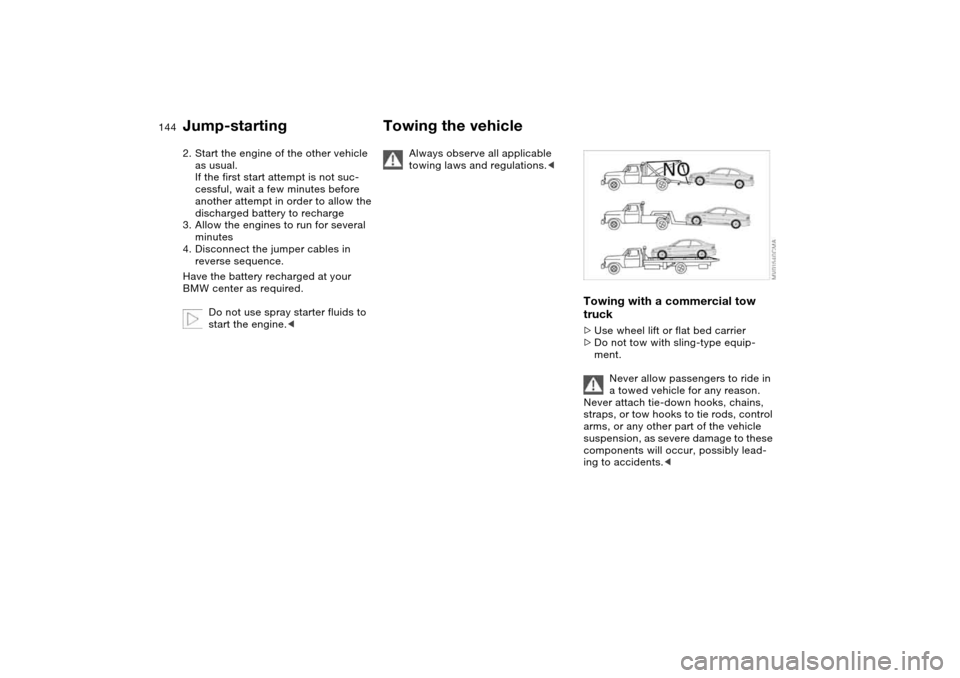
Towing with a commercial tow
truck>Use wheel lift or flat bed carrier
>Do not tow with sling-type equip-
ment.
Never allow passengers to ride in
a towed vehicle for any reason.
Never attach tie-down hooks, chains,
straps, or tow hooks to tie rods, control
arms, or any other part of the vehicle
suspension, as severe damage to these
components will occur, possibly lead-
ing to accidents.<
Jump-starting
Page 145 of 170

145
Towing the vehicle with the front
axle raisedVehicles with sequential manual gear-
box SMG:
With the ignition on, move the selector
lever to position N, then turn off the
ignition.Towing eyeletThe screw-in towing eyelet is stored in
the luggage compartment under the
floor mat and must remain in the vehi-
cle. It can be attached at the front or
rear of the vehicle.
The towing eyelet should not be used
to pull a vehicle out of deep snow, mud,
sand, etc.
Comply with all applicable towing laws
and regulations at all times.
Access to tow socketsFront:
Press out the cover panel with a screw-
driver at the top of the recess.
Rear:
Press out the cover panel with a screw-
driver at the top of the recess.
Use only the towing eyelet sup-
plied with the vehicle and screw it
in firmly until it stops. Use the towing
eyelet for towing on paved roads only. If
you do not follow these instructions, the
towing eyelet could be torn out and
vehicle damage could occur.
Do not tow the vehicle by any compo-
nents of the running gear, or lash them
down in any way. If you do, the compo-
nents could be damaged, possibly
leading to accidents.<
Towing the vehicle
OverviewControlsMaintenanceRepairsDataIndex
Page 146 of 170

146
Keep the vehicles in line and avoid
towing at an offset angle. Ensure
that the towing strap connecting the
two vehicles is tight, with no slack,
before starting off.<
Use only a nylon towing strap to tow
the vehicle, since the inherent resil-
ience of this material helps protect both
vehicles from sudden jerking move-
ments.
The towed vehicle should always
be the lighter of the two vehicles.
If this is not the case, it will not be pos-
sible to control vehicle handling.<
Tow-startingFor instructions on jump-starting, refer
to page 143.
Never attempt to use your vehicle to
push another vehicle, since damage to
the energy-absorbing bumpers could
result.Towing the vehicle
Page 156 of 170

Everything from A to ZA
ABS Antilock Brake
System 112
indicator lamp 19
Accessories, refer to For
your own safety 5
Accident, refer to Emer-
gency call 142
Activated-charcoal filter 96
Adding brake fluid 125
Adding liquid sealant
Mobility system 138
Additional sources of infor-
mation 4
Air conditioning mode
automatic climate
control 94
Air distribution
automatic climate
control 94
Air distribution, individual 94
Air outlets, refer to Ventila-
tion 92
Air pressure, refer to Tire
inflation pressure 25, 114
Air recirculation, refer to
Recirculated-air mode 95
Air supply
automatic climate
control 94
Air, drying, refer to Air con-
ditioning mode 94Airbags 53
deactivating 53
indicator lamp 18, 55
sitting safely 43
Airing out, refer to Ventila-
tion 92
AKI, refer to Fuel specifica-
tions 25
Alarm system 38
avoiding unintentional
alarms 39
All-season tires, refer to
Winter tires 118
Alternative oil types 123
Antifreeze 124
coolant 124
washer fluid 122
Antilock Brake System
(ABS) 112
indicator lamp 19
Anti-theft system 30
Anti-theft warning system,
refer to Alarm system 38
Approved axle loads, refer
to Weights 152
Approved gross weight,
refer to Weights 152
Armrest
front 98
rear 99Artificial leather, refer to the
Caring for your vehicle
brochure
Ashtray
front 100
rear 100
Assistant systems, refer to
Dynamic Stability Control
(DSC) 83
AUC Automatic recircu-
lated-air control 95
AUTO program, refer
to Automatic air distribu-
tion 94
Automatic
air distribution 94
air supply 94
cruise control 74
headlamp control 88
Automatic car wash, refer to
the Caring for your vehicle
brochure
Automatic climate control 92
Automatic curb monitor 50
Automatic dimming, interior
rearview mirror 52
Automatic recirculated-air
control (AUC) 95
Automatic windshield
washer, refer to Rain sen-
sor 73Average fuel
consumption 81
Average speed 81
Avoiding unintentional
alarms 39
Axle loads, refer to
Weights 152
B
Backrest
adjusting 44
unlocking 47
width adjustment 46
Backrest, refer to Seat
adjustment 45
Backup lamps 66
bulb replacement 135
Bandages, refer to First-aid
kit 23
Bar, towing 145
Battery 140
charge 140
disposal 140
indicator lamp 18
jump-starting 143
remote control 30, 31
Battery charge current 18
Belts, refer to Safety
belts 47
Beverage holders 98, 99
Page 159 of 170

Everything from A to Z
159
Electrical accessories, fail-
ure 141
Electrical malfunction
door lock 33
driver's door 33
fuel filler door 24
glass sunroof 42
luggage compartment
lid 35
Electronic Stability Program
(ESP), refer to Dynamic
Stability Control (DSC) 83
Emergency call 142
Emergency operation
doors 33
driver's door 33
fuel filler door 24
glass sunroof 42
Emergency release
luggage compartment lid
35, 37
Engine
breaking in 110
data 150
electronics 19
indicator lamp 19
speed 76, 150
starting 63
switching off 65
Engine compartment 120
Engine coolant 124
refilling 124Engine oil
adding 123
additives, refer to Adding
engine oil 123
alternative oils 123
capacity 153
consumption 122
indicator/warning lamp 19
quality 123
specified oils 123
temperature gauge 76
types 123
Engine oil level 19
check 122
indicator/warning lamp 18
Engine oil pressure
indicator/warning lamp 18
Engine oil temperature 76
Engine output, refer to
Engine data 150
Engine speed 76, 150
Entering the rear 47
Equipment range, refer to
the Service and Warranty
Information Booklet for US
models / Warranty and
Service Guide Booklet for
Canadian models
ESP Electronic Stability Pro-
gram, refer to Dynamic
Stability Control (DSC) 83
Exterior mirrors 51Eyeglasses compartment 99
Eyelet, towing 145
F
False alarm, refer to
Avoiding unintentional
alarms 39
Fastening the safety belts 47
Fault displays 78
Filling the windshield washer
reservoir 153
First aid, refer to First-aid
kit 23
First-aid kit 23
Flat tire 136
Flat Tire Monitor 84
Mobility system 136
repairing 136
Flat Tire Monitor 84
activating/deactivating 86
indicator lamp 18, 19, 86
Flat tire, refer to Tire condi-
tion 114
Fluid reservoir for washer
systems 122
Fog lamps 90
indicator/warning lamp 20
Folding rear backrest 102
Follow me home lamps 88
Footbrake, refer to General
driving notes 111
Front airbags 53Front center armrest 98
Front fog lamps 90
indicator/warning lamp 20
Fuel
display 77
specifications 25
volume 153
Fuel consumption
display 81
Fuel display, refer to Fuel
gauge 77
Fuel filler door 24
release following an elec-
trical malfunction 24
Fuel level indicator, refer to
Fuel gauge 77
Fuel mixture preparation 150
Fuel reserve indicator, refer
to Fuel gauge 77
Fuel tank capacity 153
Fuses 141
G
Gasoline consumption, refer
to Average fuel consump-
tion 81
Gasoline, refer to Fuel spec-
ifications 25
Gear indicator 68
Gearbox
manual transmission 66
OverviewControlsMaintenanceRepairsDataIndex