Page 202 of 283

�Î
�Ì �Ì
�Ì
�Ì
�Î
Maint enance
Maintenance Minder
199
:
Independent of the maintenance messages in the Multi-Information
Display, replace the brake fluid every 3 years.
If the message ‘‘SERVICE DUE NOW’’ does not appear more than 12 months
after the display is reset, change the engine oil every year.
See information on maintenance and emissions warranty, the first column,
page .
Inspect idle speed every 160,000 miles (256,000 km).
Adjust the valves during services A, B, 1, 2, or 3 if they are noisy.
NOTE: 1:
198
Maintenance Main Items
Replace engine oil
Replace engine oil and oil filter
Rotate tires
Inspect front and rear brakes
Check parking brake adjustment
Visually inspect these items: Tie rod ends, steering gear box, and boots
Suspension components
Driveshaft boots
Brake hoses and line (including ABS)
All fluid levels and condition of fluids
Exhaust system
Fuel lines and connections Maintenance Sub Items
Rotate tires
Replace air cleaner element If you drive primarily in dusty conditions, replace
every 15,000 miles (24,000 km).
Replace dust and pollen filter If you drive primarily in urban areas that have high
concentrations of soot in the air from industry and
from diesel-powered vehicles, replace every 15,000
miles (24,000 km).
Inspect drive belt
Replace transmission fluid Driving in mountainous areas at very low vehicle
speeds results in higher transmission temperatures.
This requires transmission fluid changes more
frequently than recommended by the Maintenance
Minder. If you regulary drive your vehicle under these
conditions, have the transmission fluid changed at
60,000 miles (100,000 km), then every 30,000 miles
(48,000 km).
Replace spark plugs
Replace timing belt and inspect water pump If you drive regularly in very high temperatures (over
110°F, 43°C), or in very low temperatures (under-20°F,
29°C), replace every 60,000 mile (U.S.)/100,000 km
(Canada)
Inspect valve clearance
Replace engine coolant
A
B
Symbol
Symbol
1
2
3
4
51
Maintenance Minder
Page 203 of 283
Maintenance Record
Maint enance200
mi
mi
mi
mi
mi
mi
mimi
mi
mi
mi
mi
mi
mi
You or the servicing dealer can record all completed maintenance here. When maintenance is performed, record the mileage, circle the coded item(s)
completed, and write in any other non-coded items (such as brake fluid replacement) below the codes. Keep the receipts for all work done on your
vehicle.
Maintenance
Performed
AB12345
AB12345
AB12345
AB12345
AB12345
AB12345
AB12345 Signature
Date
Maintenance
Performed
AB12345
AB12345
AB12345
AB12345
AB12345
AB12345
AB12345Signature
Date
Mileage
km
km
km
km
km
km
km Mileage
km
km
km
km
km
km
km
Page 204 of 283
Maintenance Record
Maint enance201
mi
mi
mi
mi
mi
mi
mimi
mi
mi
mi
mi
mi
mi
Maintenance
Performed
AB12345
AB12345
AB12345
AB12345
AB12345
AB12345
AB12345 Signature
Date
Maintenance
Performed
AB12345
AB12345
AB12345
AB12345
AB12345
AB12345
AB12345Signature
Date
Mileage
km
km
km
km
km
km
km Mileage
km
km
km
km
km
km
km
Page 206 of 283
The component parts in the engine
compartment are protected by
several covers. You may need to
remove the covers when you
perf orm some simple maintenance
work.
Most of the covers can be removed
simply by pulling them straight up.
To remove the left or right cowl
cover, push the tabs inward and pull
the cover straight up.
To remove the f ront bulkhead cover,
f irst remove the f our holding clips
using a f lat-tipped screwdriver.
When reinstalling the covers, make
sure the pins and tabs are in their
proper positions.
Engine Compartment Covers
Maint enance203
FRONT BULKHEAD COVERCOWL COVERS
Page 208 of 283

You may use a synthetic motor oil if
it meets the same requirements
given f or a conventional motor oil: it
displays the API Certif ication Seal
and it is the proper weight. You must
f ollow the oil and f ilter change
intervals shown on the Multi-
Inf ormation Display.
Your Acura does not require any oil
additives. Additives may adversely
af f ect your engine’s or transmission’s
perf ormance and durability.Always change the oil and f ilter
according to the maintenance
messages shown on the Multi-
Inf ormation Display. The oil and
f ilter collect contaminants that can
damage your engine if they are not
removed regularly.
Changing the oil and f ilter requires
special tools and access f rom
underneath the vehicle. The vehicle
should be raised on a service station-
type hydraulic lif t f or this service.
Unless you have the knowledge and
proper equipment, you should have
this maintenance done by a skilled
mechanic.
Run the engine until it reaches
normal operating temperature,
then shut it off.
Open the hood, and remove the
engine oil f ill cap. Remove the oil
drain bolt and washer f rom the
bottom of the engine. Drain the oil
into an appropriate container.
2. 1.
A dding Engine Oil, Changing the Oil and Filter
Maint enance
Synthetic Oil
Engine Oil A dditives Changing the Oil and Filter
205
DRAIN BOLT
WASHER
Page 212 of 283

Check the f luid level with the engine
at normal operating temperature.Park the vehicle on level ground.
Shut of f the engine.
Within 60 to 90 seconds, remove
the dipstick (yellow loop) f rom the
transmission, and wipe it with a
clean cloth.
Insert the dipstick all the way into
the transmission securely. Remove the dipstick, and check
the f luid level. It should be
between the upper and lower
marks.
If the level is below the lower
mark, add f luid into the f iller hole
to bring it to the upper mark.Always use Honda ATF-Z1
(Automatic Transmission Fluid). If
it’s not available, you may use a
DEXRON
III automatic
transmission f luid as a temporary
replacement. However, continued
use can af f ect the shif t quality.
Have the transmission flushed and
ref illed with Honda ATF-Z1 as
soon as it is convenient.
The transmission should be drained
and ref illed with new f luid when this
service is shown on a maintenance
message in the Multi-Information
Display. To thoroughly f lush the
transmission, the technician
should drain and ref ill it with
Honda ATF-Z1, then drive the
vehicle f or a short distance. Do
this three times. Then drain and
ref ill the transmission a f inal time.
Insert the dipstick all the way back
in the transmission.
1.
2.
3. 4.
5.
6.
Automatic Transmission Fluid
Maint enance209
UPPER
MARK
LOWER
MARK
DIPSTICK
Page 213 of 283
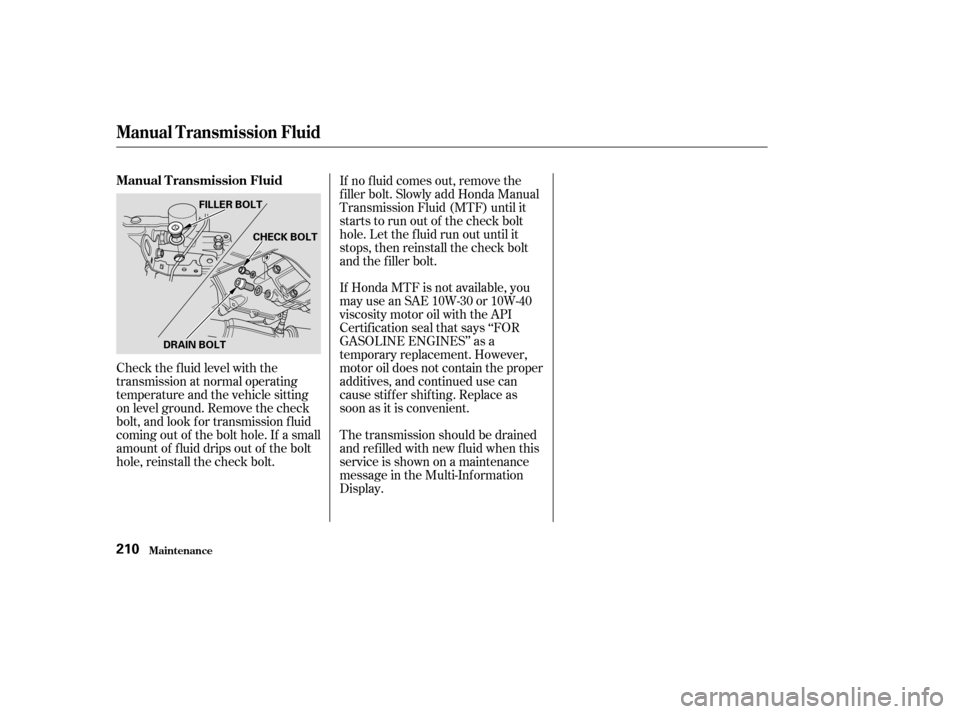
Check the f luid level with the
transmission at normal operating
temperature and the vehicle sitting
on level ground. Remove the check
bolt, and look f or transmission f luid
coming out of the bolt hole. If a small
amount of f luid drips out of the bolt
hole, reinstall the check bolt.If Honda MTF is not available, you
may use an SAE 10W-30 or 10W-40
viscosity motor oil with the API
Certif ication seal that says ‘‘FOR
GASOLINE ENGINES’’ as a
temporary replacement. However,
motor oil does not contain the proper
additives, and continued use can
cause stiffer shifting. Replace as
soon as it is convenient. If no f luid comes out, remove the
f iller bolt. Slowly add Honda Manual
Transmission Fluid (MTF) until it
starts to run out of the check bolt
hole. Let the f luid run out until it
stops, then reinstall the check bolt
and the f iller bolt.
The transmission should be drained
and ref illed with new f luid when this
service is shown on a maintenance
message in the Multi-Inf ormation
Display.
Manual T ransmission Fluid
Maint enance
Manual Transmission Fluid
210
CHECK BOLT
DRAIN BOLT FILLER BOLT
Page 224 of 283

The following chart shows the
recommended cold tire pressures f or
most normal driving conditions and
speed.Thecompactsparetirepressureis:
Because your tires have a low prof ile,
do not rely on a visual inspection to
determine whether the tires have the
proper air pressure.
Instead, we recommend that you use
a gauge to measure the air pressures
.Eventires
that are in good condition may loose
one to two psi (10 to 20 kPa, 0.1 to
0.2 kgf /cm
)parmonth.
Remember to check the spare tire at
thesametimeyoucheckallthe
other tires. Acura strongly recommends that you
not drive f aster than posted speed
limits and conditions allow. If you
decide it is saf e to drive at high
speeds (over 118 mph or 190 kph),
be sure to adjust the cold tire
pressuresasshownbelow.If youdo
not adjust the tire pressure,
excessive heat can build up and
cause sudden tire f ailure.
CONT INUED
Tire Size Cold Tire Pressure for
Normal Driving
Tire Size Cold Tire Pressure for Normal Driving Tire Size Cold Tire Pressure for
High Speed DrivingAutomatic Transmission Models
Manual Transmission Models All Models
Tires
Maint enance
Recommended T ire Pressures f orNormal Driving
Recommended T ire Pressures f orHigh Speed Driving
at least once a month
221
60 psi (420 kPa , 4.2 kgf/cm)
P235/45R17 93W
35 psi (240 kPa ,2.4 kgf/cm
)
32 psi (220 kPa , 2.2 kgf/cm
)
P235/45R17 93W
235/45R17 93W P235/45R17 93W
235/45R17 93W 39 psi (270 kPa ,
2.7 kgf/cm
)
35 psi (240 kPa , 2.4 kgf/cm
)
32 psi (220 kPa ,
2.2 kgf/cm
)
32 psi (220 kPa , 2.2 kgf/cm
)
Front:
Rear:
Front:
Rear:
Front:
Rear:
Using tires that are excessively
worn or improperly inflated can
cause a crash in which you can
be seriously hurt or killed.
Follow all instructions in this
owner’s manual regarding tire
inflation and maintenance.


