Page 102 of 134

4-9
E
EJU01355
Periodic maintenance chart
The following chart gives general guidelines for periodic maintenance. However, depend-
ing on your operating conditions maintenance may need to be performed more frequently.
(
�) This mark indicates maintenance that you may do yourself.
(
❍) This mark indicates work to be done by a Yamaha dealer.
*1: Grease capacity: 33.0–35.0 cm3 (1.11–1.18 oz)
*2: Grease capacity: 6.0–8.0 cm3 (0.20–0.27 oz)
*3: Grease capacity: 8.0 cm3 (0.27 oz)
*4: Grease capacity: 2.0 cm3 (0.07 oz)
*5: After every use
*6: Before every use
*7: Inspect fluid level before every use
MAINTENANCE INTERVAL
INITIALTHEREAFTER
EVERYPA G E
10
hours50
hours100
hours100
hours200
hours
ITEM
6
months12
months12
months24
months
Spark plug Inspect, clean, adjust����
4-15
Lubrication points Lubricate��
4-16
Intermediate housing Lubricate❍
*1�
*2�
*2 4-19
Starter motor idle gear Lubricate❍
*3�
*4�
*4 4-19
Fuel system Inspect❍❍
4-10
Fuel filter Check, clean, replace❍❍
4-11
Fuel tank Clean❍
4-11
Oil injection system Inspect, clean❍❍
—
Carburetor setting Inspect, adjust❍❍❍
4-22
Trolling speed Inspect, adjust��
4-22
Carburetor throttle shaft Inspect❍❍
—
Cooling water passages Flush
�*5 4-1
Water inlet strainer Inspect, clean❍❍
—
Bilge strainer Clean��
—
Impeller Inspect
�*6❍❍
5-4
Jet thrust nozzle angle Inspect��
4-13
Steering master Inspect❍❍❍
—
QSTS mechanism Inspect
�*6❍❍
4-14
Shift cable and mechanism Inspect, adjust
�*6❍❍
4-13
Throttle lever Check operation
�*6 4-13
Throttle cable Inspect, adjust��
4-13
Choke knob Check operation
�*6 4-19
Choke cable Inspect, adjust❍❍
4-19
Stern drain plugs Inspect, replace
�*6❍❍
3-7
Battery Inspect
�*7❍❍
4-20
Rubber coupling Inspect❍
—
Engine mount Inspect❍
—
Nuts and bolts Inspect❍❍❍
—
UGU572.book Page 9 Wednesday, August 28, 2002 1:31 PM
Page 103 of 134
4-10
E
EJU01383
Inspecting the fuel system
WARNING@ Gasoline is highly flammable and explo-
sive. A fire or explosion can cause
severe injury or death. Shut off the
engine. Do not smoke. Avoid spilling
gasoline.
@
Check the fuel system for leaks, cracks,
or malfunctions. If any problem is found, do
the necessary repair or replacement as
required. If repair is necessary, consult a
Yamaha dealer.
Check:
�Carburetor for leakage.
�Fuel pump for malfunction or leakage.
�Fuel tank for water or dirt.
�Fuel tank for damage, cracks or leakage.
�Fuel hose joint for leakage.
�Fuel hose for cracks or other damage.
�Fuel filter for leakage.
�Fuel cock for leakage.
�Air vent check valve for leakage.
�Fuel tank filler cap for damage.
WARNING@ Failure to check for and repair any fuel
leakage may result in fire or explosion.
@
UGU572.book Page 10 Wednesday, August 28, 2002 1:31 PM
Page 108 of 134
4-15
E
EJU01342
Cleaning and adjusting the
spark plugs
The spark plug is an important engine
component and is easy to inspect. The con-
dition of the spark plug can indicate some-
thing about the condition of the engine. For
example, if the center electrode porcelain is
very white, this could indicate an intake air
leak or carburetion problem in that cylinder.
Do not attempt to diagnose any problems
yourself. Have a Yamaha dealer service the
watercraft.
Remove and inspect the spark plug peri-
odically; heat and deposits will cause the
spark plug to slowly break down and erode.
If electrode erosion becomes excessive, or if
carbon and other deposits are excessive,
replace the spark plug with the specified
plug.
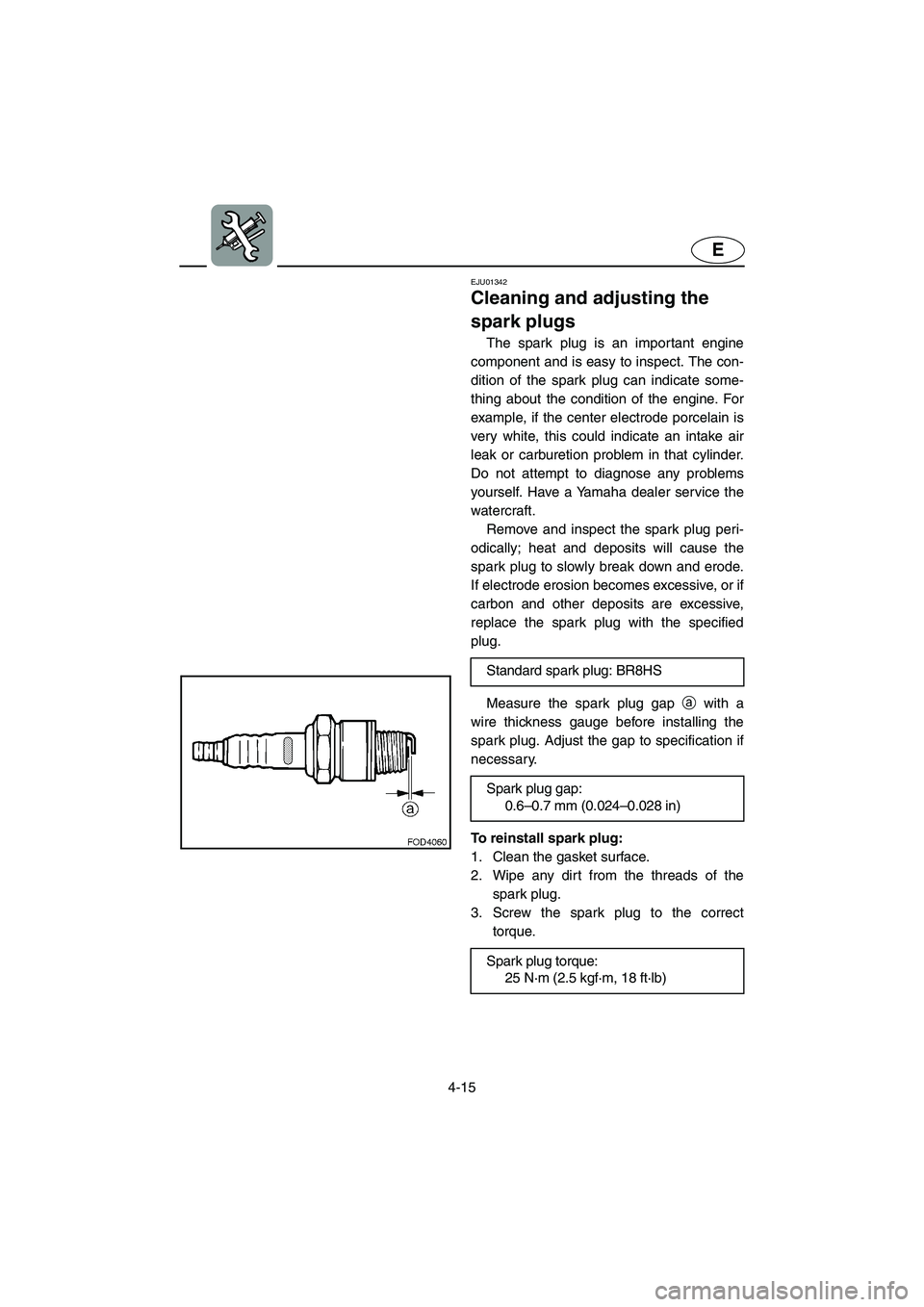
Measure the spark plug gap a with a
wire thickness gauge before installing the
spark plug. Adjust the gap to specification if
necessary.
To reinstall spark plug:
1. Clean the gasket surface.
2. Wipe any dirt from the threads of the
spark plug.
3. Screw the spark plug to the correct
torque. Standard spark plug: BR8HS
Spark plug gap:
0.6–0.7 mm (0.024–0.028 in)
Spark plug torque:
25 N·m (2.5 kgf·m, 18 ft·lb)
UGU572.book Page 15 Wednesday, August 28, 2002 1:31 PM
Page 115 of 134

4-22
E
EJU01109
Adjusting the carburetor
The carburetor is a vital part of the engine
and requires very sophisticated adjustment.
Most adjusting should be left to a Yamaha
dealer who has the professional knowledge
and experience to perform it. However, the
operator may adjust the trolling speed as
part of the usual maintenance routine.
CAUTION:@ The carburetor was set at the Yamaha
factory after many tests. If the settings
are disturbed by someone who does not
have the necessary technical knowledge,
poor engine performance and damage
may result.
@
EJU01262
Adjusting the trolling speed
1. Put the watercraft in the water.
2. Start the engine and warm it up for 1 or
2 minutes. Using a diagnostic tachome-
ter or, if necessary, the tachometer in the
multifunction meter, adjust the engine
speed to specification.
3. Turn the throttle stop screw 1 clockwise
to increase engine speed if necessary.
Turn it counterclockwise to decrease
engine speed if necessary.
Trolling speed: 1,250–1,350 r/min
UGU572.book Page 22 Wednesday, August 28, 2002 1:31 PM
Page 117 of 134

4-24
E
EJU01359
Specifications
MODEL
ITEMUnit SUV1200
WATERCRAFT CAPACITY
Maximum people on board Number of people 4
Maximum load capacity kg (lb) 300 (662)
DIMENSIONS
Length mm (in) 3,850 (151.6)
Width mm (in) 1,510 (59.4)
Height mm (in) 1,140 (44.9)
Dry weight kg (lb) 370 (816)
PERFORMANCE
Maximum output kW (PS) @ r/min 99.3 (135)@ 6,750
Maximum fuel consumption L/h (US gal/h, Imp gal/h) 53.0 (14.0, 11.7)
Cruising range at full throttle hr. 1.3
Trolling speed r/min 1,250–1,350
ENGINE
Engine type 2-stroke
Number of cylinders 3
Engine displacement
cm
3 (cu in)1,131 (69.01)
Bore & stroke mm (in) 84 ×
68 (3.31 ×
2.68)
Compression ratio 6.0:1
Lubrication system Oil injection
Cooling system Water cooled
Starting system Electric starter
Ignition system Digital CDI
Spark plug BR8HS (NGK)
Spark plug gap mm (in) 0.6–0.7 (0.024–0.028)
Battery capacity V-AH 12-19
Charging system Flywheel magneto
DRIVE UNIT
Propulsion system Jet pump
Jet pump type Axial flow, single stage
Impeller rotation Counterclockwise (viewed from rear)
Transmission Direct drive from engine
Jet thrust nozzle angle Degree 26 + 26
Trim nozzle angle Degree -7, -2, 3, 8, 13
FUEL AND OIL
Recommended fuel Regular unleaded gasoline
Minimum octane rating PON
RON86
90
Recommended engine oil YAMALUBE 2-W, or an equivalent NMMA-
certified TC-W3 marine oil
Fuel tank capacity
Total L (US gal, Imp gal) 70 (18.5, 15.4)
Reserve L (US gal, Imp gal) 12 (3.2, 2.6)
Oil tank capacity L (US gal, Imp gal) 5.5 (1.5, 1.2)
UGU572.book Page 24 Wednesday, August 28, 2002 1:31 PM
Page 120 of 134
5-1
E
EJU01116
Troubleshooting
If you have any trouble with your watercraft, use this section to check for the possible
cause.
If you cannot find the cause, or if the procedure for replacement or repair is not described
in this Owner’s/Operator’s Manual, have a Yamaha dealer perform the necessary service.
EJU01367
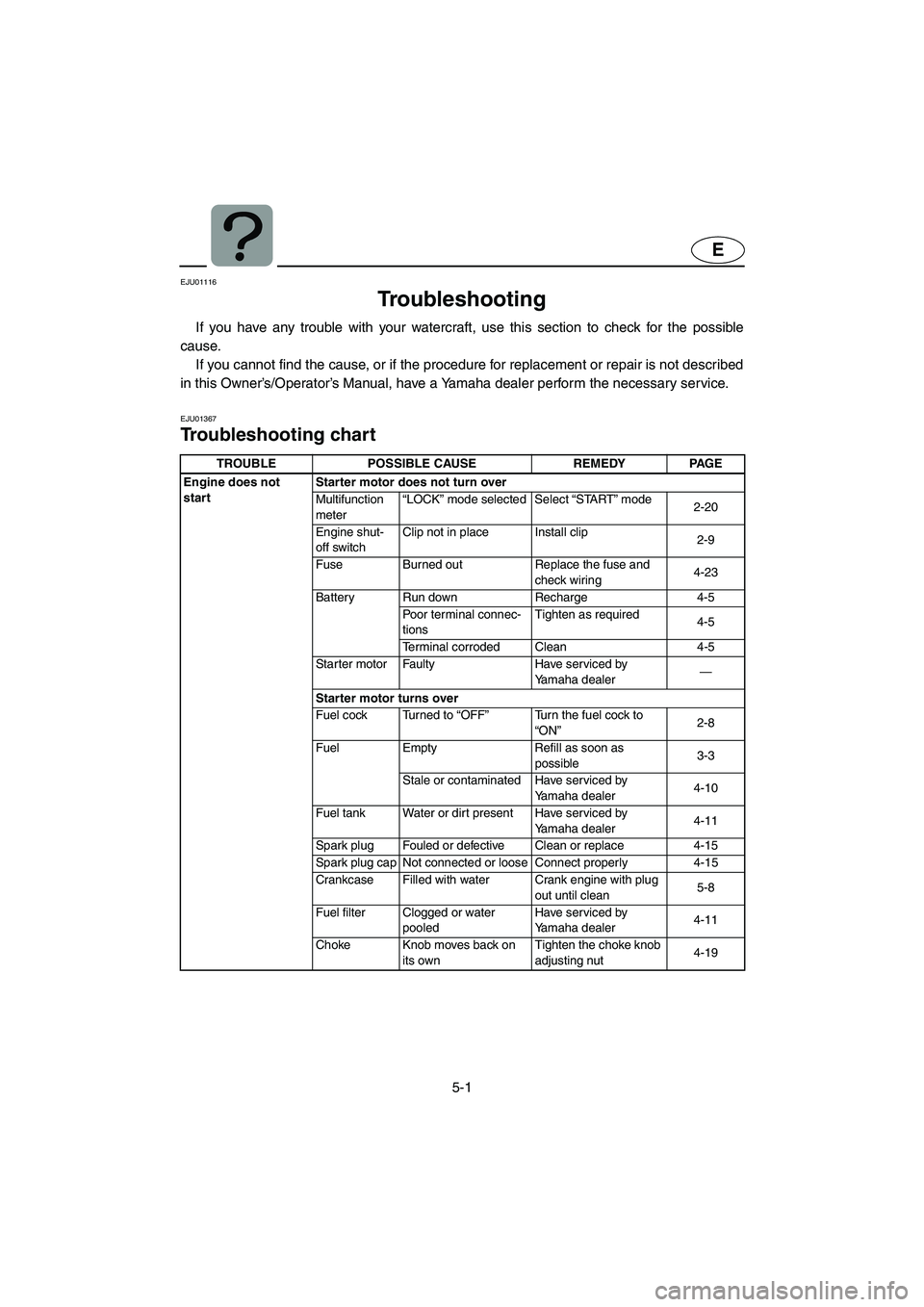
Troubleshooting chart
TROUBLE POSSIBLE CAUSE REMEDY PAGE
Engine does not
startStarter motor does not turn over
Multifunction
meter“LOCK” mode selected Select “START” mode
2-20
Engine shut-
off switchClip not in place Install clip
2-9
Fuse Burned out Replace the fuse and
check wiring4-23
Battery Run down Recharge 4-5
Poor terminal connec-
tionsTighten as required
4-5
Terminal corroded Clean 4-5
Starter motor Faulty Have serviced by
Yamaha dealer—
Starter motor turns over
Fuel cock Turned to “OFF”Turn the fuel cock to
“ON”2-8
Fuel Empty Refill as soon as
possible3-3
Stale or contaminated Have serviced by
Yamaha dealer4-10
Fuel tank Water or dirt present Have serviced by
Yamaha dealer4-11
Spark plug Fouled or defective Clean or replace 4-15
Spark plug cap Not connected or loose Connect properly 4-15
Crankcase Filled with water Crank engine with plug
out until clean5-8
Fuel filter Clogged or water
pooledHave serviced by
Yamaha dealer4-11
Choke Knob moves back on
its ownTighten the choke knob
adjusting nut4-19
UGU572.book Page 1 Wednesday, August 28, 2002 1:31 PM
Page 121 of 134
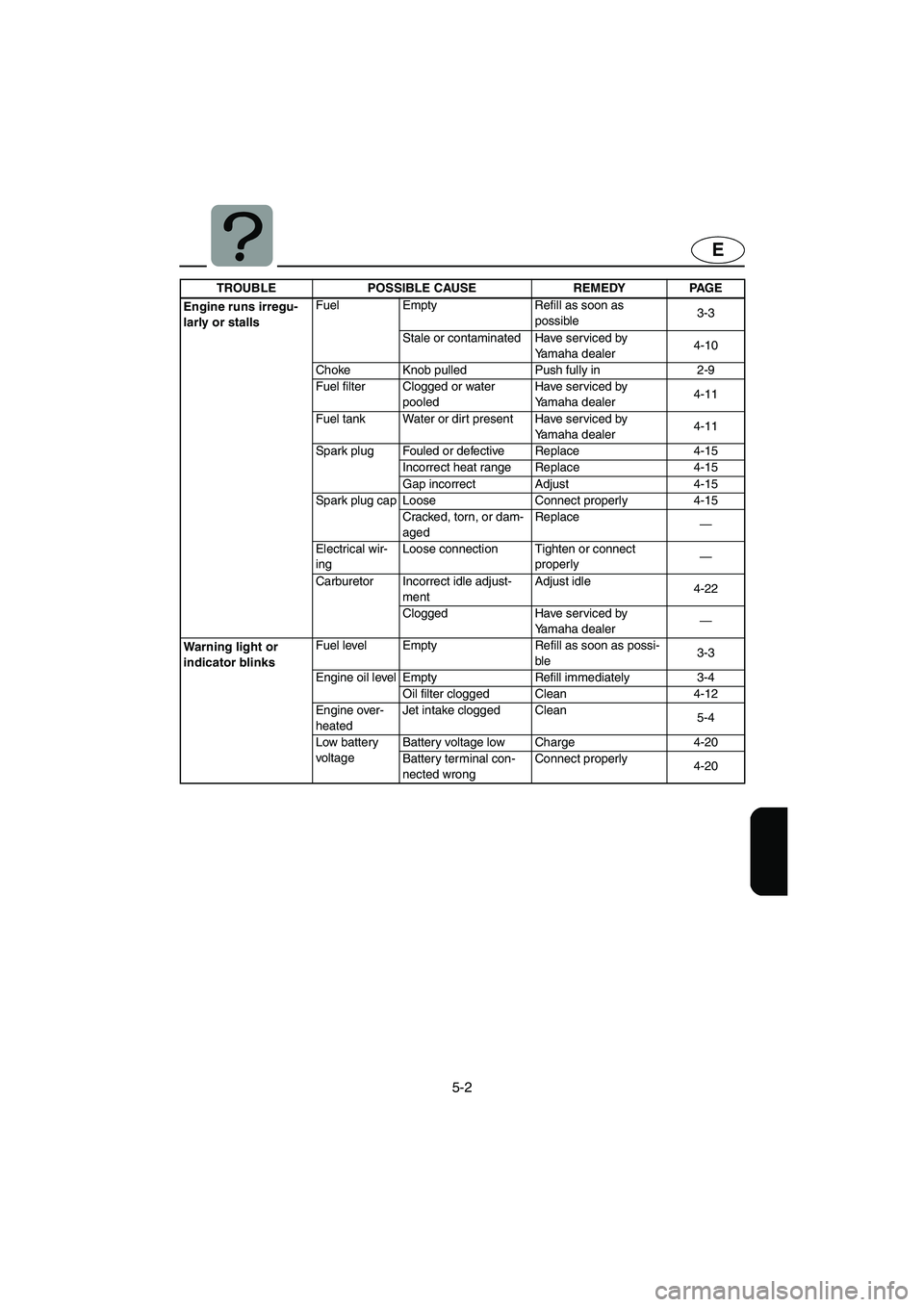
5-2
E
Engine runs irregu-
larly or stallsFuel Empty Refill as soon as
possible3-3
Stale or contaminated Have serviced by
Yamaha dealer4-10
Choke Knob pulled Push fully in 2-9
Fuel filter Clogged or water
pooledHave serviced by
Yamaha dealer4-11
Fuel tank Water or dirt present Have serviced by
Yamaha dealer4-11
Spark plug Fouled or defective Replace 4-15
Incorrect heat range Replace 4-15
Gap incorrect Adjust 4-15
Spark plug cap Loose Connect properly 4-15
Cracked, torn, or dam-
agedReplace
—
Electrical wir-
ingLoose connection Tighten or connect
properly—
Carburetor Incorrect idle adjust-
mentAdjust idle
4-22
Clogged Have serviced by
Yamaha dealer—
Warning light or
indicator blinksFuel level Empty Refill as soon as possi-
ble3-3
Engine oil level Empty Refill immediately 3-4
Oil filter clogged Clean 4-12
Engine over-
heatedJet intake clogged Clean
5-4
Low battery
voltageBattery voltage low Charge 4-20
Battery terminal con-
nected wrongConnect properly
4-20 TROUBLE POSSIBLE CAUSE REMEDY PAGE
UGU572.book Page 2 Wednesday, August 28, 2002 1:31 PM
Page 122 of 134
5-3
E
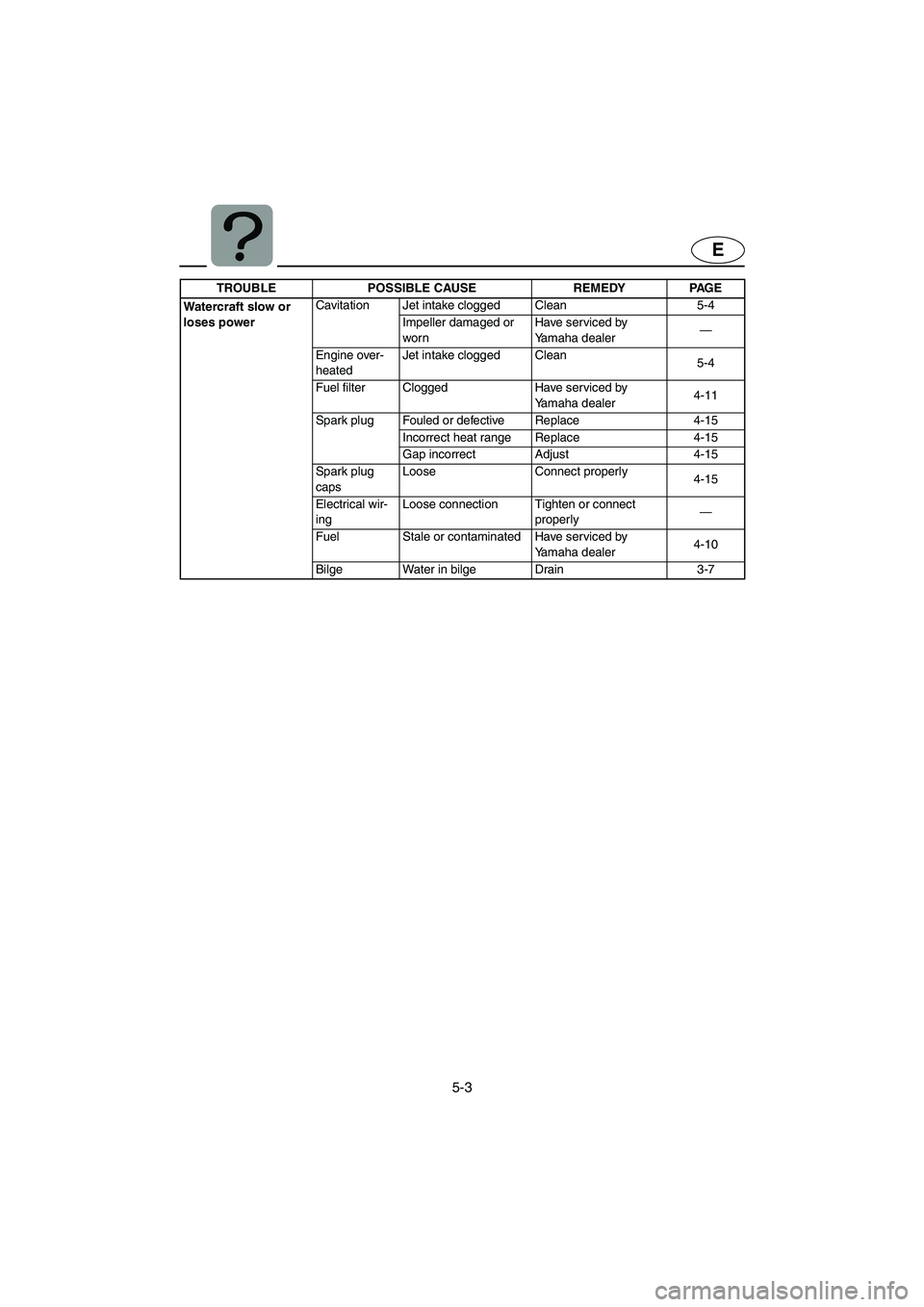
Wate rcr af t slow or
loses powerCavitation Jet intake clogged Clean 5-4
Impeller damaged or
wornHave serviced by
Yamaha dealer—
Engine over-
heatedJet intake clogged Clean
5-4
Fuel filter Clogged Have serviced by
Yamaha dealer4-11
Spark plug Fouled or defective Replace 4-15
Incorrect heat range Replace 4-15
Gap incorrect Adjust 4-15
Spark plug
capsLoose Connect properly
4-15
Electrical wir-
ingLoose connection Tighten or connect
properly—
Fuel Stale or contaminated Have serviced by
Yamaha dealer4-10
Bilge Water in bilge Drain 3-7 TROUBLE POSSIBLE CAUSE REMEDY PAGE
UGU572.book Page 3 Wednesday, August 28, 2002 1:31 PM