Page 234 of 388
7-61
CROSSING A SLOPE
Traversing a sloping surface on your ATV requires
you to properly position your weight to maintain
proper balance. Be sure that you have learned the
basic riding skills on flat ground before attempting
to cross a sloping surface. Avoid slopes with slip-
pery surfaces or rough terrain that may upset your
balance.
As you travel across a slope, lean your body in the
uphill direction. It may be necessary to correct the
steering when riding on loose surfaces by pointing
the front wheels slightly uphill. When riding on
slopes be sure not to make sharp turns either up or
down hill.
EE.book Page 61 Monday, June 18, 2001 10:18 AM
Page 236 of 388
7-63
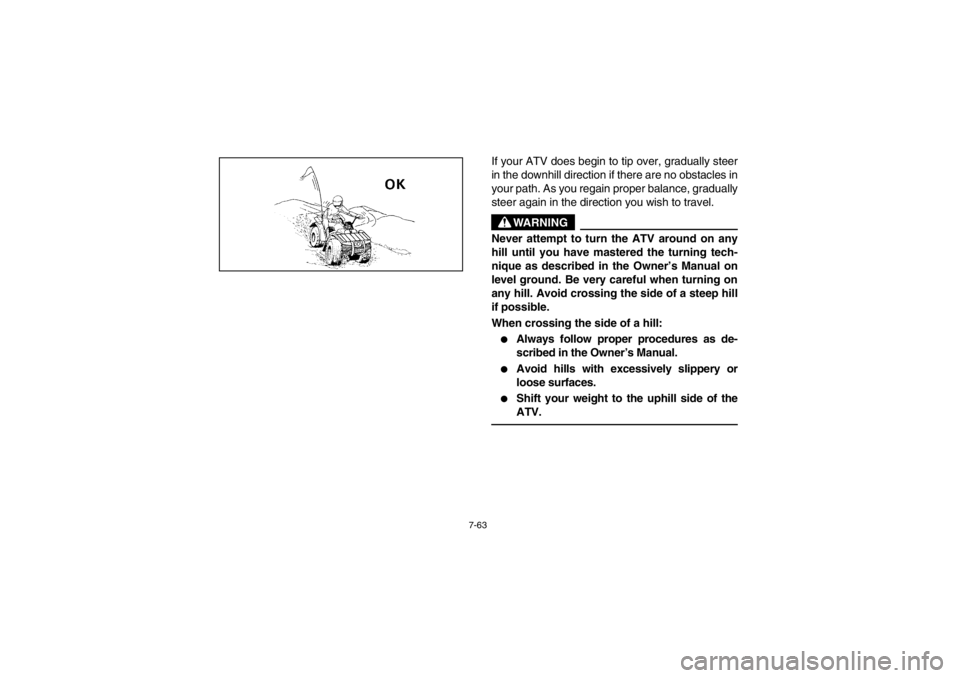
If your ATV does begin to tip over, gradually steer
in the downhill direction if there are no obstacles in
your path. As you regain proper balance, gradually
steer again in the direction you wish to travel.
WARNING
Never attempt to turn the ATV around on any
hill until you have mastered the turning tech-
nique as described in the Owner’s Manual on
level ground. Be very careful when turning on
any hill. Avoid crossing the side of a steep hill
if possible.
When crossing the side of a hill:�
Always follow proper procedures as de-
scribed in the Owner’s Manual.
�
Avoid hills with excessively slippery or
loose surfaces.
�
Shift your weight to the uphill side of the
ATV.
EE.book Page 63 Monday, June 18, 2001 10:18 AM
Page 244 of 388
7-71
SLIDING AND SKIDDING
Care should be used when riding on loose or slip-
pery surfaces since the ATV may slide. If unex-
pected and uncorrected, sliding could lead to an
accident.
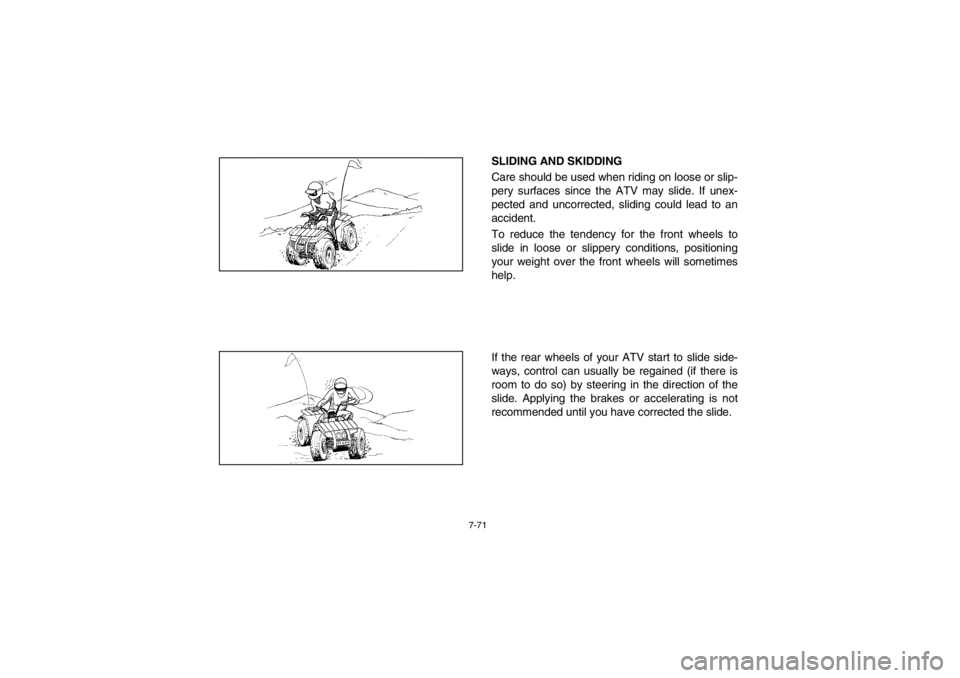
To reduce the tendency for the front wheels to
slide in loose or slippery conditions, positioning
your weight over the front wheels will sometimes
help.
If the rear wheels of your ATV start to slide side-
ways, control can usually be regained (if there is
room to do so) by steering in the direction of the
slide. Applying the brakes or accelerating is not
recommended until you have corrected the slide.
EE.book Page 71 Monday, June 18, 2001 10:18 AM
Page 248 of 388
7-75
WHAT TO DO IF...
This section is designed to be a reference guide
only. Be sure to read each section on riding tech-
niques completely.
WHAT TO DO...�
If your ATV doesn’t turn when you want it to:
Bring the ATV to a stop and practice the turning
maneuvers again. Be sure you are putting your
weight on the footboard to the outside of the
turn. Position your weight over the front wheels
for better control. (See pages 7-41 ~ 7-45.)
�
If your ATV begins to tip while turning:
Lean more into the turn to regain balance. If nec-
essary, gradually let off the throttle and/or steer to
the outside of the turn. (See pages 7-41 ~ 7-45.)
�
If your ATV starts to slide sideways:
Steer in the direction of the slide if you have the
room. Applying the brakes or accelerating is
not recommended until you have corrected the
slide. (See pages 7-71 ~ 7-73.)
EE.book Page 75 Monday, June 18, 2001 10:18 AM
Page 250 of 388
7-77�
If your ATV can’t make it up a hill you are trying
to climb:
Turn the ATV around if you still have forward
speed. If not, stop, dismount on the uphill side
of the ATV and physically turn the ATV around.
If the ATV starts to slip backwards DO NOT
USE THE REAR BRAKE - the ATV may tip
over on top of you. Dismount the ATV on the
uphill side. (See pages 7-47 ~ 7-55.)
�
If your ATV is traversing a sloping surface:
Be sure to ride with your weight positioned to-
wards the uphill side of the ATV to maintain
proper balance. If the ATV starts to tip, steer
down the hill (if there are no obstacles in your
way) to regain balance. If you discover that the
ATV is going to tip over, dismount on the uphill
side. (See pages 7-61 ~ 7-63.)
EE.book Page 77 Monday, June 18, 2001 10:18 AM
Page 366 of 388
10-1
EBU00428
1-SPECIFICATIONS
Model YFM400FP/YFM400FW
Dimensions:
Overall length 1,956 mm
Overall width 1,155 mm
Overall height 1,144 mm
Seat height 845 mm
Wheelbase 1,210 mm
Minimum ground clearance 215 mm
Minimum turning radius 3,500 mm
Basic weight:
With oil and full fuel tank 286 kg
Engine:
Engine type Air-cooled 4-stroke, SOHC
Cylinder arrangement Forward-inclined single cylinder
Displacement 386 cm
3
Bore
× stroke 83.0 ×
71.5 mm
Compression ratio 8.6:1
Starting system Electric and recoil starter
Lubrication system Wet sump
EE.book Page 1 Monday, June 18, 2001 10:18 AM
Page 384 of 388
11-1
EBU00429
HOW TO USE THE CONVERSION TABLE
All specification data in this manual are listed in SI
and METRIC UNITS.
Use this table to convert METRIC unit data to IM-
PERIAL unit data.
Ex.
CONVERSION TABLE
METRIC MULTIPLIER IMPERIAL
**mm
×
0.03937 = **in
2 mm
×
0.03937 = 0.08 in
METRIC TO IMPERIAL
Metric unit Multiplier Imperial unit
Torquem·kg
m·kg
cm·kg
cm·kg7.233
86.794
0.0723
0.8679ft·lb
in·lb
ft·lb
in·lb
Weightkg
g2.205
0.03527lb
oz
Speed km/hr 0.6214 mph
Distancekm
m
m
cm
mm0.6214
3.281
1.094
0.3937
0.03937mi
ft
yd
in
in
Volume /
Capacitycc (cm3)
cc (cm3)
lt (liter)
lt (liter)0.03527
0.06102
0.8799
0.2199oz (IMP liq.)
cu·in
qt (IMP liq.)
gal (IMP liq.)
Misc.kg/mm
kg/cm2
Centigrade
(°
C)55.997
14.2234
9/5 + 32 lb/in
psi (lb/in
2)
Fahrenheit (°
F)
EE.book Page 1 Monday, June 18, 2001 10:18 AM
Page:
< prev 1-8 9-16 17-24