2003 VOLVO XC90 display
[x] Cancel search: displayPage 54 of 242

2003 VOLVO XC90
Cruise control
The cruise control panel is located on the left side of the steering whe\
el hub.
Engaging cruise control/setting speed
l Press the CRUISE button. The word CRUISE will be displayed in the window\
in the lower section of
the speedometer.
l Press + or - to set the current speed
l Increase or decrease speed as desired
NOTE: Cruise control will not function at speeds below 22 mph (35 km/h).
Braking
Cruise control is automatically disengaged when the brake pedal is depre\
ssed. The currently set speed is
stored in memory. Quickly pressing resume will return the vehicle to the\
previously set speed.
Acceleration
l Momentary acceleration, such as when passing another vehicle, does not a\
ffect cruise control
operation. The vehicle will automatically return to the previously set s\
peed when you release the
accelerator pedal.
l When the cruise control is already engaged, the vehicle's speed can be i\
ncreased or decreased by
holding down + or - until the vehicle reaches the desired speed. One sho\
rt press on either symbol
corresponds to a speed change of approximately 1 mph (1.6 km/h).
Disengaging cruise control
Cruise control can also be disengaged by:
l Pressing the CRUISE button.
l Putting the gear selector in (N)eutral.
NOTE: Cruise control is automatically disengaged if the engine is switched off\
, if the gear selector is
file:///K|/ownersdocs/2003/2003_XC90/03xc90_02b.htm (4 of 14)12/30/200\
6 4:18:53 PM
Page 58 of 242

2003 VOLVO XC90
12-volt socket in the cargo compartment
l If the ignition is switched off and a device drawing more than 0.1A is c\
onnected to a socket, a battery
warning will be displayed in the text window.
l The covers should be kept on when the auxiliary sockets are not in use. \
l Maximum current from the sockets is 15A.
Ashtrays/cigarette lighter
The auxiliary sockets can also be used for cigarette lighters.
Ashtrays and lighters are available as accessories. Please contact your \
Volvo retailer.
pg. 40 Instruments and controls
Electrically operated windows
The electrically operated windows are controlled by buttons in the arm r\
ests.
l The ignition switch must be ON* (ignition key in position I, II or the \
engine running) for the
electrically operated windows to function.
l To lower: Press down the front edge of the button to the first detent (\
"stop").
l To raise: Lightly pull up the front edge of the button to the first dete\
nt ("stop").
* The electrically operated windows will also function after the ignitio\
n has been switched off as long as
neither of the front doors has been opened.
Auto up/down function (front doors only):
Either front door window can be opened or closed automatically.
Auto down: Press the front part of the button as far down as possible and release i\
t immediately. To
stop the window at any time, pull the button up.
Auto up: Pull the front part of the button up as far as possible and release it i\
mmediately. To stop the
file:///K|/ownersdocs/2003/2003_XC90/03xc90_02b.htm (8 of 14)12/30/200\
6 4:18:53 PM
Page 66 of 242

2003 VOLVO XC90
Acceleration
The air conditioning is momentarily disengaged during full-throttle acce\
leration.
Climate control maintenance
All maintenance on the climate control systems should be carried out by \
an authorized Volvo service technician only.
Refrigerant
Volvo cares about the environment. The air conditioning system in your v\
ehicle contains a CFC-free refrigerant - R134a.
This substance will not deplete the ozone layer. The system contains 2.2\
lbs (1000 g) R134a and uses PAG oil.
Passenger compartment blower
Approximately 50 minutes after the ignition is turned off, the blower ma\
y come on automatically, and run for seven
minutes, to remove condensation in the A/C evaporator.
Blower function to reduce battery drain
The climate system's blower functions normally while the engine is runni\
ng.
However, when the engine is switched off (even if the ignition is switc\
hed to positions I or II), the blower control will be
automatically switched off to avoid unnecessary battery drain. The follo\
wing points pertain if the ignition key is on but the
engine is not running:
l To restart the blower, turn the control knob to the setting of your choi\
ce.
l After approximately 2 minutes, the blower speed will be reduced to avoid\
battery drain.
You can reset the blower speed at any time. Please be aware that the sys\
tem has been designed to reduce the blower's speed
again after 2 minutes, until the engine is started. If the battery becom\
es drained:
l LOW BATTERY, FAN IS REDUCED will be displayed in the text window in the \
instrument panel.
l The yellow warning light in the instrument panel (see page 25) will also light up.
pg. 47 Climate control
Air distribution
Air distribution
The incoming air is distributed through the ventilation points in the pa\
ssenger compartment shown above.
file:///K|/ownersdocs/2003/2003_XC90/03xc90_03.htm (2 of 7)12/30/2006 \
4:18:54 PM
Page 102 of 242

2003 VOLVO XC90
The function can be turned off by pressing any of the buttons on the rem\
ote control or will stop
automatically after 25 seconds. When a button is pressed, there is a 5 s\
econd delay before the panic
alarm is deactivated.
NOTE: This button will NOT unlock the vehicle.
pg. 81 Locks and Alarm
Temporarily turning off the alarm sensor(s) - option
This button will only be found in vehicles equipped with the accessory i\
nclination and/or movement
sensors.
In certain situations it may be desirable to turn off the accessory incl\
ination and movement alarm
sensors if, for example, you drive your vehicle onto a ferry where the r\
ocking of the boat could trigger
the alarm or if a pet is left in the vehicle with the doors locked.
To temporarily turn off the inclination and movement alarm sensors from \
the alarm system:
From the time the ignition key is turned from the Drive position (posit\
ion II) until you lock the vehicle,
you can press the button in the center console*. The LED in the switch w\
ill light up and a message will
be displayed in the text window to indicate that the sensors are disconn\
ected.
The vehicle can then be locked in the usual way to set the alarm.
NOTE: The optional sensors are automatically reconnected to the alarm system t\
he next time the
vehicle is unlocked and then locked again. LED alarm status signals The \
status of the alarm system is
file:///K|/ownersdocs/2003/2003_XC90/03xc90_05.htm (10 of 11)12/30/200\
6 4:18:56 PM
Page 103 of 242
2003 VOLVO XC90
indicated by the red LED at the top of the dash:
l LED off - the alarm is not armed
l LED flashes once per second - the alarm is armed
l LED flashes rapidly before the ignition is switched on - the alarm has b\
een triggered
l Fault in the alarm system: If a fault has been detected in the alarm system, a message will be
displayed in the text window. Contact your Volvo retailer.
Automatic re-lock/re-arm system
If the vehicle is unlocked with the remote, the vehicle will re-lock and\
the alarm will re-arm after 2
minutes unless a door or the tailgate has been opened.
* The position of this button may vary, depending on the specifications \
of your vehicle.
pg. 82 Locks and Alarm
This page intentionally left blank
Contents | Top of Page
file:///K|/ownersdocs/2003/2003_XC90/03xc90_05.htm (11 of 11)12/30/200\
6 4:18:56 PM
Page 113 of 242

2003 VOLVO XC90
WARNING!
Avoid driving diagonally across steep inclines as this could increase th\
e risk of a roll-over. Try to
drive straight up or down the slope.
If the road is very steep, avoid turning the vehicle around to help avoi\
d the risk of rolling over. Back
the vehicle up or down the incline instead.
NOTE: Avoid driving on steep inclines if the fuel tank is nearly empty. If the\
flow of fuel to the engine
is interrupted due to the vehicle's angle of inclination, this could res\
ult in damage to the three-way
catalytic converter. We recommend keeping the fuel tank at least half fu\
ll when driving on steep inclines.
Driving through water
l The vehicle should not be driven through water that is deeper than 18 in\
ches (48 cm). Driving through
deeper water could result in damage to transmission components or the di\
fferential, or to the engine if
excess water is drawn in through the air intake system.
l Drive slowly and avoid stopping when driving through water.
l After having driven through water, apply the brakes lightly several time\
s to remove water, mud, etc
from the brake discs.
l Never allow the vehicle to stand in water above the door sills. This cou\
ld result in damage to the
electrical system.
Conserving electrical current
Keep the following in mind to help minimize battery drain:
l When the engine is not running, avoid turning the ignition key to positi\
on II (see page 88). Many
electrical systems (the audio system, the optional infotainment/navigat\
ion systems, power windows, etc)
will function with the ignition key in position I. This position reduces\
drain on the battery.
l Please keep in mind that using systems, accessories, etc that consume a \
great deal of current when the
engine is not running could result in the battery being completely drain\
ed.
NOTE: A warning message will be displayed in the text window in the instrument\
panel when the
battery charge is low.
pg. 91 Starting and driving
Automatic transmission with Geartronic
file:///K|/ownersdocs/2003/2003_XC90/03xc90_06a.htm (10 of 15)12/30/20\
06 4:18:58 PM
Page 116 of 242

2003 VOLVO XC90
l Models equipped with a 5-cylinder turbo engine have five forward speeds.\
Models equipped with a 6-
cylinder turbo engine have four forward speeds
l A "lock-up" feature on gears 3 and 4 (and 5, if equipped) reduces engi\
ne speed and help saves fuel.
The currently selected gear will be displayed in the instrument panel (\
see
page 24).
l To access the (MAN)ual shifting position from (D)rive, move the gear selector to the left to MAN.
l To return to the (D)rive position from MAN, move the gear selector to the right.
While driving
If you select the (MAN)ual position while driving, the gear that was being used in the (D)rive position
will also initially be selected in (MAN)ual position.
l Move the gear selector forward (toward "+") to shift to a higher gear \
or rearward (toward "-") to shift
to a lower gear.
l If you hold the gear selector toward "-", the transmission will downshif\
t one gear and will utilize the
braking power of the engine. If the current speed is too high for using \
a lower gear, the downshift will
not occur until the speed has decreased enough to allow the lower gear t\
o be used.
l If you slow down to a very low speed, the transmission will automaticall\
y shift down.
l When starting in the (MAN)ual position, 3rd gear is the highest gear that may be selected.
Kickdown
Automatic shift to a lower gear (kickdown) is achieved by depressing t\
he accelerator pedal fully and
briskly. An upshift will occur when approaching the top speed for a part\
icular gear or by releasing the
accelerator pedal slightly. Kickdown can be used for maximum acceleratio\
n or when passing at highway
speeds.
NOTE: The gear selector must be in the D (Drive) position for kickdown to fu\
nction.
Automatic transmission - adaptive system
The automatic transmission is controlled by an adaptive control system t\
hat constantly monitors the way
in which the transmission functions. It senses and adapts each gear shif\
t for optimal performance. The
system also monitors your particular driving style and adapts gear shift\
ing accordingly.
pg. 93 Starting and driving
file:///K|/ownersdocs/2003/2003_XC90/03xc90_06a.htm (13 of 15)12/30/20\
06 4:18:58 PM
Page 117 of 242
2003 VOLVO XC90
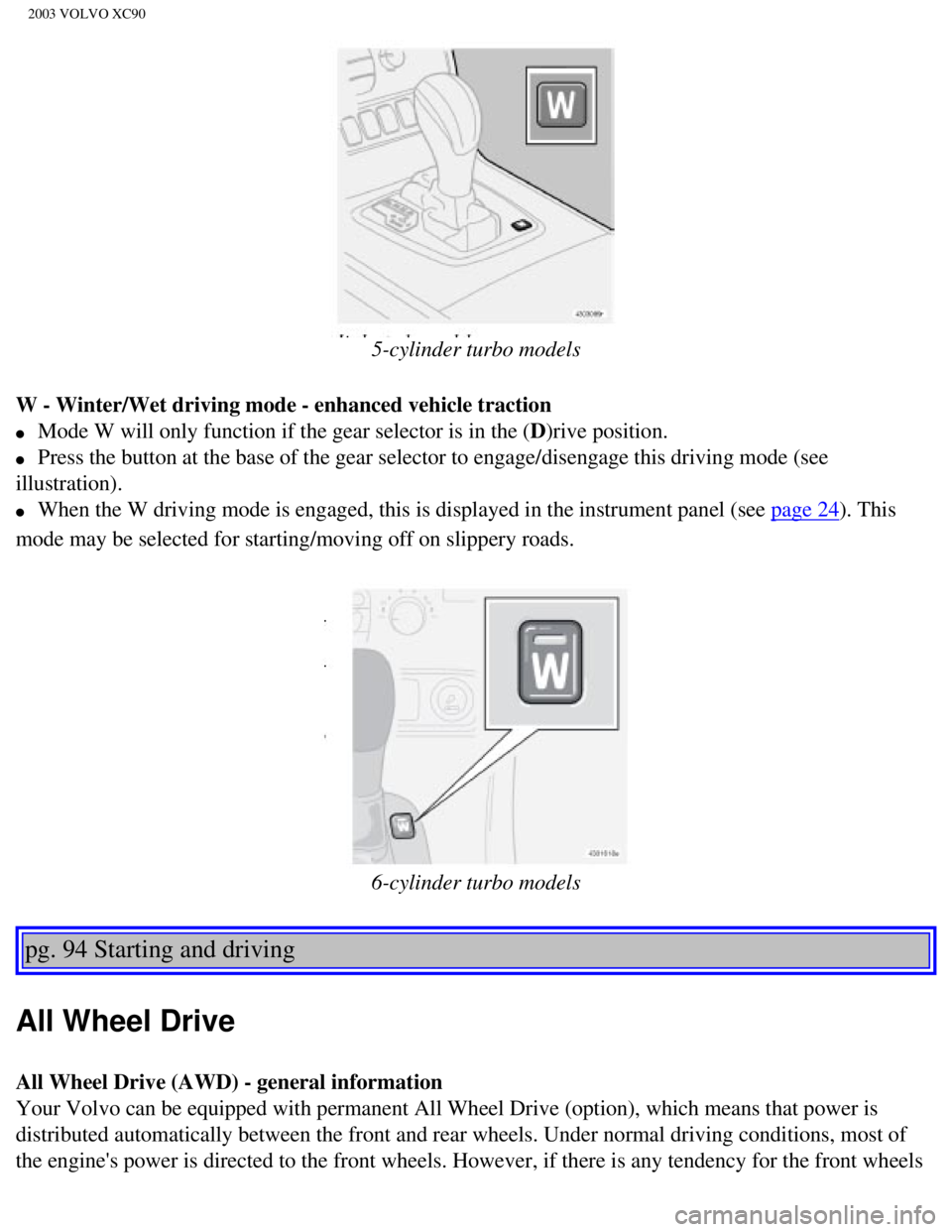
5-cylinder turbo models
W - Winter/Wet driving mode - enhanced vehicle traction
l Mode W will only function if the gear selector is in the (D)rive position.
l Press the button at the base of the gear selector to engage/disengage th\
is driving mode (see
illustration).
l When the W driving mode is engaged, this is displayed in the instrument \
panel (see page 24). This
mode may be selected for starting/moving off on slippery roads.
6-cylinder turbo models
pg. 94 Starting and driving
All Wheel Drive
All Wheel Drive (AWD) - general information
Your Volvo can be equipped with permanent All Wheel Drive (option), wh\
ich means that power is
distributed automatically between the front and rear wheels. Under norma\
l driving conditions, most of
the engine's power is directed to the front wheels. However, if there is\
any tendency for the front wheels
file:///K|/ownersdocs/2003/2003_XC90/03xc90_06a.htm (14 of 15)12/30/20\
06 4:18:58 PM