2003 VOLVO XC90 ESP
[x] Cancel search: ESPPage 138 of 242

2003 VOLVO XC90
beneficial.
l Before applying polish or wax the vehicle must be washed and dried. Tar \
spots can be removed with
kerosene or tar remover. Difficult spots may require a fine rubbing comp\
ound.
l After polishing use liquid or paste wax.
l Several commercially available products contain both polish and wax.
l Waxing alone does not substitute for polishing a dull surface.
l A wide range of polymer-based waxes can be purchased today. These waxes \
are easy to use and
produce a long-lasting, high-gloss finish that protects the bodywork aga\
inst oxidation, road dirt and
fading.
l Do not polish or wax your vehicle in direct sunlight (the surface of th\
e vehicle should not be warmer
than 113° F (45° C).
Cleaning the upholstery
l The fabric can be cleaned with soapy water or a detergent. For more diff\
icult spots caused by oil, ice
cream, shoe polish, grease, etc., use a clothing/fabric stain remover.
l The plastic in the upholstery can be cleaned with a soft cloth and mild \
soap solution.
l Leather upholstery/suede-like upholstery (alcanteraTM) can be cleaned with a soft cloth and mild soap
solution. For more difficult spots, Volvo offers a leather care kit.
l Under no circumstances should gasoline, naphtha or similar cleaning agen\
ts be used on the plastic or
the leather since these can cause damage.
Cleaning the seat belts
Clean only with lukewarm water and a mild soap solution.
Cleaning floor mats
The floor mats should be vacuumed or brushed clean regularly, especially\
during winter when they
should be taken out for drying. Spots on textile mats can be removed wit\
h a mild detergent.
Bear in mind
l Take extra care when removing stains such as ink or lipstick since the c\
oloring can spread.
l Use solvents sparingly. Too much solvent can damage the seat padding.
l Start from the outside of the stain and work toward the center.
pg. 112 Vehicle care
Paint touch up
Paint damage requires immediate attention to avoid rusting. Make it a ha\
bit to check the finish regularly
- when washing the vehicle for instance. Touch-up if necessary.
Paint repairs require special equipment and skill. Contact your Volvo re\
tailer for any extensive damage.
file:///K|/ownersdocs/2003/2003_XC90/03xc90_07.htm (3 of 5)12/30/2006 \
4:19:00 PM
Page 145 of 242

2003 VOLVO XC90
l With warm tires, correct only when the pressure is too low. The tire tem\
perature rises after driving
just a few miles.
Vehicle loading
The tires on your Volvo will perform to specifications at all normal loa\
ds when inflated as
recommended on the tire information label located on the inside of the f\
uel filler door. This label lists
both tire and vehicle design limits. Do not load your vehicle beyond the\
load limits indicated.
WARNING!
Improperly inflated tires will reduce tire life, adversely affect vehicl\
e handling and can possibly lead
to failure resulting in loss of vehicle control without prior warning.
Temporary Spare
The spare tire in your vehicle is called a "Temporary Spare".
Recommended tire pressure (see decal on Fuel filler door) should be ma\
intained irrespective which
position on the vehicle the Temporary Spare tire is used on. In the even\
t of damage this tire, a new one
can be purchased from your Volvo retailer.
WARNING!
Current legislation prohibits the use of the Temporary Spare" tire other\
than as a temporary
replacement for a punctured tire. It must be replaced as soon as possibl\
e by a standard tire. Road
holding and handling may be affected with the "Temporary Spare" in use. \
Do not exceed 50 mph (80
km/h). Do not drive farther than 50 miles (80 km) on a temporary spar\
e tire.
CAUTION
The vehicle must not be driven with wheels of different dimensions or wi\
th a spare tire other than the
one that came with the vehicle. The use of different size wheels can ser\
iously damage your vehicle's
transmission.
The temporary spare tire is for temporary, low-speed, short-distance use\
only. Replace it with a full-
sized tire as soon as possible, in accordance with "Tire Rotation" in th\
e previous paragraph. Do not drive
on the temporary spare at speeds above 50 m.p.h. (80km/h) or for dista\
nces greater than 50 miles (80
km). Never install snow chains on a temporary spare.
NOTE: Certain models may be equipped with a full-size spare tire. When used, i\
t should be inflated to
the same pressure as the tire it is replacing.
file:///K|/ownersdocs/2003/2003_XC90/03xc90_08.htm (5 of 12)12/30/2006\
4:19:01 PM
Page 147 of 242

2003 VOLVO XC90
TREADWEAR
The treadwear grade is a comparative rating based on the wear rate of th\
e tire when tested under
controlled conditions on a specified government test course. For example\
, a tire graded 150 would wear
one and one half (1 1/2) times as well on the government course as a t\
ire graded 100. The relative
performance of tires depends upon the actual conditions of their use, ho\
wever, and many depart
significantly from the norm due to variation in driving habits, maintena\
nce practices and differences in
road characteristics and climate.
TRACTION
The traction grades, from highest to lowest, are AA, A, B, and C, as mea\
sured under controlled
conditions on specified government test surfaces of asphalt and concrete\
. A tire marked C may have
poor traction performance.
WARNING!
The traction grade assigned to this tire is based on braking (straight-\
ahead) traction tests and is not a
measure of cornering (turning) traction.
TEMPERATURE
The temperature grades are AA (the highest), A, B, and C, representing\
the tire's resistance to the
generation of heat and its ability to dissipate heat when tested under c\
ontrolled conditions on specified
indoor laboratory test wheel. Sustained high temperature can cause the m\
aterial of the tire to degenerate
and reduce tire life, and excessive temperature can lead to sudden tire \
failure. The grade C corresponds
to minimum level of performance that all passenger vehicle tires must me\
et under the Federal Motor
Safety Standard No. 109. Grades B and A represent higher levels of perfo\
rmance on the laboratory test
wheel than the minimum required by law.
WARNING!
The temperature grade for this tire is established for a tire that is pr\
operly inflated and not overloaded.
Excessive speed, underinflation, or excessive loading, either separately\
or in combination, can cause
heat buildup and possible tire failure.
pg. 119 Wheels and tires
Changing wheels
file:///K|/ownersdocs/2003/2003_XC90/03xc90_08.htm (7 of 12)12/30/2006\
4:19:01 PM
Page 161 of 242

Checking the oil level
The oil level should be checked every time the vehicle is refueled. This\
is especially important
during the period up to the first ma")
2003 VOLVO XC90
Oil and fluids (contd)
Checking the oil level
The oil level should be checked every time the vehicle is refueled. This\
is especially important
during the period up to the first maintenance. CAUTION
Not checking the oil level regularly can result in serious engine damage\
if the oil level becomes too
low.
Park the vehicle on a level surface and wait for at least 5 minutes afte\
r the engine has been switched
off. Be sure the oil level is maintained between the upper and lower mar\
ks on the dipstick. Low oil
level can cause internal damage to the engine and overfilling can result\
in high oil consumption. The
distance between the dipstick marks represents approx. 1.6 US qt (1.5 l\
iter). The oil should preferably
be checked when cold, before the engine has been started.
NOTE: The engine must be stopped when checking the oil.
WARNING!
Do not allow oil to spill onto or come into contact with hot exhaust pip\
e
surfaces.
Adding oil (topping up)
l Add oil of the same kind as already used.
file:///K|/ownersdocs/2003/2003_XC90/03xc90_09a.htm (9 of 15)12/30/200\
6 4:19:02 PM
Page 178 of 242

2003 VOLVO XC90
Front fog lights
Avoid touching the glass on the bulb with your fingers.
1. Switch off the ignition.
2. Turn the bulb holder slightly counterclockwise to release it.
3. Replace the bulb. The shape of the foot of the bulb corresponds to th\
e shape of the bulb holder.
4. Reinstall the bulb holder by turning it slightly clockwise. The side \
of the holder marked "TOP" should
face upward.
pg. 141 Maintenance
Location of tail light bulbs
A - Turn signal - PY 21 W (amber)
B - Brake light - 21W BA 15
C - Back-up light - 21 W BA 15
file:///K|/ownersdocs/2003/2003_XC90/03xc90_09b.htm (11 of 23)12/30/20\
06 4:19:04 PM
Page 193 of 242
 specifica")
2003 VOLVO XC90
The VIN plate is located on the top left surface of the dashboard. The V\
IN is also stamped on the right
hand door pillar.
6 Federal Motor Vehicle Safety Standards (FMVSS) specifications (USA)\
and Ministry of
Transport (CMVSS) standards (Canada)
Your Volvo is designed to meet all applicable safety standards, as evide\
nced by the certification label on
the facing side of the driverÕs door. For further information regardi\
ng these regulations, please consult
your Volvo retailer.
7 Child safety latch label
*The Vehicle Identification Number (VIN) should always be quoted in al\
l correspondence concerning
your vehicle with the retailer and when ordering parts.
pg. 151 Specifications
Dimensions and weights
Dimensions Length 188.9 in (479.8 cm)
Width 74.7 in (189.8 cm)
Height 70.2 in (178.4 cm)
Wheelbase 112.5 in (285.7 cm)
Front track 64.3 in (163.4 cm)
Rear track 63.9 (162.4 cm)
Turning
circle 39-40 ft. (11.9-12.3 m)
Cargo capacity
With optional 3rd row of seats folded down:
5-seat: 41.6 cu ft (1178 litres)
7-seat: 43.3 cu ft (1225 litres)
Behind 1st row of seats, with 2nd (and optional 3rd) row of seats fold\
ed down:
5-seat: 84.9 cu ft (2403 litres)
7-seat: 85.1 cu ft (2410 litres)
Behind 1st row of seats, with front passenger seat, 2nd row (and option\
al 3rd row) of seats folded
file:///K|/ownersdocs/2003/2003_XC90/03xc90_10.htm (3 of 10)12/30/2006\
4:19:05 PM
Page 211 of 242
2003 VOLVO XC90
audible station and then stop.
3. Press one of the buttons again to start a new search.
Manually search for a known frequency
1. Press and hold the
or button (or the corresponding buttons on the steering wheel
keypad). MAN will be shown in the display. The radio will slowly scroll\
in the desired direction and
then increase speed after a few seconds.
2. Release the button when the desired frequency is displayed.
3. If you need to adjust the frequency, press briefly on
or .
4. The manual search function is available for five seconds after you la\
st pressed the button.
pg. 169 Audio
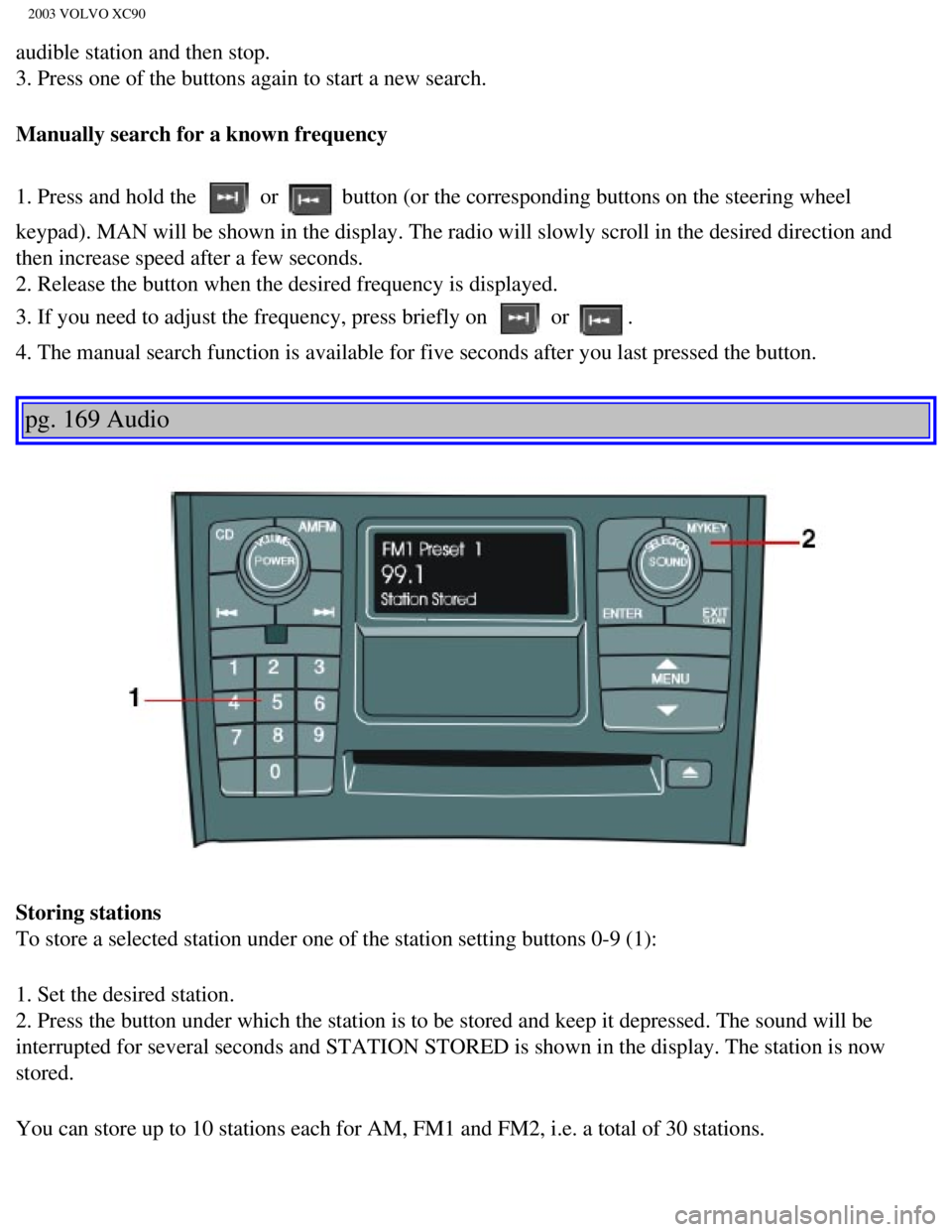
Storing stations
To store a selected station under one of the station setting buttons 0-9\
(1):
1. Set the desired station.
2. Press the button under which the station is to be stored and keep it \
depressed. The sound will be
interrupted for several seconds and STATION STORED is shown in the displ\
ay. The station is now
stored.
You can store up to 10 stations each for AM, FM1 and FM2, i.e. a total o\
f 30 stations.
file:///K|/ownersdocs/2003/2003_XC90/03xc90_11a.htm (11 of 17)12/30/20\
06 4:19:06 PM
Page 212 of 242
 to program a favorite function from the men\
u, such as SCAN,")
2003 VOLVO XC90
RadioFrequency band
FM 87.7 - 107.9 MHz
AM 530 - 1710 kHz
MY KEY - programming a shortcut
Use the MY KEY buttons (2) to program a favorite function from the men\
u, such as SCAN,
AUTOSTORE, etc. See
page 174 for the functions that can be programmed with the MY KEY button.
1. Use the MENU buttons to scroll among the functions.
2. Select the desired function from the menu by holding one of the MY KE\
Y buttons depressed for more
than two seconds.
3. When MY KEY STORED is shown in the display, the function has been sto\
red.
4. Activate the function by briefly pressing the MY KEY button with whic\
h the functions was stored.
Repeat steps 1-4 to store new functions on the MY KEY buttons.
NOTE: The MY KEY buttons can only be programmed for one shortcut function at a\
time.
pg. 170 Audio
Automatically storing stations - AUTOSTORE
This function automatically searches for, and stores up to 10 strong AM \
or FM stations in a separate
memory. If more than 10 stations are found, the 10 strongest ones will b\
e stored. The function is
especially useful in areas in which you are not acquainted with radio st\
ations or their frequencies.
file:///K|/ownersdocs/2003/2003_XC90/03xc90_11a.htm (12 of 17)12/30/20\
06 4:19:06 PM