2003 VOLVO XC70 roof
[x] Cancel search: roofPage 100 of 257

Open the tailgate. Hang or secure your grocery bags by means of tensioni\
ng straps or ho")
2003 VOLVO XC70
An extra roof lamp is fitted at the end of the cargo area.
Holder for grocery bags (option)
Open the tailgate. Hang or secure your grocery bags by means of tensioni\
ng straps or holders. To
remove the plastic tray (option), turn the two knobs at the sides.
Auxiliary 12 Volt socket in cargo area (option)
Fold down the cover when you want to use the electric socket.
NOTE: The socket is live whether the ignition is switched on or off. Using th\
e socket without the
engine running can drain your car's battery.
pg. 68 Securing cargo
file:///K|/ownersdocs/2003/2003_XC70/03xc70_04b.htm (9 of 21)12/30/200\
6 4:17:57 PM
Page 124 of 257
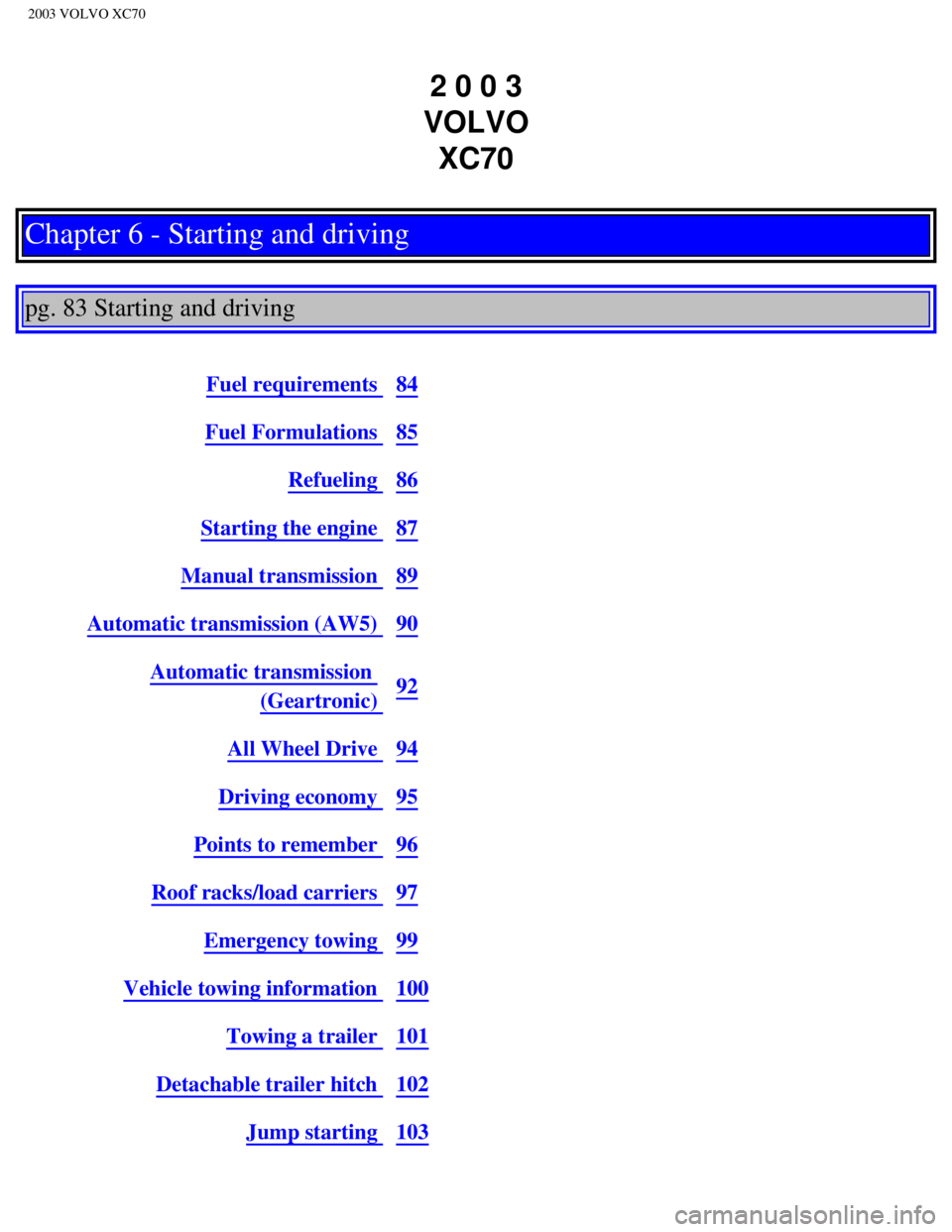
2003 VOLVO XC70
2 0 0 3
VOLVO XC70
Chapter 6 - Starting and driving
pg. 83 Starting and driving
Fuel requirements 84
Fuel Formulations 85
Refueling 86
Starting the engine 87
Manual transmission 89
Automatic transmission (AW5) 90
Automatic transmission
(Geartronic) 92
All Wheel Drive 94
Driving economy 95
Points to remember 96
Roof racks/load carriers 97
Emergency towing 99
Vehicle towing information 100
Towing a trailer 101
Detachable trailer hitch 102
Jump starting 103
file:///K|/ownersdocs/2003/2003_XC70/03xc70_06a.htm (1 of 22)12/30/200\
6 4:17:59 PM
Page 139 of 257

2003 VOLVO XC70
pattern, load-, speed-, traction-, temperature-, and treadwear rating. N\
ever drive on mixed tires, except
for brief periods when the temporary spare tire is in use.
Always use properly inflated tires of correct dimensions. Tire size and \
inflation pressures are shown on
the tire pressure label located inside the fuel filler door.
Tire Rotation
Volvo recommends rotating the tires every 7,500 miles (12,000 km). Tir\
es should be rotated front-to-
back/back-to-front only. Tires must maintain the same direction of rotat\
ion throughout their lifetime, and
should never be rotated from one side of the vehicle to the other.
Temporary Spare
The temporary spare tire is for temporary, low-speed, short-distance use\
only. Replace it with a full-
sized tire as soon as possible, in accordance with "Tire Rotation" above\
. Do not drive on the temporary
spare at speeds above 50 m.p.h. (80km/h) or for distances greater than\
50 miles (80 km).
Never install snow chains on a temporary spare.
pg. 95 Driving economy
Economical driving conserves natural resources
Better driving economy may be obtained by thinking ahead, avoiding rapid\
starts and stops and
adjusting the speed of your vehicle to immediate traffic conditions. Obs\
erve the following rules:
l Bring the engine to normal operating temperature as soon as possible by \
driving with a light foot on
the accelerator pedal for the first few minutes of operation. A cold eng\
ine uses more fuel and is subject
to increased wear.
l Whenever possible, avoid using the car for driving short distances. This\
does not allow the engine to
reach normal operating temperature.
l Drive carefully and avoid rapid acceleration and hard braking.
l Do not exceed posted speed limits.
l Avoid carrying unnecessary items (extra load) in the car.
l Maintain correct tire pressure. Check tire pressure regularly (when tir\
es are cold).
l Remove snow tires when threat of snow or ice has ended.
l Note that roof racks, ski racks, etc., increase air resistance and also \
fuel consumption.
l Avoid using automatic transmission kickdown feature unless necessary.
l Avoid using the air conditioning when it is not required. When engaged, \
the conditioner's compressor
places an additional load on the engine. However, at higher driving spee\
ds, fuel consumption will be
file:///K|/ownersdocs/2003/2003_XC70/03xc70_06a.htm (16 of 22)12/30/20\
06 4:18:00 PM
Page 142 of 257

2003 VOLVO XC70
Electrical system
When replacing the battery or when carrying out work involving the elect\
rical system, the following
should be observed:
l A battery connection to the wrong terminal will damage the electrical sy\
stem. Be sure to connect the
positive battery cable to the positive battery terminal and the negative\
battery cable to the negative
battery terminal.
l If booster batteries are used for starting, they must be properly connec\
ted to minimize the risk of the
electrical system being damaged. For correct connection, see "Jump start\
ing" section.
l Never disconnect the battery circuit (for example, to replace the batte\
ry) while the engine is running,
as this may damage the generator. Always make sure that all the battery \
connections are properly
cleaned and tightened.
l If any electrical welding work is performed on the vehicle, the battery'\
s ground lead (negative cable)
and all the connecting cables of the generator must be disconnected and \
the welder cables placed as near
the welding points as possible.
l The radio must be turned off before the battery is disconnected.
l Switch off the ignition for at least 10 minutes before disconnecting the\
battery.
pg. 97 Roof racks/Load carriers
Load carriers (accessory)
Load carriers are available as Volvo accessories. Observe the following \
points when in use:
l To avoid damaging your car and to achieve maximum safety when driving, w\
e recommend using the
load carriers that Volvo has developed especially for your car.
l Volvo-approved removable roof racks are designed to carry the maximum al\
lowable roof load for this
vehicle: 220 lbs (100 kg). For Non-Volvo roof racks, check the manufac\
turer's weight limits for the rack.
l Never exceed the rack manufacturer's weigh limits and never exceed the m\
aximum rated roof load of
220 lbs (100 kg).
l Avoid single-point loads. Distribute loads evenly.
l Place heavier cargo at the bottom of the load.
l Anchor the cargo correctly with appropriate tie-down equipment.
l Check periodically that the load carriers and load are properly secured.\
l Remember that the car's center of gravity and handling change when you c\
arry a load on the roof.
l The car's wind resistance (and correspondingly, fuel consumption) will\
increase with the size of the
load.
l Drive smoothly. Avoid rapid starts, fast cornering and hard braking.
file:///K|/ownersdocs/2003/2003_XC70/03xc70_06a.htm (19 of 22)12/30/20\
06 4:18:00 PM
Page 143 of 257

The attachment brackets for the load carriers are located under the roof\
molding.
1 Make sure that th")
2003 VOLVO XC70
Load carrier attachment points
Attaching load carriers (models without rails)
The attachment brackets for the load carriers are located under the roof\
molding.
1 Make sure that the load carriers are placed in the right direction. Se\
e the mark on the decal under the
cover.
2 Press the guide lugs into the holes (1).
3 Carefully lower the opposite side of the load carrier to the roof.
4 Loosen the tightening wheel slightly. Slide the hook on the load carri\
er attachment into the attachment
bracket under the roof molding.
5 Turn the tightening wheel to secure the load carrier in the attachment\
bracket.
6 Repeat this procedure for the other load carrier attachments.
7 Check that the hooks on all four load carrier attachments are securely\
tightened in the respective
attachment brackets on the roof of the car.
8 Press down the covers.
Check periodically that the load carriers and load are properly secured.\
Reducing wind noise and improving fuel economy
To maximize fuel efficiency and minimize wind noise, Volvo recommends th\
at load carriers be removed
when not in use.
pg. 98 Load carriers (models with rails)
file:///K|/ownersdocs/2003/2003_XC70/03xc70_06a.htm (20 of 22)12/30/20\
06 4:18:00 PM
Page 144 of 257
. The load ca")
2003 VOLVO XC70
Position of load carriers
Make sure that the wing-shaped load carriers are installed on the roof r\
ails with the rounded edge
forward (see the inset illustration above). The load carriers are iden\
tical and can be placed anywhere
along the roof rails.
Reducing wind noise and improving fuel economy
To maximize fuel efficiency and minimize wind noise, Volvo recommends th\
at load carriers be removed
when not in use.
Fitting the load carriers (accessory)
Make sure that the load carrier is pressed firmly out against the roof r\
ail. Screw the load carrier in place.
Use the supplied torque wrench and tighten to the mark on the wrench (c\
orresponding to 6 Nm). See
illustration.
file:///K|/ownersdocs/2003/2003_XC70/03xc70_06a.htm (21 of 22)12/30/20\
06 4:18:00 PM
Page 171 of 257

2003 VOLVO XC70
24 Relay for extended D1 feed: climate control system, power driver's se\
at, driver's info 10A
25 Ignition switch, relay starter motor, SRS, engine control module 10A
26 Climate control system blower 30A
27 -
28 Electronic module - courtesy lighting 10A
29 -
30 Left front/rear parking lights 7.5A
31 Right front/rear parking lights, license plate lights 7.5A
32 Central electrical module, vanity mirror lighting, power steering, gl\
ove compartment
light, interior courtesy lighting 10A
33 Fuel pump 15A
34 Power sun roof 15A
35 Central locking system, power windows - left door mirror 25A
36 Central locking system, power windows - right door mirror 25A
37 Rear power windows, power child safety 30A
38 Alarm siren 5A
* Please be aware that if this fuse is not intact, or if it is removed, \
the alarm will sound.
pg. 119 Fuses in the cargo area
Fuses in the cargo area
The fuses in the cargo area are located on the trim on the left-hand sid\
e. When replacing a blown fuse,
be sure to replace it with a new one of the same color and amperage (wr\
itten on the fuse).
file:///K|/ownersdocs/2003/2003_XC70/03xc70_08a.htm (6 of 21)12/30/200\
6 4:18:03 PM
Page 183 of 257

2003 VOLVO XC70
several thin paint coats and let dry after each application.
3. If there is a longer scratch, you may want to protect surrounding pai\
nt by masking it off.
pg. 127 Washing the car
Washing the car
l The car should be washed at regular intervals since dirt, dust, insects \
and tar spots adhere to the paint
and may cause damage. It is particularly important to wash the car frequ\
ently in the wintertime to
prevent corrosion, when salt has been used on the roads.
l When washing the car, do not expose it to direct sunlight. Use lukewarm \
water to soften the dirt
before you wash with a sponge and plenty of water, to avoid scratching. \
l Bird droppings: Remove from paintwork as soon as possible. Otherwise the finish may be\
permanently damaged.
l A detergent can be used to facilitate the softening of dirt and oil.
l A water-soluble grease solvent may be used in cases of sticky dirt. Howe\
ver, use a wash place
equipped with a drainage separator.
l Remove dirt from the drain holes in the doors and rocker panels.
l Dry the car with a clean chamois.
l Tar spots can be removed with kerosene or tar remover after the car has \
been washed.
l A stiff-bristle brush and lukewarm soapy water can be used to clean the \
wiper blades. Frequent
cleaning improves visibility considerably.
l Wash off the dirt from the underside (wheel housings, fenders, etc.). \
l In areas of high industrial fallout, more frequent washing is recommende\
d.
CAUTION:
During high pressure washing, the spray mouthpiece must never be closer \
to the vehicle than 13" (30
cm). Do not spray into the locks.
Special sun roof cautions:
- Always close the sun roof and sun shade before washing your vehicle. \
- Never use abrasive cleaning agents on the sun roof.
- Never use wax on the rubber seals around the sun roof.
l When washing or steam cleaning the engine, avoid spraying water or steam\
directly on the electrical
components or toward the rear side of the engine.
l After cleaning the engine, the spark plug wells should be inspected for \
water and blown dry if
necessary.
file:///K|/ownersdocs/2003/2003_XC70/03xc70_08a.htm (18 of 21)12/30/20\
06 4:18:03 PM