2003 VOLVO S60 automatic transmission
[x] Cancel search: automatic transmissionPage 67 of 120

Mode W will only function if the gear selector is in the (D)rive position.
Press the button at the base of the gear selector to engage/disengage this driving mode (see illustration).
When the W driving mode is engaged, this is displayed in the instrument panel (see page 22).
This mode may be selected for starting/moving off on slippery roads.
Automatic transmission AW55- 50 - shift gate positions
The gear selector can be moved freely between N and D.
Depressing the button on the front of the gear selector knob enables you to move the gear selector to positions P, R, N,
D, 4, 3 and L.
"Kickdown"
Automatic shift to a lower gear (kickdown) is achieved by depressing the accelerator pedal fully and briskly. An
upshift will occur when approaching the top speed for a particular gear or by releasing the accelerator pedal slightly.
Kickdown can be used for maximum acceleration or when passing at highway speeds.
Automatic transmission - adaptive system
The automatic transmission is controlled by an adaptive control system that constantly monitors the way in which the
transmission functions. It senses and adapts each gear shift for optimal performance. The system also monitors your
particular driving style and adapts gear shifting accordingly.
Cold starts
When driving before the engine has reached its normal operating temperature, the transmission will shift up at a
slightly higher engine speeds to heat the three-way catalytic converter as quickly as possible.
pg. 88 Starting and driving
Geartronic (option)
ProCarManuals.com
Page 68 of 120

P Park
Use this position when starting the engine or parking the car.
Never use P while the car is in motion.
The parking brake should also be set whenever the car is parked.
The gear selector is mechanically locked in the P position (SHIFTLOCK). To release the gear selector from this
position, the engine must be running (or the ignition key must be in position II) and the brake pedal must be
depressed.
WARNING!
Never leave the car unattended when the engine is running. If, by mistake, the gear selector is moved from P, the car
may start moving.
R (Reverse)
Never engage R while the car is moving forward.
N (Neutral)
Neutral - no gear engaged. Use the parking brake.
D (Drive)
D is the normal driving position and should be used as often as possible to help improve fuel economy. The car should
not be moving when shifting from R to the D position.
Automatic transmission - adaptive system
The automatic transmission is controlled by an adaptive control system that constantly monitors the way in which the
transmission functions. It senses and adapts each gear shift for optimal performance. The system also monitors your
particular driving style and adapts gear shifting accordingly.
Automatic transmission - shift gate positions
You can move the gear selector freely between the ( MAN)ual and ( D)rive positions while driving.
Depress the button on the front of the gear selector knob to move between the R, N, D, and P positions.
pg. 89 Starting and driving
Geartronic (option) (contd)
Manual shifting - Geartronic
ProCarManuals.com
Page 69 of 120

You can move the gear selector freely between the (MAN)ual and ( D)rive positions while driving. Gears 3, and 4
have a "lock -up" function which reduces engine speed and helps save fuel.
The currently selected gear will be displayed in the instrument panel (see page 22
).
To access the ( MAN)ual shifting position from ( D)rive, move the gear selector to the left to MAN .
To return to the (D)rive position from MAN , move the gear selector to the right.
While driving
If you select the ( MAN)ual position while driving, the gear that was being used in the ( D)rive position will also
initially be selected in ( MAN)ual position.
Move the gear selector forward (toward "+") to shift to a higher gear or rearward (toward "-") to shift to a lower
gear.
If you hold the gear selector toward "-", the transmission will downshift one gear and will utilize the braking power
of the engine. If the current speed is too high for using a lower gear, the downshift will not occur until the speed has
decreased enough to allow the lower gear to be used.
If you slow down to a very low speed, the transmission will automatically shift down.
When starting in the ( MAN)ual position, 3rd gear is the highest gear that may be selected.
NOTE: Kickdown does not function when the transmission is in the manual shift (Geartronic) mode.The gear selector
must be in the D(Drive) position.
Kickdown
Automatic shift to a lower gear (kickdown) is achieved by depressing the accelerator pedal fully and briskly. An
upshift will occur when approaching the top speed for a particular gear or by releasing the accelerator pedal slightly.
Kickdown can be used for maximum acceleration or when passing at highway speeds.
Kickdown does not function when the transmission is in the manual shift (Geartronic) mode.
W - Winter/Wet driving mode - enhanced vehicle traction
Mode W will only function if the gear selector is in the ( D)rive position.
Press the button at the base of the gear selector to engage/disengage this driving mode (see illustration).
When the W driving mode is engaged, this is displayed in the instrument panel (see page 22).
This mode may be selected for starting/ moving off on slippery roads.
pg. 90 Starting and driving
All Wheel Drive (option)
All Wheel Drive (AWD) - general information
ProCarManuals.com
Page 77 of 120

vehicle.
pg. 110 Wheels and tires
Changing wheels
Insert flat end of lug wrench and turn/pull straight out
Changing wheels
The spare wheel is located under the carpet on the trunk floor. The jack and crank are secured in the wheel recess.
There are two jack attachment points on each side of the car (see illustration on next page). To change a wheel:
Engage the parking brake.
Put the gear selector in (P)ark (automatic transmission) or reverse (manual transmission).
Loosen the wheel bolts
Remove the wheel cap (where applicable) using the lug wrench in the tool kit.
With the car still on the ground, use the lug wrench to loosen the wheel bolts 1/2 - 1 turn. Turn the bolts
counterclockwise to loosen.
CAUTION:
The car must not be driven with wheels of different dimensions or with a spare tire other than the one that came with
the car. The use of different size wheels can seriously damage your car's transmission.
Correct tightening torque on wheel bolts must be observed. The wheel bolts should never be greased or lubricated. The
extended, chromed wheel bolts must not be used with steel rims, as they make it impossible to fit the hub caps.
pg. 111 Wheels and tires
ProCarManuals.com
Page 94 of 120

7 Child safety latch label
*The Vehicle Identification Number (VIN) should always be quoted in all correspondence concerning your vehicle
with the retailer and when ordering parts.
pg. 145 Specifications
Dimensions, weights
Dimensions
Length 180 in. (458 cm)
Width 71 in. (180 cm)
Height 56.2 in. (143 cm)
Wheelbase 107 in. (272 cm)
Front track 61.5 in. (156 cm)
Rear track 61.4 (156 cm)
Turning circle, between curbs 35.4- 38.7 ft. (10.8- 11.8 m)
Cargo capacity, trunk SAE V1 - 13.9 (394)
Weights
Gross vehicle weight *
5 cyl. (manual transmission)
USA 4360 lbs
Canada 1980 kg
5 cyl. (automatic transmission)
USA 4400 lbs
Canada 1996 kg
ProCarManuals.com
Page 95 of 120

5 cyl. turbo (manual transmission)
USA 4430 lbs
Canada 2010 kg
5 cyl. turbo (automatic transmission)
USA 4470 lbs
Canada 2030 kg
5 cyl. turbo (automatic transmission) AWD
USA 4540 lbs
Canada 2060 kg
Capacity weight
5 cyl./5 cyl. turbo
USA 890 lbs
Canada 400 kg
5 cyl. turbo AWD
USA 860 lbs
Canada 390 kg
Permissible axle weights, front *
5 cyl.
USA 2330 lbs
Canada 1060 kg
5 cyl. turbo
USA 2400 lbs
Canada 1010 kg
5 cyl. turbo AWD
USA 2420 lbs
Canada 1100 kg
Permissible axle weights, rear *
5 cyl./5 cyl. turbo
USA 2220 lbs
Canada 1010 kg
5 cyl. turbo AWD
USA 2310 lbs
Canada 1050 kg
Curb weight
5 cyl.
USA 3240- 3345 lbs
Canada 1475- 1517 kg
5 cyl. turbo
USA 3335- 3430 lbs
Canada 1515- 1560 kg
ProCarManuals.com
Page 96 of 120
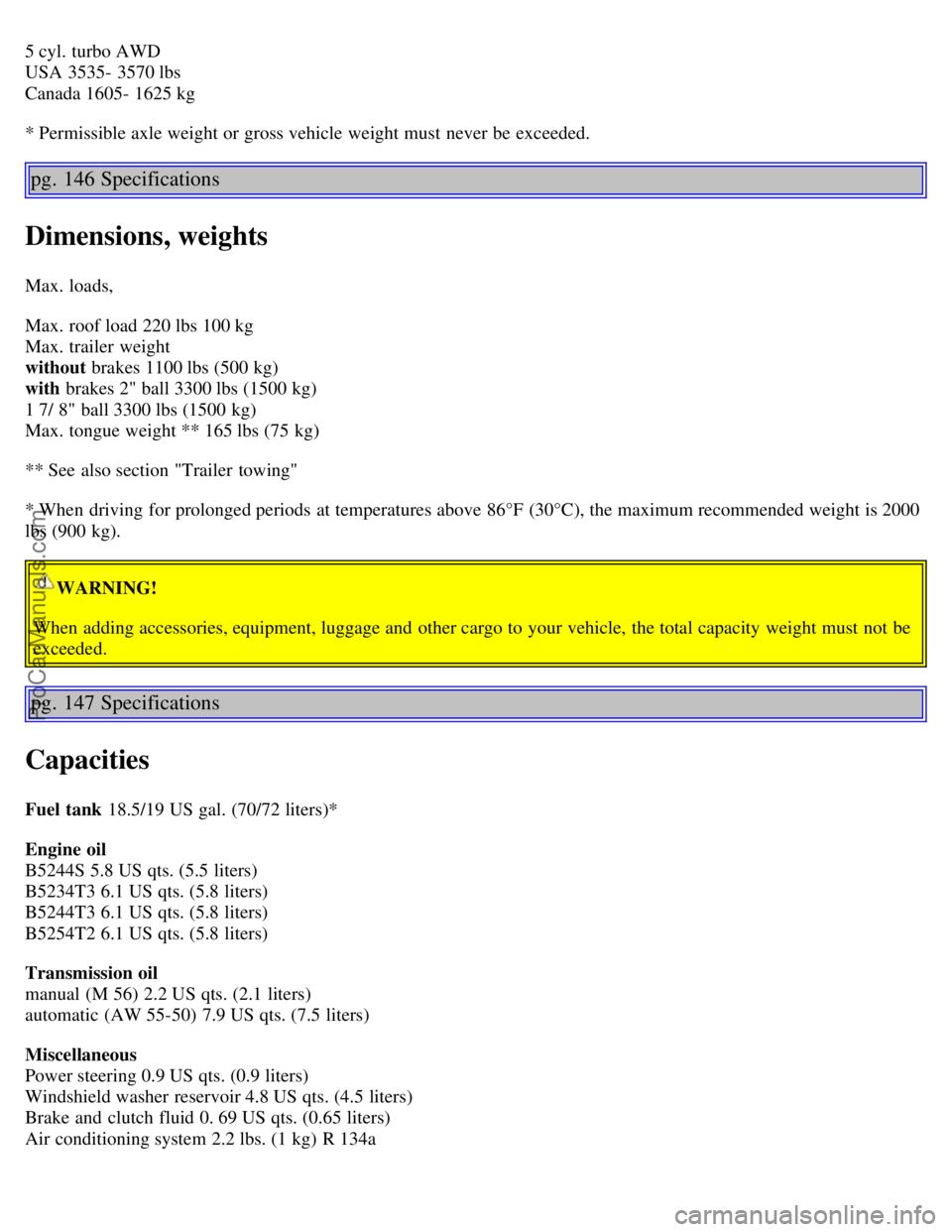
5 cyl. turbo AWD
USA 3535- 3570 lbs
Canada 1605- 1625 kg
* Permissible axle weight or gross vehicle weight must never be exceeded.
pg. 146 Specifications
Dimensions, weights
Max. loads,
Max. roof load 220 lbs 100 kg
Max. trailer weight
without brakes 1100 lbs (500 kg)
with brakes 2" ball 3300 lbs (1500 kg)
1 7/ 8" ball 3300 lbs (1500 kg)
Max. tongue weight ** 165 lbs (75 kg)
** See also section "Trailer towing"
* When driving for prolonged periods at temperatures above 86°F (30°C), the maximum recommended weight is 2000
lbs (900 kg).
WARNING!
When adding accessories, equipment, luggage and other cargo to your vehicle, the total capacity weight must not be
exceeded.
pg. 147 Specifications
Capacities
Fuel tank 18.5/19 US gal. (70/72 liters)*
Engine oil
B5244S 5.8 US qts. (5.5 liters)
B5234T3 6.1 US qts. (5.8 liters)
B5244T3 6.1 US qts. (5.8 liters)
B5254T2 6.1 US qts. (5.8 liters)
Transmission oil
manual (M 56) 2.2 US qts. (2.1 liters)
automatic (AW 55-50) 7.9 US qts. (7.5 liters)
Miscellaneous
Power steering 0.9 US qts. (0.9 liters)
Windshield washer reservoir 4.8 US qts. (4.5 liters)
Brake and clutch fluid 0. 69 US qts. (0.65 liters)
Air conditioning system 2.2 lbs. (1 kg) R 134a
ProCarManuals.com
Page 97 of 120

* 19 US gals (72 liters) on models equipped with All Wheel Drive.
Minimum octane requirement - AKI 87 (RON 91) unleaded fuel (See also page 78)
pg. 148 Specifications
Lubricants
Engine oil
Meeting minimum ILSAC specification GF- 2, including ACEA A1, API SJ, SJ/ CF and SJ/Energy Conserving.
Volvo does not recommend the use of oil additives.
Transmission
Oil grade:
Manual: Volvo synthetic transmission oil 97308
Automatic: Volvo transmission oil 1161540-8
Different types of oil should never be mixed.
Power steering
Grade: ATF
Brake fluid
Fluid type: Brake fluid DOT 4+ boiling point > 536°F (280° C), P/N 94374433
Cooling system
Type Positive pressure, closed system.
Coolant Volvo original coolant/antifreeze
Volume 5 cyl. non-turbo
8.5 US qts. (8.0 liters)
5 cyl. turbo
9.3 US qts (8.8 liters)
The thermostat begins to open at 194°F (90° C).
pg. 149 Specifications
Three way catalytic converter
Three-way catalytic converter cautions
Keep your engine properly tuned. Certain engine malfunctions, particularly involving the electrical, fuel or
distributor ignition systems, may cause unusually high three-way catalytic converter temperatures. Do not continue to
operate your vehicle if you detect engine misfire, noticeable loss of power or other unusual operating conditions, such
as engine overheating or backfiring. A properly tuned engine will help avoid malfunctions that could damage the three-
way catalytic converter.
Do not park your car over combustible materials, such as grass or leaves, which can come into contact with the hot
exhaust system and cause such materials to ignite under certain wind and weather conditions.
Excessive starter cranking (in excess of one minute), or an intermittently firing or flooded engine can cause three-
ProCarManuals.com