2003 VOLVO C70 engine
[x] Cancel search: enginePage 67 of 98
fast highway driving may necessitate replacement sooner.
Under normal driving conditions, spark plugs require no maintenance between replacement intervals. When installing
new plugs, be sure to use the right type and to tighten them correctly. When changing the plugs, clean the terminals
and rubber seals. Also check that the suppressor connectors are in good condition. Cracked or damaged connectors
should be replaced.
pg. 114 Fuel/emissions systems
Fuel system
The fuel system is all-electronic and is microprocessor-controlled. It can continually compensate for variation in
engine load, speed and temperature to give the best economy and power. A mass air flow sensor measures the inducted
air. In this way the system can make instantaneous adjustments for changes in air temperature or density, thus always
assuring the best economy with the lowest possible exhaust emissions.
Heated oxygen sensor(s)
This is an emission control system designed to reduce emissions and improve fuel economy. The heated oxygen sensor
monitors the composition of the exhaust gases leaving the engine. The exhaust gas analysis is fed into an electronic
module. This adjusts the air-fuel ratio to provide optimum conditions for combustion and efficient reduction of the
three major pollutants (hydrocarbons, carbon monoxide and oxides of nitrogen (NOx)) by a three-ways catalytic
converter.
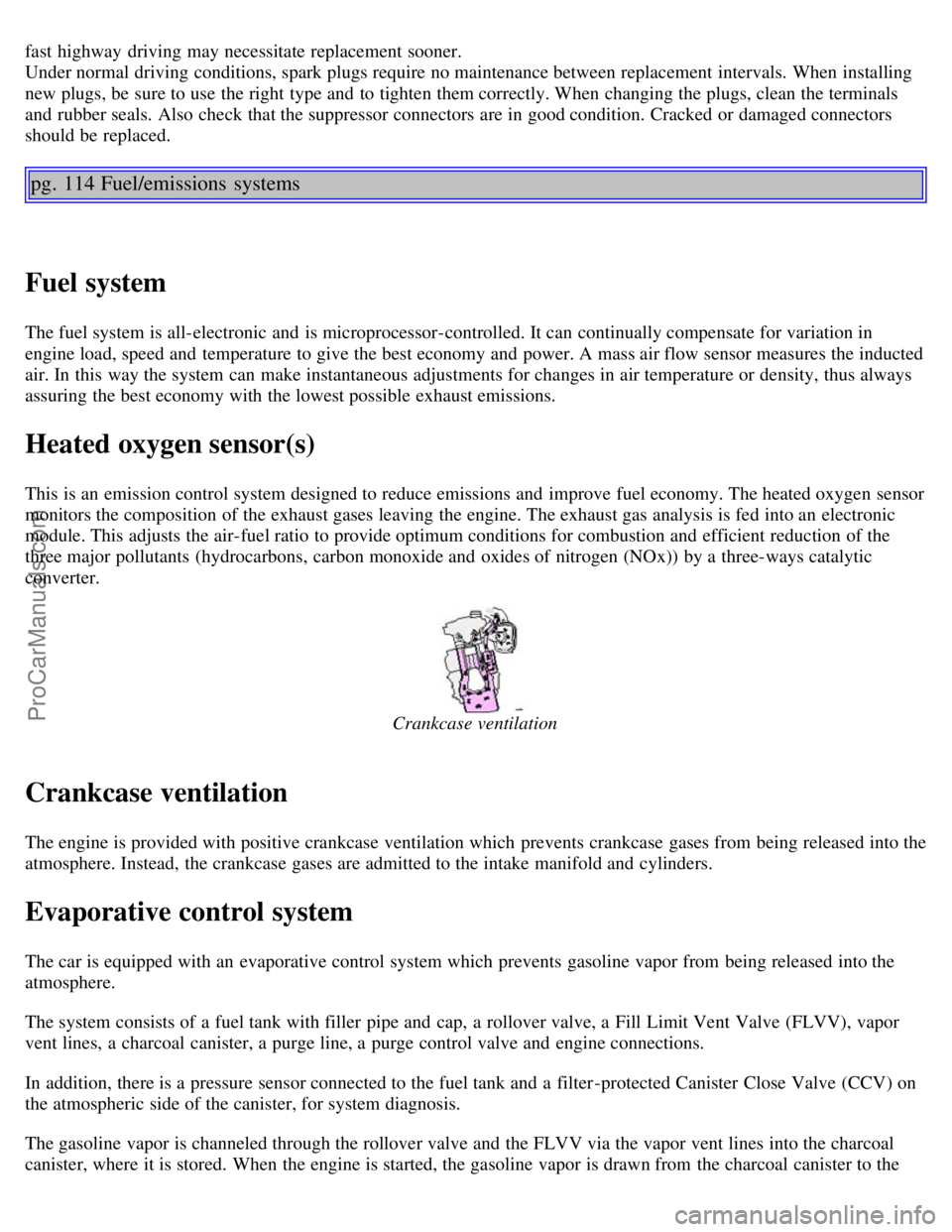
Crankcase ventilation
Crankcase ventilation
The engine is provided with positive crankcase ventilation which prevents crankcase gases from being released into the
atmosphere. Instead, the crankcase gases are admitted to the intake manifold and cylinders.
Evaporative control system
The car is equipped with an evaporative control system which prevents gasoline vapor from being released into the
atmosphere.
The system consists of a fuel tank with filler pipe and cap, a rollover valve, a Fill Limit Vent Valve (FLVV), vapor
vent lines, a charcoal canister, a purge line, a purge control valve and engine connections.
In addition, there is a pressure sensor connected to the fuel tank and a filter -protected Canister Close Valve (CCV) on
the atmospheric side of the canister, for system diagnosis.
The gasoline vapor is channeled through the rollover valve and the FLVV via the vapor vent lines into the charcoal
canister, where it is stored. When the engine is started, the gasoline vapor is drawn from the charcoal canister to the
ProCarManuals.com
Page 68 of 98

engine's air intake system and into the combustion process.
NOTE:
If the fuel filler cap is not closed tightly or if the engine is running when the car is refueled, the Malfunction
Indicator Lamp may indicate a fault.
During a transitional period, a small number of service stations may still have fuel nozzles that are not compatible
with the fuel filler neck on cars equipped with the evaporative emission control system mandated by the U.S.
Environmental Protection Agency and the California Air Resources Board. If you experience difficulties in refueling
your vehicle, please ask the gas station attendant for assistance.
CAUTION:
Fuel must not be siphoned from the fuel tank. This will damage the evaporative emission control system.
Contents | Top of Page
ProCarManuals.com
Page 69 of 98

2 0 0 3
VOLVO C70
Chapter 9 - Specifications
pg. 125 Specifications
Page
Oil/fluids specifications 126
Engine specifications127
Cooling/fuel/distributor ignition systems128
Front/rear suspensions128
Transmission, Capacities, Vehicle loading129
Electrical system/bulbs130
Dimensions and weights131
On Call Road assistance132
pg. 126 Oil/fluid specifications
Engine Oil
Meeting or exceeding ILSAC specification GF-2, including ACEA A1, API SJ, SJ/CF, and SJ/Energy Conserving.
Oil additives must not be used.
Engine oil Quality:
Meeting API SJ, SJ/CF, and SJ/Energy
Conserving. Capacity (incl. filter)
: 6.2 US
qts. (5.8 liters)
Automatic
transmission fluid Quality:
AW5. Only Volvo gearbox oil (1161540-8). Do
not mix with other oils.. Capacity:
8 US qts. (7.5 liters)
Manual transmission
fluid Quality:
Volvo synthetic gearbox oil 1161423 Capacity: 2.2 US qts. (2.1 liters)
Power steering fluid Quality: ATF Capacity:
0.95 US qts. (0.9
liters)
Brake fluid Quality: DOT 4+ boiling point > 536°F (280°C), P/N
9437433 Capacity:
0.64 US qts. (0.6
liters)
All specifications are subject to change without notice.
ProCarManuals.com
Page 70 of 98

pg. 127 Engine specifications
Engine
Liquid-cooled gasoline, 5-cylinder, in-line engine. Aluminum alloy cylinder block with cast-iron cylinder liners cast
directly into the block. Aluminum alloy cylinder head with double overhead camshafts and separate intake and outlet
channels.
Engine lubrication is provided by an eccentric pump driven from the crankshaft. Full-flow type oil filter. Exhaust
emission control is accomplished by multiport fuel injection, heated oxygen sensor(s) and three-way catalytic
converter.
Charge air cooler (Intercooler)
Turbocharged engines employ a turbo-compressor to force air into the engine inlet manifold and a charge air cooler to
cool the compressed inlet air. The resulting increase in air flow raises pressure in the intake manifold by approx. 8.7
psi (over atmospheric pressure) and engine power output by approx. 50 horsepower over that developed by the
normally-aspirated engine. The charge air cooler (which resembles a radiator) is located between the turbo-compressor
and inlet manifold.Designation: Volvo B 5234 T3
Output 242 hp at 5400 rpm (180 kw/90 rps)
Max. torque 243 ft. lbs. at 2400-5100 rpm (330 Nm/40-92 rps)
Number of cylinders 5
Bore 3.19" (81 mm)
Stroke 3.54" (90 mm)
Displacement 2.3 liters
Compression ratio 8.5:1
Number of valves 20
Designation: Volvo B 5244 T
Output 197 hp at 5700 rpm (147 kw/95 rps)
Max torque 210 ft. lbs. at 1800-5000 rpm (285 Nm/30-83 rps)
Number of cylinders 5
Bore 3.27" (83 mm)
Stroke 3.54" (90 mm)
Displacement 2.4 liters
Compression ratio 9.0:1
Number of valves 20
All specifications are subject to change without notice.
pg. 128 Specifications
ProCarManuals.com
Page 71 of 98

Cooling system
Type: Positive pressure, closed system
Thermostat begins to open at 180° F (87° C)
Coolant: Volvo original coolant/antifreeze
Capacity: 7.4 US qts. (7.0 liters)
Fuel system
The engine is equipped with a multiport fuel injection system.
Distributor ignition system
Firing order: 1-2-4-5-3
Distributor ignition setting: Not adjustable
Spark plugs: Champion RC87PYP (or equivalent)
Spark plug gap: 0.03" (0.75 mm)
Tightening torque: 18.4 ft. lbs. +/- 3.7 ft. lbs. (25 Nm +/- 5 Nm)WARNING!
The distributor ignition system operates at very high voltages. Special safety precautions must be followed to
prevent injury. Always turn the ignition off when:
Replacing distributor ignition components e.g. plugs, coil, etc.
Do not touch any part of the distributor ignition system while the engine is running. This may result in unintended
movements and body injury.
All specifications are subject to change without notice.
Front suspension
Spring strut suspension with integrated shock absorbers and control arms linked to the support frame. Power-assisted
rack and pinion steering. Safety type steering column.
The alignment specifications apply to an unladen car but include fuel, coolant and spare wheel.
Toe-in measured on the wheel rims: 2.4 mm +/- 0.7 mm
Toe-in measured on tire sides: 2.9 +/- 0.9 mm
Rear suspension
Delta-link individual rear wheel suspension with longitudinal support arms, double link arms and track rods.
Toe-in measured on the tire sides: 4° +/- 10°
ProCarManuals.com
Page 72 of 98

pg. 129 Specifications
Power transmission
Manual transmission: M 56 H
Single-disc dry plate clutch. All-synchromesh on all gears including reverse; integrated final drive. Operation via a
floor mounted gear lever.Final drive ratio 4.00:1
Reduction ratios
1st gear 3.07:1
2nd gear 1.77:1
3rd gear 1.19:1
4th gear 0.87:1
5th gear 0.70:1
Reverse 2.99:1
Automatic transmission: AW 55-50 LE
4 or 5-speed automatic electronically controlled gearbox comprising a hydraulic torque converter with a lockup
function; planetary gear, integrated final drive.
Operation via a floor mounted gear selector lever. Drive shafts with symmetrical joint location. Overdrive. Final drive ratio 2.44:1
Reduction ratios
1st gear 4.77:1
2nd gear 3.00:1
3rd gear 1.96:1
4th gear 1.32:1
5th gear 1.02:1
Reverse 3.23:1
Capacities
Fuel tank 17.9 US gals (68 liters)
Cooling system 7.4 US qts. (7.0 liters)
Engine oil (incl. filter) 6.1 US qts. ( 5.8 liters)
Automatic transmission 2 US gals (7.6 liters)
Manual transmission 2.2 US qts. (2.1 liters)
Power steering fluid 0.95 US qts (0.9 liters)
Washer fluid reservoir 4.7 US qts. (4.5 liters)
Brake/clutch system 0.6 US qts (0.6 liters)
ProCarManuals.com
Page 73 of 98

Vehicle loading
The tires on your Volvo should perform to specifications at all normal loads when inflated as recommended on the tire
information label. The label is located on the inside of the fuel filler flap. The label lists vehicle load limits. Do not
load your car beyond the indicated limits.WARNING!
Improperly inflated tires will reduce tire life, adversely affect vehicle handling and can possibly lead to failure
resulting in loss of vehicle control without prior warning.
All specifications are subject to change without notice.
pg. 130 Specifications
Electrical system
12 Volt, negative ground.
Voltage-controlled generator. Single-wire system with chassis and engine used as conductors.
Battery
Voltage 12,6 Volt
Capacity 520 A/100 min
(certain markets) 420 A/75 min
The battery contains corrosive and poisonous acids. It is of the utmost importance that old batteries are disposed of
correctly. Your Volvo retailer can assist you in this matter.
Generator
Rated output 1400 W
Max. current 120 A
Bulbs
Bulb US no.Power SocketNo/bulbs
Headlights
ProCarManuals.com
Page 87 of 98
The remaining two HomeLink® buttons can be programmed in the same way. In the event of any problems in
programming the HomeLink® Universal Transceiver, call toll-free 1-800-355-3515 (Internet: www.HomeLink.com
).
Operating the HomeLink® Universal Transceiver Once programmed, the HomeLink® Universal Transceiver can
be used in place of your hand -held transmitters.
To operate, the key must be turned to the "accessory" position (II) or the engine must be running. Press the
programmed HomeLink® button to activate the garage door, driveway gate, security lighting, home security system,
etc.
Your original hand -held transmitters may, of course, be used at any time.
Erasing programmed buttons
Individual buttons cannot be erased. To erase all three programmed buttons:
1. Turn the ignition key to the "accessory" position (II).
2. Hold down the two outside buttons on the HomeLink® Universal Transceiver for about 20 seconds, until
HomeLink® 's indicator light begins to flash.
3. Release both buttons.
The HomeLink® buttons can be reprogrammed using the procedures described on the previous page.
(HomeLink® information is continued on the next page)
pg. 192 HomeLink® Universal Transceiver (option)
Reprogramming a single HomeLink® button
1. Press and hold the desired HomeLink® button. Do not release the button until step 3 has been completed.
2. When the indicator light begins to flash slowly (after approximately 20 seconds), position the hand -held transmitter
2 to 5 in. (5 to 12 cm) away from the HomeLink® surface.
3. Press and hold the hand -held transmitter button.
The HomeLink® indicator light will begin to flash, first slowly then rapidly. When the indicator light flashes rapidly,
release both buttons.
The previously programmed device has now been erased and the new device can be activated by pressing the
HomeLink® button that has just been programmed. This procedure will not affect any other programmed HomeLink®
buttons.
NOTE:
Retain the original transmitter(s) for future programming procedures (i.e., if you purchase a new car).
It is also suggested that if you sell your car, the programmed channels on the HomeLink® Universal Transceiver be
erased for security purposes.
ProCarManuals.com