217
CAUTION
To prevent burning yourself, do not
remove the radiator cap when the en-
gine is hot.
158.Coolant type selection
Use of improper coolants may damage
your cooling system. Your coolant must
contain ethyleneglycol type coolant for a
proper corrosion protection of your hybrid
system that contains aluminum compo-
nents. We have used “Toyota Genuine
Long Life Coolant” in your Toyota vehicle.
In order to avoid technical problems, we
strongly recommend using “Toyota Genu-
ine Long Life Coolant” or equivalent.
In addition to preventing freezing and sub-
sequent damage to the hybrid system, this
type of coolant will also prevent corrosion.
Further supplemental inhibitors or additives
are neither needed nor recommended.
Read the coolant container for information
on freeze protection. Follow the manufac-
turer’s directions for how much to mix
with plain water (preferably demineralized
water of distilled water). The total capacity
of the cooling system is given on page
242 in Section 9. We recommend to use 50% solution for
your Toyota, to provide protection down to
about 35
°C (31 °F). When it is extremely
cold, to provide protection down to about
50° C (58 °F), 60% solution is recom-
mended. Do not use more than 70% solu-
tion for better coolant performance.NOTICE
Do not use alcohol type antifreeze or
plain water alone.
The engine cooling system is integral to
maximizing performance of your Toyota
vehicle. In line with this, it is strongly
recommended that you use “Toyota Genu-
ine Long Life Coolant” for protecting the
system, as it is an ethyleneglycol based
premium antifreeze coolant with excellent
corrosion protection properties that has
been specifically formulated for use in
Toyota vehicles.
Please contact your Toyota dealer for fur-
ther details of the “Toyota Genuine Long
Life Coolant” range.
218
If any of the above parts are extremely
dirty or you are not sure of their condi-
tion, take your vehicle to Toyota dealer.
CAUTION
To prevent yourself from burning, be
careful not to touch the radiator or
condenser when the engine is hot.
NOTICE
To prevent damage to the radiator
and condenser, do not perform the
work by yourself.
160.Checking brake fluid
82p002a
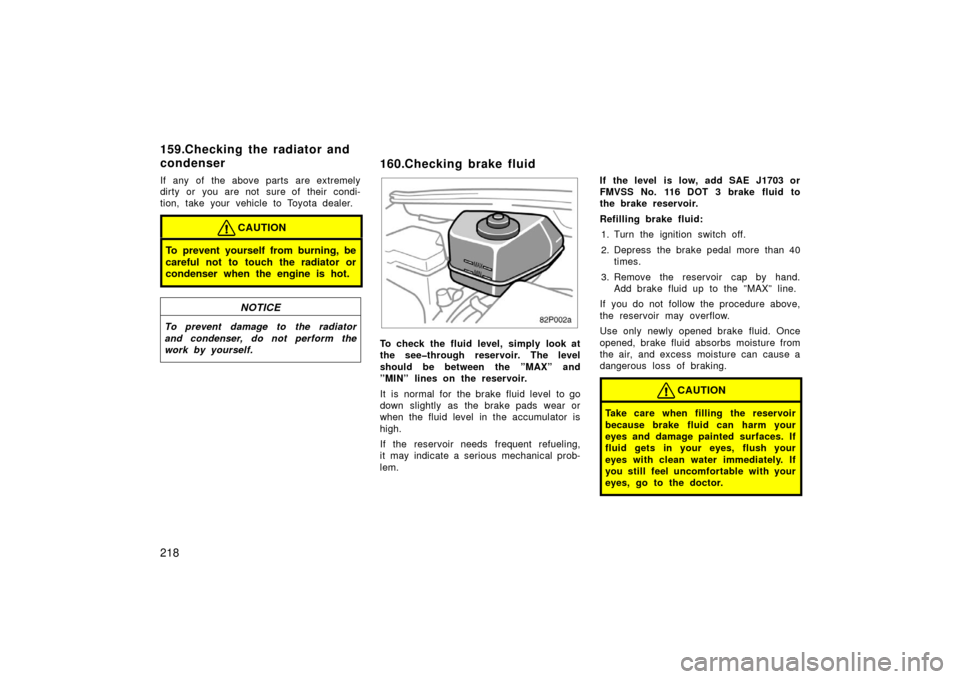
To check the fluid level, simply look at
the seethrough reservoir. The level
should be between the ”MAX” and
”MIN” lines on the reservoir.
It is normal for the brake fluid level to go
down slightly as the brake pads wear or
when the fluid level in the accumulator is
high.
If the reservoir needs frequent refueling,
it may indicate a serious mechanical prob-
lem.If the level is low, add SAE J1703 or
FMVSS No. 116 DOT 3 brake fluid to
the brake reservoir.
Refilling brake fluid:
1. Turn the ignition switch off.
2. Depress the brake pedal more than 40 times.
3. Remove the reservoir cap by hand. Add brake fluid up to the ”MAX” line.
If you do not follow the procedure above,
the reservoir may overflow.
Use only newly opened brake fluid. Once
opened, brake fluid absorbs moisture from
the air, and excess moisture can cause a
dangerous loss of braking.
CAUTION
Take care when filling the r eservoir
because brake fluid can harm your
eyes and damage painted surfaces. If
fluid gets in your eyes, flush your
eyes with clean water immediately. If
you still feel uncomfortable with your
eyes, go to the doctor.
159.Checking the radiator and
condenser