Page 217 of 312
’03 L/C U (L/O 0301)
213
�After driving through tall grass,
mud, rock, sand, rivers, etc., check
that there is no grass, bush, paper,
rags, stone, sand, etc. adhering or
trapped on the underbody. Clear
off any such matter from the under-
body. If the vehicle is used with
these materials trapped or adhering
to the underbody, a breakdown or
fire could occur.
�In a rollover crash, an unbelted per-
son is significantly more likely to
die than a person wearing a seat
belt. Therefore, the driver and all
passengers should fasten their seat
belts whenever the vehicle is mov-
ing.
�When driving offroad or in rugged
terrain, do not drive at excessive
speeds, jump, make sharp turns,
strike objects, etc. This may cause
loss of control or vehicle rollover
causing death or serious injury.
You are also risking expensive dam-
age to your vehicle’s suspension
and chassis.
NOTICE
�If driving through water, such as
when crossing shallow streams,
first check the depth of the water
and the bottom of the river bed for
firmness. Drive slowly and avoid
deep water.
� Take all necessary safety measures
to ensure that water damage to the
engine or other components does
not occur.
� Water entering the engine air intake
will cause severe engine damage.
� Water can wash the grease from
wheel bearings, causing rusting and
premature failure, and may also en-
ter the differentials, transmission
and transfer case, reducing the gear
oil’s lubricating qualities.
� Sand and mud that has accumulated
in brake drums and around brake
discs may affect braking efficiency
and may damage brake system com-
ponents.
�Always perform a maintenance in-
spection after each day of offroad
driving that has taken you through
rough terrain, sand, mud, or water.
For scheduled maintenance informa-
tion, refer to the “Scheduled Main-
tenance Guide” or “Owner’s Manual
Supplement”.
Page 224 of 312
’03 L/C U (L/O 0301)
220
TIRES
�Ensure that your vehicle’s tires are
properly inflated. Adjust the tire pres-
sure indicated below:
Tire pressure, kPa (psi)Front 220 (32)
Rear 240 (35)
See Section 72 and Section 8 for in-
structions.
�The trailer tires should be inflated to
the pressure recommended by the trail-
er manufacturer in respect to the total
trailer weight.
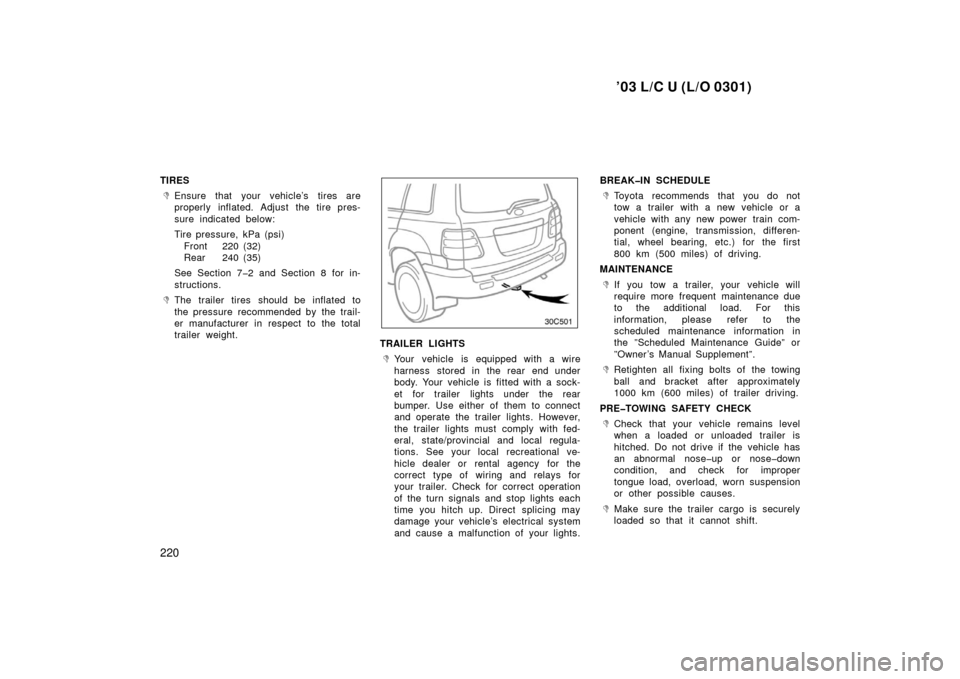
TRAILER LIGHTS
�Your vehicle is equipped with a wire
harness stored in the rear end under
body. Your vehicle is fitted with a sock-
et for trailer lights under the rear
bumper. Use either of them to connect
and operate the trailer lights. However,
the trailer lights must comply with fed-
eral, state/provincial and local regula-
tions. See your local recreational ve-
hicle dealer or rental agency for the
correct type of wiring and relays for
your trailer. Check for correct operation
of the turn signals and stop lights each
time you hitch up. Direct splicing may
damage your vehicle’s electrical system
and cause a malfunction of your lights. BREAKIN SCHEDULE
�Toyota recommends that you do not
tow a trailer with a new vehicle or a
vehicle with any new power train com-
ponent (engine, transmission, differen-
tial, wheel bearing, etc.) for the first
800 km (500 miles) of driving.
MAINTENANCE
�If you tow a trailer, your vehicle will
require more frequent maintenance due
to the additional load. For this
information, please refer to the
scheduled maintenance information in
the ”Scheduled Maintenance Guide” or
”Owner ’s Manual Supplement”.
�Retighten all fixing bolts of the towing
ball and bracket after approximately
1000 km (600 miles) of trailer driving.
PRETOWING SAFETY CHECK
�Check that your vehicle remains level
when a loaded or unloaded trailer is
hitched. Do not drive if the vehicle has
an abnormal noseup or nosedown
condition, and check for improper
tongue load, overload, worn suspension
or other possible causes.
�Make sure the trailer cargo is securely
loaded so that it cannot shift.
Page 300 of 312

’03 L/C U (L/O 0301)
296
AUTOMATIC TRANSMISSION
Fluid capacity (drain and refill), L (qt.,
Imp. qt.)
Up to 3.0 (3.2, 2.6)
Fluid type: “Toyota Genuine ATF Type TIV”
Change automatic transmission fluid only
as necessary.
Generally, it is necessary to change auto-
matic transmission fluid only if your ve-
hicle is driven under one of the Special
Operating Conditions listed in your
”Scheduled Maintenance Guide” or ”Own-
er’s Manual Supplement”. When changing
the automatic transmission fluid, use only
“Toyota Genuine ATF Type TIV” (ATF
JWS3309 or NWS6500) to aid in assuring
optimum transaxle performance.
Notice: Using automatic transmission
fluid other than “Toyota Genuine ATF
Type TIV” may cause deterioration in
shift quality, locking up of your trans-
mission accompanied by vibration, and
ultimately damage the automatic trans-
mission of your vehicle. TRANSFER
Oil capacity, L (qt., Imp. qt.)
1.3 (1.4, 1.1)
Oil type: Gear oil API GL4 or GL5
Recommended oil viscosity: SAE 75W90
DIFFERENTIAL
Oil capacity, L (qt., Imp. qt.): Front 1.6 (1.7, 1.4)
Rear 3.3 (3.5, 2.9)
Oil type: Standard differential Hypoid gear oil API GL5
Limitedslip differential Hypoid gear oil for limitedslip
differential API GL5
Recommended oil viscosity: Above 18 C (0 F)
SAE 90
Below 18 C (0 F)
SAE 80W or 80W90 CHASSIS LUBRICATION
Wheel bearings:
Lithium base wheel bearing grease,
NLGI No.2
Front drive shaft thrust bushings: Synthetic oil and lithium soap base
chassis grease, NLGI No.1
Propeller shafts: Lithium base wheel bearing grease,
NLGI No.2
BRAKES
Minimum pedal clearance when depressed
with the force of 490 N (50 kgf, 110 lbf)
with the engine running, mm (in.): 116 (4.6)
Pedal free play, mm (in.): 1—6 (0.04—0.24)
Pad wear limit, mm (in.):
1.0 (0.04)
Lining wear limit, mm (in.): 1.0 (0.04)
Parking brake adjustment when pulled with
the force of 196 N (20 kgf, 44 lbf): 4—6 clicks
Fluid type: SAE J1703 or FMVSS No.116 DOT 3